Should You Repair or Replace an Inefficient Heater?
Repair it if the problem is a fixable efficiency loss and the repair costs under about 30% of replacement cost; replace it if the unit is around 15 years old, has a cracked heat exchanger, or needs repeated costly repairs. Waiting past that point can raise bills, create safety risks, and lead to paying for the same problem twice. This guide gives a practical repair-or-replace framework, with payback checks and safety red flags.
What does an inefficient heater mean?
An inefficient heater turns more of its fuel or electricity into waste than useful heat. For furnaces and boilers, AFUE shows the share of fuel that becomes heat, so 80% AFUE means about 80% delivered and 20% lost. Heat pumps are usually compared with HSPF for heating and SEER2 for cooling.
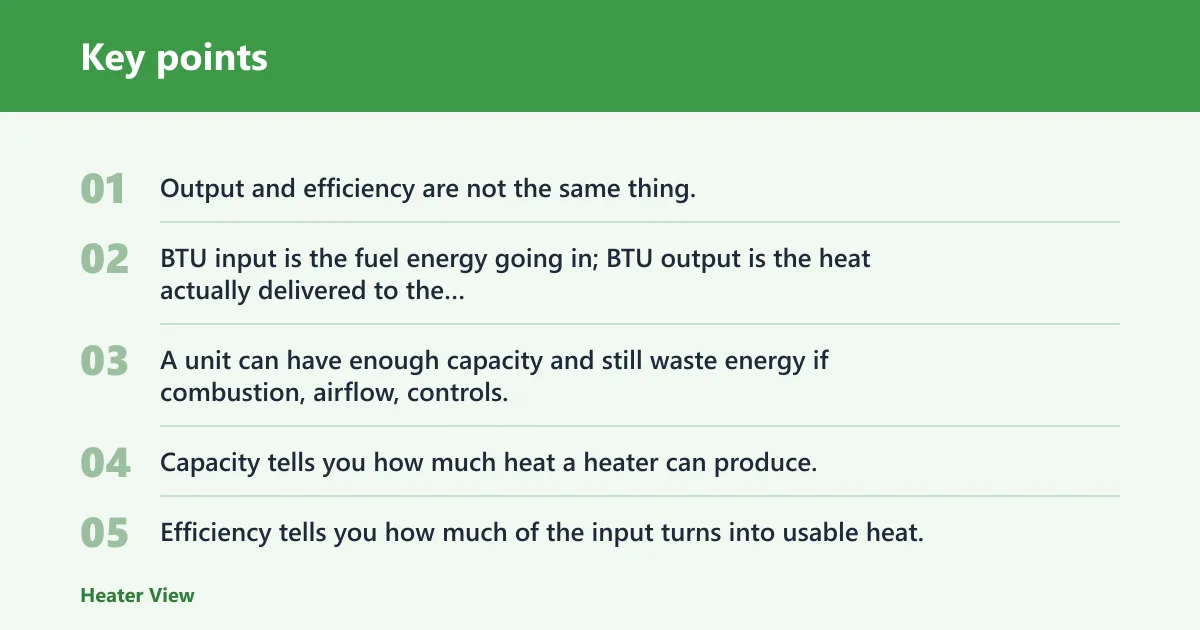
Output and efficiency are not the same thing. BTU input is the fuel energy going in; BTU output is the heat actually delivered to the home. A unit can have enough capacity and still waste energy if combustion, airflow, controls, or ductwork are off.
Efficiency vs. output
Capacity tells you how much heat a heater can produce. Efficiency tells you how much of the input turns into usable heat. A furnace with proper size but low AFUE may still warm the house, yet it will cost more to run than a higher-efficiency replacement.
That is why a “weak” heater is not always undersized. Sometimes it is simply losing heat through poor combustion, dirty burners, clogged filters, bad duct sealing, or controls that keep it cycling too often.
Why is your heater losing efficiency?
Many efficiency complaints come from parts around the heater, not the heat source itself. Dirty filters, restricted airflow, thermostat problems, duct leaks, and maintenance gaps can all raise runtime and utility bills. If those issues are the cause, a full replacement may solve less than a focused repair.
Airflow, filters, and duct issues
A clogged filter can choke airflow and make a furnace or air handler run longer to do the same work. Leaky ducts can waste heated air before it reaches the rooms. In either case, the equipment may look inefficient even though the core heat exchanger or compressor is still sound.
Thermostat and control problems
Controls matter. A thermostat with poor placement, wrong settings, or bad wiring can cause short cycling or long run times. Smart or programmable controls can improve timing, but they will not fix a cracked heat exchanger or a failing compressor.
Wear, age, and repeated breakdowns
Older systems often lose efficiency as parts wear, combustion drifts, and repairs pile up. Repeated breakdowns are a warning sign because each failure raises the odds of another one, especially after major parts such as inducer motors, control boards, ignition parts, or compressors start failing.
Suppose a 14-year-old furnace keeps short cycling because the filter is packed and the thermostat is miscalibrated. That is a repair-and-adjustment problem, not automatic end-of-life. Change the filter, inspect airflow, and correct the controls before judging the furnace by its fuel bill alone.
How do you score repair vs. replace?
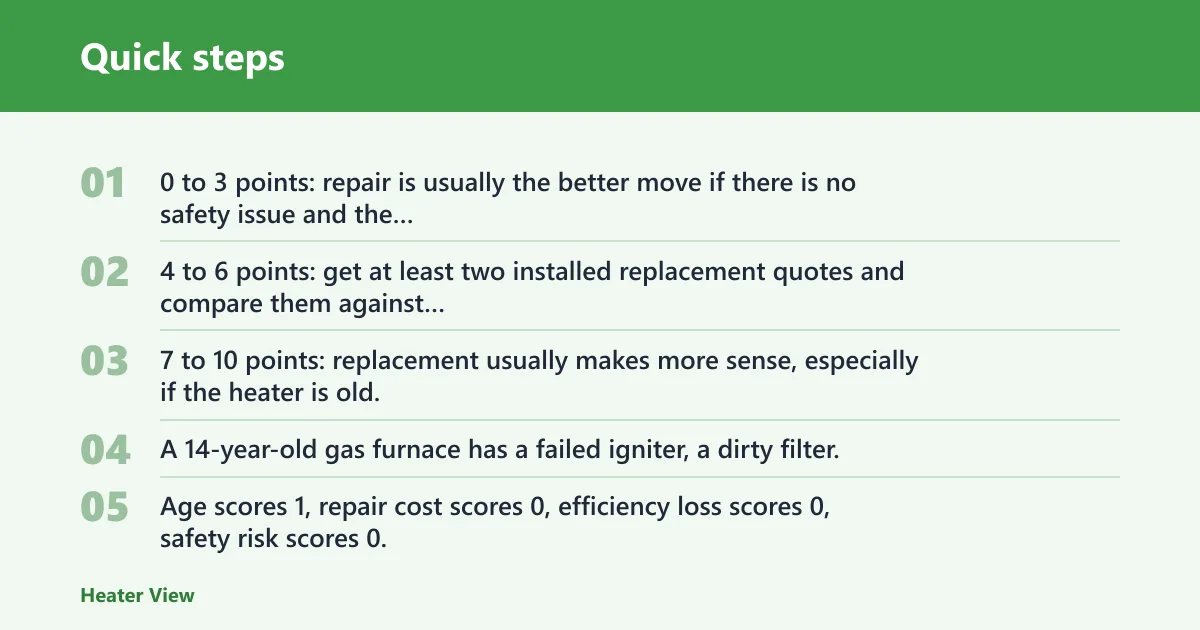
Use the matrix below as a scoring tool. Give each factor 0 points for the repair side, 1 point for the middle, and 2 points for the replace side. Add the points: 0 to 3 points usually supports repair, 4 to 6 points suggests getting multiple quotes and a closer inspection, and 7 to 10 points usually supports replacement.
| Factor | Repair side | Replace side | What it means |
|---|---|---|---|
| Age | Under 10 years | 15 years or more | Older equipment is more likely to lose efficiency and fail again. |
| Repair cost | Under 30% of replacement cost | 30% or more of replacement cost | Large repairs on old equipment are harder to justify. |
| Efficiency loss | Controls, airflow, or maintenance issue | Low AFUE, weak HSPF, or worn system parts | Fixable losses favor repair; broad system decline favors replacement. |
| Safety risk | No safety issue found | Cracked heat exchanger, CO risk, gas leak, or electrical fault | Safety problems override savings and age. |
| Expected payback | Payback from repair is under 3 years | Replacement pays back in 3 to 7 years or less | Short payback supports replacement when the unit is already old. |
How to read the score
0 to 3 points: repair is usually the better move if there is no safety issue and the system still has life left.
4 to 6 points: get at least two installed replacement quotes and compare them against the repair quote, not just the equipment price.
7 to 10 points: replacement usually makes more sense, especially if the heater is old, inefficient, or already unreliable.
Worked example: furnace
A 14-year-old gas furnace has a failed igniter, a dirty filter, and no heat-exchanger issue found. Age scores 1, repair cost scores 0, efficiency loss scores 0, safety risk scores 0, and payback scores 0. Total: 1 point. That points to repair.
Worked example: boiler
A 19-year-old boiler has repeated shutdowns, a corroded vent, and a quote for a new circulator plus cleanup work. Age scores 2, repair cost scores 2, efficiency loss scores 2, safety risk scores 2, and payback scores 1. Total: 9 points. That points to replacement.
Worked example: heat pump
A heat pump with poor airflow, a weak thermostat, and no compressor fault is in the middle. Age scores 1, repair cost scores 0 or 1, efficiency loss scores 0, safety risk scores 0, and payback scores 0 or 1. Total: 1 to 3 points. That points to repair first.
Yes/no rule: if the heater is under 10 years old, the problem is fixable, and repair is under 30% of replacement cost, repair it. If it is around 15 years old or more, has a safety fault, or needs another costly fix after repeated breakdowns, replacement is commonly recommended.
A common mistake for first-time buyers is treating all “inefficient” heaters the same. A $220 blower repair on a 7-year-old furnace is a different decision from a $2,400 heat exchanger job on a 17-year-old unit with rust, nuisance shutdowns, and rising gas use.
Should I repair an old heater?
Yes, if the heater is old but still structurally sound, the problem is isolated, and the repair restores normal operation without pushing costs close to replacement. Small fixes make sense when they address a bad igniter, thermostat, clogged filter, fan motor capacitor, control fault, or duct leak.
When repairs still make sense
Repairs still make sense when maintenance has been neglected and the equipment itself is not near failure. If the issue is airflow, controls, or routine wear, a repair can recover much of the lost efficiency. That is especially true when the unit is not yet near the 15-year mark.
When a small fix is enough
A small fix is enough when one part failed and the rest of the system still looks healthy. That includes one-off component failures, a bad thermostat, or a duct seal problem that is driving run time up. After the fix, compare fuel use over the next billing cycle or two.
When to stop sinking money into it
Stop repairing when breakdowns start repeating, when one repair leads to another, or when the next quote approaches replacement cost. If the system needs major parts and still has low AFUE, low HSPF, or weak combustion performance, the money is usually better spent on a new unit.
When does replacement make more sense?
Replacement makes more sense when the heater is near end of life, the repair bill is large, or the system has a safety defect. It also makes sense when the old unit is so inefficient that even a good repair will not change monthly bills enough to justify more years of operation.
Age and repeated failure patterns
Age matters because older equipment usually has more wear, lower efficiency, and a higher chance of another breakdown. If you have repeated service calls in a short span, the pattern matters more than one repair total. Multiple failures often point to a system that is past routine maintenance.
High repair quotes on low-efficiency units
High repair quotes are harder to justify on low-efficiency units because the repair solves only the current failure. The house still pays the penalty of low AFUE, poor HSPF, or weak controls. Replacement deserves a hard look once the repair cost is above about 30% of replacement cost.
System changes that affect price
Replacement cost is not just the box. It can include installation, venting changes, ductwork updates, electrical work, condensate drainage, or gas line changes. A higher quote may still be worth it if the new setup is safer, properly sized, and much more efficient than the old one.
Picture a 16-year-old boiler with recurring ignition faults and corroded venting. Even if the burner can be repaired, the venting, controls, and boiler efficiency may all be aging out together. That is a stronger replacement case than a boiler with one failed circulator pump and otherwise stable operation.
How much can a new heater save?
A new heater can save enough to matter when the old unit wastes a lot of fuel or electricity and the home uses enough heat for the savings to add up. The payback depends on utility prices, climate, and how often the system runs, so the same upgrade can look good in one home and weak in another.
Estimate annual energy savings
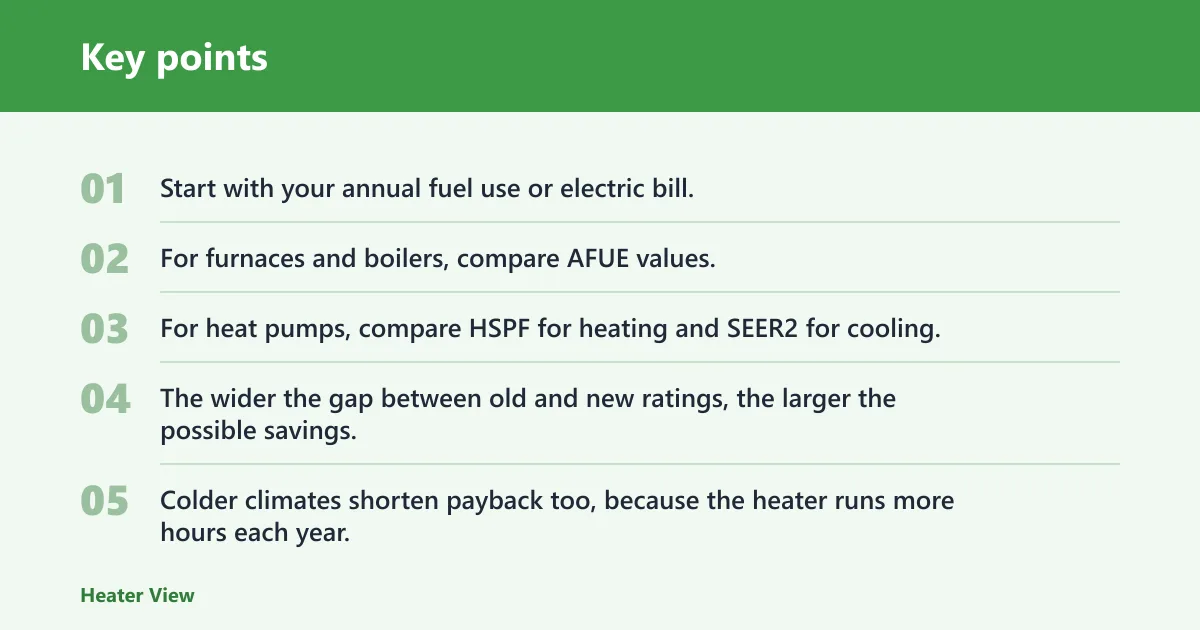
Start with your annual fuel use or electric bill, then estimate the drop from a better efficiency rating. For furnaces and boilers, compare AFUE values. For heat pumps, compare HSPF for heating and SEER2 for cooling. The wider the gap between old and new ratings, the larger the possible savings.
Use fuel prices and climate
Higher fuel prices shorten payback. Colder climates shorten payback too, because the heater runs more hours each year. A mild climate with low runtime may not save enough to justify a large replacement unless safety or reliability already point that way.
Compare savings to payback time
Use a simple check: annual savings = current annual heating cost minus expected annual heating cost after replacement. Then divide replacement cost by annual savings to estimate payback time. If payback is short and the unit is old, replacement is easier to defend.
If a furnace spends about $2,000 a year on gas and a new one trims that by about $400, payback on a $4,000 installed replacement is about 10 years before financing and maintenance differences. If the current furnace also needs major repairs, the replacement case gets stronger because you are comparing against the cost of doing both.
Heater efficiency examples
These examples show how the same framework works across fuel types. The goal is not a perfect calculator. It is a practical decision that separates a fixable loss from a unit that is too costly or risky to keep.
Furnace example
A 14-year-old gas furnace at 80% AFUE has a failed igniter and a dirty filter. The repair is modest, the heat exchanger is intact, and the airflow problem is clear. Repair makes sense if the quote stays well below 30% of replacement cost and there are no safety findings.
Boiler example
A 19-year-old boiler with repeated shutdowns, rust around the vent, and a quote for a new circulator is a different case. Even if the circulator failure is real, age plus repeated breakdowns plus venting concerns move the decision toward replacement, especially if the AFUE is low.
Heat pump example
A heat pump with low HSPF, poor airflow, and a bad thermostat may be underperforming for reasons outside the compressor. If a controls correction and maintenance restore normal operation, repair is reasonable. If the compressor is failing and the system is old, replacement with a better HSPF and SEER2 rating may pay back faster.
How do I know if my heater is too inefficient to keep?
Your heater is probably too inefficient to keep when it is old, breaks down often, and still costs a lot to run after simple fixes. Look for a mix of low AFUE or low HSPF, rising utility bills, repeated service calls, and signs that the repair will only buy a little more time.
A professional inspection should check combustion, airflow, venting, electrical condition, and controls before you decide. Compare at least two quotes when replacement is on the table, and ask for the installed cost, not just the equipment price.
Frequently asked questions
Should I repair or replace an inefficient heater?
Repair it if the issue is a fixable part failure, controls problem, or airflow problem and the quote stays under 30% of replacement cost. Replace it if the unit is around 15 years old, has a safety defect, or keeps breaking down after earlier repairs.
How much should I spend on heater repair before replacing it?
A common rule of thumb is the 30% threshold. If a repair is at or above 30% of replacement cost, replacement deserves serious consideration, especially on older equipment. Safety issues can push that decision much faster than cost alone.
Will a new heater save enough on energy bills to be worth it?
It can, but only if the old unit wastes enough energy and the home runs the heater often enough for savings to matter. Compare your annual fuel use, local fuel price, climate, and expected efficiency gain. Shorter payback makes replacement easier to justify.
What signs mean my heater is nearing end of life?
Frequent breakdowns, repeated part failures, rust, noisy operation, poor combustion readings, and rising bills after maintenance all point toward end of life. Age matters too. Once a heater is near or past 15 years, each major repair carries more risk that another one is close behind.
How do efficiency ratings affect the repair-or-replace decision?
AFUE helps compare furnaces and boilers, while HSPF and SEER2 help compare heat pumps. Lower ratings mean more wasted energy and weaker payback from continued repairs. If a repair will not fix the low rating, and the unit is old, replacement often makes more sense.
What heater problems are worth fixing and what are not?
Worth fixing: dirty filters, thermostat issues, airflow problems, ignition faults, and isolated wear parts on a younger system. Not worth fixing: cracked heat exchangers, gas leaks, electrical faults, or a stack of expensive repairs on an old unit that still runs inefficiently.
Is it better to repair an old furnace or replace it?
Repair the old furnace if the problem is minor, the furnace is under 10 years old, and the quote is modest. Replace it if the furnace is near 15 years old, has low AFUE, needs repeated repairs, or has any safety finding that makes continued use risky.