How to Maintain a Pool Heater Through the Season
Check the water every week, clean airflow and circulation every month, and do a full pre-season inspection before the first fire-up. Skip those steps, and you invite corrosion, restricted heat transfer, nuisance shutdowns, and higher repair bills. This guide lays out a season-long maintenance schedule for gas, heat pump, and solar pool heaters, with startup checks and clear DIY limits.
Why seasonal pool heater care matters

- Tests chlorine, pH, alkalinity, hardness, and CYA
- Quick, easy water testing with included reagents
- Professional-standard kit for home or pro use
What wears first
The first parts to age are often the ones hit by water, flame, airflow, and debris, but controls, sensors, and switches can also fail early. In gas units, the heat exchanger is the wear-sensitive core, and scale or corrosion shortens its life. In heat pumps, airflow and coil cleanliness matter most. In solar systems, flow and collector condition decide how well heat moves into the water.
For gas pool heaters, proper seasonal care and correct water chemistry can help support a longer service life. Neglect can cut that life short. That gap is large enough to justify regular checks even on an older heater that is nearing replacement.
How water chemistry shortens heater life
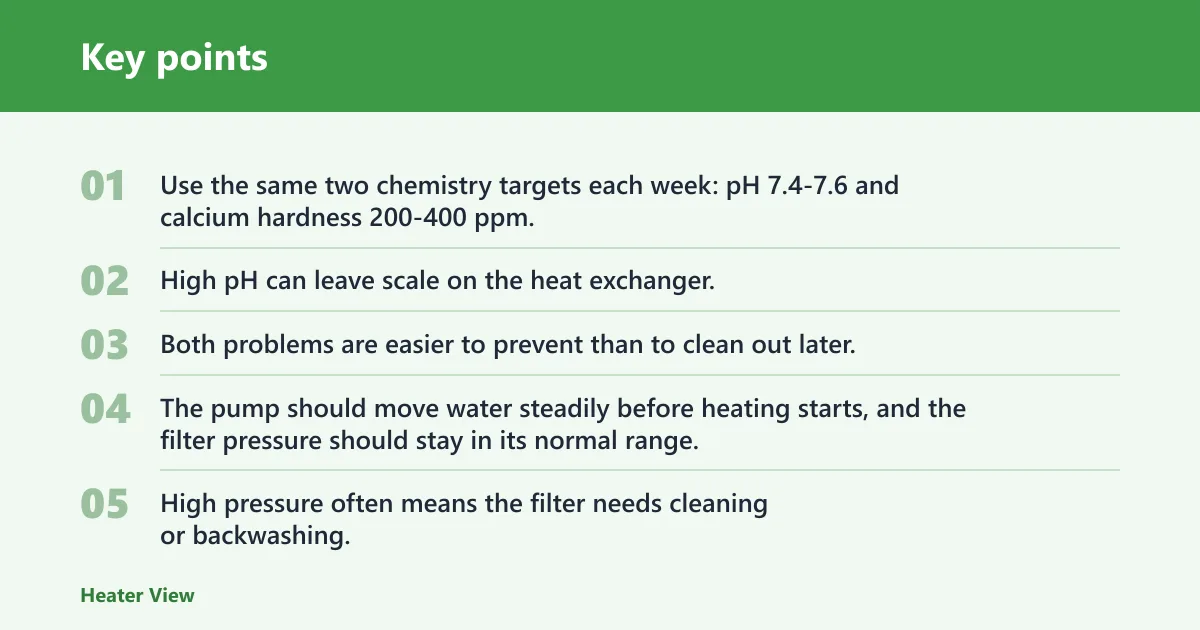
Use pH 7.4-7.6 and calcium hardness 200-400 ppm as the main targets, and keep total alkalinity and sanitizer balance in range as well. Below about pH 7.2, water is commonly more corrosive. Above about pH 7.8, scale tends to form more easily on the heat exchanger and other wet parts.
A common missed link is this: a heater that fires but does not warm well often has either scale on the exchanger or low flow through the filter and pump, not a bad thermostat setting. The symptom points you toward the maintenance miss.
Why older heaters still need routine checks
An older heater still benefits from cleaning, chemistry control, and airflow checks. Even if replacement is likely within a few seasons, good maintenance can keep the unit steady enough to avoid mid-season outages and reduce stress on the remaining components.
What should you check before first use?
Before first fire-up, verify water chemistry, circulation, airflow, and startup response for the heater type in front of you. Spring opening is the most important maintenance moment for the heater. For a gas unit, the startup test should show ignition within the time specified by the manufacturer. For any heater, a clogged filter or blocked vent can stop the season before it starts.
Gas heater startup points
- Open the heater valve fully. Confirm the gas shutoff valve at the heater is fully open. A partially open valve can create low gas pressure and ignition failures, and it is not the same as the meter valve.
- Check the vent path. Look for bird nests, wasp nests, or other blockage in the vent and exhaust flue. Blocked flue pipes can trigger high limit shutoffs and backflow of combustion exhaust.
- Inspect the igniter area. Check the igniter electrode gap against the manufacturer manual. Remove carbon deposits carefully, and do not bend the electrode during cleaning.
- Test thermostat response. Set the thermostat 5 degrees Fahrenheit above current water temperature. The heater should fire within the startup window specified by the manufacturer during startup checks.
- Cycle power if needed. If the heater does not fire, reset by cycling power off for 30-60 seconds. If it still will not start, stop there and call for service.
Heat pump startup points
For a heat pump, confirm that the cabinet has open airflow, the filter is clean, and the pump is moving steady water. Heat pumps depend on moving air across the coil, so leaves, fencing, stacked storage, and dirty fins can all reduce output. If the unit runs but produces little heat, flow or airflow is the first place to look.
Check that the thermostat or setpoint matches the season’s target water temperature. If the unit short-cycles, the cause is often poor circulation, a dirty filter, or a sensor issue rather than the heater “being weak.”
Solar heater startup points
For solar systems, confirm that valves route water through the collectors and that the pool pump provides steady circulation. Solar collectors are commonly sized at roughly 50% to 100% of pool surface area. A 16 ft by 32 ft pool has 512 ft2 of surface area, so the collector area will often be planned against that number.
If the collector field is not warming the pool, check for air in the lines, blocked flow, or a damaged valve layout before assuming the panels are at fault.
How often should you test pool water chemistry during heater season?
Test pool water chemistry weekly during swim season. That schedule keeps pH and calcium hardness in range before the heater has to deal with corrosive or scaling water. If the pool is heavily used, sees rain, or gets chemical corrections, test sooner. Chemistry drift can damage heater parts before a visible problem shows up in the pool.
Pool water chemistry and circulation checks
Low pH can eat into metal parts and seals. High pH can leave scale on the heat exchanger. Both problems are easier to prevent than to clean out later.
Then check circulation. The pump should move water steadily before heating starts, and the filter pressure should stay in its normal range. High pressure often means the filter needs cleaning or backwashing. Low flow often shows up as weak heating, repeated shutoff, or a heater that runs without delivering a meaningful temperature rise.
Should you use a cover with your pool heater? Yes. A pool cover reduces evaporation and heat loss, helps preserve temperature between uses, and lowers how often the heater has to cycle. Use a cover only when the manufacturer calls for it, and be sure it is used in a way that does not trap moisture or accelerate corrosion. That matters most overnight and between swim sessions, when avoidable heat loss otherwise turns into extra run time.
Pass-fail checks by heater type
| Task | Gas heater | Heat pump | Solar heater |
|---|---|---|---|
| Pre-season water chemistry | Pass: pH 7.4-7.6 and calcium hardness 200-400 ppm. Fail: pH below 7.2 or above 7.8, or hard-water scale visible on the exchanger area. | Pass: same chemistry targets. Fail: scale buildup that reduces heat transfer or stains around wetted parts. | Pass: same chemistry targets. Fail: corrosive water or scale that coats valves and collector plumbing. |
| Airflow or venting | Pass: clear venting and no debris in the burner compartment. Fail: bird nests, wasp nests, blocked flue, or soot-like signs of poor combustion. | Pass: cabinet and coil area open to air. Fail: blocked intake, packed leaves, or restricted discharge air. | Pass: unobstructed collector plumbing and valve path. Fail: trapped air or blocked flow through the solar loop. |
| Circulation | Pass: filter clean, pump steady, heater fires normally. Fail: low flow, dirty filter, or startup that fails after thermostat demand. | Pass: steady circulation and normal temperature response. Fail: short cycling or poor heat gain after the pump starts. | Pass: water moves through collectors with no leaks or airlocks. Fail: weak flow or no measurable warming from the solar loop. |
| Startup behavior | Pass: ignition within 60-90 seconds. Fail: no fire, repeated retries, or lockout. | Pass: compressor and fan start normally. Fail: repeated restarts or little temperature rise. | Pass: valves route flow correctly and panels warm under sun. Fail: no output despite strong daylight and proper pump flow. |
How to service a pool heater
Service a pool heater by pairing seasonal cleaning with checks that match the heater type. For gas, that means ignition parts, burner tray debris, venting, and water chemistry. For heat pumps, focus on airflow and coil cleanliness. For solar, focus on valves, collectors, and circulation. Keep the work to what is safe and visible.
Season-long maintenance matrix
| Task | Gas heater | Heat pump | Solar heater |
|---|---|---|---|
| Pre-season | Check pH 7.4-7.6 and calcium hardness 200-400 ppm; inspect igniter electrode gap near 1/8 inch; clear venting; verify thermostat demand and ignition response. | Check chemistry; clear cabinet airflow; inspect the coil for debris; verify steady circulation and setpoint response. | Check chemistry; inspect valves and collector lines; confirm the pump can move water through the solar loop without airlocks. |
| Weekly | Test water chemistry; confirm normal startup behavior; look for weak flame signs, odd noises, or repeated retries. | Test water chemistry; make sure the intake and discharge stay open; confirm the unit is still meeting setpoint. | Test water chemistry; inspect for leaks, air in lines, or poor warming from the collectors. |
| Monthly | Clean burner tray debris; check burner ports for blockage; inspect vent and exhaust flue; confirm filter pressure is normal. | Clean exterior fins and remove debris from the cabinet; check coil airflow; confirm filter pressure is not high. | Inspect collector surfaces and valve positions; clear debris around roof or rack piping; verify circulation remains steady. |
| Shutdown | Clean accessible debris; leave gas valve in the proper off position for the off-season; cover the unit if the manufacturer calls for it. | Shut down per manufacturer guidance; clear debris; protect the cabinet from leaves and standing water. | Drain or isolate as required by the system design; leave valves in the safe storage position; check for winter damage before spring. |
- Test the water first. Check pH and calcium hardness before you open the heater for the season. That prevents a clean-looking heater from going straight back into corrosive or scale-forming water.
- Check flow and pressure. Confirm the pump runs steadily and the filter pressure is normal. A dirty filter can starve the heater and mimic a more serious fault.
- Inspect the heater path. For gas units, look at the vent, burner tray, and igniter area. For heat pumps, check airflow around the cabinet. For solar, inspect the collector loop and valves.
- Run a startup test. Set the thermostat 5 degrees Fahrenheit above current water temperature and watch the response. Normal ignition within the manufacturer’s specified startup window is a good sign; anything else needs closer attention.
How often should you inspect the heater?
Inspect the heater at least weekly during swim season, then do a deeper check monthly and after storms or heavy use. Weekly checks catch chemistry drift and startup problems early. Monthly checks catch debris, venting issues, and filter buildup before they turn into shutdowns or weak heat output.
Weekly checks during swim season
Look at water chemistry, heater startup behavior, and circulation. For gas, watch for ignition delays or unusual burner behavior. For heat pumps, make sure the fan and compressor cycle normally. For solar, make sure the pool still gains heat when the system is calling for it.
Say your gas heater fires after a 10-second delay, then shuts off before the water warms. That pattern often points to low flow, a dirty filter, or poor gas delivery rather than a failed thermostat. The missed maintenance item matters more than the symptom alone.
Monthly checks during swim season
Once a month, clean visible debris, check the filter pressure, and inspect vents or collector pathways. Burner tray debris, blocked burner ports, and clogged airflow paths can create uneven combustion, weak output, or lockout risk in gas units. Heat pumps suffer when airflow is restricted. Solar systems need open flow to keep working well.
Checks after storms or heavy use
After storms, inspect for leaves, branches, bird nests, wasp nests, and standing water near the heater. After heavy use, check whether the filter pressure has climbed and whether the heater still meets setpoint. A small maintenance miss after a storm can become a no-heat call a few days later.
What problems point to skipped maintenance?
Skipped maintenance usually shows up as no heat with the unit running, short cycling, ignition trouble, or weak output after a filter change. Those symptoms often trace back to chemistry, flow, airflow, or venting, not the thermostat alone. The repair path gets easier when you match the symptom to the likely missed task.
No heat but the unit runs
This often means the heater is starting its sequence but cannot sustain heat transfer. On gas heaters, low gas pressure, blocked vents, or a dirty burner area can be the cause. On heat pumps, weak airflow or a dirty filter often limits output. On solar systems, the pump may not be moving enough water through the collectors.
Short cycling or shutoff
Short cycling often points to low flow, blocked flue pipes, or a heater that is protecting itself because of a fault. Gas heaters may shut off on a high limit condition if exhaust cannot move properly. If the heater starts, runs briefly, then stops, do not keep restarting it without finding the cause.
Poor ignition or uneven firing
Ignition failures often trace to the igniter electrode gap, carbon buildup, or a gas supply issue. Check the igniter against the manufacturer manual, clean carbon deposits carefully, and keep the burner tray clear of debris. A blocked burner port can cause uneven combustion and a lockout risk.
Reduced output after a filter change
A filter change can expose weak circulation that was already present. If the heater output drops after cleaning or replacing the filter, check whether the pump is still moving steady water and whether valves returned to the correct position. A valve that is slightly off can starve the heater and make it look underpowered.
How to fix a pool heater
For routine maintenance, start with the simple causes first: chemistry outside target range, dirty filter, blocked airflow, and a valve that is not fully open at the heater. If the issue is gas supply, electrical components, refrigerant, code faults, or repeated lockouts, stop the DIY work and bring in a pro. That is the safe line.
A common first-timer mistake is cleaning the heater exterior while leaving a clogged filter in place. The heater still runs, but the lack of circulation keeps it from transferring heat. Fixing the visible debris alone does not solve the actual problem.
Shutdown and off-season care
Shutdown care protects the heater from corrosion, debris, and accidental startup when the season ends. Clean what you can reach, leave valves in the correct safe position for the system design, and keep the area clear. The goal is to start spring with less cleaning and fewer surprises.
What to clean before storage
Remove leaves, dirt, and dust from around the cabinet, burner area, vents, and nearby pads or shelves. For gas heaters, keep the flue path clear. For heat pumps, keep the coil area open. For solar systems, inspect exposed piping and collectors for damage before winter weather does more of it.
When to schedule a professional inspection
Schedule a professional if the heater has repeated ignition failures, lockouts, unusual exhaust behavior, gas odor, electrical problems, refrigerant issues, or signs of internal corrosion. Gas line inspections should be handled according to local licensing rules and by the appropriate qualified professional. That is not a good place for guesswork.
Frequently asked questions
How long should a pool heater last?
Service life varies by model, maintenance, and water chemistry. Heat pump and solar units vary by design, but the same pattern holds: clean water, open airflow, and prompt service extend useful life.
What should I check before the first heater use of the season?
On gas heaters, inspect the igniter electrode gap per the manufacturer manual, the burner tray, and the exhaust path before you ask the unit to fire.
When should I call a professional for pool heater maintenance?
Call a professional for gas, electrical, refrigerant, or code-related problems, and for repeated no-fire or lockout conditions. You should also stop DIY work if you see blocked flue issues, gas supply questions, persistent ignition failures, or internal corrosion that needs parts replacement or deeper diagnosis.
Should I use a cover with my pool heater?
Yes. A cover reduces evaporation and heat loss, which helps the heater hold temperature between uses and run less often. That matters for gas, heat pump, and solar units alike, because less heat loss means less demand on the system and fewer startup cycles.