Water Heater Maintenance and Warranty Requirements
Keep the installation invoice, serial number, and at least one annual service record, plus photos or readings that show the heater stayed within the maker’s rules. Lose that paper trail, and a denied warranty claim can turn a covered tank, valve, or leak into a full replacement bill. This guide shows which maintenance steps, receipts, measurements, and dates to save for manufacturer and home warranty claims.
What warranty rules apply first?
The owner’s manual comes first for manufacturer coverage. It sets the maintenance schedule, and that schedule can change by model, fuel source, water quality, and installation. Home warranties follow a separate contract, and some exclude cleaning or maintenance-related problems even when the heater itself is otherwise eligible.
Manufacturer warranty requirements
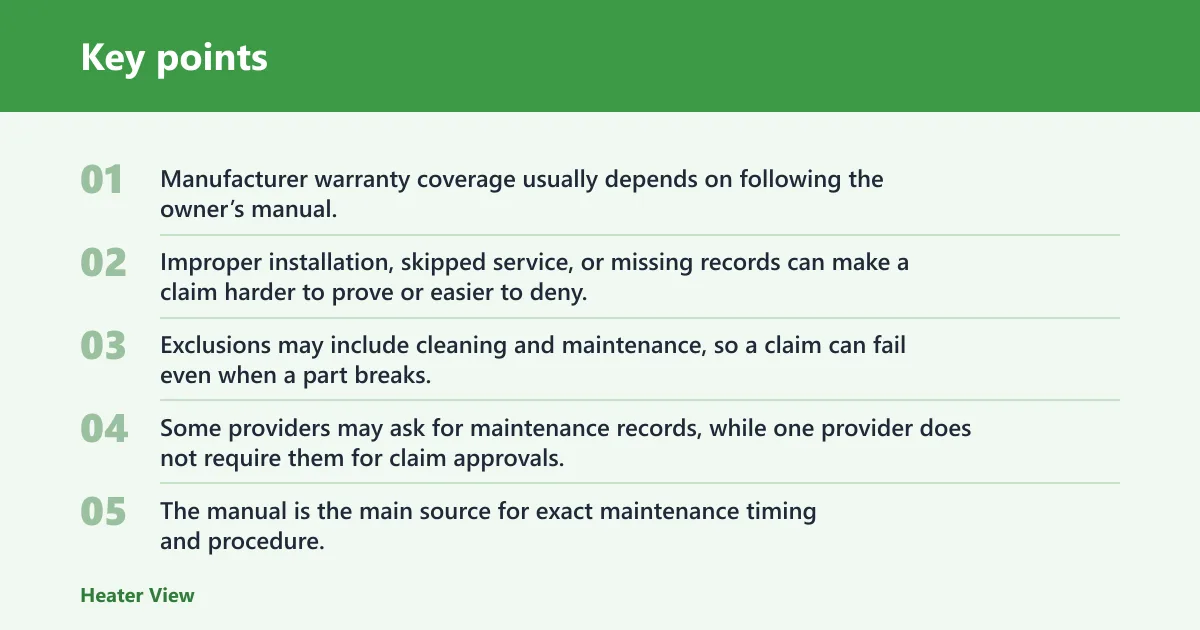
Manufacturer warranty coverage usually depends on following the owner’s manual. That may include flushing, valve checks, anode rod inspection, or descaling, but the required interval can differ by unit type and installation. Improper installation, skipped service, or missing records can make a claim harder to prove or easier to deny.
Home warranty requirements
Home warranty companies often cover eligible failures caused by normal wear and tear, but coverage limits vary by provider. Exclusions may include cleaning and maintenance, so a claim can fail even when a part breaks. Some providers may ask for maintenance records, while one provider does not require them for claim approvals.
Why the owner’s manual controls the schedule
The manual is the main source for exact maintenance timing and procedure. Follow it before flushing or testing valves, because some units have model-specific steps or warnings. A generic yearly rule is not enough if the manual calls for different intervals, different parts, or different safety checks.
For a manufacturer claim, the strongest evidence is the manual page that names the task, the dated record that shows it was done, and the receipt for any parts or service call. For a home warranty claim, the key question is often different: did the failure stem from a covered wear-and-tear event, or from cleaning, neglect, or a maintenance exclusion?
📊 Storage tank water heaters typically last eight to 12 years. Source: Thisoldhouse.
Which maintenance records should you keep?
Keep receipts, dated service notes, and clear identification details. A claim file should show what heater you own, when it was installed, what service was performed, what was measured, and where the manual says that task belongs. Photos help when they show a readable label, a drained tank, a valve position, or a part after inspection.
Receipts and service invoices
Save the installation invoice and every service receipt. If a plumber or technician replaces a part, the receipt should ideally name the part, date, labor performed, and the company that did the work. Keep separate records for flushing, anode rod replacement, valve work, descaling, and repair visits.
Model, serial number, and install date
Write down the model number, serial number, fuel source, and installation date from the data plate. Those details tie your records to the exact unit under warranty. If the heater is sold, rented, or transferred with the home, those same identifiers help match older service records to the current appliance.
Photos, readings, and manual page references
Take dated photos of the heater label, the drain valve, the T&P valve discharge line, and any visible corrosion or leaks. Save readings such as temperature settings, pressure readings if taken, and the result of any manual-directed test. Note the page number in the owner’s manual that describes the task or limit.
-
Photograph the data plate.
Capture the model number, serial number, fuel source, and install date label in one clear image if possible. That makes later matching easier when a claim reviewer asks which unit was serviced. -
Save the service invoice.
Keep the full invoice as a PDF or paper copy, not just a text message summary. The best invoice names the task, date, labor performed, and parts used. -
Record manual pages.
Write the page number beside each task, such as flushing, T&P valve testing, or anode inspection. This shows the work followed the model’s own instructions rather than a generic checklist. -
Store before-and-after photos.
Photograph sediment, corrosion, a replaced valve, or a drained bucket before service and after service if the condition changed. These images help show that the work actually happened and what it addressed.
Warranty-ready maintenance log
| Heater type | Date | Task completed | Parts checked | Measurements / observations | Receipt saved | Manual page noted | Claim-risk flag |
|---|---|---|---|---|---|---|---|
| Tank gas | 2026-03-12 | Flushed sediment and checked T&P valve discharge | Drain valve, T&P valve, burner area | Water ran cloudy for 2 minutes; no leaks after closing valve | Yes | Pages 18-19 | Medium if manual calls for more frequent flushing in hard water |
| Tank electric | 2026-04-08 | Inspected anode rod and confirmed full tank before restoring power | Anode rod, upper access panel | Rod showed severe pitting; power restored only after tank filled | Yes | Pages 14-16 | High if power was restored before tank was full |
| Tankless | 2026-05-03 | Descaled heat exchanger and cleaned inlet screen | Inlet filter, isolation valves, heat exchanger | Flow restored; no error code after restart | Yes | Pages 22-24 | Medium if hard water service interval was missed |
| Heat pump | 2026-06-21 | Checked condensate drain and air filter | Filter, drain pan, condensate line | Filter had dust buildup; drainage clear after cleaning | Yes | Pages 11-13 | Low if service log is dated and complete |
| Indirect | 2026-07-09 | Inspected coil connections and relief valve | Relief valve, coil fittings, supply piping | No visible seepage; pressure and temperature within manual limits | Yes | Pages 9-10 | Medium if boiler-side service was missed |
How should you maintain the heater?
Maintenance depends on the heater type. Tank units usually need sediment control and valve checks. Tankless units often need descaling and inlet screen cleaning. Heat pump and indirect units add their own parts and service points. Always start with the manual, because the right interval and procedure change by model and water quality.
Tank water heaters
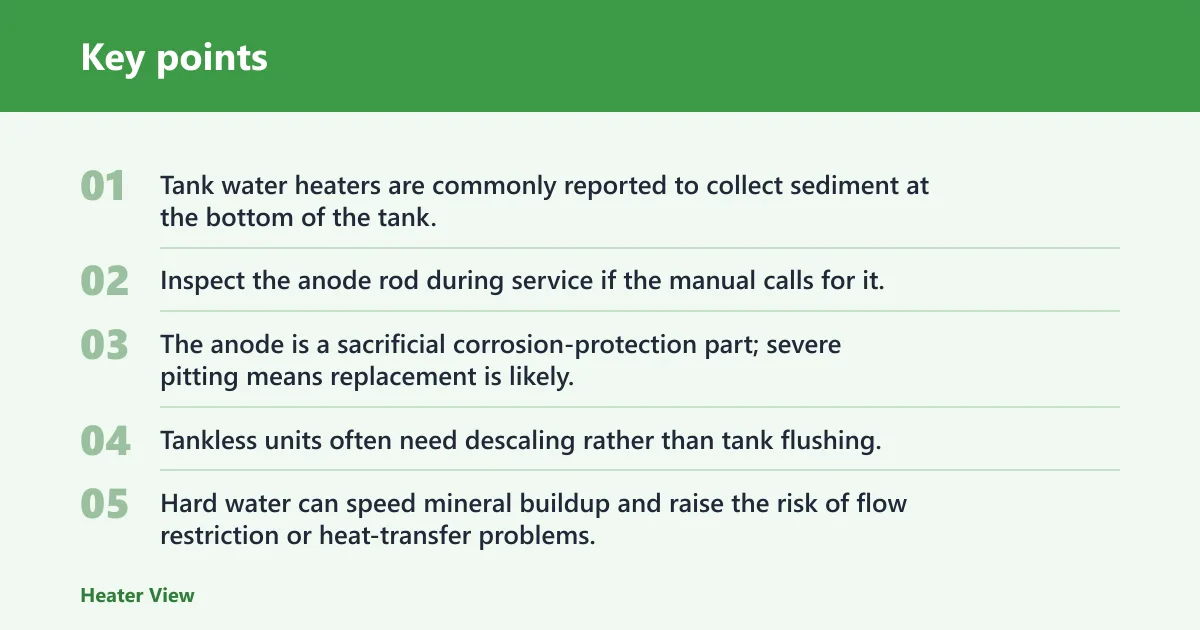
Tank water heaters are commonly reported to collect sediment at the bottom of the tank. That buildup can cause popping or rumbling, reduce efficiency, and shorten lifespan. The drain valve is used for flushing, but it must discharge to a safe drain or hose, and the manual should say whether sediment removal is feasible for that unit.
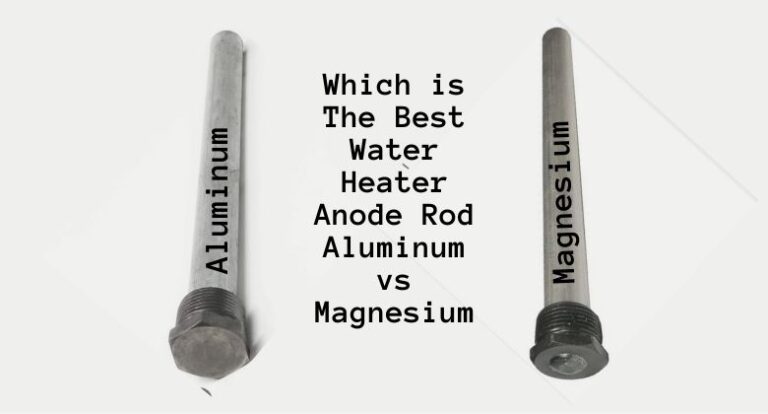
Inspect the anode rod during service if the manual calls for it. The anode is a sacrificial corrosion-protection part; severe pitting means replacement is likely. If the valve sticks, leaks, or breaks during service, stop and call a qualified plumber or technician instead of forcing it.
Tankless water heaters
Tankless units often need descaling rather than tank flushing. Hard water can speed mineral buildup and raise the risk of flow restriction or heat-transfer problems. The exact interval depends on water quality, fuel source, and the manufacturer’s schedule, so the service record should match the model’s instructions rather than a generic annual rule.
Heat pump and indirect water heaters
Heat pump water heaters often need air filter cleaning, condensate drain checks, and cabinet inspection in addition to the manual’s specific service steps. Indirect water heaters may need relief-valve checks and attention to the boiler-side connection or coil. Because these units tie into other systems, a qualified plumber or technician is often the safer choice for documentation and repairs.
Say your tank water heater starts making a popping sound after a year in a hard-water area. A claim file is stronger if it includes the flush date, the amount of sediment discharged, a photo of cloudy water, and the manual page that says the model should be flushed at that interval. Without those records, the noise can be blamed on neglect.
Why do sediment and hard water matter?
Sediment and hard water matter because they change both performance and claim risk. Sediment can create noise, reduce efficiency, and shorten lifespan. Hard water can significantly shorten a water heater’s lifespan and may require more frequent descaling or flushing, which makes the manual’s schedule even more important for warranty proof.
Sediment noise, reduced efficiency, and claim risk
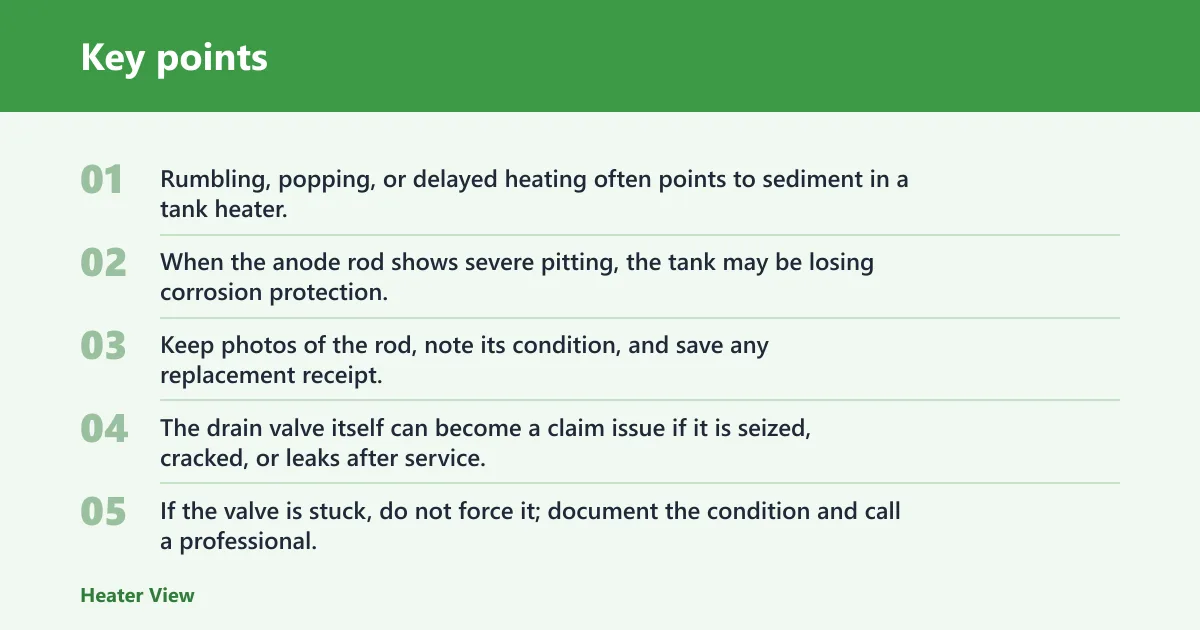
Rumbling, popping, or delayed heating often points to sediment in a tank heater. Those symptoms can be used in a dispute if the claim reviewer says the unit was neglected. A dated flush record, plus photos or a note that the drain water ran cloudy or gritty, helps show that the issue was addressed on time.
Anode rod checks and corrosion clues
When the anode rod shows severe pitting, the tank may be losing corrosion protection. Keep photos of the rod, note its condition, and save any replacement receipt. Rust around fittings, a damp base, or rust-colored discharge should also be documented because those signs can become part of a corrosion dispute.
Drain valve condition and flushing limits
The drain valve itself can become a claim issue if it is seized, cracked, or leaks after service. The record should note whether water flowed normally, whether the valve was opened fully, and whether the drain line carried discharge safely. If the valve is stuck, do not force it; document the condition and call a professional.
When does a professional need to step in?
Gas work, electrical work, stuck valves, and repairs belong with a qualified plumber or technician. Those tasks are easier to document correctly and less likely to create a new problem. They also reduce the chance that a claim is denied because the service was altered, incomplete, or unsafe.
Gas or electrical work
Do not attempt gas line changes, burner repairs, wiring changes, or control-board work unless the manual explicitly allows that task and local rules allow it. For electric units, power should not be restored until the tank is full. That detail matters because dry-firing can damage the unit and complicate coverage.
Stuck, damaged, or leaking valves
Never plug or cap the T&P valve discharge line. The T&P valve is a critical safety device, and discharge water from flushing or valve testing may be very hot and scalding. If the valve sticks, drips, or will not reseat, stop the work and record the condition before arranging service.
Repairs, replacements, and safety checks
Use a professional for repairs, replacements, and any service that changes the pressure, gas path, electrical path, or safety devices. A good invoice should show the diagnosis, the part numbers, and the final test result. That level of detail is often stronger evidence than a simple note that “service was completed.”
Picture a heat pump water heater that stops heating after the condensate pan overflows. A short note that says “cleaned” is weak evidence. A stronger record lists the clogged drain, the filter condition, the cleared line, the date, and the manual page that describes condensate maintenance.
What can cause a warranty denial?
Denials often trace back to missing records, skipped maintenance, improper installation, or an exclusion in the contract. Sediment buildup, rust, stuck valves, and corrosion can all become dispute points if the file does not show timely service. The right paperwork does not guarantee approval, but it gives the claim a real chance.
Common denial triggers
- Missing installation invoice or serial number record
- No proof that the manual’s service schedule was followed
- Evidence of cleaning or maintenance exclusions under a home warranty
- Improper installation or unapproved alterations
- Corrosion, sediment, or stuck valves with no service log
- DIY gas or electrical work that changed the unit’s condition
- No proof that hard-water service was done more often when required
Documentation that answers each trigger
| Denial trigger | Exact documentation that counters it |
|---|---|
| Missing install record | Installation invoice, model number, serial number, and install date photo |
| Skipped maintenance schedule | Service log with date, task, manual page reference, and receipt |
| Cleaning or maintenance exclusion | Home warranty contract page plus service record showing the failure was not caused by routine cleaning |
| Improper installation | Licensed installer receipt, startup notes, and any permit or inspection record if available |
| Corrosion or sediment claim dispute | Photos of rust or cloudy flush water, anode inspection notes, and flush receipt |
| Stuck or leaking valve | Professional service invoice stating valve condition and test result |
Frequently asked questions
What maintenance is required to keep a water heater warranty valid?
Follow the owner’s manual for your exact model. That usually means the listed flushing, valve checks, anode inspection, or descaling schedule, plus proof that the work was done. Manufacturer warranty rules can differ by unit type, fuel source, and installation, so one schedule does not fit every heater.
Do I need proof of flushing or service for a home warranty claim?
Often, yes. Home warranty companies may deny claims because of cleaning and maintenance exclusions, and some providers may ask for maintenance records. Save the invoice, the date, the task completed, and any photos or readings that show the heater was serviced. One provider does not require maintenance records for approvals, but that is not typical everywhere.
How often should a water heater be maintained to satisfy warranty terms?
There is no single interval that fits all units. The correct schedule depends on the model, fuel source, water quality, and installation. Some storage tank water heaters typically last eight to 12 years, while tankless water heaters typically last 15–20 years, but the maintenance cadence still comes from the manual.
What records should I keep for water heater warranty coverage?
Keep the installation invoice, model and serial number, install date, owner’s manual page references, service receipts, dated photos, and any reading or observation tied to the service. For a claim, a reviewer should be able to trace who serviced the unit, what was done, when it was done, and which manual instruction it followed.
Will sediment buildup or rust void my water heater warranty?
Not automatically, but sediment, rust, and corrosion can create denial risk if the contract says the problem came from neglect or missed maintenance. Document the flush, the anode rod condition, any rust photos, and the manual page that sets the service interval. Without that trail, the symptom may be treated as avoidable damage.
Can I do DIY water heater maintenance without affecting coverage?
Some basic tasks can be done by a homeowner if the manual allows them, such as checking visible conditions or recording readings. But gas work, electrical work, and repairs should go to a qualified plumber or technician. If a DIY task risks a valve, wiring, or safety device, the documentation and the coverage may both suffer.