Why Your Heater Runs Constantly and Wastes Energy
A heater that runs almost nonstop usually has one of three problems: a bad control setting or sensor, restricted airflow, or a house losing heat faster than the system can replace it. Ignore it, and bills climb, blower and heat exchanger wear rises, and rooms can still stay cold. This guide shows the first checks to run, how to separate system faults from heat-loss problems, and when to call for service.
Why a heater runs all day

Constant runtime can be normal during a cold snap, especially if the system is sized for milder weather or the house is hard to keep warm. It becomes a warning sign when the heater never satisfies the thermostat, air from the vents feels weak, or rooms stay cold even after long run times.
A fuel-burning furnace should generally run in short bursts, not continuously. Longer run cycles mean higher energy waste and higher gas bills, but the cause may be the heater, the controls, or the house itself. Heat flow moves through conduction, convection, and radiation, so a weak envelope can make even a healthy system look underpowered.
Check the thermostat first
The thermostat setpoint is the indoor temperature target. If the call-for-heat frequency is high because the setpoint is set far above the room temperature, the system may run for long periods while it catches up. A large setpoint gap after a setback period can also lead to long recovery times without necessarily indicating a fault.
Cycling behavior matters. If the system runs almost continuously from a cold start but shuts off and restarts normally after the house reaches temperature, the problem may be load, not failure. If it never reaches setpoint, or if the thermostat keeps calling even when the room feels warm enough, the control may be reading wrong or placed in a poor location.
- Confirm the setpoint. Compare the thermostat target with the current room temperature. A gap of about 2 to 4 degrees is often normal during recovery; a much larger gap can keep the heater running for a long time.
- Watch one full cycle. Note whether the thermostat stops calling before the room warms, or whether it never stops at all. That difference helps separate a control issue from low heat output.
- Check thermostat placement. Make sure it is not near a supply register, exterior door, lamp, or kitchen heat source. A bad location can make it call for heat too often or too long.
If the thermostat is set at about 70°F while the living room is around 63°F after an overnight setback, a longer first recovery cycle is expected. A long first recovery cycle is expected. If the same system still runs nearly nonstop after the room reaches the low 60s and the vents feel weak, the next suspect is airflow or heat output, not the setpoint alone.
Can a dirty filter make your heater waste energy?
Yes. A clogged filter can choke airflow, which reduces the amount of air the blower can move across the heat source and through the rooms. That lower airflow can lengthen runtime, reduce comfort, and make the heater waste energy even if the burner or electric element is still working.
Filter restriction depends on thickness, dust loading, and mERV rating. Higher mERV filters catch smaller particles, but they can also raise resistance if the system was not designed for that level of filtration. If airflow drops too far, the heater may run longer while delivering less useful heat.
- Pull the filter out. Hold it to a light. If dust blocks most of the surface, or if it looks gray and matted, replace it before more checks.
- Match the filter rating. Use the size and mERV rating recommended by the system maker if available. A higher mERV number is not automatically better if the blower cannot move enough air through it.
- Track replacement timing. Replace disposable filters on the interval listed by the maker or sooner in dusty homes, pet homes, or during heavy winter use. A clogged filter can cut burner efficiency and strain the blower.
A common first-timer mistake is swapping in a thicker, higher-mERV filter because it looks better on paper. If the old filter was already borderline, the new one can cut airflow enough to make the whole system feel weaker the same day.
Runtime matrix
This matrix separates symptom from likely cause, then gives a quick check you can do before calling for service. Use it to sort furnace, boiler, and space-heater problems without guessing.
| System type | Symptom | Likely cause | Quick homeowner check | Likely energy impact | When to call a technician |
|---|---|---|---|---|---|
| Furnace | Runs almost continuously, but supply air feels weak | Dirty filter, weak blower fan, duct delivery problem | Check filter load, register flow, and whether several rooms stay cold | High; longer runtime with little comfort gain | If the blower sounds strained, airflow stays low after filter replacement, or vents are still weak |
| Furnace | Runs long and the flame looks uneven or sooty | Dirty burners, poor combustion quality, venting issue | Look for soot, yellowing flame where visible, or repeated ignition retries | High; fuel waste rises as combustion quality drops | Right away if soot, odor, or shutdowns appear |
| Boiler | Boiler runs a long time but radiators stay lukewarm | Low water circulation, air in loops, control setting issue, heat loss | Check whether all zones call for heat and whether radiators are partially cold | Moderate to high; runtime rises when heat transfer is poor | If pressure, leaks, or venting concerns appear, or if heat never reaches all zones |
| Boiler | Burner cycles less than expected and the house still feels cold | Control sensor error or serious envelope heat loss | Compare thermostat behavior with room temperature and outdoor conditions | Moderate; may be a load problem, not boiler output loss | If the boiler short-cycles, leaks water, or shows unusual noises |
| Space heater | Runs constantly in one room but comfort stays uneven | Room heat loss, undersized unit, blocked intake or outlet | Clear the intake and outlet, then check drafts around windows and doors | Moderate to high; constant electric draw adds up fast | If the unit overheats, trips protection, smells hot, or has damaged cord or plug |
| Space heater | Turns on but heat output is weak | Dust buildup, damaged element, fan issue in a fan-forced model | Inspect for dust on the grille and verify the outlet can supply the rated load | High if it runs longer to make the same heat | If the heater is sparking, buzzing, or repeatedly shutting off |
What heater parts waste the most energy?
The biggest waste comes from parts that lower heat output or move less heat to the rooms. Burners that are dirty, a heat exchanger that is fouled or cracked, a blower fan that moves too little air, and a blocked combustion air supply can all keep runtime high while comfort falls.
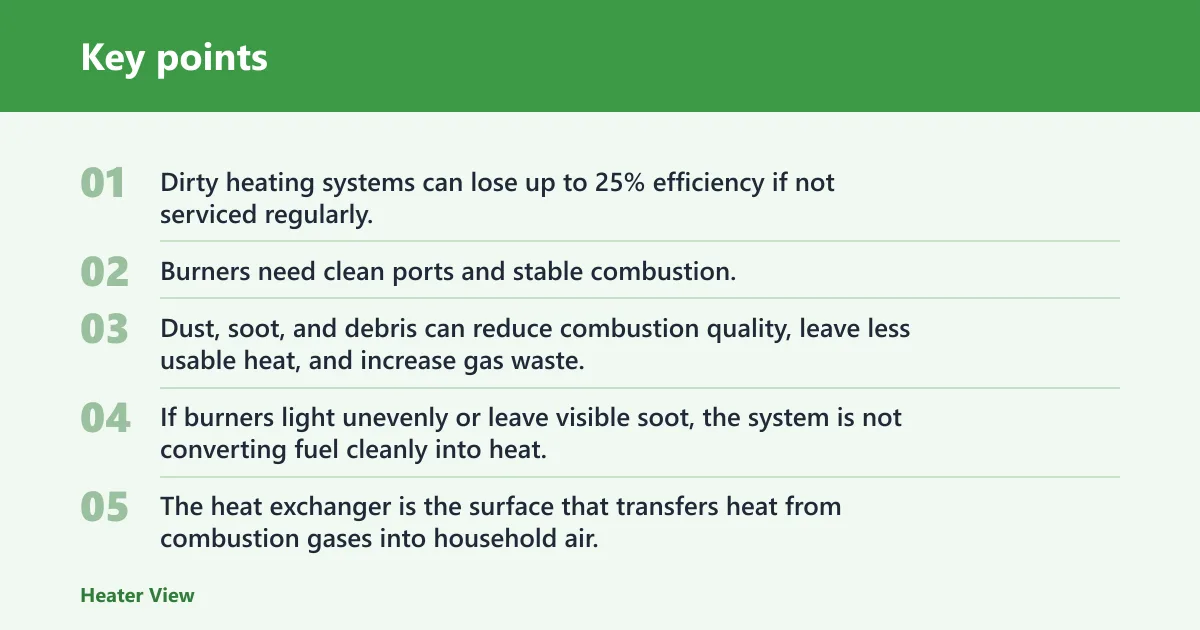
Dirty heating systems can lose up to 25% efficiency if not serviced regularly. That loss is not just about fuel use. It also means more wear, longer cycles, and more stress on safety-related parts.
Burners and combustion quality
Burners need clean ports and stable combustion. Dust, soot, and debris can reduce combustion quality, leave less usable heat, and increase gas waste. If burners light unevenly or leave visible soot, the system is not converting fuel cleanly into heat.
Heat exchanger fouling or cracks
The heat exchanger is the surface that transfers heat from combustion gases into household air. Fouling cuts heat transfer efficiency. Cracks are a safety risk because they can allow combustion products to mix with indoor air, which demands immediate service.
Blower fan output, motor condition, and speed setting
The blower fan sets airflow volume. If the motor is weak, the wheel is dirty, or the speed setting is wrong, the system may overheat or deliver too little warm air to the rooms. That leads to longer runtime and uneven temperatures, even if the burner itself is fine.
Combustion air supply and venting path
Combustion air supply affects oxygen availability and safe venting. Blocked intake pipes, obstructed flues, or a compromised venting path can reduce combustion quality and create indoor safety concerns. Any sign of poor venting needs a technician, not a guess.
Picture a furnace that lights normally, but the return grille is packed with dust and the supply air feels only mildly warm. In that case, the problem may be airflow first. If the same furnace also leaves dark soot near the burners, the issue moves from comfort to combustion and should be treated as a service call.
Is the house losing heat faster than the heater can replace it?
Yes, and that happens often. Air leakage and too little insulation account for a large portion of home energy loss. If the house leaks heat faster than the heater can add it, constant runtime may be the correct response to a weak thermal boundary rather than a failed furnace. (Energy)
A good thermal boundary cuts heat loss and energy waste. Windows, doors, attic insulation, basement leakage, and leaky duct runs all matter. The heater may be working as designed while the house keeps dumping that heat outdoors.
Insulation level and thermal boundary
Insulation limits conductive heat loss. If the attic, rim joists, or exterior walls are underinsulated, the house needs more runtime to hold the same setpoint. This is especially obvious on windy or very cold days, when the temperature difference across the thermal boundary gets larger.
Air leakage around windows and doors
Drafts around windows and doors increase convective heat loss. Check for cold air at frames, gaps at thresholds, and obvious light leaks where trim meets the wall. If room comfort improves when you seal a leak, the heater may not be the main problem.
Room-to-room clues that point to envelope loss
When one room is coldest no matter how long the heater runs, the issue may be a local envelope leak or poor air sealing, not a whole-system failure. If upper floors are warmer than lower ones, or rooms near exterior corners lag behind, the building shell deserves attention before more equipment parts are blamed.
- Compare hot and cold rooms. Note which rooms warm up first and which stay behind. A single cold room points to leakage, duct delivery, or a closed register more often than a full-system fault.
- Inspect obvious leaks. Check weatherstripping, door sweeps, window latches, and attic access hatches. Small gaps add up fast in winter.
- Feel the walls and floors. Exterior walls that feel unusually cold, or floors above uninsulated spaces that feel chilled, often indicate envelope heat loss rather than heater failure.
When constant runtime means call a technician
Call a technician when constant runtime comes with soot, unusual odors, repeated ignition problems, tripped safety switches, leaking water, or visibly weak heat after the filter and thermostat checks are done. Safety signs linked to poor combustion should never wait for a second opinion.
Weak heat output after basic checks can point to burner trouble, exchanger fouling, blower failure, or venting problems. Boilers and space heaters deserve the same caution if they run longer than expected and still cannot warm the space, especially when noises, odors, or shutdowns join the symptom.
- Shut it down if unsafe. If you smell gas, see soot, notice a cracked heat exchanger concern, or get repeated safety lockouts, turn the system off and arrange service. Safety comes before further troubleshooting.
- Document the symptoms. Note when the runtime started, which rooms are affected, and whether the problem follows a filter change or thermostat change. That short record helps pinpoint whether the fault is control, airflow, or heat output.
- Ask for full-system checks. A proper service visit should cover burners, heat exchanger condition, blower performance, venting, and combustion air supply. Those checks matter because poor maintenance raises energy bills over time and can hide safety defects.
How much energy do inefficient furnaces waste? The exact amount depends on the fault, but the source of the waste is clear: more runtime for the same heat. If a system is losing up to 25% efficiency from dirt and neglect, the bill impact can be substantial, especially through a full heating season.
Frequently asked questions
Why does my heater run constantly but not heat the house?
That usually means the heater is losing output somewhere between the thermostat and the rooms. Start with the setpoint, filter, and register airflow, then look at burners, blower performance, and the house envelope. If the system runs but the rooms stay cold, the heater may be weak or the house may be leaking heat faster than it can be replaced.
What causes a furnace to run longer and still feel weak?
Low airflow is a common cause. A dirty filter, weak blower, blocked duct, or closed registers can all cut delivered heat. Dirty burners or a fouled heat exchanger can also lower output. If the furnace lights and runs but the air feels lukewarm, the issue is often heat transfer or delivery, not just the thermostat.
Can a dirty filter make my heater waste energy?
Yes. A dirty filter adds resistance and can reduce airflow enough to lengthen run time, strain the blower, and lower comfort. That is more likely with higher mERV filters that are too restrictive for the system. Replacing the filter is one of the fastest checks, and often one of the cheapest fixes.
Is it normal for a heater to run all day in winter?
Sometimes, yes. During a severe cold snap, a properly working heater may run for long stretches, especially if the house has high heat loss or the thermostat is recovering from a setback. It is less normal if the unit never reaches the setpoint, the vents stay weak, or the house should have enough capacity for the weather.
When does constant running mean a heating system problem?
It is more likely a system problem when constant runtime comes with uneven temperatures, weak airflow, repeated ignition attempts, soot, strange odors, or unusually high bills after a filter and thermostat check. If the furnace should be cycling but stays on continuously, or the boiler and space heater cases show the same symptom, service is warranted.
What heater issues increase gas or electric bills the most?
The biggest bill drivers are restricted airflow, dirty burners, a weak blower, and poor combustion, because they force longer runtime for the same heat. House heat loss can be just as important. Air leakage and too little insulation can keep the heater running when the real problem is the building shell, not the equipment.
When should I call a professional for a heater that never shuts off?
Call a professional right away if you see soot, smell gas or combustion odors, hear unusual noises, get repeated shutdowns, or suspect a cracked heat exchanger or venting issue. Also call if basic checks do not change the symptom. Constant runtime is normal only when the weather and house load clearly explain it.