Can a Block Heater Be Installed on Any Engine?
There is generally no universal block heater that fits every engine. Fit usually depends on the engine’s block casting, available freeze-plug or threaded ports, and physical clearance. A wrong match can leave you without cold-start help, or cause leaks, damaged threads, or a heater that cannot be installed at all. This guide explains the heater types, the engine features that matter, and how to check access before you buy.
What a block heater actually heats
Coolant, oil, or the block itself
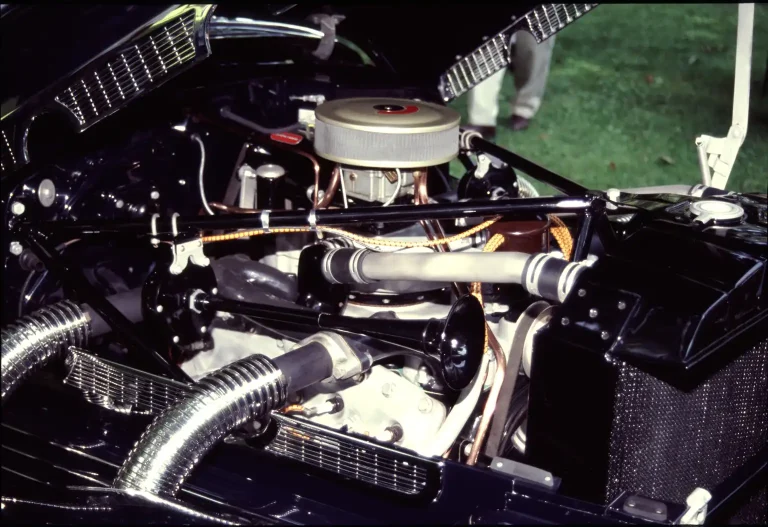
An engine block heater is an electrical device designed to warm part of the engine and/or the motor oil before startup. That matters because cold oil gets thicker, which makes the engine harder to turn over. Some heaters warm coolant inside the engine, while others warm oil or the outside of the block.
That split decides fitment. A heater that replaces a freeze plug needs a usable plug opening. A heater that wraps the oil pan or sits on top of the engine can work around missing internal access. Many heaters also run from a standard 120V AC outlet, so power access matters as much as mounting access.
Why heater type matters before fitment
Do not start with the brand label or the vehicle type. Start with the engine layout, the access points, and the heater style. A diesel pickup, a small gasoline tractor, and a generator can all need different hardware even if all three are called “block heaters” in casual use.
That is why two engines from the same family may not take the same retrofit. One may have a spare core plug. Another may hide the plug behind brackets, turbo plumbing, or a frame rail. The heater may still be possible, but not with the same parts or the same labor.
📊 If temperatures regularly fall below 10 degrees Fahrenheit, a block heater is worth considering. Source: Thedrive.
Can a block heater be installed on any engine?
No. A block heater cannot be assumed to fit any engine, because the usable mounting point varies by casting, coolant passage layout, and access around the block. Some engines accept a direct-fit heater. Others need an external style. A few air-cooled or tightly packaged engines are poor candidates for the common retrofit paths.
What makes an engine compatible or incompatible
Compatibility usually comes down to three questions: does the engine have a place to transfer heat, is that place accessible, and does the heater style match the engine’s construction. If the answer is no for any one of those, the “universal” claim falls apart.
For example, a core-plug heater typically needs an existing freeze-plug location, while an inline heater needs room in a coolant hose. A bolt-on external heater typically needs a flat exterior block surface. If the engine has neither the right opening nor the clearance, you need a different heater or a different heating strategy.
Block heater compatibility matrix
This matrix sorts common engines and equipment by the heater styles that usually fit, the mounting point they need, and the red flags that argue against a universal claim. Use it as a screening tool, then confirm the exact location in the service manual before buying parts.
| Engine family or equipment | Heater styles that usually fit | Required mounting point | Likely install difficulty | Red flags |
|---|---|---|---|---|
| Modern gasoline road vehicles | Freeze plug, inline, oil pan, dipstick | Accessible freeze plug, coolant hose section, oil pan surface, dipstick tube | Moderate | Plastic splash shields, cramped subframes, no exposed core plug |
| Modern diesel road vehicles | Freeze plug, inline, oil pan, bolt-on external | Coolant passage access, hose section, flat block surface | Moderate to difficult | Turbo plumbing, tight accessory drive area, hidden plug location |
| Older gasoline engines | Freeze plug, oil pan, dipstick | Existing core plug or exposed oil pan | Easy to moderate | Corroded plugs, seized hardware, unavailable service data |
| Tractors and farm equipment | Oil pan, freeze plug, engine-warming blanket, bolt-on external | Accessible pan, block face, or hood space | Moderate | Nonstandard engine bays, missing catalog fitment, guarded access panels |
| Generators | Oil pan, inline, engine-warming blanket | Coolant hose or top/underside hood area | Moderate | Limited service access, compact shrouds, air-cooled design |
| Air-cooled engines | Oil pan, engine-warming blanket in some cases | Oil surface or exterior heat path | Variable | No coolant passages, no freeze plug, thin or covered surfaces |
| Small off-road engines | Oil pan, dipstick, blanket | Oil access or exterior heating area | Easy to moderate | No room for hose splice, no service-listed plug location |
| Equipment with sealed or unusual housings | External blanket or bolt-on external only if allowed | Accessible outside surface | Difficult | No approved mounting point, sealed case, heat-sensitive parts nearby |
Gasoline engines
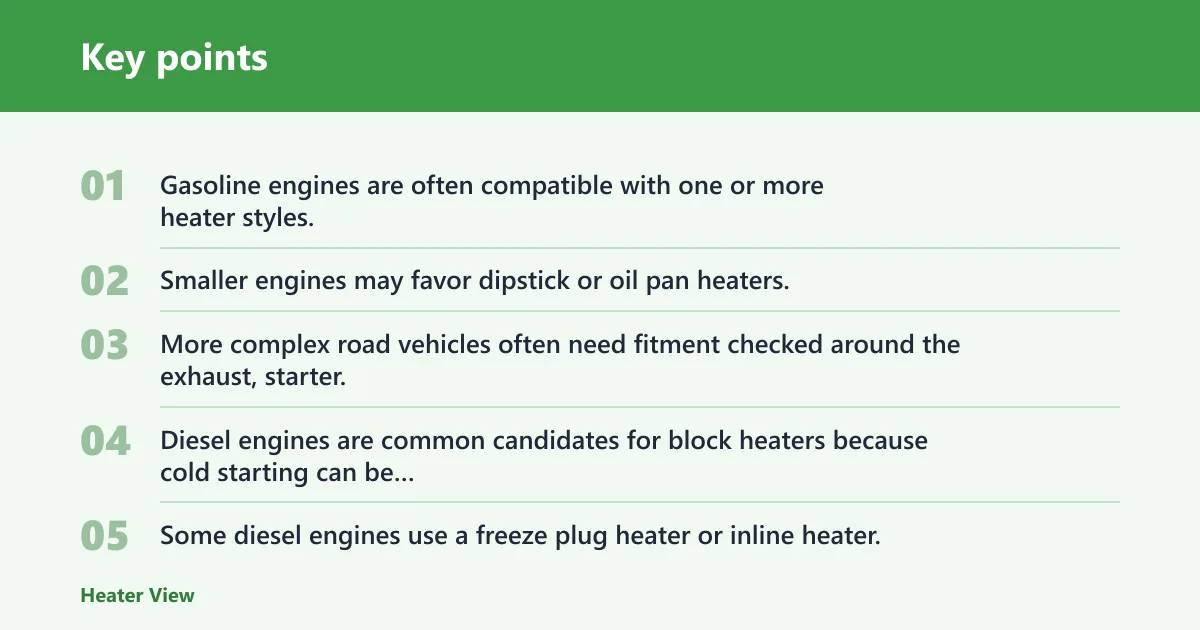
Gasoline engines are often compatible with one or more heater styles, but not every gasoline engine has an easy freeze-plug location. Smaller engines may favor dipstick or oil pan heaters. More complex road vehicles often need fitment checked around the exhaust, starter, and subframe before a plug-in style can be chosen.
Diesel engines
Diesel engines are common candidates for block heaters because cold starting can be harder, but the heater style still depends on the engine architecture. Some diesel engines use a freeze plug heater or inline heater. Others are better served by an oil pan heater or a bolt-on external heater when coolant access is poor.
Tractors, generators, and farm equipment
Off-road equipment is its own category. Tractor and generator engines often sit in tight frames, under shrouds, or behind guards that make a standard retrofit more difficult than on a road vehicle. In many cases, an engine-warming blanket, oil pan heater, or a service-manual-specific plug heater is the safer starting point.
Picture a compact tractor with no visible core plug and a protected belly pan. A blanket-style heater on the hood area may fit better than a freeze-plug heater, because the external style works around missing access. That is the kind of difference the catalog listing may not spell out clearly.
Air-cooled engines and other edge cases
Air-cooled engines generally do not have coolant passages, so a coolant-heating block heater is usually the wrong assumption. An oil-based or external heater may still work if the housing allows it, but the decision turns on surface area, heat tolerance, and the exact equipment design. If the machine is sealed or unusually compact, the answer may be no.
Which type of block heater fits which engine?
Freeze plug heaters
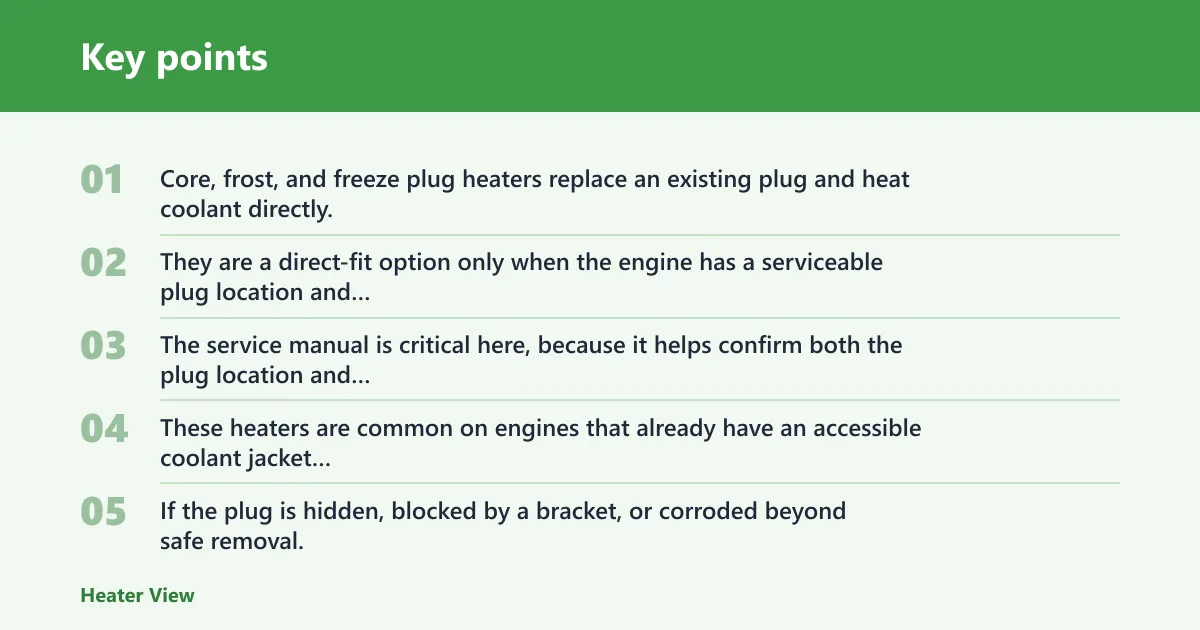
Core, frost, and freeze plug heaters replace an existing plug and heat coolant directly. They are a direct-fit option only when the engine has a serviceable plug location and enough room to remove and replace it. The service manual is critical here, because it helps confirm both the plug location and the correct orientation.
These heaters are common on engines that already have an accessible coolant jacket opening. They are not a universal retrofit. If the plug is hidden, blocked by a bracket, or corroded beyond safe removal, the job can shift from simple to impractical very quickly.
Oil pan and dipstick heaters
Oil pan heaters are heating pads attached with magnets or bolts, and dipstick heaters replace the dipstick with a heating element. These styles are often the fallback when there is no good coolant access. Some heaters, such as dipstick heaters, are easy to install, but they still need enough room for the cord and the mounting surface.
Use these when the engine block does not give you a clean place for a coolant or inline heater. They are especially useful where the oil is the main cold-start problem and the surrounding hardware blocks a freeze-plug retrofit.
Inline heaters and engine-warming blankets
Inline heaters are spliced into a coolant hose, and non-circulating inline heaters are also spliced into a coolant hose. They can work well when the hoses are accessible, but installation may be more involved because you need to cut or reroute hose sections correctly. In many cases, professional installation is reasonable.
Engine-warming blankets can be placed on top of the engine or under the hood. They are external and can be useful on tractors, generators, and other equipment where internal access is limited. They heat the engine from outside in, so they are often a workaround rather than a first-choice direct-fit option.
Bolt-on external heaters
A bolt-on heater is directly attached to the exterior of the engine block. This style depends on a flat, usable mounting surface and enough clearance to secure it safely. It is not a universal fix, but it can solve cases where a plug-in coolant heater will not fit and a blanket would not sit securely.
What if your engine has no freeze plug?
If your engine has no usable freeze plug, a core-plug heater is off the table. That does not mean the engine cannot be preheated. It means you need to look at external heating options such as an oil pan heater, dipstick heater, engine-warming blanket, or a bolt-on external heater if the block surface allows it.
Why some engines rule out a core-plug heater
Some engines have no accessible plug in the right location. Others have a plug that is buried behind brackets or frame members. On some newer castings, the available opening may not match a standard heater design. In those cases, forcing the wrong part can create leaks or damage the sealing surface.
Say your generator has a sealed shroud and no visible core plug. A freeze-plug heater is not the safe default. An external blanket or an oil pan heater may be the better path, provided the housing, heat path, and cord routing are all compatible.
Safer fallback options when space is tight
When access is tight, choose the heater style that works around the obstruction instead of through it. That often means an external pad, blanket, or a hose-mounted inline unit if the coolant line is reachable. If the installation requires disassembly you cannot verify in the service manual, stop before buying parts.
Can you install one yourself?
Sometimes. The easier heaters can be a DIY job, but not every installation belongs on a driveway with basic tools. The service manual tells you where the freeze plug or hose connection is, whether the block has room for the heater body, and whether nearby parts must come off first. That is the safest planning step.
What the service manual tells you
The service manual is critical for locating the freeze plug and confirming fitment. It can also show torque values, hose routing, and clearance limits that a parts listing may skip. If the manual does not show a clear heater path, treat that as a warning sign rather than a gap to guess through.
Tools, access, and when a mechanic is the better call
Basic pad or dipstick heaters may only need simple hand tools. Inline heaters, corroded freeze plugs, or tightly packaged diesel engines can need more disassembly, coolant draining, or specialty removal tools. In those cases, professional labor may be the safer call because one bad seal or cross-threaded fitting can turn a winter convenience into a repair.
- Check the service manual for the exact mounting point.
- Confirm the engine type: liquid-cooled or air-cooled.
- Look for a usable freeze plug, hose section, or oil pan surface.
- Measure clearance around belts, brackets, and shields.
- Match the heater style to the available access.
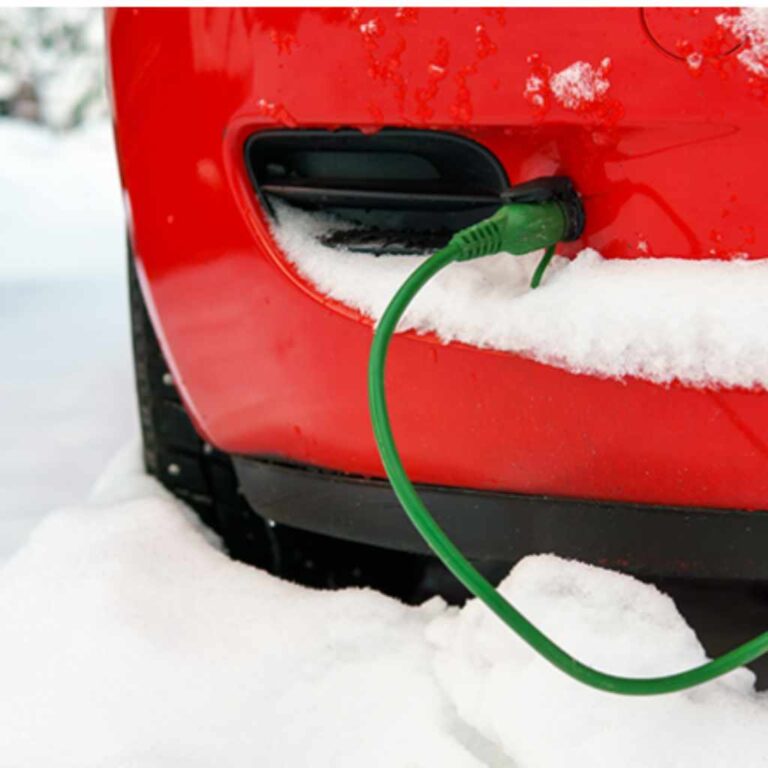
- Confirm 120V AC outlet access and cord routing.
- Stop if the installation requires unsafe force or hidden disassembly.
Frequently asked questions
What engines are compatible with a block heater?
Liquid-cooled gasoline and diesel engines are the most common candidates, but compatibility still depends on the available mounting point. Older engines, tractors, generators, and some farm machines may work with a freeze-plug, oil pan, dipstick, or blanket-style heater if the service manual confirms access.
Are block heaters universal or model-specific?
They are model-specific in practice. A heater may be sold for a broad engine family, but fit still depends on plug size, hose layout, block surface, and clearance. Treat any universal claim with caution until the exact mounting point is verified in the service manual.
Which type of block heater works on diesel engines?
Diesel engines often use freeze-plug heaters, inline heaters, oil pan heaters, or bolt-on external heaters. The right choice depends on the engine layout, not just the fuel type. Some diesel engines have easy coolant access; others need an external style because the plug is hidden or blocked.
Can I install a block heater myself or do I need a mechanic?
Simple dipstick, oil pan, or blanket-style heaters can often be installed by a careful owner. Freeze-plug and inline heaters are more involved, especially if access is tight or parts must come off first. If the service manual is unclear, professional installation is the safer call.
What happens if my engine doesn’t have a freeze plug?
Then a core-plug heater is not the right choice. Use a different heater style, such as an oil pan heater, dipstick heater, inline heater, or engine-warming blanket if the equipment allows it. The key is matching the heater to the available mounting point instead of forcing a plug-in fit.
Do all block heaters need a 120V outlet?
Most electric preheaters do need a 120V AC outlet, and many are designed around that power source.ers use an extension cord to reach it. That applies to common block heater styles, including plug-in coolant heaters and many external pads. Check the cord condition before every use and keep connections dry.
Can I use a block heater with an extension cord or timer?
Yes, if the cord and timer are rated for the load and are in good condition. A timer is useful because it avoids leaving the heater on all night. In deep freezes, some guidance recommends turning it on about 3-4 hours before driving. Do not drive away while it is still plugged in.
How cold does it need to be before a block heater is worth it?
If temperatures regularly fall below 10 degrees Fahrenheit, a block heater is worth considering. The exact need still depends on engine size, oil grade, and how the vehicle or equipment is stored. You do not need to leave it plugged in overnight to get the benefit.