Why Your Block Heater Plug Feels Hot: Causes and Fixes
A block heater plug that feels hot often points to a poor connection, damaged cord, loose outlet, or overloaded extension cord; some warmth can be normal, but a plug you cannot hold for a few seconds should be inspected. Left alone, that heat can melt blades, carbonize outlets, trip breakers, and start a fire. This article shows how to tell whether the heat starts at the outlet, vehicle cord, extension cord, or heater itself, and what to check first.
Why your block heater plug feels hot
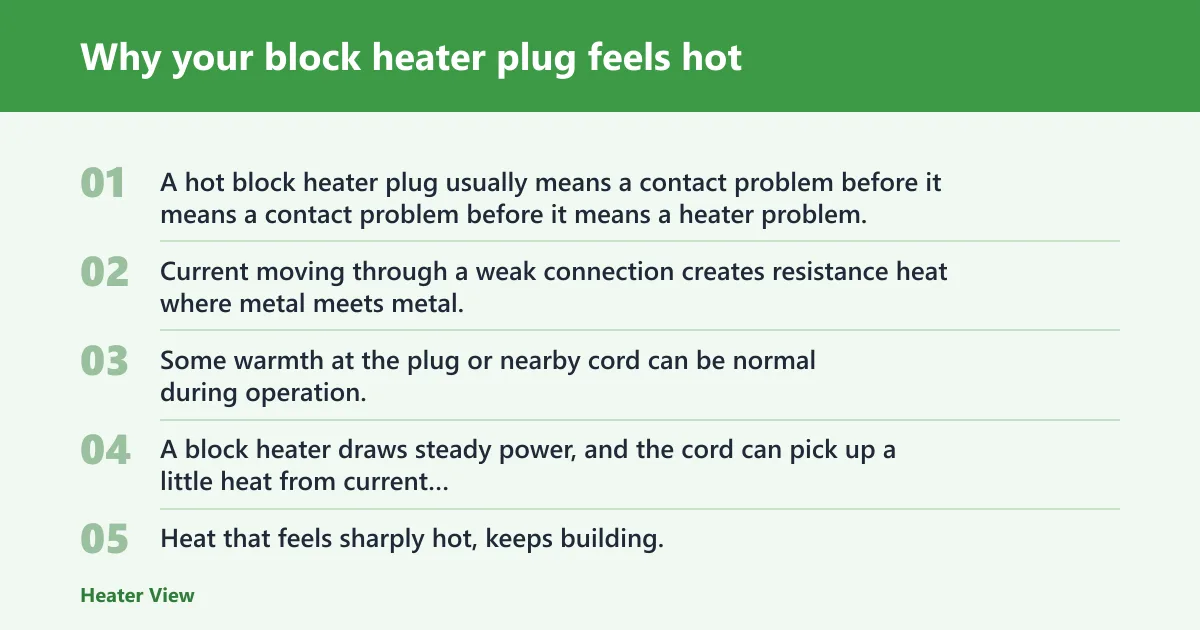
A hot block heater plug usually means a contact problem before it means a heater problem. Current moving through a weak connection creates resistance heat where metal meets metal, so the hottest point often shows where the fault begins.
What warmth can be normal
Some warmth at the plug or nearby cord can be normal during operation, especially in very cold weather. A block heater draws steady power, and the cord can pick up a little heat from current flow and from sitting near a warm engine bay. The key word is slight.
What heat points to a fault
Heat that feels sharply hot, keeps building, or stays focused at one end is a warning sign. That usually means loose outlet contact, corrosion on the blades, a damaged cord, a poor extension cord fit, or a heater drawing more current than the circuit should carry.
Is a warm block heater plug normal?
A warm plug can be normal, but a very hot plug is not. Normal heat usually stays modest and spreads out; fault-level heat stays focused at the blades, outlet, cord end, or heater body. If the plug feels too hot to hold, stop using it until you identify the source.
Where normal heat usually shows up
Normal warmth is often felt near the plug shell or the first short section of cord after several hours of operation. It should not leave the blades darkened, the outlet discolored, or the insulation soft. A weatherproof cover may trap a little ambient warmth, but it should not hide damage.
When heat becomes a stop-use warning
Stop using the heater if the plug is painful to touch, the blades look dark or pitted, the outlet is brown or melted, or the cord jacket feels soft. A burnt smell, sparking, or repeated breaker or GFCI tripping also moves the problem from “monitor” to “repair now.”
What a hot plug usually means
Heat centered at the plug almost always means the connection itself is making resistance. That can happen with a loose receptacle, oxidized blades, moisture intrusion, or a cord end that no longer grips tightly. The heater load may still be normal; the bad connection is what turns current into heat.
Loose outlet contact and worn receptacles
If the receptacle grips weakly, the plug blades do not make enough firm contact. That small gap raises resistance and concentrates heat at the blades and outlet face. A worn outlet often feels loose when you insert the plug, and it may leave visible heat marks around the slots.
Corrosion, moisture, and arcing
Outdoor winter use brings moisture, road spray, and condensation. Corrosion on the blades or inside the receptacle increases resistance, and intermittent contact can create arcing. Look for black specks, pitting, discoloration, or a burnt smell. A weatherproof outlet cover helps reduce moisture intrusion, but it does not fix a poor fit.
Damaged blades, cuts, and melted insulation
Heat can also come from the cord end itself. Bent blades, a cracked plug body, cuts, flat spots, or melted insulation point to damage that should not be ignored. If the cord gets hot near the plug end while the rest stays cooler, the fault often sits at that connection.
Could the outlet be the problem?
Yes. The wall outlet is one of the first places to inspect because it carries the full load and often fails through wear, corrosion, or moisture exposure. A hot block heater plug with a weak receptacle grip, discoloration, or tripped GFCI often points to the outlet side rather than the vehicle side.
How to check receptacle grip
Unplug the heater first. Then look at how firmly the receptacle holds a known good plug or the heater plug itself. It should feel snug, not floppy. A loose outlet does not keep contact pressure high enough, and that low pressure can create heat even when the heater and cord are otherwise sound.
What discoloration and burn marks mean
Brown plastic, blackened slots, melted edges, or a scorched odor mean the outlet has already overheated. At that point, continuing to use it risks arcing and more damage. Replace the outlet rather than trying to “work around” it with a tighter push or a different plug angle.
Why outdoor moisture matters
Outdoor receptacles face freeze-thaw cycles, condensation, and snow melt. Moisture lowers insulation quality and can speed corrosion inside the contacts. A GFCI outlet may trip if moisture or leakage is present, while a standard breaker may trip if the load or fault is severe enough.
Can an extension cord make my block heater plug overheat?
Yes. A long or undersized extension cord can add resistance and create heat, especially if it is not outdoor-rated or if the connection at either end is loose. Heavy-gauge winter cords are preferred; common choices are 12/3 or 14/3, with shorter length generally causing less voltage drop and less heat.
Gauge and length limits
The longer the cord, the more resistance it adds. That resistance turns into heat and voltage drop. A 12/3 cord carries more current with less loss than a 14/3 cord, especially over longer runs. The exact choice depends on the heater’s amperage, cord length, and circuit capacity.
Why outdoor-rated cords matter
Outdoor-rated cords use jackets that handle cold better and resist abrasion and moisture. A light indoor cord can stiffen in winter, which reduces flexibility and can weaken the plug-to-cord connection. If the cord jacket is cracked, stiff, or nicked, replace it rather than hoping it will hold up.
Heat caused by a poor cord-to-plug fit
Sometimes the extension cord itself is fine, but the plug connection is not. If heat is strongest right at the junction between the heater plug and the extension cord socket, the fit may be loose or contaminated. That can create the same resistance heat as a worn wall outlet.
How to tell whether the cord or heater is at fault

Location matters. Heat at the plug end often means poor contact; heat spread along the cord points to overload or damaged insulation; heat at the heater body points more toward the element or an internal fault. Breaker or GFCI trips help sort out whether the issue is overload, ground fault, or a failing component.
Heat at the plug end versus along the cord
If only the first few inches near the plug get hot, look at the blades, receptacle, and extension cord fit. If the entire cord warms or feels soft, inspect for damage, undersized wire, excessive length, or a heater load that is too high for the setup. One hot spot tells a different story than uniform warmth.
Signs of block heater cord damage
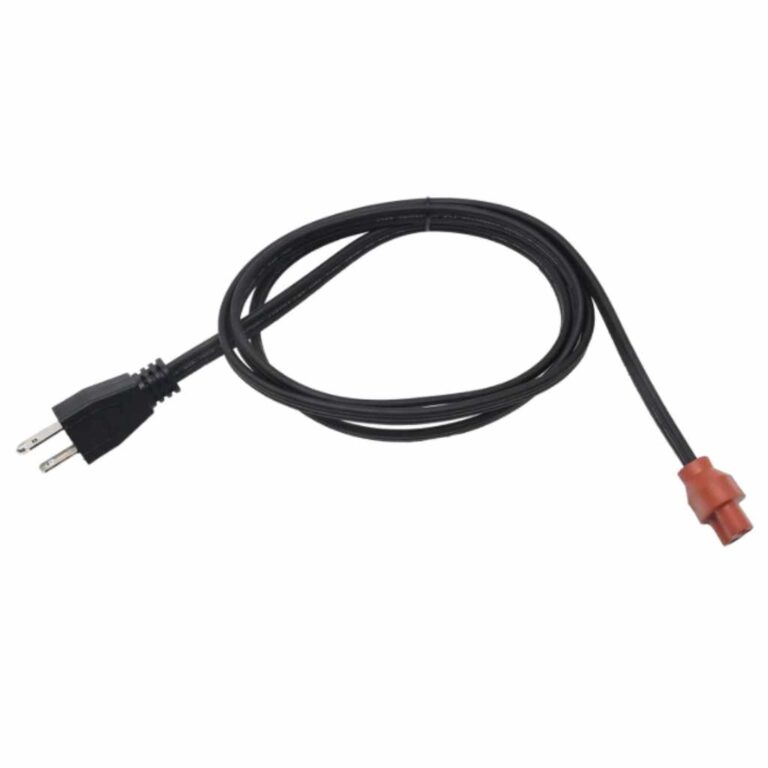
Check for cracks, cuts, flat spots, swelling, hardening, or melted sections. Cold weather can make insulation brittle, and repeated bending can open hidden damage near the strain relief. A damaged cord should be replaced, not taped over, if you want a safe and durable repair.
When the heater body points to an internal fault
If the heater body itself is unusually hot, or if the circuit trips shortly after power is applied, the heater element may be failing internally. A partial short can change the load and heat pattern. That is a replace-the-part situation, not a “keep watching it” situation.
Say your outlet cover is weatherproof, but the plug still feels hot after an hour. If the receptacle feels loose and the blades show dark marks, the cover is not the fix. The receptacle needs repair or replacement, and the plug or cord end may need replacement too.
Suppose a 6-foot extension cord runs from a garage outlet to a truck parked outside, and the plug end feels hotter than the rest of the cord. That pattern points toward cord gauge, length, or connection quality. An outdoor-rated 12/3 cord is a better starting point than a light indoor cord.
Hot block heater troubleshooting table
| Where the heat is strongest | Likely cause | Next action |
|---|---|---|
| Plug blades only | Loose outlet, corrosion, poor blade contact, moisture | Repair outlet or replace plug end; do not keep using if blades are discolored |
| Outlet only | Worn receptacle, arcing, discoloration, weak grip | Repair outlet |
| Entire cord | Undersized wire, excessive length, damaged insulation, overload | Replace part |
| Extension cord | Not outdoor-rated, too long, too light a gauge, poor socket fit | Replace part |
| Heater body | Element fault, internal short, abnormal load | Replace part |
When to stop using the block heater
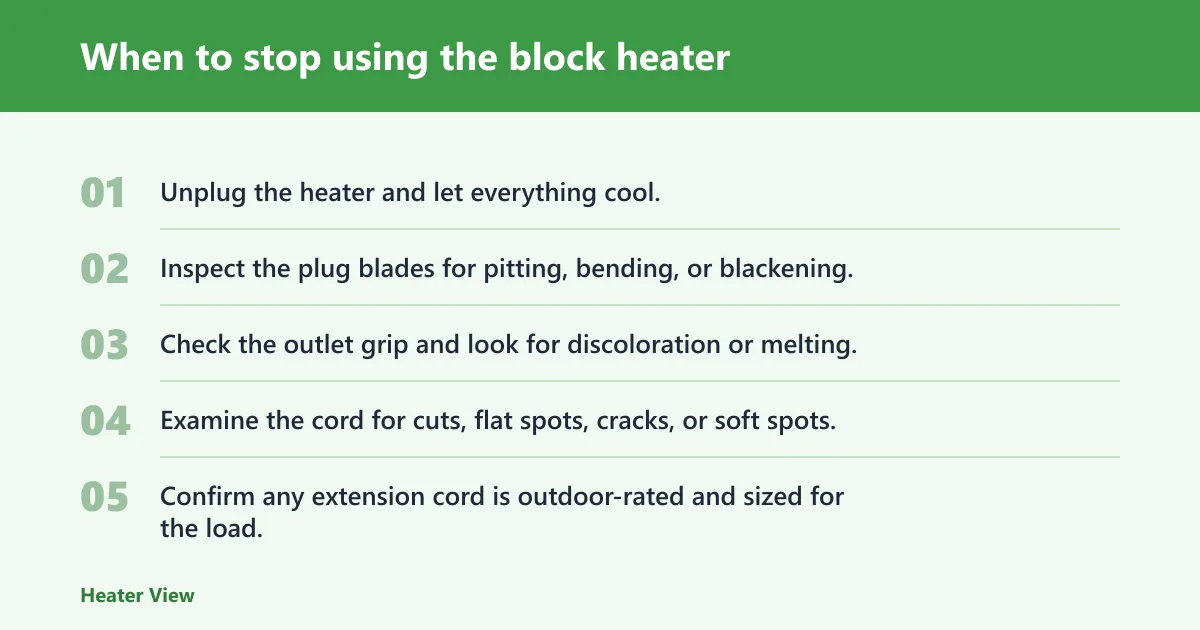
Stop using it immediately if any part is melted, cracked, discolored, or arcing. Repeated breaker or GFCI trips also suggest the circuit should be checked. A hot plug that stays hot after you correct the outlet and cord setup should not be left in service.
What to check before you reconnect power
- Unplug the heater and let everything cool.
- Inspect the plug blades for pitting, bending, or blackening.
- Check the outlet grip and look for discoloration or melting.
- Examine the cord for cuts, flat spots, cracks, or soft spots.
- Confirm any extension cord is outdoor-rated and sized for the load.
- Reconnect only after damaged parts are repaired or replaced.
What the breaker or GFCI is telling you
A breaker trip often points to overload, a short, or a failing heater circuit. A GFCI trip often points to ground leakage or moisture. Neither should be ignored, and neither is solved by simply resetting the device and trying again without inspection.
Frequently asked questions
Why does my block heater plug feel hot?
A hot block heater plug usually means resistance at the connection point, not normal heater warmth. Loose receptacles, corrosion, moisture, bent blades, or an extension cord that is too light or too long can all create heat at the plug. A plug that is too hot to hold should be inspected and corrected.
Is it normal for a block heater cord to get warm?
Slight warmth can be normal during operation, especially near the plug or first section of cord. What is not normal is heat that is strong, localized, or spreading along the cord jacket. If the cord feels soft, smells burnt, or shows discoloration, stop using it and replace the damaged part.
When is a block heater plug too hot to touch?
If you cannot hold the plug for a few seconds, treat it as too hot. That level of heat usually means a bad connection, a damaged outlet, or an overloaded extension cord. The safe move is to unplug it, inspect the parts, and replace anything discolored, cracked, melted, or loose.
Can a hot block heater plug start a fire?
A hot plug can damage insulation, harm the receptacle, and cause arcing, which can increase fire risk. The danger is highest when heat is paired with discoloration, sparking, a burnt smell, or repeated tripping. Do not keep using the heater until the source of heat is found and corrected.
Does a loose outlet make a block heater plug hot?
A loose receptacle can reduce contact pressure, which can raise resistance at the plug blades and create heat. That heat can discolor the outlet, weaken the plug end, and eventually cause arcing. If the outlet feels loose or looks browned, it should be repaired or replaced.
Can an extension cord make my block heater plug overheat?
Yes. An undersized, extra-long, or indoor-only extension cord can add resistance and make the plug end overheat. Winter use calls for outdoor-rated cordage, and common heavy-gauge choices are 12/3 or 14/3 depending on load and length. Heat at the cord junction is a sign to replace the cord.
How do I know if the plug, cord, or outlet is the problem?
Look at where the heat starts. Heat at the blades points to contact trouble, heat at the outlet points to a worn receptacle, heat along the cord points to damage or undersizing, and heat at the heater body points to the heater itself. That location-based pattern is the fastest way to narrow the fault.
What should I check if my block heater plug is hot in cold weather?
Check the outlet grip, the plug blades, the cord jacket, and any extension cord first. Cold weather can stiffen insulation, reduce contact pressure, and expose hidden damage. Unplug before inspecting, and replace any part that is cracked, melted, discolored, or showing signs of arcing or repeated tripping.