Electric Baseboard Heaters: Essential 120v vs 240v
Choosing between 120v and 240v electric baseboard heaters is simpler than you think! 120v heaters are great for smaller spaces and existing outlets, while 240v heaters offer more power for larger rooms and are often more energy-efficient. This guide will help you pick the right one for your home.
For portable-heater comparisons, Infrared Heater vs Halogen Heater: Essential Guide gives readers another helpful angle before buying or using one.
Welcome! Feeling a chill and looking to warm up your home? Electric baseboard heaters are a popular choice for good reason – they’re easy to use and can make any room cozy. But when you’re shopping, you’ll notice they come in two main types: 120-volt (120v) and 240-volt (240v). It can feel a bit confusing, but don’t worry! This guide is here to break it all down for you. We’ll make sure you understand the difference and feel confident choosing the perfect heater for your space.
Understanding the Basics: Volts and Your Home
Before we dive into the heaters themselves, let’s quickly touch on what “volts” mean in your home. Think of volts (V) as the “pressure” of electricity. Your home’s electrical system uses different voltages, and the standard outlets you plug your lamps and toasters into are usually 120v. Many major appliances, like your dryer or electric stove, use a higher 240v connection because they need more power.
Electric baseboard heaters work by converting electricity into heat. The voltage they’re designed for (120v or 240v) tells us how that electricity flows into them. Understanding this is the first step to making the right choice for your heating needs.
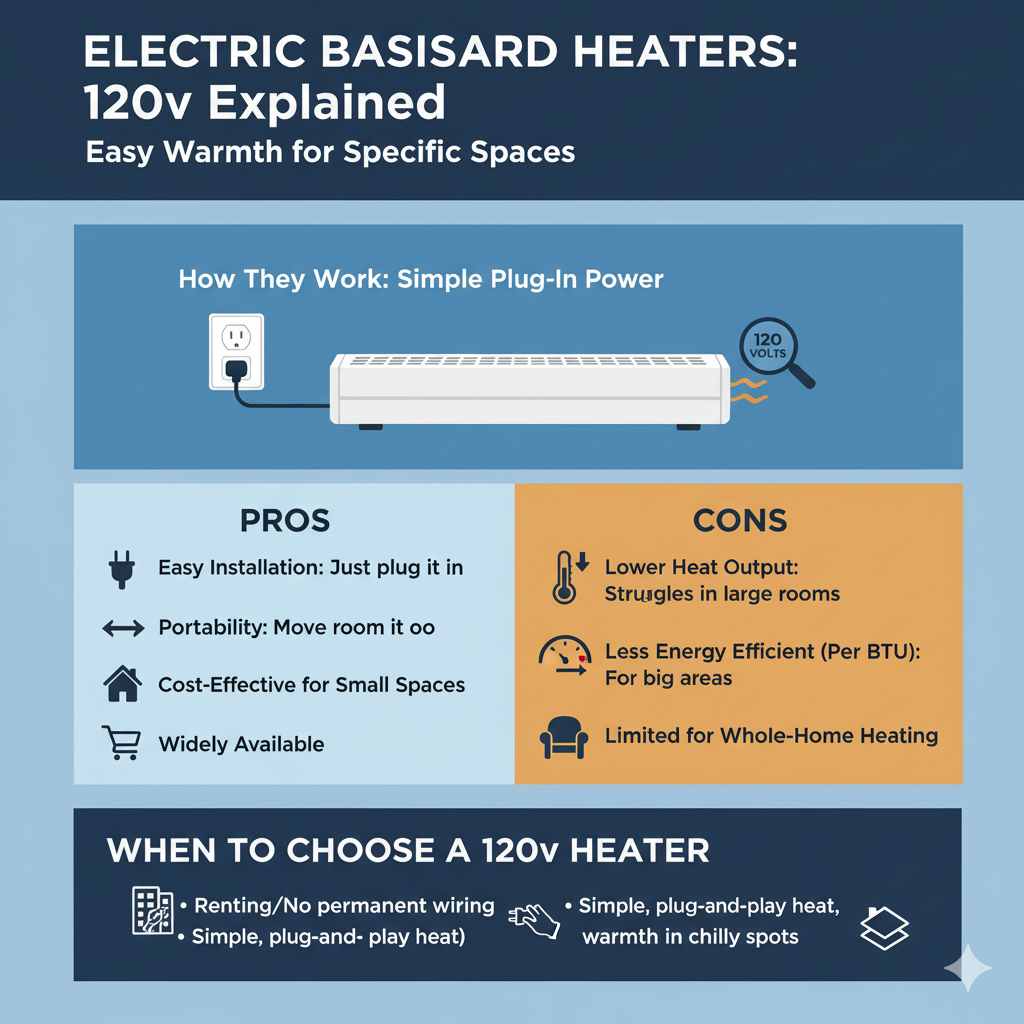
Electric Baseboard Heaters: 120v Explained
Electric baseboard heaters are long, slim heaters that fit under your windows, usually along the base of your walls. They’re popular because they provide radiant and convective heat, warming the air around them and gently pushing it into the room. They’re a great option for providing supplemental heat or for heating smaller, individual rooms.
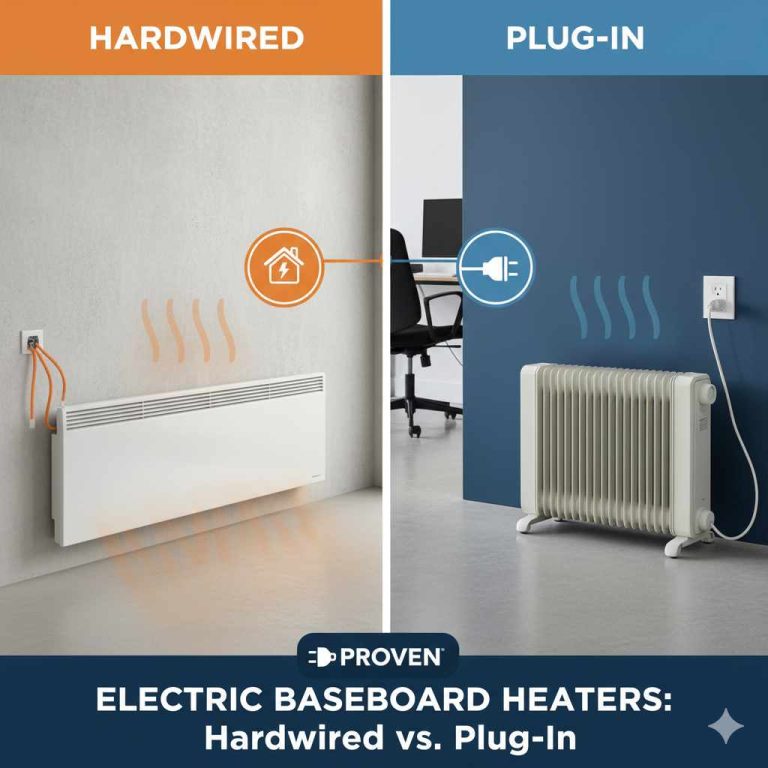
The key thing to remember about 120v heaters is their power source. They are designed to plug directly into a standard household wall outlet that provides 120 volts of electricity. This makes them incredibly convenient, especially for renters or situations where you don’t want to alter your home’s wiring.
Pros of 120v Electric Baseboard Heaters
- Easy Installation: Often, it’s as simple as plugging them into an existing outlet. No complex electrical work is usually required.
- Portability: Many 120v models are standalone units that can be moved from room to room as needed.
- Cost-Effective for Small Spaces: If you only need to warm a small bathroom, office, or entryway, a 120v heater can be an affordable solution.
- Widely Available: You’ll find a large selection of 120v models at most home improvement stores.
Cons of 120v Electric Baseboard Heaters
- Lower Heat Output: Compared to 240v heaters, 120v units generally produce less heat. This means they may struggle to warm larger rooms or very cold spaces effectively.
- Can Be Less Energy Efficient (Per BTU): Because they are less powerful, they might run for longer periods to maintain a temperature in larger areas, potentially using more energy overall than a similarly sized 240v unit.
- Limited for Whole-Home Heating: They are best suited for individual room heating rather than serving as the primary heat source for an entire house.
When to Choose a 120v Heater
A 120v electric baseboard heater is a fantastic choice if:
- You are renting and cannot make permanent electrical modifications.
- You need to warm a specific, small-to-medium sized room like a home office, bedroom, or bathroom.
- You want a simple, plug-and-play heating solution.
- You are looking for supplemental heat in an area that’s often a bit cooler than the rest of your home.
Electric Baseboard Heaters: 240v Explained
240v electric baseboard heaters are designed to operate on the higher voltage circuits found in most homes. Unlike their 120v counterparts, these heaters typically require a dedicated circuit and hardwiring by a qualified electrician. This is because they draw more power and need a more robust electrical connection to operate safely and efficiently.
The primary advantage of a 240v heater is its significantly higher heat output. This makes them ideal for warming larger rooms, ensuring consistent temperatures even in colder climates, and potentially serving as a primary heat source for certain areas of your home.
Pros of 240v Electric Baseboard Heaters
- Higher Heat Output: Produce more heat, making them ideal for larger rooms, living areas, or spaces with higher ceilings.
- More Energy Efficient (Per BTU): While they use more electricity per hour than a 120v heater when running, they often heat a space faster and more effectively. This means they cycle off more frequently, potentially leading to better overall energy efficiency for larger areas.
- Better for Primary Heating: Can be a viable primary heating source for individual rooms or even smaller homes if sized correctly.
- Quieter Operation: Often designed with internal components that result in quieter operation compared to some 120v models.
Cons of 240v Electric Baseboard Heaters
- Requires Professional Installation: Nearly always needs to be hardwired into a dedicated 240v circuit by a licensed electrician, which adds to the upfront cost.
- Less Portable: Once installed, they are a permanent fixture and cannot be easily moved.
- Initial Cost Can Be Higher: Factor in the cost of the unit itself plus the professional installation.
When to Choose a 240v Heater
A 240v electric baseboard heater is a great choice if:
- You need to heat a large room (e.g., a living room, a master bedroom, a finished basement).
- You are looking for a more powerful primary heat source for a specific area.
- You are renovating or building and can easily add a new 240v circuit.
- You want the most effective and potentially energy-efficient solution for medium to large spaces.
Key Differences at a Glance: 120v vs. 240v
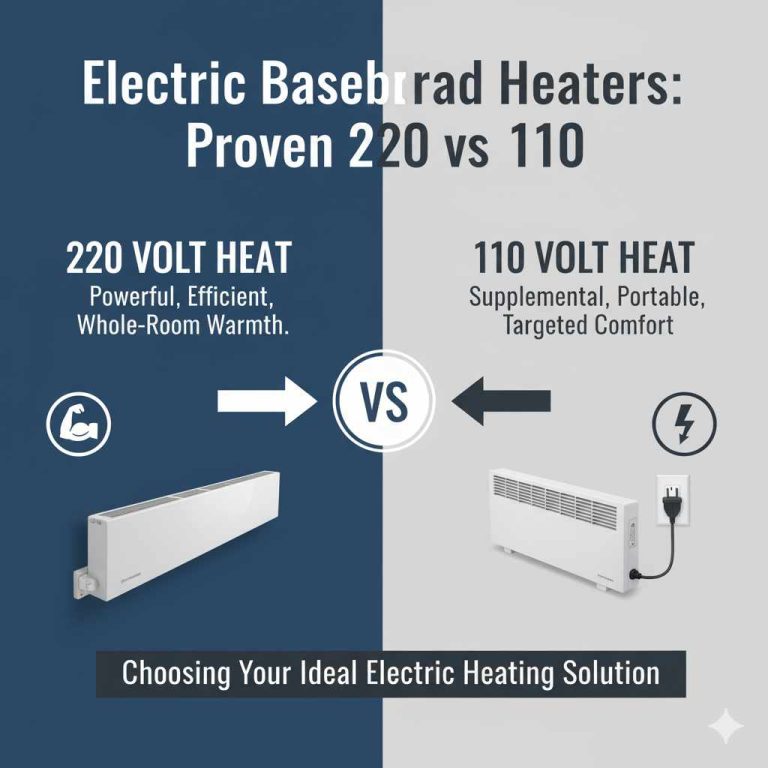
To make the decision even clearer, let’s look at the main differences side-by-side. This table highlights the essential distinctions between 120v and 240v electric baseboard heaters.
| Feature | 120v Electric Baseboard Heater | 240v Electric Baseboard Heater |
|---|---|---|
| Voltage | 120 Volts | 240 Volts |
| Power Outlet | Standard wall outlet (plugs in) | Requires dedicated 240v circuit (hardwired) |
| Installation | DIY-friendly, plug-and-play | Requires a licensed electrician |
| Heat Output | Lower to moderate | Moderate to very high |
| Ideal Space Size | Small to medium rooms, supplemental heat | Medium to large rooms, primary heat source for areas |
| Portability | Often portable | Permanent installation |
| Energy Efficiency | Can be less efficient in larger areas due to longer run times | Often more efficient for larger areas as they heat faster and cycle off more |
| Typical Wattage Range | 250 – 1600 watts | 500 – 4000+ watts |
The wattage is crucial here: higher wattage generally means more heat. A 120v heater might peak around 1500-1600 watts, while a 240v heater can go much higher. This is why 240v units are better for bigger jobs!
How to Choose the Right Heater for Your Needs
Now that you know the differences, let’s talk about how to pick the best heater for your specific situation. Think about these key factors:
1. Room Size Matters Most
This is the biggest deciding factor. A small bathroom (say, 50-75 sq ft) might only need a modest 120v heater, perhaps around 500-750 watts. A large living room or a finished basement (200-300+ sq ft) will definitely benefit from the higher heat output of a 240v model, likely in the 2000-3000+ watt range.
As a general rule of thumb, you can use this simple calculation to estimate the wattage needed:
Square Footage x Target Wattage per Square Foot = Total Wattage Needed
For example, for a room that is 150 sq ft, a common recommendation is about 10 watts per square foot, so you’d need around 1500 watts. For a very cold climate or a poorly insulated room, you might increase this by 10-20%.
2. Your Home’s Electrical System
Do you have a standard 120v outlet readily available in the room, or is it already wired for 240v (like where a clothes dryer is)?
- Existing 120v Outlet: If you have a standard outlet and the room size is appropriate, a 120v heater is the easiest DIY option. You may need to ensure the outlet is on its own circuit or can handle the heater’s load, especially if it’s an older home. The U.S. Department of Energy offers guides on home heating systems that could help you understand your options.
- Wants/Needs 240v: If you need more power for a larger space, or if you’re building/renovating, a 240v heater is likely the better performance choice. This will require a dedicated 240v circuit, which means hiring an electrician.
3. Installation Preferences (DIY vs. Professional)
Are you comfortable with a simple plug-and-play setup, or are you willing to hire an electrician for a permanent installation?
- DIY-Friendly: If you prefer to do it yourself and avoid extra costs, a 120v heater is the way to go.
- Professional Installation: If you’re looking for the best performance for larger spaces and don’t mind the cost of hiring a pro, 240v is often the superior choice.
4. Heating Goals (Supplemental vs. Primary)
Are you trying to take the chill off a specific room, or are you looking for a heater that can handle a significant portion of your heating needs?
- Supplemental Heat: For areas where the main heating system struggles, like a drafty sunroom or an upstairs bedroom that gets too cold, a 120v heater can be perfect.
- Primary Heat: For heating garages, workshops, or as the main source for a small cabin or additions, a properly sized 240v heater is usually necessary.
Installation Tips for Electric Baseboard Heaters
Safety and proper installation are key to ensuring your heater works efficiently and safely. Here are some general tips:
For 120v (Plug-In) Heaters:
- Clearance is Crucial: Always ensure there’s at least 6 inches of clearance above the heater and 0 inches from the wall it’s mounted against. Keep curtains, furniture, and anything else flammable at least 3 feet away.
- Check the Outlet: Make sure the outlet is in good condition and is on a circuit that can handle the heater’s wattage. If you’re unsure, consult an electrician. It’s best if the heater is on its own dedicated circuit.
- Proper Cord Management: Don’t run cords under rugs or where they can be stepped on or damaged.
- Thermostat Settings: Familiarize yourself with the heater’s built-in thermostat or consider using a smart plug-in thermostat for better control and potential energy savings.
For 240v (Hardwired) Heaters:
- Hire a Licensed Electrician: This is non-negotiable for safety and code compliance. They will ensure the correct breaker size, wire gauge, and connection are used.
- Proper Sizing: An electrician can help ensure the heater is appropriately sized for the room’s square footage and your climate.
- Thermostat Integration: 240v heaters often come with built-in thermostats, but many can also be wired to a central thermostat or smart home system for integrated control.
- Location, Location, Location: Install them under windows where cool air typically gathers. This uses the natural convection of rising warm air to circulate heat throughout the room effectively. Avoid placing them behind large furniture.
For more detailed electrical safety information, the Electrical Safety Foundation International (ESFI) is an excellent resource.
Energy Efficiency and Cost Considerations
When it comes to electric baseboard heaters, understanding energy efficiency can sometimes feel tricky. Here’s a simple breakdown:
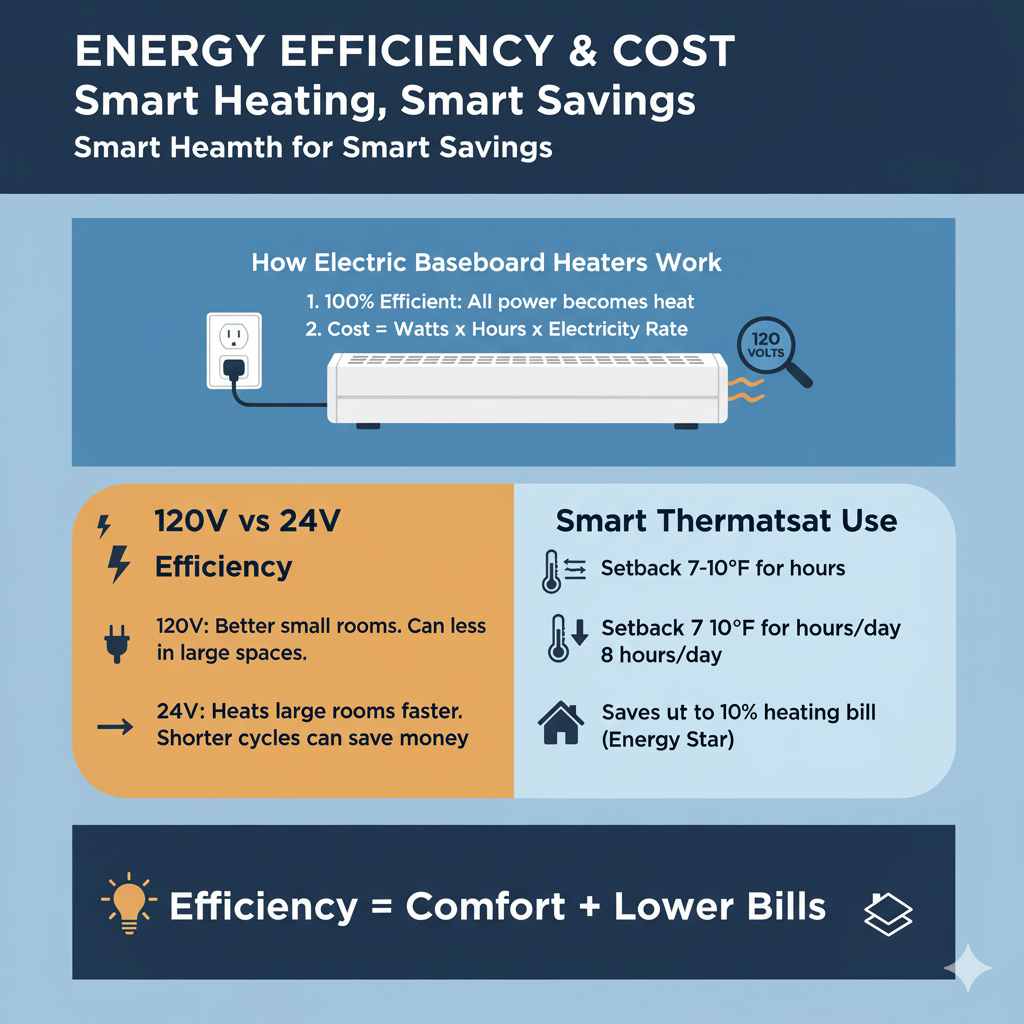
- 100% Efficient Conversion: All electric resistance heaters, including baseboard heaters, are virtually 100% efficient at converting electricity into heat. This means almost all the electricity they consume turns into warmth.
- Cost of Electricity: The main factor in their operating cost is the price of electricity in your area and how much electricity the heater uses (its wattage).
- 120v vs. 240v Efficiency: While both are 100% efficient at converting power to heat, a 240v heater often heats a larger space more quickly. This faster heating means it runs for shorter cycles, which can sometimes make it more cost-effective for larger areas than a 120v heater running constantly to achieve the same temperature.
- Thermostat Control: Using a good thermostat (built-in, wall-mounted, or smart) is crucial for managing energy use. Setting it lower when you’re away or sleeping can significantly reduce your electricity bill.
To get an idea of your local electricity costs, you can often check your utility provider’s website or your monthly bill for the price per kilowatt-hour (kWh).
Frequently Asked Questions (FAQ)
Q1: Can I plug a 120v electric baseboard heater into any outlet?
Yes, a 120v heater is designed to plug into a standard 120v household outlet. However, it’s important to ensure the outlet and the circuit it’s on can handle the heater’s wattage. Overloading a circuit can be a fire hazard. If you’re unsure, it’s best to consult an electrician.
Q2: How do I know if my home has 240v outlets?
Homes typically have 240v outlets for high-demand appliances like electric clothes dryers, ovens, or large air conditioners. A 240v outlet looks different from a standard 120v outlet; it usually has more slots or prongs to accommodate the higher voltage connection. If you don’t see one where you plan to install a heater, you’ll need an electrician to add a dedicated 240v circuit.
Q3: Are electric baseboard heaters expensive to run?
Electric baseboard heaters are not typically the cheapest form of heating to run, as electricity can be more expensive than natural gas. However, their 100% efficiency means little energy is wasted. Their running cost depends heavily on the electricity rates in your area, the size of the room, how well insulated it is, and how you use the thermostat. For supplemental heating or well-managed, smaller spaces, they can be quite manageable.
Q4: Can I use a 120v heater in a larger room if I just get a more powerful one?
While higher wattage 120v heaters exist, they have limitations. A very high-wattage 120v heater will draw a lot of amperage, potentially exceeding what a standard household circuit can safely provide without tripping the breaker.