Garage Heater Noise Levels: What to Expect by Type
Garage heater noise is often reported in a broad range, roughly 35 to 70 dB. Quiet radiant or infrared units sit near the low end, fan-forced electric heaters often land in the middle, and forced-air propane or kerosene heaters can reach the loud end. Choose poorly, and a heater can drown out conversation, hide warning sounds, or make a workshop feel tiring. This guide breaks down noise by heater type, explains the fan, combustion, and mounting factors behind it, and translates dB ratings into what you’ll actually hear in a garage.
Garage heater noise matrix
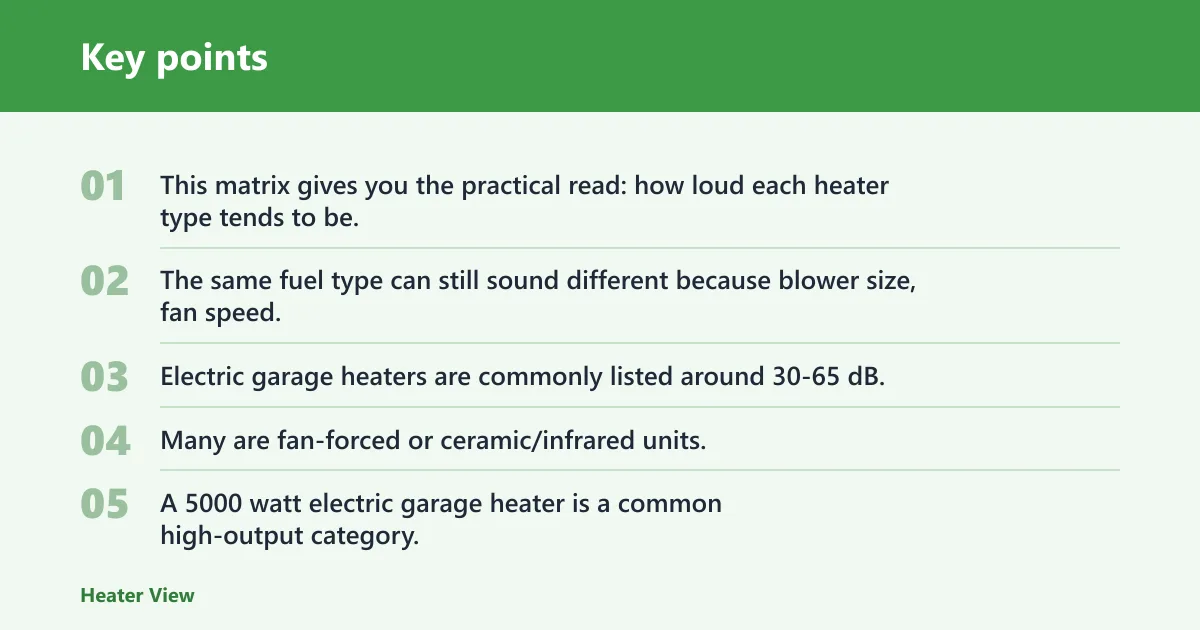
This matrix gives you the practical read: how loud each heater type tends to be, what the sound feels like, where the noise comes from, and when you are most likely to notice it in a garage. The same fuel type can still sound different because blower size, fan speed, and mounting quality change the result.
| Heater type | Typical dB range | Sound character | Likely noise source | When it becomes noticeable in a garage |
|---|---|---|---|---|
| Electric | 30-65 dB | Can be near silent at low output, or a steady fan hum at higher output | Fan motor, airflow, relay clicks, higher wattage output | Startup on high heat, then again when the fan ramps up or cycles |
| Propane radiant | 40-60 dB | Low mechanical noise, with a soft burner sound | Burner, ignition, occasional valve or regulator noise | More noticeable in a small or attached garage when the burner lights |
| Propane forced air | 40-60 dB | Audible fan hum and air movement, sometimes a sharper startup sound | Combustion blower, circulation fan, ignition | At startup and whenever the blower runs at higher speed |
| Natural gas radiant | 40-60 dB | Usually quieter than fan-forced gas, with less steady mechanical sound | Burner and ignition, plus any cabinet vibration | Most noticeable during ignition and burn cycles |
| Natural gas forced air | 40-60 dB | More noticeable air movement and fan noise, especially during heat-up | Blower, circulation fan, combustion components | During startup and while the fan is moving air through the space |
| Infrared | Often toward the low end of electric or radiant ranges | Quiet, with little airflow noise | Minimal fan use in many models | Most noticeable only at ignition or if a fan-assisted version is used |
Electric garage heater: dB range and sound character
Electric garage heaters are commonly listed around 30-65 dB, and the sound level rises as fan speed and wattage rise. Many are fan-forced or ceramic/infrared units, so the quietest versions may sound almost still at low output while higher-output models add a steady hum and air noise.
A 5000 watt electric garage heater is a common high-output category. Some units list low-noise operation around 58 dB, and many are sold with three heat levels such as 3,000 / 4,000 / 5,000 W. That matters because the same heater can sound restrained on a lower setting and much more obvious on the highest one.
Propane garage heater: dB range and sound character
Propane garage heaters are commonly described around 40-60 dB. Radiant propane models are usually quieter than fan-assisted units, because they depend less on forced airflow. The tradeoff is that the quietest versions often heat more slowly than forced-air units.
Many propane heaters are commonly described as needing safety features such as oxygen depletion and tip-over protection, especially on portable units. In a smaller workspace, a carbon monoxide detector belongs in the conversation along with noise and fuel choice.
Natural gas garage heater: dB range and sound character
Natural gas garage heaters are commonly described at roughly 40 to 60 dB. Wall and ceiling units are common, but the main noise contributors are still the fan and blower, not the fuel line itself. Sealed-combustion designs can be quieter than open models because they control the combustion path better.
Forum reports also point to real spread within the same fuel type. Some quiet gas units are often cited as low-noise options, with reported output in the low-to-mid 30s to mid-40s dB(A) range. That spread shows why fuel type alone does not tell the whole story.
Forced air versus radiant noise
Forced air heaters are typically 50 dB or more, and they are usually louder because they move heated air with a fan. Radiant heaters are often quieter because many have no fan at all. If sound matters more than rapid heat-up, radiant models usually have the edge.
Forced air does have a clear advantage: faster distribution of heat across a garage. The price is noise from the combustion blower and circulation fan, plus more startup sound when the system first comes on.
How loud is a garage heater by type?
The same fuel can sound different because noise is not one thing. Startup noise, steady-state noise, and cycling noise can each be distinct, and the loudest moment is often not the one you notice most during normal use. Fan size, fan speed, burner design, and mounting all change what reaches your ears.
Why the same fuel type can sound different
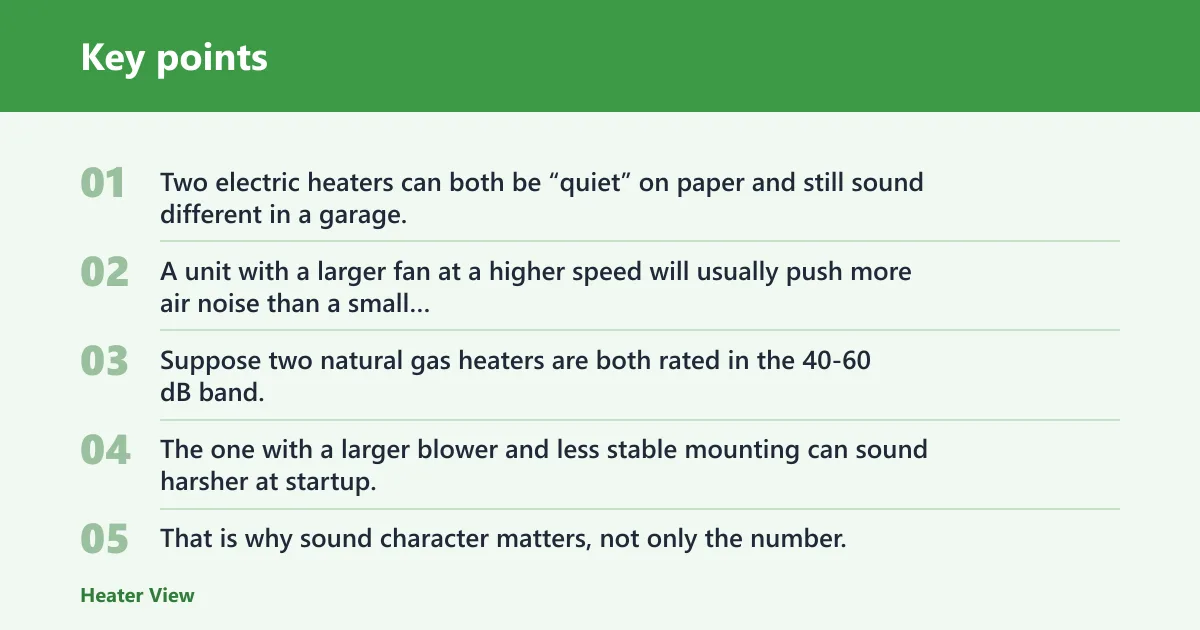
Two electric heaters can both be “quiet” on paper and still sound different in a garage. A unit with a larger fan at a higher speed will usually push more air noise than a small radiant-style electric heater, and a heavier cabinet can sometimes carry less vibration into the wall or ceiling.
Suppose two natural gas heaters are both rated in the 40-60 dB band. The one with a larger blower and less stable mounting can sound harsher at startup, even if the nameplate rating is similar. That is why sound character matters, not only the number.
Startup, steady-state, and cycling noise
Startup noise is the first burst you hear when ignition begins and the fan spins up. Steady-state noise is the ongoing hum, hiss, or airflow sound while the heater is running. Cycling noise is what happens when the unit turns on and off to hold temperature.
A common first-timer mistake is checking only the steady rating and ignoring cycling. In a garage, short bursts can be more annoying than a softer continuous hum, especially if you are using power tools or working near a vehicle with the doors shut.
What changes with fan size and mounting
Blower size and mounting quality can make the same heater sound calmer or louder. A fan that moves more air often produces more audible airflow, and loose brackets can turn a mild hum into a vibration you feel through studs, joists, or sheet metal. Wall mounting is not automatically quiet.
For attached garages, vibration matters as much as the decibel number. A heater that is lightly isolated from the structure may seem easier to live with than one that transmits a hard buzz through the wall.
What does 50 dB sound like in a garage?
Fifty decibels is about the level of a quiet library. In a garage, that usually means you can still talk, but the heater is clearly present in the background. It is not whisper-quiet, and it will be more noticeable in a small or enclosed space than in a detached shop.
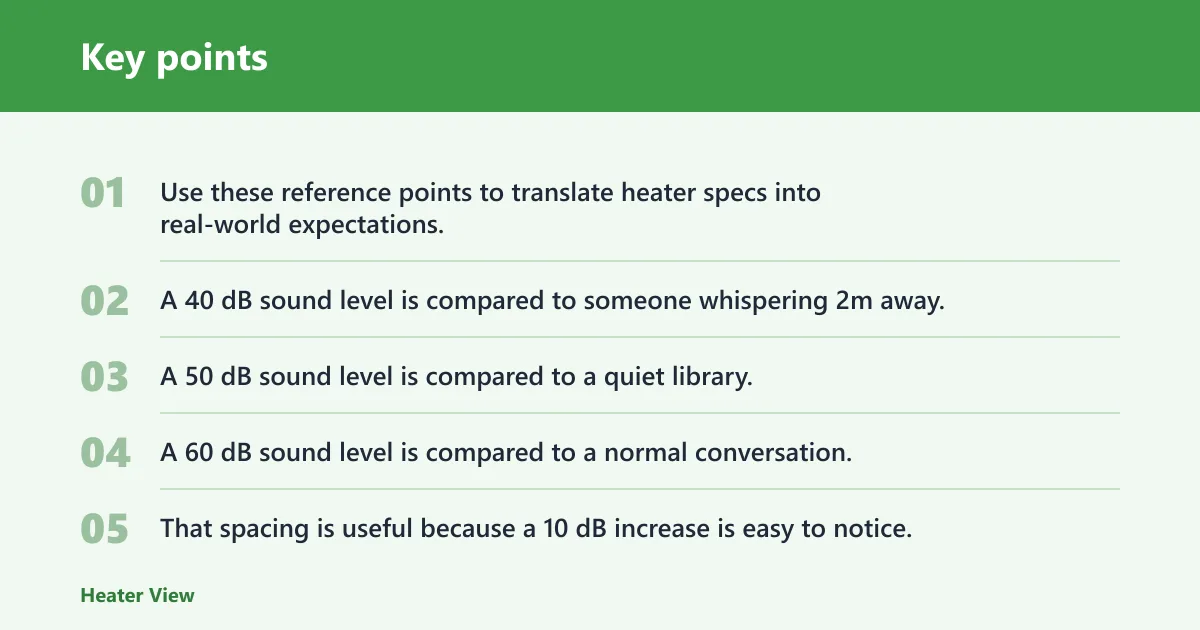
40 dB, 50 dB, and 60 dB compared
Use these reference points to translate heater specs into real-world expectations. A 40 dB sound level is compared to someone whispering 2m away. A 50 dB sound level is compared to a quiet library. A 60 dB sound level is compared to a normal conversation.
That spacing is useful because a 10 dB increase is easy to notice. A heater near 60 dB may still be acceptable for a garage, but it is no longer subtle if the room is otherwise quiet.
Whisper, quiet library, and normal conversation as reference points
Those examples help separate “quiet enough” from “barely there.” A whisper level may disappear under tool noise. A quiet-library level is noticeable but usually tolerable for a workspace. Normal conversation level often becomes the point where people start turning their heads toward the heater.
If a listing says 58 dB, expect something closer to a steady conversational background than to a nearly silent panel. That does not make it unusable; it just means you should expect to hear it.
How distance changes what you hear
Distance changes perceived noise fast. A heater mounted far from your bench will usually seem quieter than one hanging above the work area, even at the same rating. Reflections off concrete, metal doors, and bare walls can also make sound seem harder than the spec suggests.
Picture a 20-by-20-foot garage with a heater mounted over the door track. The same 50 dB unit will usually feel less intrusive near the far wall than right under the mounting point, especially when the fan first ramps up.
Are electric garage heaters quieter than gas heaters?
Often, yes, but not always. Electric heaters are frequently quieter than gas or propane heaters because they can avoid combustion noise, yet a fan-forced electric model can still be louder than a radiant gas unit. The fan, not the fuel label, often decides what you hear.
Fan-forced electric noise versus combustion noise
Electric heaters usually trade combustion noise for fan noise. That can be a good swap, because the sound is often a smoother hum rather than a burner-and-blower mix. Still, a high-output electric unit can be very audible when the fan runs hard.
Gas and propane heaters add burner and blower sounds together. That combination can make startup more noticeable, especially in a smaller attached garage where reflected sound has less room to dissipate.
When wattage and fan speed raise sound
Higher wattage often means more heat, but it can also mean more fan demand. On many electric garage heaters, noise rises with output because the fan needs to move more air to carry that heat away. A lower setting may be much easier to live with than full power.
The same idea applies to propane and natural gas forced-air units. More air movement usually means more sound, even if the fuel is not the loud part.
Where infrared and radiant electric models fit
Infrared and other radiant electric models sit near the quieter end because they often need less airflow. They do not heat a garage the same way a fan-forced unit does, so they tend to keep mechanical noise down. If your priority is conversation-friendly sound, they belong on the short list.
That said, quiet does not mean silent. Ignition clicks, relay changes, and occasional fan assistance can still be audible, especially in a small garage with hard surfaces.
Why forced air heaters usually sound louder
Forced air heaters usually sound louder because they use a blower to push hot air through the space. That fan sound is layered on top of combustion noise, so you hear both the source of heat and the movement of the heat. Fast warm-up is the tradeoff.
Combustion blower noise
The combustion blower is one of the main reasons forced-air models feel louder than radiant units. It helps manage the burn process and move heated air, but it also creates a steady mechanical sound that many garage owners notice right away.
Circulation fan noise
The circulation fan adds another layer. Even if the burner itself is quiet, the fan can create a breeze-like hiss or hum that becomes obvious in a small workspace. That is why two heaters with similar heat output can sound very different.
Fast heat-up versus sound tradeoff
If you need the garage warm quickly before a short project, forced air can make sense. If you want the least noise during long sessions, radiant or infrared units usually fit better. The right choice depends on whether speed or quiet matters more to you.
How quiet is a wall-mounted garage heater?
Wall-mounted garage heaters can be quiet, but wall mounting does not remove noise by itself. It changes how vibration travels through the structure. A well-mounted unit can feel restrained; a poorly mounted one can broadcast a low buzz across the wall and into the room.
Wall and ceiling mounting effects
Wall and ceiling mounting can reduce floor clutter and keep the heater away from tool traffic, but the mount also becomes part of the sound path. If the bracket is rigid and the cabinet vibrates, the structure can carry that vibration farther than expected.
Vibration transfer and bracket quality
Bracket quality matters because loose hardware, thin sheet metal, or a flexible mounting point can amplify sound. A heater may be listed at a respectable dB level and still feel louder if the vibration is transferred into framing members or metal panels.
That is why user reviews about “rattling,” “buzzing,” or “hum through the wall” are worth reading. Those complaints often point to mounting and vibration, not just the heater design.
Why installation details affect perceived noise
Small installation choices change the sound picture. Tight fasteners, solid backing, and proper clearances can keep the cabinet from resonating. In contrast, a heater installed on a thin or poorly supported surface may sound louder than its spec sheet suggests.
For a detached workshop, that may be an annoyance. For an attached garage, it can be enough to reach living spaces nearby.
What to expect from a 5000 watt electric heater
A 5000 watt electric garage heater is a common high-output choice, especially where you want plug-in or hardwired heat without combustion. Many models offer 3,000 / 4,000 / 5,000 W settings, so the noise level can shift with the selected output rather than staying fixed.
Common 3k, 4k, and 5k watt settings
Three heat levels let you match sound to the job. Lower settings usually mean less fan demand and less noise. Full output is where the heater is most likely to reach its advertised sound level and become more noticeable in the room.
Typical low-noise claims and what they mean
Some 5000W units list noise around 58 dB. That is close to the loud end of a conversation and clearly audible in a quiet garage. It is still manageable for many users, but it is not the same as a nearly silent radiant panel.
One common specification set also includes ETL certification and overheat protection. Those are safety features, not noise features, but they matter because a higher-output heater should still be protected against runaway temperature conditions.
Overheat protection and ETL certification in context
ETL certification and overheat protection do not make a heater quiet. They do tell you the unit has been built with basic safety controls in mind. If you are comparing two 5000W units, treat the noise spec and safety spec as separate checks, not substitutes for each other.
- Decide whether you want speed or quiet first.
- Check the noise range, not just the heater fuel.
- Look for fan size, blower design, and mounting method.
- Separate startup noise from steady running noise.
- For gas or propane, plan for a carbon monoxide detector.
If you are choosing for a detached workshop, a slightly louder fan may be acceptable because background sound is less intrusive. In an attached garage, lower startup noise and less vibration usually matter more because sound carries into the house.
Frequently asked questions
Are propane garage heaters noisy?
They can be, but the answer depends on whether the heater is radiant or forced air. Propane radiant models are usually quieter than fan-assisted units, while propane forced-air heaters add blower and airflow noise. In a small garage, ignition and cycling can be easier to notice than in a detached workshop.
What does 50 dB sound like for a garage heater?
Fifty decibels is about a quiet library. In a garage, that usually means the heater is clearly audible but still compatible with normal work. You can talk over it, though it may be distracting during quiet tasks or when the garage is otherwise empty.
Which garage heater type is quietest for a workshop?
Radiant and infrared models are usually the quietest choice because many have no fan. They heat more slowly than forced-air units, but they keep mechanical noise down. If fast warm-up matters more than silence, a fan-forced unit may still be the better fit.
What noise level should I expect from a 5000 watt garage heater?
Many 5000W electric heaters land in the upper midrange for noise, and some list operation around 58 dB. If the unit has multiple heat settings, the lower settings are often quieter. Expect a steady fan sound rather than silence, especially during startup and on full output.