Heater Goes on and Off at Night
Heaters cycle on and off more at night because outdoor temperatures drop, windows and ducts lose more heat, and thermostat settings or airflow problems can trigger shorter runs. Ignoring it can waste energy, leave rooms cold, and wear parts that should not restart every few minutes. This guide explains the nighttime causes, the conditions that make short cycling worse, and how to separate thermostat behavior from airflow restrictions and safety shutdowns.
Why heaters cycle more at night
Nighttime makes short cycling easier to spot because the house loses heat faster while the heater has less help from sun-warmed rooms. A thermostat setback can also create a bigger temperature swing, so the system starts more often and may stop sooner if airflow is weak or a safety device reacts.
Thermostat setback and temperature swing
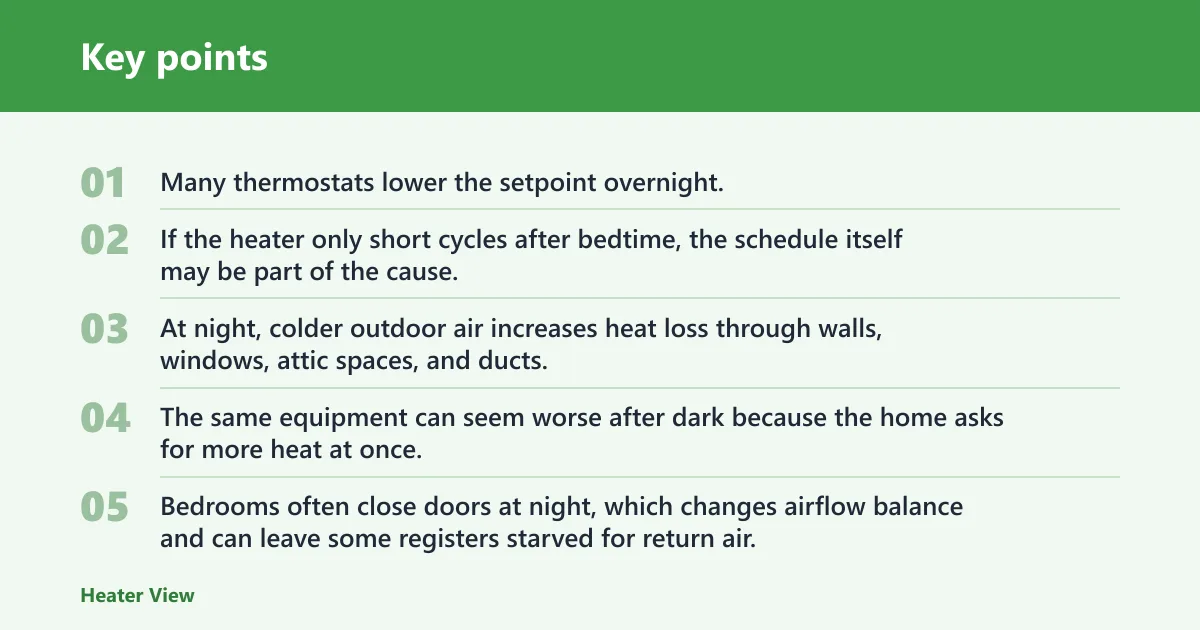
Many thermostats lower the setpoint overnight. That is normal, but a larger setback means the system must recover from a cooler room temperature in a shorter window, which can produce more starts and stops. If the heater only short cycles after bedtime, the schedule itself may be part of the cause.
Colder outdoor air and heat loss
At night, colder outdoor air increases heat loss through walls, windows, attic spaces, and ducts. Reduced solar gain also matters; rooms do not get the small daytime heat boost that can hide weak airflow or an oversized furnace. The same equipment can seem worse after dark because the home asks for more heat at once.
Drafts, ducts, and bedroom zones
Drafts near windows, exterior doors, attic hatches, and leaky ducts can make one area cool faster than the rest of the home. Bedrooms often close doors at night, which changes airflow balance and can leave some registers starved for return air. That shift can make nighttime cycling look more severe even when the furnace fault is unchanged.
Short cycling and what it means
Short cycling means the heater starts and stops too often. In problem cases, cycles are often under about 5 to 10 minutes. That pattern is not the same as a long run that simply ends when the setpoint is reached, and it is not the same as a single safety shutdown after a fault.
Burner cycling versus full-system cycling
Burner cycling means the burners shut off while the blower may keep running to clear heat from the heat exchanger. Full-system cycling means the entire heating sequence drops out, then restarts from the beginning. Distinguishing those two tells you whether the issue is more likely flame sensing, a high-limit trip, thermostat logic, or a control board fault.
Cycle length clues that matter
Very short cycles often point to a safety or control problem. A burner that lights for a few seconds and shuts off suggests flame sensor trouble or a control board that is not seeing proof of flame. A unit that runs for several minutes, then shuts down and restarts after a cooling pause can point to overheating, airflow restriction, or a high-limit switch opening.
Common causes behind frequent starts and stops
Typical causes include thermostat problems, airflow restriction from a clogged filter, a dirty flame sensor, a high-limit switch opening on overheating, and an oversized furnace that heats the space too fast. Blower motor trouble and control board faults can also break the sequence. Nighttime conditions can make each of those faults more obvious.
Thermostat settings to check first
Yes, thermostat settings can make a heater cycle overnight. Schedule changes, placement, battery status, and calibration all affect how long the unit runs and how often it starts again. On older controls, heat anticipator or cycle-rate settings can also change the pattern.
Schedule changes overnight
A lower nighttime setpoint is common, but a thermostat that drops too far and then asks for a quick recovery can shorten run times. Some smart thermostats also use adaptive logic that changes cycle timing. If the heater only acts up after bedtime, compare the evening setback to the morning recovery period.
Placement, batteries, and calibration
Thermostats mounted near drafts, vents, windows, lamps, or direct sunlight can read the room incorrectly. Weak batteries can cause erratic control, and a thermostat that reads off by a few degrees can start and stop the system too often. If the display and room feel disagree, placement or calibration deserves attention.
Heat anticipator and cycle-rate settings
Older thermostats may have a heat anticipator or cycle-rate setting that changes how early the thermostat stops a call for heat. If that setting is off, the heater may short cycle or overshoot. Newer smart thermostats usually handle this internally, but the setting still matters on older controls.
- Check the overnight schedule. Compare the bedtime setpoint with the wake-up setpoint. A large setback can make the system recover in bursts, especially when outdoor temperatures fall fast after sunset.
- Inspect thermostat placement. Look for nearby supply vents, cold drafts, exterior doors, windows, or heat sources such as lamps. A bad location can make the thermostat shut the heater off before the rest of the home is warm.
- Replace weak batteries. If the thermostat uses batteries, swap them before judging the furnace. Low battery voltage can cause missed calls for heat or odd cycling behavior.
Air filter and airflow problems
A dirty air filter can restrict airflow and may trip the high-limit switch. MERV rating matters because tighter filters can reduce airflow if the system was not set up for them. If the heater runs longer during the day but short cycles at night, limited airflow may be part of the reason.
How a clogged filter can trigger overheating
Restricted airflow keeps heat in the exchanger longer, which raises temperature and can open the high-limit switch. That safety device stops the burner when the heat exchanger gets too hot. After the unit cools, it often resets and starts again, which creates a repeating night pattern.
MERV rating and airflow tradeoffs
Higher MERV ratings capture smaller particles, but they can also increase resistance to airflow. A filter that is too restrictive for the furnace and duct system can cause the blower to move less air than the heat output needs. Most homes need filter replacement every 1 to 3 months, depending on dust, pets, and runtime.
Vents, registers, and blocked returns
Closed or blocked vents can add to the problem, but return-air blockage matters too. A sofa pushed over a return grille or a closed bedroom door can reduce circulation enough to trigger overheating protection. Nighttime makes these issues easier to see because occupied rooms often have different door and vent patterns than daytime rooms.
- Replace the filter first. Install the correct size and keep the airflow arrow pointed toward the furnace. If the filter is visibly dirty or overdue, change it before testing anything else.
- Open blocked air paths. Make sure supply registers and return grilles are unobstructed. Restore normal airflow through bedrooms and hallways so the blower can move heat out of the unit.
- Match the filter to the system. If a very tight filter was added recently, step back to a less restrictive option that still protects indoor air quality. A filter that chokes airflow can create repeated high-limit trips.
High-limit switch and flame sensor issues
Could the furnace limit switch be tripping at night? Yes. A high-limit switch opens when the heat exchanger gets too hot, usually because airflow is low or the blower is not moving enough air. A flame sensor problem looks different: the burners light, then shut off a few seconds later.
What a high-limit trip looks like
A high-limit trip often produces burner shutdown with the blower still running for a while. After cooling, the furnace may relight. If that cycle repeats at night, look first at filter restriction, blocked returns, or weak blower airflow before assuming the switch itself is bad.
Why burners shut off after a few seconds
When the flame sensor cannot confirm burner flame, the control board shuts off gas for safety. The symptom is usually brief ignition followed by shutdown within a few seconds. That is burner cycling, not a room-temperature problem, and it often points to a dirty or failing flame sensor, a grounding issue, or a control board that misreads the signal.
How the control board may react
The control board interprets thermostat calls and safety inputs. It can interrupt the sequence, lock out heating after repeated faults, or store fault codes that help identify the failure. If the board is seeing a limit trip or flame failure, the nighttime cycle pattern may repeat until the underlying fault is corrected.
Suppose the burners light for 4 seconds, then stop, while the blower never really gets into a steady heating run. That pattern points more toward flame sensing or control-board response than toward a dirty filter. If the blower keeps running after shutdown, the system is reacting to a safety event, not simply reaching room temperature.
Blower motor and oversizing problems
Weak blower airflow can shorten burner runs because the furnace may overheat and the high-limit switch can open. An oversized furnace can also short cycle because it produces heat faster than the home can absorb it. Both problems can look worse after bedtime, when cooler rooms and tighter bedroom zoning change how the system breathes.
Weak blower airflow
A worn blower motor, failing capacitor, or bad speed setting can reduce airflow across the heat exchanger. The furnace then heats too fast internally and trips on temperature before the rooms are satisfied. If the blower sounds weak, starts slowly, or seems to change speed, airflow across the furnace deserves close attention.
Capacitor, speed, and control board issues
On some systems, the blower motor depends on a capacitor or control board signal to start and maintain proper speed. If those parts are failing, airflow can drop enough to cause repeated overheating protection. That kind of fault often shows up as irregular fan behavior, not just one bad cycle.
Why an oversized furnace short cycles
An oversized furnace heats the air in the system faster than the home can absorb it, so the thermostat satisfies quickly and the unit shuts down. The result is frequent starts, short cycles, and uneven room temperatures. Nighttime setbacks can make the problem more obvious because the system keeps overshooting small room demands.
Suppose a bedroom heater is programmed to cycle off after a few minutes and then restart when the room drops below the set temperature overnight. If the furnace is oversized, it may blast the space back to setpoint in a few short bursts, then shut off, then restart after only a small temperature drop. That pattern is inefficient, and it can leave upstairs rooms warmer than downstairs rooms.
Heater goes diagnostic table
This table helps separate thermostat-driven cycling from airflow problems and safety shutdowns. Use the shortest description that matches what you see, then start with the safest check.
| Observed symptom | Likely cause category | First safe check |
|---|---|---|
| Cycle length under 5 minutes; only after bedtime setback | Thermostat logic or placement | Compare setpoint schedule, battery status, and thermostat location |
| Burners light, then shut off in a few seconds | Flame sensor or control board | Look for repeated ignition failure codes and note whether the blower keeps running |
| Burner stops, blower keeps running, then the unit relights after cooling | High-limit switch or airflow restriction | Check the air filter, returns, and closed or blocked vents |
| Blower sounds weak or uneven; cycle time shortens at night | Blower motor or capacitor issue | Confirm the filter is clean and listen for slow startup or speed changes |
| Frequent starts and stops in multiple rooms, with uneven temperatures | Oversized furnace or duct balance problem | Check for large temperature swings between rooms and repeated short runs |
| Fault light or error code appears after repeated cycling | Control board safety lockout | Record the code, then shut down the system if it repeats |
Decision checklist for nightly cycling
Use this sequence to separate thermostat, airflow, and safety-switch faults. It keeps you from swapping parts too early and helps you spot the pattern that matches the symptom.
- Match the timing. If the problem appears only after thermostat setback, start with schedule, placement, and battery checks. If it happens at any time, move quickly to airflow and safety checks.
- Watch the blower. If the blower keeps running after the burners stop, think high-limit trip or overheating. If the whole unit shuts off and restarts from scratch, think control board, thermostat, or flame sensing.
- Check the flame pattern. If the burners light and then quit within seconds, focus on flame sensor, ignition, or control-board response. That is different from a room that simply reaches setpoint.
- Inspect airflow first. Replace the filter, open blocked returns, and clear closed vents before assuming a major part failure. Low airflow is one of the fastest ways to trigger nighttime short cycling.
- Look for repeat lockouts. If the furnace keeps stopping with a fault code or needs repeated resets, shut it down and arrange professional service. Repeated safety trips are not a normal operating pattern.
Frequently asked questions
Why does my heater keep turning on and off?
Repeated on-off behavior usually means short cycling. Common causes include a thermostat that is set too close to room temperature, restricted airflow from a dirty filter, a flame sensor problem, a high-limit trip, or an oversized furnace. If the cycle length is often under 5 to 10 minutes, the pattern deserves attention.
Why does my heater go on and off at night?
Nighttime can expose the problem because the house loses heat faster, thermostat setbacks create a larger recovery swing, and drafts or duct leaks become more noticeable. Reduced solar gain also removes daytime heat help. That combination can turn a mild issue into repeated short cycles after bedtime.
Is it normal for a heater to short cycle after bedtime?
No. Some increase in runtime after a setback is normal, but frequent starts and stops are not. If the heater runs for only a few minutes at a time or keeps relighting after shutdown, something in the thermostat, airflow, or safety system is likely interrupting normal operation.
Can thermostat settings make a heater cycle overnight?
Yes. A large overnight setback, poor thermostat placement, weak batteries, or incorrect cycle-rate settings on older controls can all shorten runs or trigger extra starts. If the issue appears only after bedtime, thermostat logic is one of the first things to check.
Does a dirty filter cause nighttime heater cycling?
Yes. A clogged filter can restrict airflow enough to raise furnace temperature and trip the high-limit switch. That often causes the burners to stop while the blower keeps running, then the unit relights after cooling. Filter checks are a fast first step, especially if the filter is overdue.
When is on-and-off cycling a sign of a dangerous heater problem?
Repeated shutdowns with fault codes, a fuel smell, visible scorching, or a furnace that keeps locking out after a safety trip need prompt professional attention. If the burners light and quit in seconds, or the high-limit switch keeps opening, shut the system down and arrange an HVAC inspection.