How Long Heater Repairs Usually Take
Most heater repairs often take about 1 to 3 hours. Simple fixes can finish in under an hour, while failed motors, controls, or heat exchangers can turn the job into a day or more. Delays can leave you without heat, add labor charges, emergency fees, or force a second visit. This guide breaks down heater repair timelines by fault type and shows what keeps a visit same-day versus a parts-order or replacement job.
Heater repair timeline matrix


| Symptom | Likely failed part | Diagnostic time | Typical repair time | Delay risk | Usual timing |
|---|---|---|---|---|---|
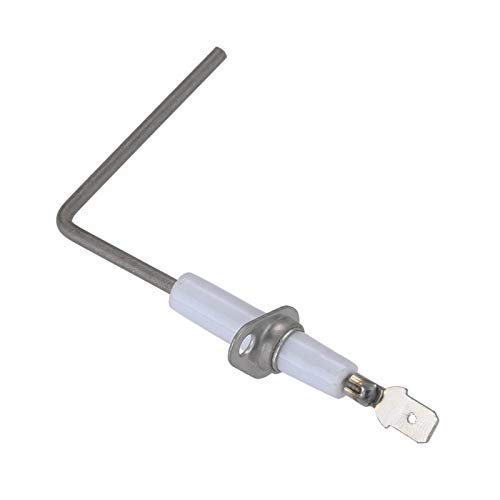
| No heat, unit clicks or tries to start | Igniter | 15 to 30 minutes | 30 to 60 minutes | Low if the correct part is on the truck | Same-day |
| Heat starts, then shuts off fast | Flame sensor | 15 to 25 minutes | 20 to 45 minutes for cleaning, 30 to 60 minutes for replacement | Low | Same-day |
| Wrong temperature, short cycling, no response to setting changes | Thermostat or wiring | 20 to 40 minutes | 20 to 90 minutes | Low to moderate if wiring or compatibility is unclear | Same-day |
| Blower runs weakly, loudly, or not at all | Blower motor | 30 to 60 minutes | 1 to 3 hours | Moderate to high if the motor must be ordered | Same-day or next-day |
| Error code, random shutdowns, dead control, locked out system | Control board | 30 to 60 minutes | 1 to 2 hours after the part arrives | High because boards are often special-order items | Next-day or multi-day |
| Cracked heat exchanger, soot, combustion concern, carbon monoxide alarm | Heat exchanger | 45 to 90 minutes | Repair is often not practical; replacement may take 4 to 8 hours or more | Very high due to safety shutdown and inspection needs | Multi-day |
Diagnostic time and repair time are separate parts of the visit. A technician may spend 20 to 45 minutes finding the fault, then another hour replacing the part, or stop after diagnosis if the part is unavailable or the system is unsafe to run.
How long does a heater diagnostic visit usually take?
A typical diagnostic visit takes about 20 to 60 minutes. The technician usually checks the thermostat call for heat first, then power supply, safety switches, error codes, ignition sequence, airflow, and visible wear. If the issue points to a safety fault or a part not on the truck, diagnosis may end the visit.
What the technician checks first
The first checks are simple and fast: thermostat settings, breaker position, filter restriction, shutoff switches, and whether the system responds at all. From there, the inspection moves to ignition, flame sensing, blower operation, and control signals. Those steps often narrow the problem before any parts come out.
When diagnosis is separate from repair
Diagnosis becomes a separate visit when the needed part is not stocked, when the system needs a board or motor matched by exact model number, or when safety concerns require shutdown. In those cases, the first visit identifies the fault and the second visit completes the repair after parts arrive.
When the visit ends with a parts order
That happens most often with control boards, blower motors, and some specialty ignition modules. Older systems can add more delay because the exact part may be discontinued, superseded, or available only through a distributor. A clear model number shortens this step.
How long do common heater repairs take?
Common heater repairs usually take 20 minutes to 3 hours once the fault is known. Igniters and flame sensors are often quick-service jobs. Motors and control boards usually take longer because of access, testing, and part matching. Heat exchanger problems often change the job from repair to replacement.
Igniter repairs
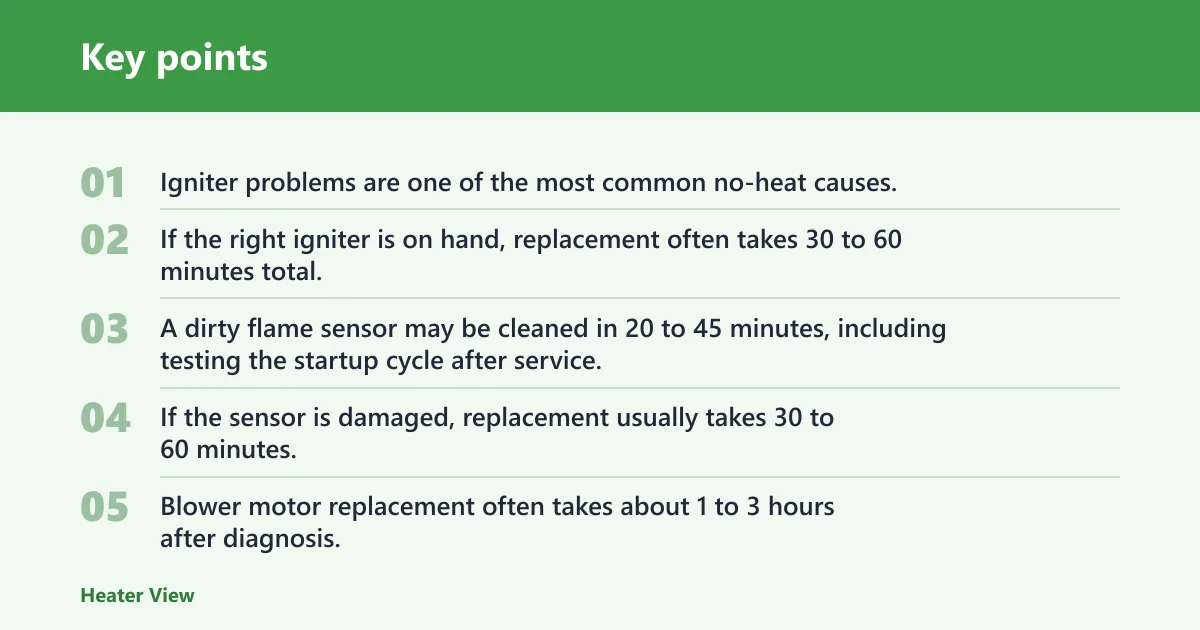
Igniter problems are one of the most common no-heat causes. A technician usually tests the igniter before replacing it, because the issue can also be a bad flame signal, weak voltage, or a control fault. If the right igniter is on hand, replacement often takes 30 to 60 minutes total.
Flame sensor cleaning or replacement
A dirty flame sensor may be cleaned in 20 to 45 minutes, including testing the startup cycle after service. If the sensor is damaged, replacement usually takes 30 to 60 minutes. This is a quick-service scenario when the furnace lights and then shuts down soon after.
Thermostat wiring or compatibility fixes
Thermostat issues can be fast if the problem is loose wiring, dead batteries, or a bad connection at the wall or control panel. If the thermostat is incompatible with the furnace or heat pump setup, the job can take longer because the wiring must be traced and the replacement may need setup or configuration. Expect 20 to 90 minutes in many cases.
Blower motor replacement
Blower motor replacement often takes about 1 to 3 hours after diagnosis. The labor is more involved because the technician may need to remove panels, disconnect wiring, match the motor specs, and verify airflow after installation. If the motor is not in stock, the timeline shifts to next-day or later.
Control board replacement
Control boards can be deceptive. The diagnosis may take longer because a failed board can mimic thermostat, ignition, or safety-switch problems, and the replacement itself may require setup, dip-switch changes, or system-specific configuration. Once the correct board arrives, the physical swap often takes about 1 to 2 hours.
Heat exchanger problems
Heat exchanger issues are different because the problem is safety-related. Inspection can take about 45 to 90 minutes, and if the exchanger is cracked or suspected of leaking combustion gases, the system is usually shut down. That often leads to replacement rather than repair, or at minimum a second opinion and permit review.
What makes a heater repair take longer than expected?
Parts availability is the biggest reason a same-day visit turns into a multi-day job. OEM parts may fit exactly but be slower to source, while universal parts are sometimes available sooner but may not solve the issue. Seasonal demand, older equipment, and distributor stock limits all stretch the timeline.
Parts availability and shipping delays
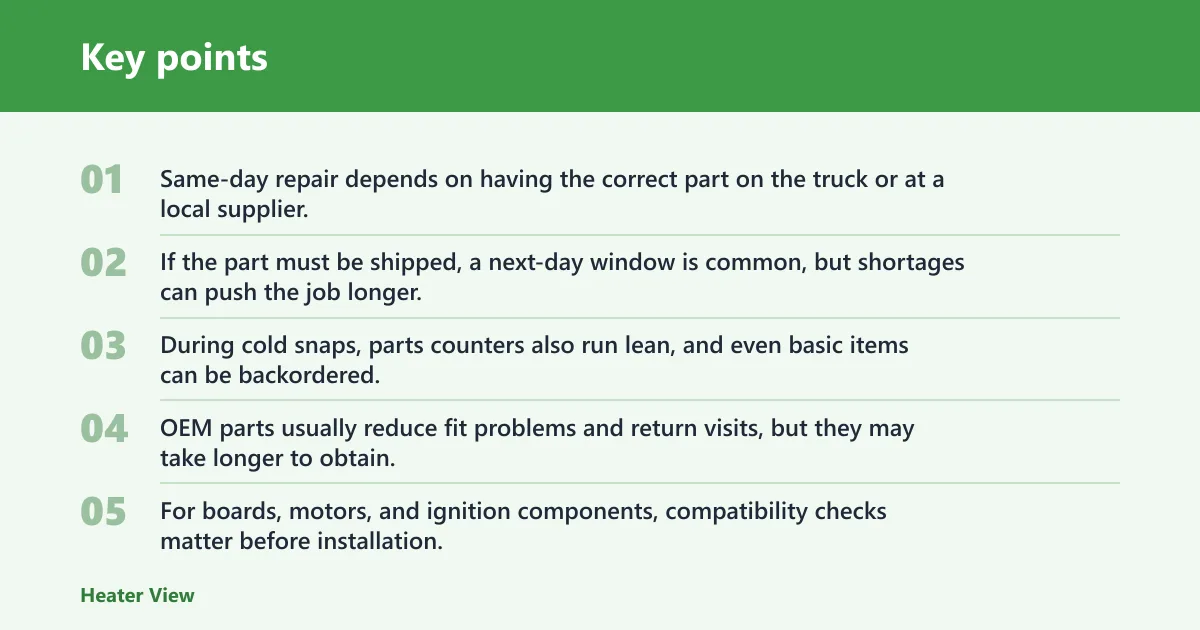
Same-day repair depends on having the correct part on the truck or at a local supplier. If the part must be shipped, a next-day window is common, but shortages can push the job longer. During cold snaps, parts counters also run lean, and even basic items can be backordered.
OEM versus universal parts
OEM parts usually reduce fit problems and return visits, but they may take longer to obtain. Universal parts can sometimes speed the job, though they still need to match voltage, airflow, size, and control requirements. For boards, motors, and ignition components, compatibility checks matter before installation.
Older systems and hard-to-find components
Older heaters often need discontinued boards, specialty motors, or exact-match sensors. When that happens, the repair can stop at diagnosis while the homeowner decides whether to wait, source a used part, or replace the system. The older the unit, the more likely the timing shifts beyond one day.
Seasonal demand and scheduling pressure
Cold-weather calls are prioritized, but that also means every crew is busy. Routine service can slide to later in the day, and non-emergency jobs may wait behind no-heat calls. If the problem is serious but the home still has partial heat, the visit may still be scheduled around emergency work.
Suppose a furnace starts, runs for two minutes, then shuts off with a flame-sense code. That is often a same-day cleaning or sensor swap if the part is available. If the same furnace needs a control board and the correct board must be ordered, the timeline changes even though the symptom looks similar at first.
When does a repair turn into a replacement?
A repair becomes a replacement when the system has a safety defect, repeated major failures, or a part that is no longer practical to source. Heat exchanger damage is the clearest example. Repeated motor or board failures can also push the decision toward replacement, especially on older equipment.
Safety issues tied to the heat exchanger
A cracked or suspected heat exchanger can stop the furnace immediately. The technician may need to document the issue, shut the unit down, and explain replacement options. That changes the job from a repair visit into a replacement plan, often with inspection requirements before the new system runs.
Repeated control board or motor failures
If the same major component has failed more than once, the wiring, airflow, voltage, or control logic may be contributing to the problem. At that point, replacement can be faster and more reliable than another repair. This is especially true when labor time starts stacking up against the age of the unit.
Permit or code inspection time
Replacement jobs can need permits or code inspection depending on the local jurisdiction. That can add time before the new unit is started or signed off. The schedule varies by area, so a replacement that sounds like a one-day job may stretch once inspection windows are included.
How long does replacement take?
Most standard heater replacements often take about 4 to 8 hours of labor once the equipment is on site. Straight swaps can finish the same day. If duct changes, venting changes, permit timing, or an inspection are involved, the job can extend into a second visit or a later start date.
Standard replacement timing
A straightforward replacement usually includes removal of the old unit, setting the new equipment, connecting gas or electrical lines, testing operation, and checking airflow and safety controls. The work often fits in one day if access is clear and the new unit matches the existing setup closely.
How permits and inspections add time
Permits can require waiting before work starts, and inspections can add a pause before final startup approval. Local rules vary, so the same replacement may be finished the same day in one area and take longer in another. The calendar, not just the labor, sets the total timeline.
Emergency no-heat replacement cases
Emergency no-heat calls are prioritized, but after-hours labor can add cost and may limit what can be completed immediately. A temporary fix sometimes restores partial heat until the full replacement is scheduled. If the safety issue is severe, temporary operation may not be allowed at all.
What can speed up the visit?
Homeowners can shorten the visit by sharing the symptom pattern before the technician arrives. Give the model number, the error code if there is one, and whether the system fails at startup or shuts down after running. Clear access to the furnace, thermostat, and electrical panel also saves time.
-
Describe the symptom clearly.
Tell the dispatcher whether the system has no heat, short cycles, makes noise, or trips a safety code. That helps the technician bring likely parts and reduces guesswork on site. -
Have the model number ready.
The model and serial plate usually tells the technician which board, motor, igniter, or sensor matches the unit. That matters because similar-looking parts are often not interchangeable. -
Share the failure pattern.
Say whether the heater fails at startup, after a few minutes, or only on the first call of the day. Repeating patterns point to different faults and can save a return visit. -
Clear the work area.
Remove stored items near the furnace, water heater, or thermostat access point. A clear path helps the technician inspect panels, wiring, drains, and venting without wasting time.
A common first-timer mistake is reporting only “the heat is out.” A better description is “the furnace clicks, the igniter glows, then it shuts down after 30 seconds.” That single detail can separate an igniter problem from a flame-sensor or control-board issue.
Frequently asked questions
How long do heater repairs usually take?
Most heater repairs take 1 to 3 hours once the problem is known. Simple issues such as flame sensor cleaning or thermostat wiring can be faster, while blower motors and control boards usually take longer. If the part is not available, the repair can stretch into the next day or longer.
How long does it take to fix a heater igniter?
Fixing a heater igniter often takes 30 to 60 minutes total if the part is on hand. The technician usually tests the igniter first, because startup failure can also come from voltage issues or another control problem. A quick-swap job is common when the furnace lights but will not stay on.
How long does a blower motor replacement take?
A blower motor replacement usually takes 1 to 3 hours after diagnosis. The work involves access, electrical disconnection, removal, installation, and airflow checks. If the correct motor is not stocked locally, the total timeline becomes next-day or multi-day even though the labor itself is still a few hours.
How long does it take to replace a furnace control board?
Once the correct board arrives, replacement often takes 1 to 2 hours. The bigger delay is usually diagnosis and part sourcing, because board failures can mimic other problems and many boards are exact-match parts. Some units also need setup changes after installation before they run correctly.
How often should a heater be serviced?
A heater should usually be serviced once a year, often before the cold season starts. Annual service helps catch dirty sensors, airflow problems, loose wiring, and wear before they become no-heat calls. Regular service does not prevent every failure, but it can reduce surprise delays during peak season.