Water Heater Service Intervals by Heater Type
By: Editorial staff
Many tank water heaters need service about once a year; gas tanks in hard water often need attention about every 6 months, tankless units usually need descaling about once a year, and heat pump models need filter and condensate checks about every 3 to 6 months [1][2][3][4][5]. Skip the schedule and sediment builds up, efficiency drops, service life shortens, and repair bills can land without warning. This guide breaks service intervals down by heater type, water quality, and age, so you know when owner maintenance is enough and when to call a technician.
Water heater service intervals
Start with the heater type, then shorten the interval for hard water, heavy use, older equipment, or symptoms such as popping, slow recovery, or rusty water. Service means two different things: owner maintenance you can handle safely, and technician service that touches gas, combustion, refrigerant, electrical faults, or safety valves that do not behave normally [1][2][3][4][5].
Choose the right interval by heater type
| Heater type | Normal-water interval | Hard-water interval | Softened-water interval | Owner tasks | Pro-only tasks | Shorten interval if X |
|---|---|---|---|---|---|---|
| Storage tank, gas | Annual flush; annual TPR test; anode inspection every 3 to 5 years [1][2][6] | Flush every 6 to 12 months [1][2] | Keep annual flushing, but inspect the anode sooner because softened water can shorten replacement to about 2 years [2][6] | Drain a few gallons or full flush if safe; test the TPR valve; look for leaks, rust, and rusty water [1][2] | Venting and flue inspection; burner and combustion checks; corroded or blocked draft path [1][2] | Popping, rumbling, delayed recovery, rusty water, frequent TPR discharge, or visible corrosion [1][2][6] |
| Storage tank, electric | Annual flush; annual TPR test; thermostat and element checks every 3 to 5 years [1][2][6] | Flush every 6 to 12 months [1][2] | Keep annual flushing; check anode more often if the tank has one [2][6] | Flush sediment; test the TPR valve; monitor recovery time and breaker trips [1][2] | Thermostat, element, or wiring faults; persistent tripping; damaged insulation or terminals [1][6] | Popping sounds, slow heating, breaker trips, rusty water, or repeated lukewarm showers [1][2] |
| Tankless, gas | Descale every 6 to 12 months in hard water areas; inlet screen cleaning every 6 to 12 months [3][7][8] | Descale every 6 to 12 months, using manufacturer-approved descaling solution [3][7][8] | Often can stretch beyond hard-water timing, but follow the manual and scale symptoms [3][7] | Clean inlet screens; verify flow paths; watch for reduced output, error codes, or longer wait times [3][7] | Heat exchanger, gas train, combustion, condensate, error codes that return after cleaning [3][7][8] | Longer hot-water wait, low flow, mineral flakes in the screen, or scale-related fault codes [3][7] |
| Tankless, electric | Inlet screen cleaning every 6 to 12 months; descale based on water quality [3][7] | Descale every 6 to 12 months [3][7] | Often longer than hard-water timing, but do not skip descaling if flow drops [3][7] | Clean inlet screens; check for stable flow and consistent outlet temperature [3][7] | Heating element faults, sensor issues, repeated shutoff, leak paths [3][7] | Low flow, temperature swings, scale at fittings, or repeated shutoff [3][7] |
| Heat pump | Air filter cleaning every 60 to 90 days; annual professional refrigerant check [4][5] | Same schedule, plus closer condensate and tank scale checks [4][5] | Same schedule; softened water does not remove the need for filter care [4][5] | Clean the air filter; inspect the condensate drain; look for standing water or dust loading [4][5] | Refrigerant checks, compressor issues, condensate drain repair, sealed-system work [4][5] | Dusty location, longer run times, condensate blockage, or new noise from the compressor area [4][5] |
Use that table as the baseline, then adjust for age and water quality. A newer tank in good water can often stay on the annual plan, while an older tank in hard water usually needs the shorter end of the range because sediment and scale build faster [1][2][6].
How often should I service my water heater?
Most homeowners should plan at least one owner-maintenance visit every year, with more frequent checks for hard water, softened water, or high-demand homes. A tank model usually needs a flush and TPR valve test annually, while tankless and heat pump units need extra tasks on shorter cycles [1][2][3][4][5].
What changes with age and water quality
Age matters because scale, corrosion, and worn parts accumulate. A 10-year-old tank may need closer attention than a newer unit even if the model is the same, and hard water speeds sediment formation. Very hard water may justify shorter intervals [1][2][6].
Softened water changes the anode rod schedule. Magnesium and aluminum rods protect the tank, but softened water can shorten replacement intervals. That does not mean softened water is harmless; it means you should watch the sacrificial rod more closely, not less [2][6].
How often should a tank water heater be serviced?
Tank water heaters usually need service once a year, with a flush every 6 to 12 months and sooner in hard water. Gas and electric tanks share the sediment problem, but gas units add venting and flue checks, while electric units add thermostat and heating element checks instead of combustion work [1][2][6].
Gas tank units
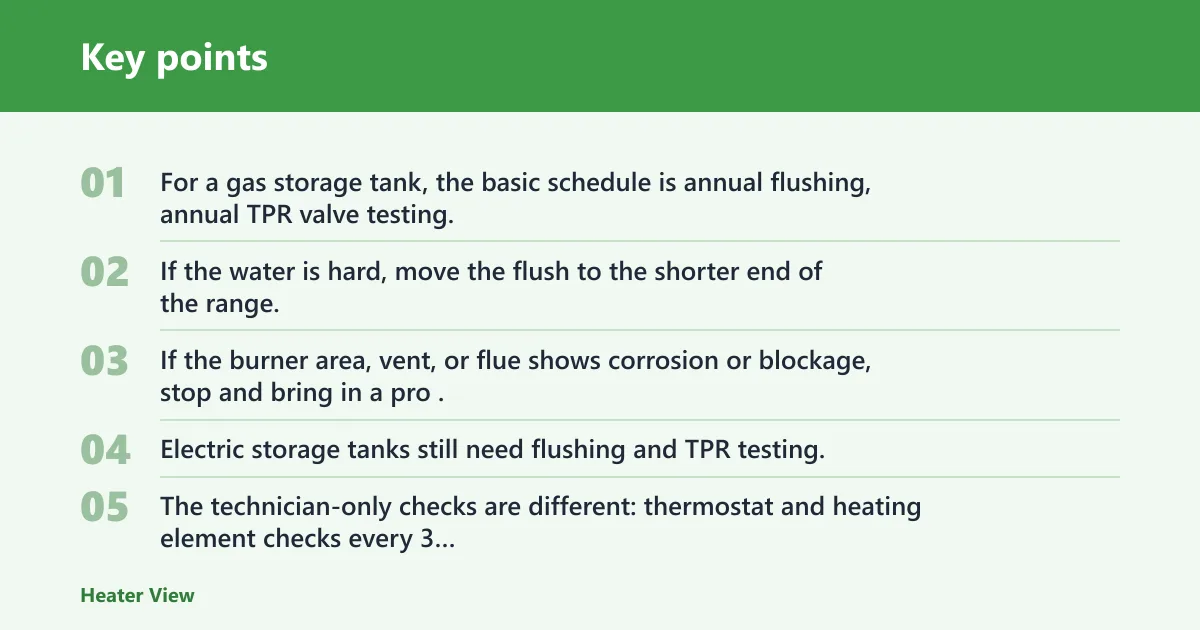
For a gas storage tank, the basic schedule is annual flushing, annual TPR valve testing, and anode rod inspection on a manufacturer- and water-dependent schedule [1][2][6]. If the water is hard, move the flush to the shorter end of the range. If the burner area, vent, or flue shows corrosion or blockage, stop and bring in a pro [1][2].
Electric tank units
Electric storage tanks still need flushing and TPR testing, but they do not need venting or combustion service. The technician-only checks are different: thermostat and heating element checks every 3 to 5 years, plus wiring and terminal inspection if the unit trips breakers, heats unevenly, or heats too slowly [1][6].
That distinction matters. Electric units can look “simple,” but the parts that fail are not the same as on gas models. If an electric tank starts making popping sounds, it often points to sediment on the bottom, not a gas or vent issue [1][2].
Sediment flush, TPR test, and anode rod checks
Annual maintenance for storage tank units includes flushing sediment. The TPR valve test is part of that same visit: confirm it discharges freely and closes without dripping. If the valve is corroded, stuck, or fails to reseat, replace it [1][2].
The anode rod is the tank’s corrosion target. Inspection intervals vary by manufacturer and water chemistry. Sediment, rusty water, or a tank that is older than average for its class are all reasons to shorten the interval [2][6].
How often should I service a tankless water heater?
Tankless water heaters usually need descaling every 6 to 12 months in hard water, plus inlet filter screen cleaning every 6 to 12 months. Use a manufacturer-approved descaling solution. If water is not hard and the unit sees modest use, you may stay closer to the longer end, but flow loss is a reason to move sooner [3][7][8].
Descaling intervals by water hardness
Hard water shortens the time between descales, and many units need service at 6-month intervals. Scale narrows passages and hurts heat transfer fast [3][7][8].
Gas and electric tankless units share the same scale problem, but gas units also need combustion and venting attention. If a gas tankless unit shows error codes tied to flame, airflow, or exhaust, cleaning alone may not solve it. That is pro work [3][7][8].
Inlet screen cleaning and pro-only steps
Clean the inlet filter screen on the schedule listed in the manual, often every 6 to 12 months. That small screen catches debris before it reaches the heat exchanger. If the screen keeps clogging, the plumbing upstream may need a pro inspection [3][7].
Suppose a tankless unit in hard water starts taking longer to deliver hot water to a shower. That points to scale or flow restriction, not a reason to wait until the next calendar year. Shorten the interval, clean the screen, and descale before the problem turns into a shutdown [3][7][8].
Heat pump water heater maintenance timing
Heat pump water heaters need more frequent filter care than standard tanks. Clean the air filter every 60 to 90 days, inspect the condensate drain, and schedule technician service if the unit shows error codes or performance problems. Hybrid heat pump water heaters are commonly serviced annually, but filter cleaning belongs on the homeowner calendar [4][5].
Air filter cleaning schedule
The air filter is the part most homeowners can and should handle. Dust buildup reduces airflow and hurts performance, so cleaning every 60 to 90 days is a practical baseline. In a dusty utility room, that interval may need to move shorter [4][5].
Condensate drain checks
Check the condensate drain for blockage, standing water, or signs of algae growth. A blocked drain can trigger shutdowns or leaks around the base. If the drain needs clearing beyond a simple rinse, call a technician rather than forcing it [4][5].
Annual refrigerant service
Refrigerant work is technician-only. If the unit is running longer than usual, showing error codes, or making new noises, do not treat that as a filter-only issue [4][5].
Service interval decision table
Use the master table below after you identify the heater type. If your water is hard, or if the unit is older than average, choose the shorter interval. If it is softened water, do not assume the schedule gets longer across the board; the anode rod can wear faster [1][2][3][4][5][6].
Shorten the interval if you notice these signs
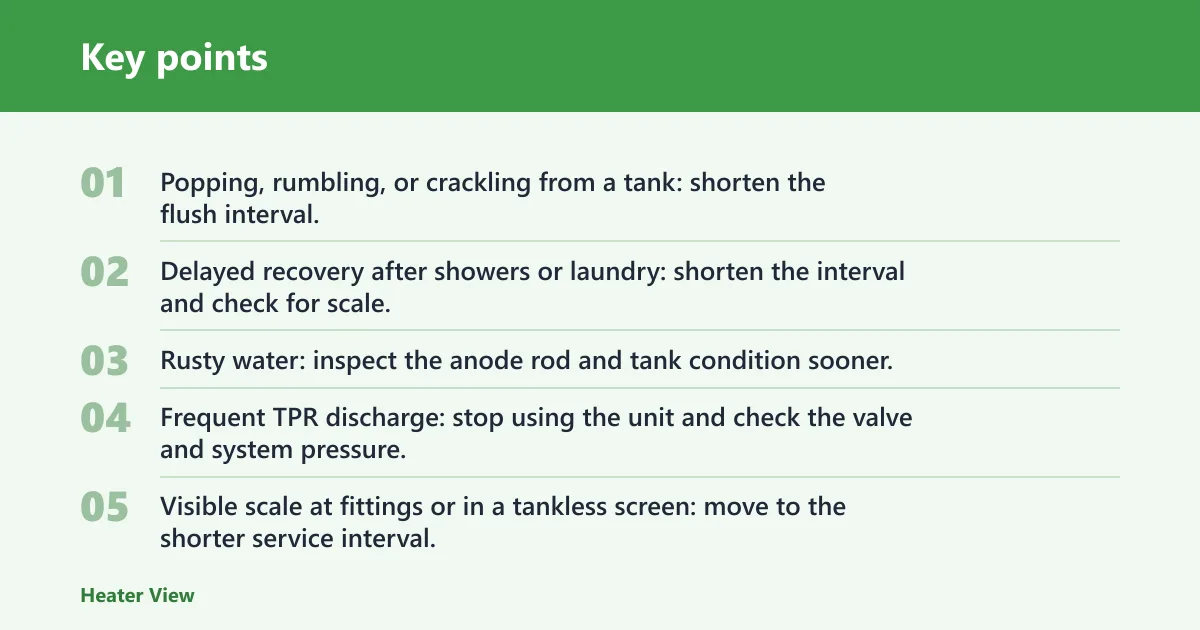
- Popping, rumbling, or crackling from a tank: shorten the flush interval.
- Delayed recovery after showers or laundry: shorten the interval and check for scale.
- Rusty water: inspect the anode rod and tank condition sooner.
- Frequent TPR discharge: stop using the unit and check the valve and system pressure.
- Visible scale at fittings or in a tankless screen: move to the shorter service interval.
- Breaker trips, error codes, or uneven heating: shorten the interval and call a pro if the fault repeats.
A common first-timer mistake is skipping annual flushing on a tank-style heater until sediment has already reduced its efficiency. By then, scale or corrosion has often been building for months. Shortening the interval after a warning sign usually costs less than replacing a failed component [1][2][6].
| Heater type | Normal-water interval | Hard-water interval | Softened-water interval | Owner tasks | Pro-only tasks | Shorten interval if X |
|---|---|---|---|---|---|---|
| Storage tank, gas | Annual flush; annual TPR test; anode inspection every 3 to 5 years [1][2][6] | Flush every 6 to 12 months [1][2] | Keep annual flushing, but inspect the anode sooner because softened water can shorten replacement to about 2 years [2][6] | Drain a few gallons or full flush if safe; test the TPR valve; look for leaks, rust, and rusty water [1][2] | Venting and flue inspection; burner and combustion checks; corroded or blocked draft path [1][2] | Popping, rumbling, delayed recovery, rusty water, frequent TPR discharge, or visible corrosion [1][2][6] |
| Storage tank, electric | Annual flush; annual TPR test; thermostat and element checks every 3 to 5 years [1][2][6] | Flush every 6 to 12 months [1][2] | Keep annual flushing; check anode more often if the tank has one [2][6] | Flush sediment; test the TPR valve; monitor recovery time and breaker trips [1][2] | Thermostat, element, or wiring faults; persistent tripping; damaged insulation or terminals [1][6] | Popping sounds, slow heating, breaker trips, rusty water, or repeated lukewarm showers [1][2] |
| Tankless, gas | Descale every 6 to 12 months; inlet screen cleaning every 6 to 12 months [3][7][8] | Descale every 6 to 12 months [3][7][8] | Often longer than hard-water timing, but follow the manual and scale symptoms [3][7] | Clean inlet screens; verify flow paths; watch for reduced output, error codes, or longer wait times [3][7] | Heat exchanger, gas train, combustion, condensate, error codes that return after cleaning [3][7][8] | Longer hot-water wait, low flow, mineral flakes in the screen, or scale-related fault codes [3][7] |
| Tankless, electric | Inlet screen cleaning every 6 to 12 months; descale based on water quality [3][7] | Descale every 6 to 12 months [3][7] | Often longer than hard-water timing, but do not skip descaling if flow drops [3][7] | Clean inlet screens; check for stable flow and consistent outlet temperature [3][7] | Heating element faults, sensor issues, repeated shutoff, leak paths [3][7] | Low flow, temperature swings, scale at fittings, or repeated shutoff [3][7] |
| Heat pump | Air filter cleaning every 60 to 90 days; annual refrigerant check [4][5] | Same schedule, with closer drain and scale checks [4][5] | Same schedule, with attention to anode wear if the tank has one [2][4][5] | Clean the air filter; inspect the condensate drain; look for standing water or dust loading [4][5] | Refrigerant, compressor, condensate drain repair [4][5] | Dusty location, longer run times, condensate blockage, or new noise from the compressor area [4][5] |
When should I call a professional?
Call a professional for any gas venting or flue problem, any TPR valve that will not discharge freely, corrosion around safety parts, repeated electrical faults, or refrigerant service on a heat pump unit. If a tankless or tank heater keeps failing after basic cleaning, the next step is diagnostic work, not another rinse [1][2][3][4][5].
Gas venting and flue problems
Gas-unit-specific inspection is not optional when the vent shows rust, gaps, poor draft, soot, or blockage. Those conditions can point to combustion problems or backdraft risk. Do not keep operating the heater while waiting for a better weekend [1][2].
TPR discharge, corrosion, and electrical faults
The TPR valve is a safety device, not a nuisance part. If it drips constantly, sticks, or fails the lift test, replace it. Corrosion at the valve, tank fitting, breaker, thermostat, or element is also a reason to bring in a technician [1][2][6].
Picture a 50-gallon electric tank set to 120°F in a family home with hard water. If it starts popping and recovery slows after showers, the fix is not just a thermostat tweak. The schedule should move to a shorter flush interval, with element and sediment checks next [1][2][6].
Frequently asked questions
How often should a tankless water heater be serviced?
Tankless water heaters should be descaled every 6 to 12 months in hard water areas, and their inlet filter screens should be cleaned every 6 to 12 months. If scale, low flow, or error codes show up sooner, shorten the interval and do not wait for the next annual date [3][7][8].
How often should a gas water heater be serviced?
A gas water heater should usually get annual maintenance, but the exact timing changes with sediment, water hardness, and age. Tank models need flushing and TPR testing, while gas-specific venting, draft, and combustion checks belong to a technician, especially if corrosion or blockage appears [1][2][6].
Does hard water change water heater service intervals?
Yes. Hard water speeds sediment and scale, so service intervals should move shorter. Very hard water often means more frequent flushing for tanks and more frequent descaling for tankless units, especially if output starts to drop [1][2][3][7][8].
When should I call a professional instead of doing it myself?
Call a professional for gas venting issues, repeated TPR discharge, corroded safety parts, electrical faults, refrigerant service, or any problem that returns after basic cleaning. Owner maintenance covers flushing, filter cleaning, and a simple TPR lift test; sealed systems, combustion, and failed safety parts do not [1][2][3][4][5].
Sources
- U.S. Department of Energy Energy Saver pages on water heating, tankless water heaters, and heat pump water heaters [1][4]
- EPA WaterSense guidance on water heating efficiency and maintenance considerations [2]
- Tankless OEM installation and operation manuals covering descaling, inlet screen cleaning, error-code, and maintenance schedules [3][7][8]
- Storage-tank OEM manuals covering flushing, TPR valve testing, anode-rod inspection, and thermostat/element maintenance [1][6]
- Heat pump water heater OEM manuals covering air filter cleaning, condensate drain care, and service guidance [4][5]