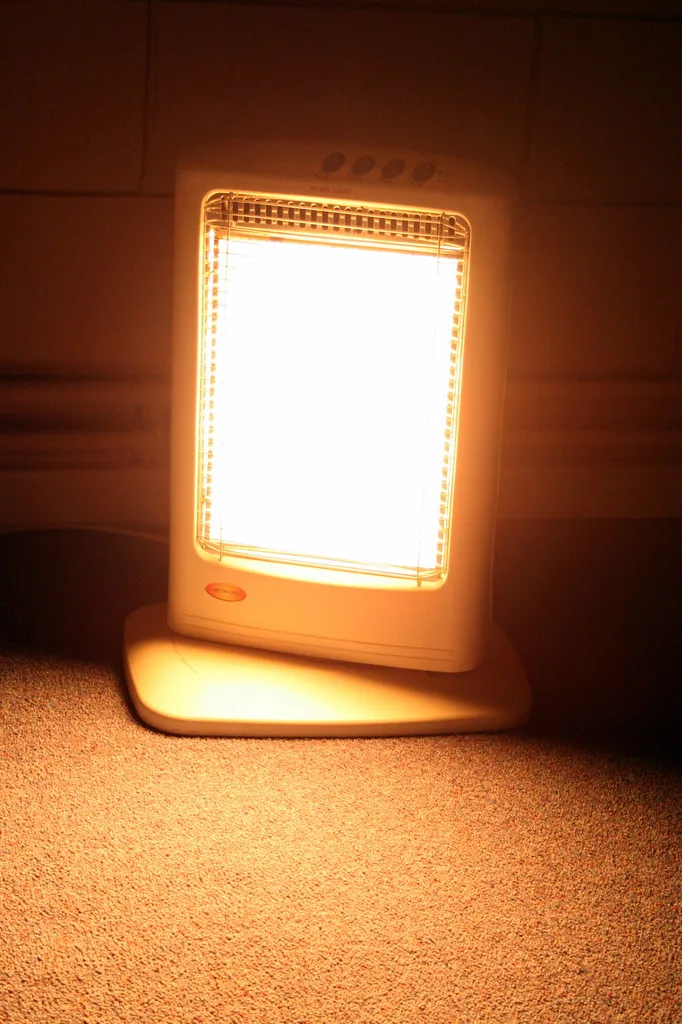
How to Use an Infrared Heater to Lower Heating Bills
Use an infrared heater to cut heating bills by warming one occupied room, keeping that room closed off, and setting the main thermostat 4 to 7°F lower while the unit runs. Used poorly, it can waste electricity and leave the furnace doing most of the work anyway. This guide covers placement, runtime, thermostat settings, and a simple cost calculation.
How infrared heat cuts bills

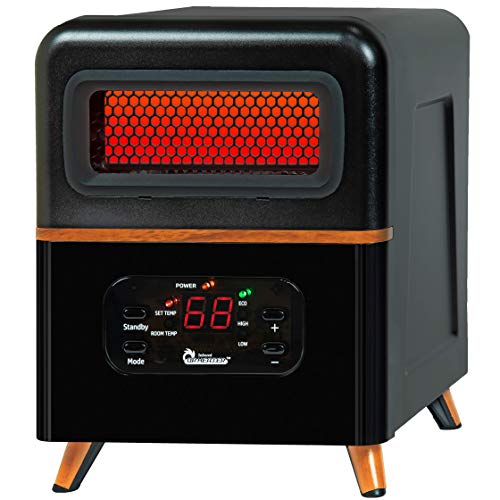

Infrared heaters warm people and objects directly, so they work best as zone heaters. The savings come from conditioning less space for fewer hours, not from making the air in every room equally warm. That is why the strategy pairs best with closed doors, lower central settings, and short, targeted runtime.
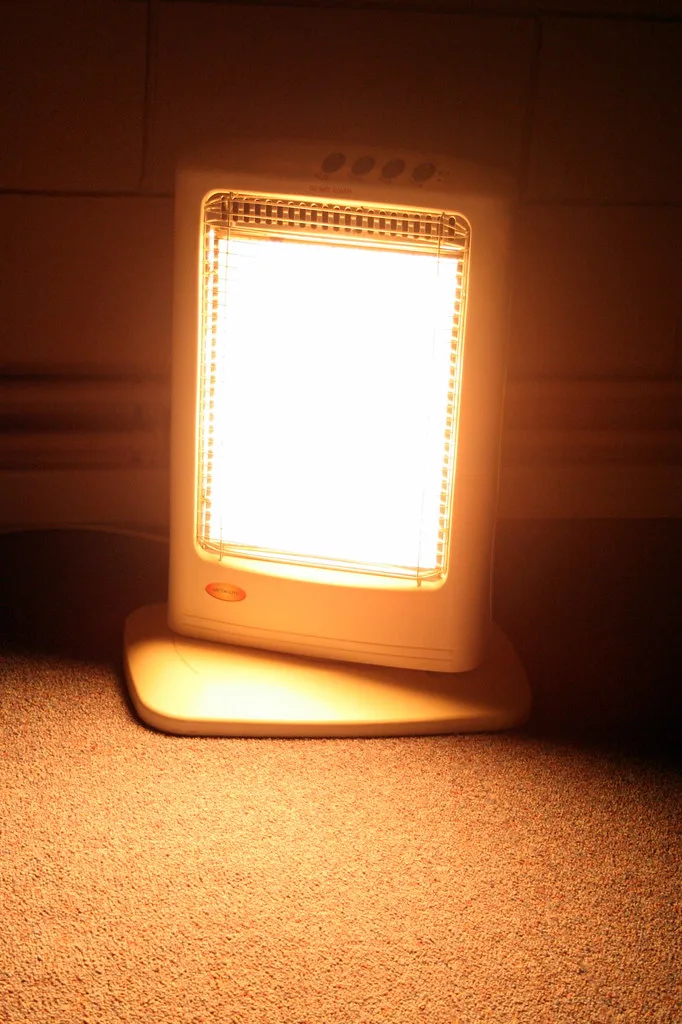
They come as portable, wall-mounted, panel, and tower units, with common electric inputs around 750W and 1500W. A 1500W heater on a standard 120V household circuit draws about 12.5 amps, which is near the practical limit for continuous use on a typical 15A circuit, and the hourly cost still follows the basic formula of watts converted to kW times your rate. The wattage on the nameplate and your electricity rate set the hourly cost, while a thermostat or timer can reduce waste by cycling instead of running nonstop. For more on the bill math, see the infrared heater effect on your electric bill.
What you need before you start
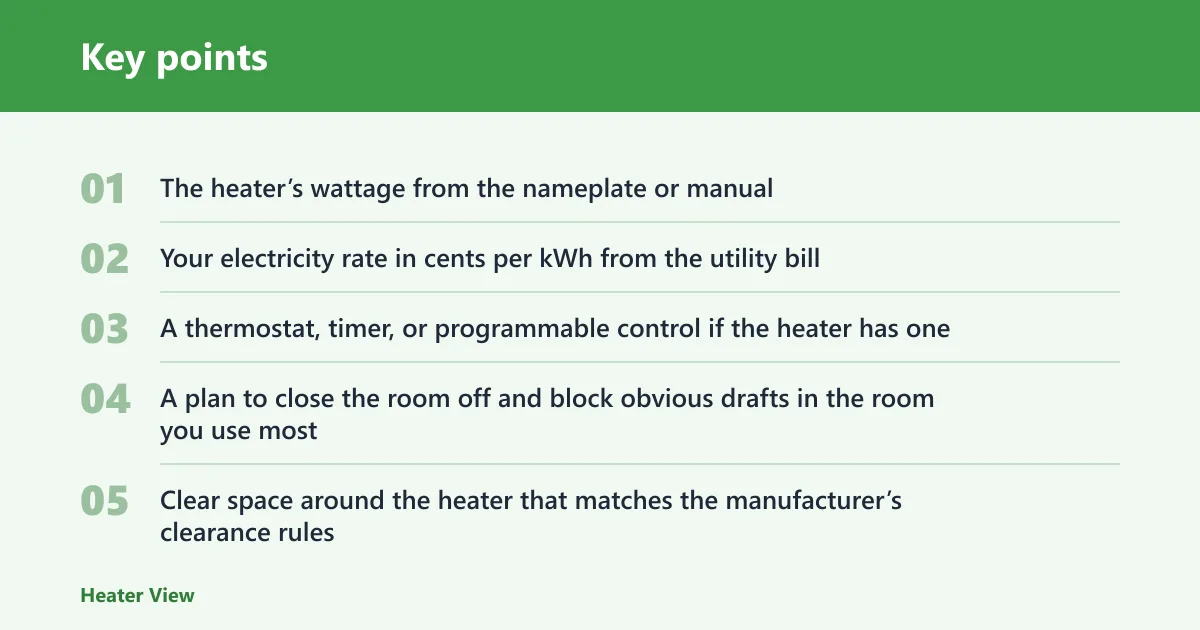
- The heater’s wattage from the nameplate or manual
- Your electricity rate in cents per kWh from the utility bill
- A thermostat, timer, or programmable control if the heater has one
- A plan to close the room off and block obvious drafts in the room you use most
- Clear space around the heater that matches the manufacturer’s clearance rules
Electricity use
An infrared heater’s electricity use is straightforward: watts tell you how much power it draws, and runtime tells you how much energy it uses. A 750W setting uses 0.75 kWh per hour, while a 1500W setting uses 1.5 kWh per hour. Multiply that by your local rate to estimate cost and compare it with the heat you are avoiding elsewhere.
How low should you set the thermostat?
Lower the central thermostat before you turn on the infrared heater, then raise comfort only in the room you are using. A 4 to 7°F drop is a practical target in many homes because government and utility guidance commonly recommends setbacks in that range for reducing heating demand while maintaining comfort in an occupied zone.
- Set the central thermostat about 4 to 7°F lower than the usual setting.
- Turn on the infrared heater only in the room you occupy.
- Use the heater’s thermostat, if available, to hold comfort without nonstop runtime.
- Check whether the furnace cycles less often after 30 to 60 minutes.
The thermostat matters because it controls how often the heater cycles. If the room stays comfortable at a lower setpoint on the main system, the furnace or boiler does less work. That is where the bill reduction usually comes from, especially when the room door stays shut and the rest of the house is allowed to drift cooler.
Where should you place the heater?
Place the heater so its output reaches the occupied zone, not a hallway or empty corner. Aim it toward the area where you sit, sleep, or work, and follow the manufacturer’s clearance from curtains, furniture, bedding, and anything else that can overheat. Manufacturer instructions often require several feet of clearance around the front and sides.
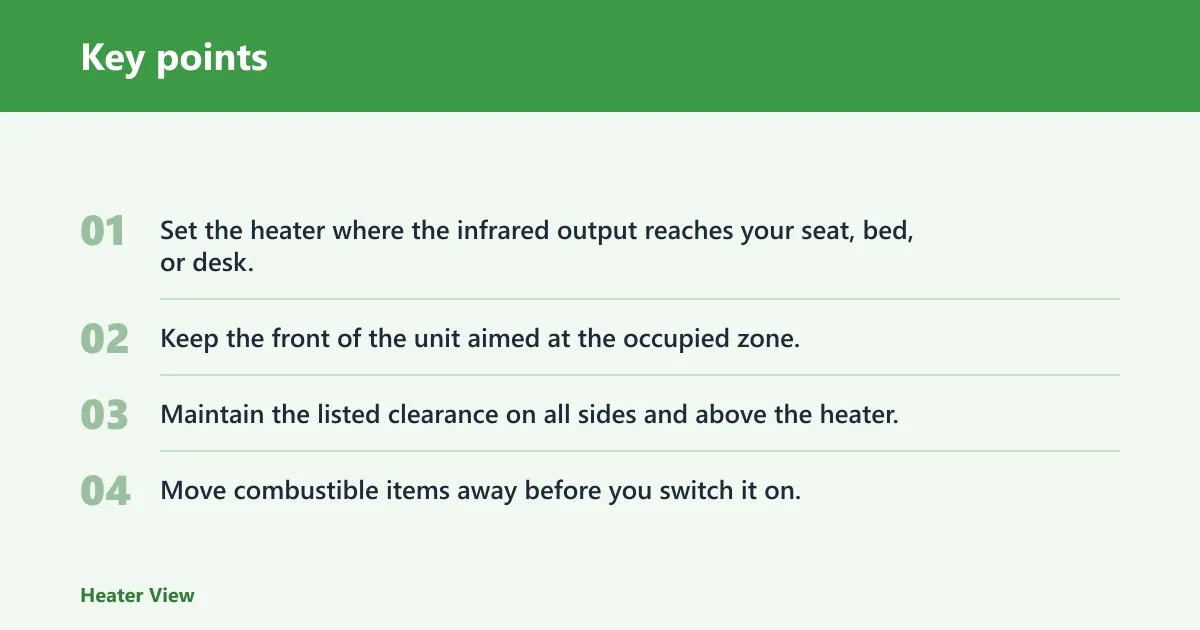
- Set the heater where the infrared output reaches your seat, bed, or desk.
- Keep the front of the unit aimed at the occupied zone.
- Maintain the listed clearance on all sides and above the heater.
- Move combustible items away before you switch it on.
Picture a 12-by-14-foot office with a desk near one wall. A wall-mounted or panel unit aimed across the desk area usually makes more sense than a unit pointed at the doorway. The goal is direct comfort where you stay still, not warmer air in the whole room, and the heater should never be placed where cords, drapes, or bedding can crowd the clearance zone.
Best placement
The best placement is usually the location that aligns the heater with the seated or sleeping zone while preserving all required clearances. For a desk, angle the unit across the work area; for a bed, position it so the beam reaches the body without facing fabric directly. Avoid corners and traffic paths that reduce effectiveness.
Safe sitting distance
There is no single safe sitting distance because manufacturers set different clearance and comfort ranges, but the right rule is simple: sit far enough away to stay outside the unit’s specified clearance and still feel even warmth. If the beam feels intense, move the chair back rather than moving the heater closer to combustible materials.
How do you run it without wasting power?
Use a timer for predictable routines, then let the thermostat cycle the heater instead of running continuously. Close the room off and keep the windows shut while it runs. Avoid heating spaces no one is using. Those three habits matter more than the brand or shape of the heater, especially when the room already holds warmth for a while.
- Program the heater to start 15 to 30 minutes before the room is used.
- Let the thermostat hold the room at the comfort target.
- Shut the door and keep the windows closed while it runs.
- Turn it off when the room is empty for the day.
Suppose a bedroom needs warmth only from 6:30 p.m. to 11:00 p.m. A timer can preheat the room, then a thermostat can cycle the unit after bedtime. That reduces unnecessary runtime and prevents the heater from running all night in an empty room, which is also consistent with utility advice to avoid unnecessary space-heater use when central heat can be set lower instead.
Hourly cost formula
Use this formula to estimate cost per hour:
Hourly cost = (wattage ÷ 1000) × electricity rate per kWh
If the heater is 1500W and the rate is 16 cents per kWh, the cost is about 1.5 × $0.16, or $0.24 per hour. A 750W setting at that rate costs about $0.12 per hour. That estimate is the starting point for comparing the heater with what the central system would otherwise spend.
Infrared heater savings worksheet
Use this text-only worksheet to decide whether the heater will lower total heating spend. Fill in your own rate and the rooms you actually occupy. A useful break-even example: if a 1500W heater costs about $0.24 per hour and your central heat would have cost about $0.40 per hour for the same occupied zone, then you save about $0.16 per hour before accounting for any additional house heating needs.
| Heater setting | Wattage | Rate example | Cost per hour | Cost for 4 hours |
|---|---|---|---|---|
| Low | 750W | 16¢/kWh | $0.12 | $0.48 |
| High | 1500W | 16¢/kWh | $0.24 | $0.96 |
| High | 1500W | 22¢/kWh | $0.33 | $1.32 |
Zone-heating break-even example
Compare the heater’s hourly cost with the central heat you are trying to avoid. If a 1500W infrared heater costs 24 cents per hour and keeping the whole home at the higher thermostat setting would have cost 40 cents per hour for that same period, zone heating wins. If the furnace already serves only that room, the benefit may disappear.
| Question | Yes | No | What it means |
|---|---|---|---|
| Can the room be closed off from the rest of the house? | Zone heating may win | Insulation or layout limits savings | Closed rooms keep the heat where it is needed |
| Does the room have obvious drafts or leakage? | Fix leaks first | Proceed with runtime planning | Air leaks can erase the cost advantage |
| Will the heater replace central heat for occupied hours? | Likely useful | May lose to central heat efficiency | It works best when it offsets whole-home heating |
| Is the room used only for short blocks of time? | Good fit | Continuous use may cost more | Short, predictable occupancy favors timers |
Room-by-room runtime plan
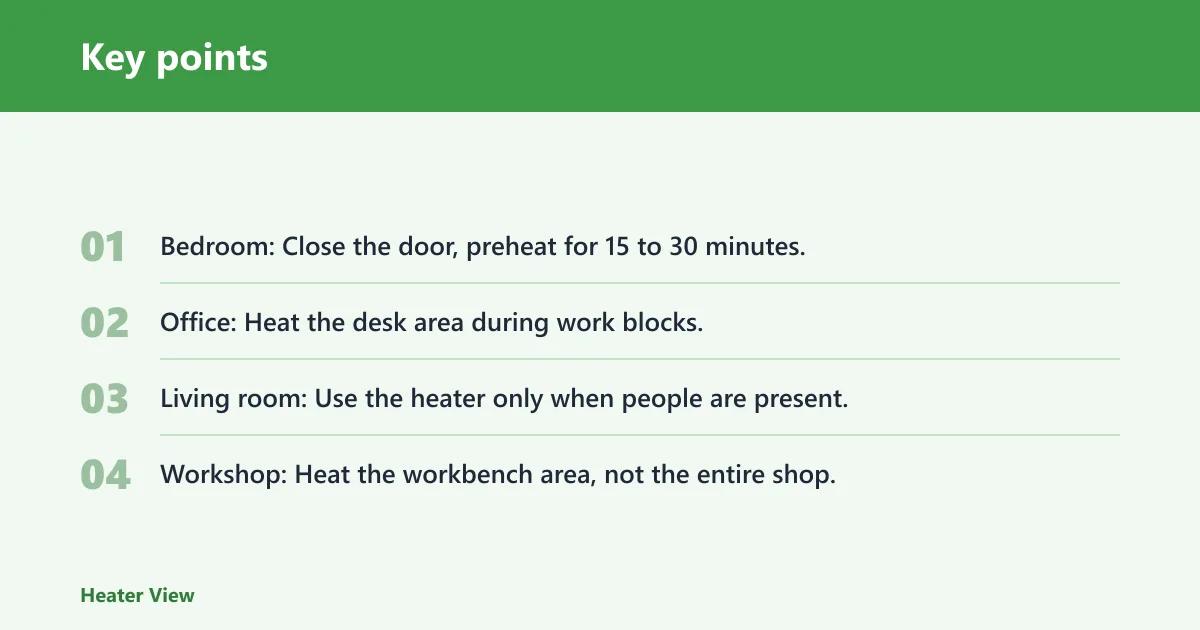
- Bedroom: Close the door, preheat for 15 to 30 minutes, then use the thermostat or timer for sleep hours only.
- Office: Heat the desk area during work blocks, and lower the central thermostat in the rest of the house.
- Living room: Use the heater only when people are present, with seating within the direct warmth zone.
- Workshop: Heat the workbench area, not the entire shop, and shut off the unit during long breaks.
Decision table: savings or fix first?
| Situation | Likely result | Best first move |
|---|---|---|
| Occupied bedroom or office, door closed, modest draft | Infrared heating can lower whole-home runtime | Use the heater with a 4 to 7°F thermostat drop |
| Drafty room with window gaps or door leakage | Savings may be weak or disappear | Add weatherstripping, curtains, or seal leaks first |
| Large open living area with little occupancy | Whole-space heating gets expensive | Heat only the seated zone or use central heat adjustments first |
| Room used for short, regular periods | Timer use can improve economics | Program preheat and shutoff times |
Common mistakes
Most bad outcomes come from expecting a zone heater to fix a leaky room or an oversized area. Infrared heat cannot cancel drafts, and it cannot make an empty room cheap to heat if the rest of the house stays warm too. It also cannot overcome poor placement or ignored clearance rules.
- Treating a drafty room as sealed. Add weatherstripping, thermal curtains, or door sweeps before expecting strong savings.
- Using the wrong wattage. A 750W setting may suit a small occupied room, while a 1500W setting is often used for larger or colder spaces.
- Heating empty space. Run the heater only during occupancy, not all day.
- Ignoring clearance rules. Follow the manufacturer’s distance requirements from curtains, furniture, and bedding.
A common first-timer mistake is placing a 1500W tower in a drafty basement and leaving the central thermostat unchanged. The room still feels uneven, the heater runs longer than expected, and the furnace keeps cycling. Seal the obvious leaks first, then test the zone-heating setup.
Prevention: If the room loses heat quickly, fix the leak path before extending runtime. A tighter room needs less heater time and gives the thermostat a better chance to reduce central heating.
Frequently asked questions
How do I use an infrared heater to lower my heating bill?
Set the central thermostat 4 to 7°F lower, close the room door, and run the heater only where you are staying. Use the heater’s thermostat or timer so it cycles instead of running continuously. That combination usually cuts waste better than simply turning the unit on and leaving it there.
How economical are infrared heaters compared with central heat?
They are economical when they let you heat one occupied room instead of the whole home. The comparison depends on your utility rate, room leakage, and how many hours you need heat. If the room is leaky or always occupied, the savings can shrink fast.
How do infrared heaters use electricity?
They convert electricity directly into heat, so power draw is fixed by the wattage setting and runtime. A 750W unit uses half the electricity of a 1500W unit each hour, but both cost whatever your local kilowatt-hour rate requires. That makes runtime control the main lever for cost control.
How far should an infrared heater be from where I sit?
There is no single comfort distance. Start far enough that the heater stays within its clearance rules, then position it so the warm beam reaches your seated area without blocking walkways. If the room still feels cool, move the seat before moving the heater closer.
What size infrared heater do I need for my room?
Match wattage to the room and the job. A common 750W unit can suit a small, occupied space or spot heating, while 1500W is the usual full-output size for larger rooms. Drafts, ceiling height, and insulation can push you toward the higher setting.
Can I use an infrared heater as the main heat source?
Usually no for an entire home. It can be the main source for a single occupied room or a short-use zone, but it is not the best fit for heating whether infrared heaters can heat multiple rooms all day. Whole-home use is often more expensive than targeted zone heating.
Will an infrared heater help in a drafty room?
Only partly. It can still warm the occupied zone, but drafts, windows, and door gaps can erase much of the expected savings. If you want better results, seal the obvious leaks first, then use the heater with closed doors and a lower central thermostat.
When can an infrared heater serve as a primary heat source for one room?
It can work as the main heat source for one closed, occupied room that has modest insulation, limited air leakage, and predictable use. It is far less suitable as the only heat source for a whole home, where doors, layout, and continuous demand make it inefficient compared with targeted zone heating.