Best Infrared Heaters for Zoned Heating (2026): We Compared
The best infrared heater for zoned heating is a wall- or ceiling-mounted quartz or carbon unit sized to the seating or sleep zone, not the whole room. Aim for roughly 10 watts per square foot of the area you actually occupy. Place it where the heat path stays in line of sight, or it wastes energy warming empty floor space.
Quick comparison
| Product | Badge | Best for | Price | ||
|---|---|---|---|---|---|
 |
DR. INFRARED HEATER DR-978 New Upgraded Dual Heating HybridDR. INFRARED HEATER | Our pick | 1500W · hybrid dual heating · portable | $99.99
Price as of 7 Nov 2026
|
View |
 |
DR. INFRARED HEATER DR218-1500W Greenhouse Garage WorkshopDR. INFRARED HEATER | Pair with it | 1500W · infrared · garage/workshop | $100.74
Price as of 7 Nov 2026
|
View |
Use the comparison table to match heater type to room layout, not just room size. Zoned heating works best when the heater can “see” the person, chair, desk, or bed that needs warmth.
Electric load matters too. A common 1500-watt heater draws about 12.5 amps on a 120V household outlet, which leaves limited room on a shared circuit.
How we chose
This guide focuses on coverage for the zone you actually use, not the full room. It also weighs placement needs, line of sight, electrical load, and controls that make daily use easier.
Safety features matter in occupied rooms. Tip-over shutoff, overheat protection, cool-touch housing, and UL or ETL certification belong on the short list.
The picks below rely on published product details, listed features, and the way each design fits common zoned-heating jobs.
What is the best infrared heater for zoned heating?
The best infrared heater for zoned heating is the one that matches your occupied area, your mounting option, and your runtime. For fixed seating zones, a wall-mounted quartz or carbon unit is often the strongest fit. For portable use, choose a 1500-watt model with a thermostat, timer, and safety shutoffs.
That answer changes quickly if the room is drafty or oversized. In those spaces, infrared can still warm the occupied zone, but it will not replace central heat for the whole room.
How infrared zoning works in occupied spaces
Infrared heat is directional. It warms people and objects in its path first, so a chair, desk, or bed can feel warm even while the rest of the room stays cooler.
That is why zoned heating is a usage strategy, not a room-temperature strategy. You heat the place where you sit, work, or sleep, then let the thermostat cycle only as needed.
Where it fails in drafty or oversized rooms
Infrared loses efficiency when line of sight is blocked or when the room leaks heat quickly. Tall garages, open basements, and sunrooms with poor insulation can leave the occupied zone warm while the surrounding air stays cold.
If the area is too large for the wattage, the heater will cycle often and still underdeliver. A 1500-watt portable is usually a zone heater, not a whole-room answer.
When central heat still does the heavy lifting
Use infrared as a supplement when you only occupy part of the house or only part of a room. Central heat still handles whole-home balance, while the infrared unit reduces the need to heat empty space in that one zone.
If the room must stay evenly warm all day, infrared alone is the wrong tool. If one person uses one corner for several hours, infrared fits much better.
Zoned heating decision table
| Room scenario | Best heater type | Wattage range | Placement distance | Estimated monthly cost at 2 hours/day | Estimated monthly cost at 4 hours/day | Estimated monthly cost at 8 hours/day |
|---|---|---|---|---|---|---|
| Bedroom with one sleep zone | Wall-mounted panel or carbon heater | 600 to 1500W | 6 to 10 feet from bed, with clear line of sight | $3.60 to $9.00 | $7.20 to $18.00 | $14.40 to $36.00 |
| Home office with a desk chair | Carbon or quartz heater | 750 to 1500W | 4 to 8 feet from seated position | $4.50 to $9.00 | $9.00 to $18.00 | $18.00 to $36.00 |
| Basement seating area | Wall-mounted panel or portable cabinet | 1000 to 1500W | 6 to 10 feet from the occupied zone | $6.00 to $9.00 | $12.00 to $18.00 | $24.00 to $36.00 |
| Garage workspace | Quartz heater or garage-rated infrared unit | 1500W | 6 to 12 feet, aimed at the workbench | $9.00 | $18.00 | $36.00 |
| Sunroom with a chair or reading spot | Carbon heater or wall-mounted panel | 750 to 1500W | 5 to 9 feet, avoiding blocked sight lines | $4.50 to $9.00 | $9.00 to $18.00 | $18.00 to $36.00 |
These cost estimates assume electricity at about $0.15 per kWh and continuous operation for the listed hours. Real bills can be lower if the thermostat cycles off after the zone reaches the set temperature.
To estimate your own cost, use this formula: watts ÷ 1000 × hours × electricity rate. A 1500-watt heater running 4 hours a day at $0.15 per kWh uses 6 kWh per day, or about $27 per 30-day month before thermostat cycling.
What size infrared heater do you need for zoned heating?
For zoned heating, start with the area you actually occupy. A common rule of thumb is about 10 watts per square foot for the target zone, though insulation, drafts, and ceiling height can shift the need up or down.
A 100-square-foot desk or sleep zone often points to about 1000 watts. A 1500-watt unit is the common upper limit for a standard 120V household outlet.
How thermostat cycling changes the real load
A thermostat does not keep the heater at full draw all the time. It cycles the element on and off to hold the set temperature, which can lower run time if the zone is small and the room is reasonably sealed.
That also means occupancy matters. If the chair is empty half the day, the heater should not be powered as if someone is sitting there the entire time.
Suppose a 120-square-foot office has a desk zone near a window. A 1500-watt heater can be enough if the chair is 5 to 8 feet away and the window is not leaking cold air. If the same heater sits behind the chair or faces a blocked partition, the warm spot shifts away from the person using the desk.
A 300-square-foot basement with one reading chair may only need one heated zone, while an open, drafty basement can still feel cold everywhere else.
Which infrared heater works best for one room at a time?
The best choice for one room at a time is the heater that can aim heat directly at the people in that room and cycle safely on a standard circuit. For a bedroom, carbon or a wall-mounted panel is often better. For a garage workspace, quartz usually fits the job better.
Portable cabinet models help when the heat target changes from room to room. Wall-mounted units work better when the seating spot never moves.
Carbon heater: best for bedrooms?
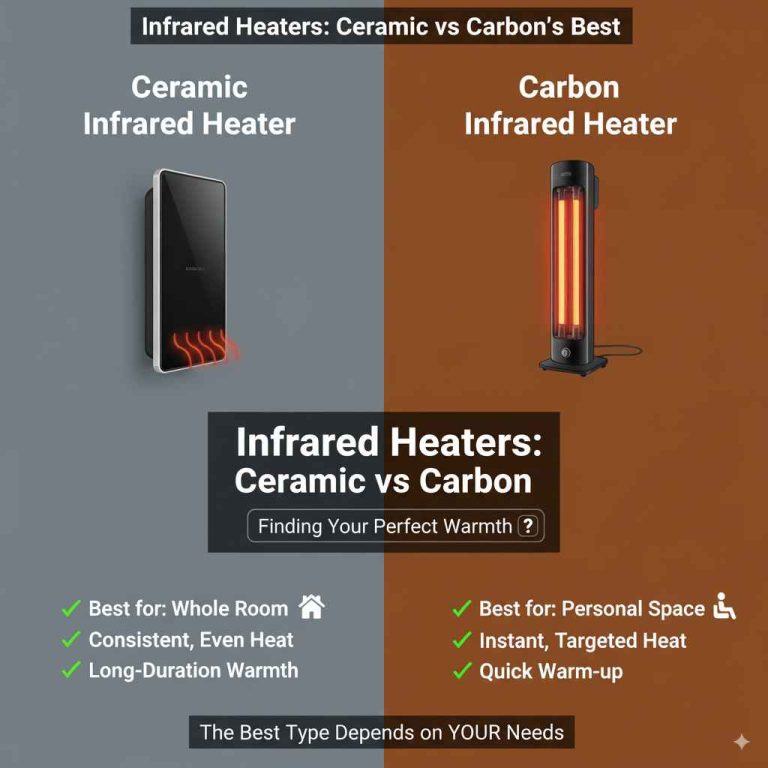
Carbon heaters are often the better fit for bedrooms because they give softer, broader radiant heat and tend to suit longer use. They are a good match when the goal is steady warmth near a bed or reading chair rather than a sharp blast of heat.
Look for a digital thermostat, timer, remote control, overheat protection, and cool-touch housing. UL or ETL certification matters here because bedrooms are occupied for long stretches and safety should not be an afterthought.
Why carbon suits longer, quieter use
Carbon elements usually feel less harsh than quartz because the heat spread is broader. That can make them easier to live with near a bed or desk.
Many carbon units are paired with thermostats and timers, which helps with occupied-room use where the heater should follow the sleep or work schedule.
When a carbon unit is the wrong choice
Carbon is not the best pick when you need immediate spot heat for a drafty garage or a chilly workshop bench. If the goal is fast, direct warmth at a fixed point, quartz is usually a better match.
Carbon also loses value if the room is too large and the heat path is not aligned with the occupied area.
Quartz heater: best for fast spot heat?
Quartz heaters are often the best fit for direct, immediate heat at a specific spot. They work well for office desks, garage benches, and other places where a person sits or stands in one position and wants heat aimed straight there.
They are less forgiving in large, open, or drafty rooms. If line of sight is blocked, the benefit drops quickly.
Good uses for offices and garage workspaces
Quartz is a strong choice when the occupied zone is small and fixed, such as a single desk chair or a workbench. It delivers direct radiant heat without waiting for the whole room to warm up.
For garages, a garage-rated model with splash resistance and portable placement can be more practical than a decorative unit built for living rooms.
Limits in larger or poorly insulated rooms
Quartz is not a cure for heat loss. In a basement with drafts or a sunroom with poor insulation, the heater may warm the user while the room itself still feels cold around the edges.
That is a placement problem as much as a power problem. If the heater cannot “see” the person, the zone does not get the full benefit.
Wall-mounted panel: best for fixed zones
Wall-mounted panels are best for fixed zones because they keep the heater out of the way and hold a stable aim. They fit bedrooms, reading corners, and desks that stay in one place day after day.
They also reduce clutter on the floor. That matters in homes with children or pets.
Best placement height and line of sight
Mount the panel so the radiant path faces the occupied spot directly. The exact height depends on the room, but the heater should not point into a blocked corner or behind furniture.
Keep seating within the stated coverage angle and avoid placing tall objects between the heater and the person using the zone.
When a portable cabinet is the better buy
A portable cabinet makes more sense when the target zone changes often or when you need to move heat between rooms. It is also the easier choice if wall mounting is not allowed or if you need a heater for a garage or basement that gets used differently across the week.
Portable units also help when you want to shift the angle to avoid glare, furniture, or reflective surfaces.
DR. INFRARED HEATER DR-978: best for bedrooms and offices
- Dual PTC + infrared heating for stronger output
- Low-noise blower helps spread warmth
- Thermostat, timer, and safety shutoffs included
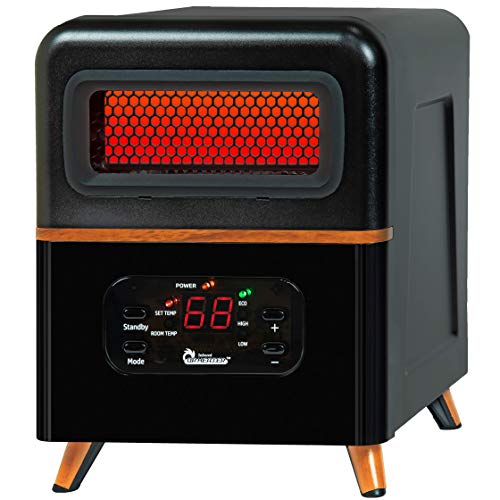
This 1500-watt hybrid portable model is a reasonable fit for a bedroom or office where you want more than pure radiant heat. The dual PTC plus infrared design, remote control, thermostat, timer, and safety shutoffs make it easier to manage a small occupied zone.
Its low-noise blower can help spread warmth a bit farther than a pure radiant unit. That can be useful in a home office or small sitting room where the goal is to reduce cold spots around the chair.
The drawback is that it is still a portable floor unit, so placement matters and it can be less focused than a wall-mounted heater. It is also limited by the common 1500-watt ceiling and a standard 120V circuit.
DR. INFRARED HEATER DR218-1500W: best for garages and workshops
- Infrared heating for garage, workshop, or greenhouse use
- IPX4 structure helps resist water splashing
- Lightweight and portable for flexible placement
This 1500-watt infrared model fits garage, workshop, or greenhouse use better than a typical living-room heater. The lightweight portable design and IPX4 splash resistance make it a practical option where the setup may change and moisture is more likely.
It suits direct heat to a workbench or standing spot, especially when the goal is zone heating rather than warming the full building volume. That makes it a useful pick for a garage workspace with a clear heat path.
The drawback is that it does not add the broader convenience features seen on some indoor comfort heaters, such as a remote, timer, or fan-assisted spread. It is also still a 1500-watt unit, so a large or leaky space can outrun it.
Which one should you buy?
Buy a carbon or wall-mounted unit if your zone is fixed, quiet, and used for long stretches, such as a bedroom or reading chair. Buy quartz if the target is a desk, bench, or other spot that needs fast direct heat. Buy a portable cabinet if the zone moves from room to room.
For a bedroom or office, the DR. INFRARED HEATER DR-978 is the better match among the two listed products. For a garage workspace, the DR218-1500W is the more practical choice. If the room is drafty, oversize, or poorly insulated, neither should be expected to heat the whole space by itself.
Do not choose by wattage alone. Choose by line of sight, mounting option, occupancy schedule, and whether the heater can sit within about 4 to 10 feet of the place you actually use.
Key features that matter most
Look for UL or ETL certification, tip-over shutoff, overheat protection, and cool-touch housing first. Then check the controls that affect daily use: remote, digital thermostat, timer, eco mode, and, where useful, fan-assisted distribution.
These features do not replace correct sizing. They make the heater easier and safer to use once the wattage and placement are right.
How to choose by room type
- Match the heater to the zone, not the whole room.
- Check whether the heat path is clear from heater to seating or sleep area.
- Use about 10 watts per square foot of the occupied zone as a starting point.
- Confirm the load stays within a standard 120V circuit and the common 1500-watt ceiling.
- Choose controls that fit the schedule, such as a thermostat and timer.
How to place it for better zoned heat
Place the heater where the radiant path reaches the body, chair, bed, or workbench directly. Keep reflective surfaces, curtains, tall furniture, and partitions out of the path where possible.
For portable units, avoid pushing the heater into a corner that traps heat but misses the person. For wall-mounted units, aim for a height and angle that keeps the heat line open and avoids blocked sight lines.
Say your office chair sits 6 feet from the heater but the desk screen blocks half the body. The heater may warm the lower legs while the upper body still feels cold. Move the unit or the chair before increasing wattage.
Frequently asked questions
What is the best infrared heater?
The best infrared heater is the one that matches the space you occupy, the way you sit or sleep, and the amount of heat loss in the room. For fixed zones, wall-mounted quartz or carbon is usually strongest. For portable use, a 1500-watt unit with a thermostat and safety shutoffs is a practical baseline.
Can an infrared heater heat only the area I’m using?
Yes, if the heater has clear line of sight to the occupied spot and the area is small enough for the wattage. Infrared is suited to occupied zones, such as a desk, bed, or chair. It is less effective when furniture, walls, or distance break the heat path.
Are wall-mounted infrared heaters better than portable ones for zoning?
Wall-mounted heaters are usually better for fixed zones because they hold a steady aim and stay out of the way. Portable heaters are better when the target area changes often. The better choice depends on whether the seating or sleep zone stays in one place.
Do infrared heaters lower heating costs in occupied rooms only?
They can, but only when they replace whole-room heating with zone heating. Savings depend on wattage, electricity rate, hours used, thermostat cycling, and how much of the room is left unheated. If you heat only the occupied area for fewer hours, the math can improve.
Is carbon or quartz better for zoned heating?
Carbon is usually better for longer, softer heat in bedrooms and offices. Quartz is usually better for direct, fast spot heat in garages and workspaces. If the room is drafty or blocked, neither performs well unless the heater is placed where the heat path stays open.
Where should I place an infrared heater for best zoned heat?
Place it so the heater can “see” the place you actually use. Keep the seating or sleep zone within the stated coverage distance, avoid blocked line of sight, and do not aim it through furniture or into a corner. Reflective surfaces and poor insulation can change the result.