Portable Heater with Thermostat: Is It Worth It?
A portable heater with a thermostat is a good choice if it will run for more than about 30 minutes or if steadier room temperature is desired; otherwise, a basic model can be enough. Without one, heaters cycle harder, waste power, and leave rooms too hot or too cold. This guide explains where a thermostat saves money, where it mainly improves comfort, and where its reading can mislead you.
How cycling, controls, and sensor placement affect comfort
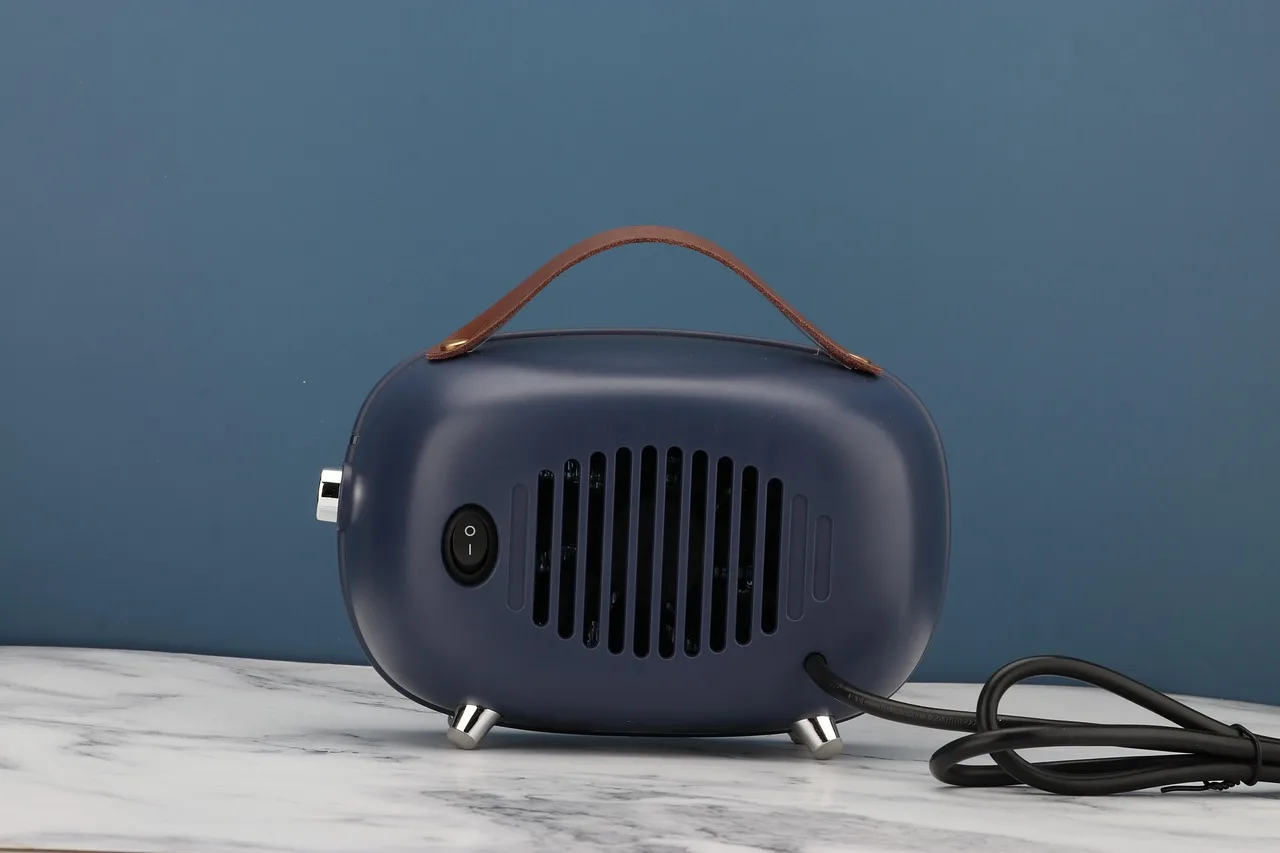
A portable heater thermostat turns the heater on and off at a chosen temperature. That cycle is the point, because the heater runs, pauses, then restarts as the room cools. A thermostat does not make the heater produce more heat; it only controls when heat is released.
On/off cycling and setpoint control
With a setpoint, the heater tries to keep the room near your chosen temperature. A manual heater usually has simple heat levels with no room-temperature target, so you do the cycling yourself. That can work for short spot heat, but it is less consistent over longer stretches.
Manual vs. digital thermostat controls
Manual thermostats usually use a dial and a bimetal or similar mechanical sensor. Digital models use an electronic sensor and display a specific setpoint. Digital controls are often easier to repeat from day to day, while manual controls can be fine if you only want approximate warmth and do not mind a wider swing.
Accuracy, tolerance, and sensor placement
A thermostat is only as good as where it senses the air. If the sensor sits too close to the heater outlet, it may shut off early because it reads hot air before the rest of the room warms up. If it sits in a draft, it may run longer than needed. That is why two heaters with the same wattage can feel different.
Does a thermostat actually save electricity on a portable heater?
Sometimes, but not by making the heater itself more efficient. A thermostat can reduce runtime, which can lower kilowatt-hour use. If you would otherwise leave a heater on longer than needed, cycling at a setpoint can cut waste. If you were already switching it off manually at the right time, savings may be small.
Runtime reduction versus heater efficiency
Electric resistance heaters generally convert electricity to heat at roughly the same end-use efficiency whether they have a thermostat or not. The thermostat changes duty cycle, not the basic heat conversion. So the savings come from fewer energized minutes, not from extra efficiency.
How duty cycle affects kWh use
Energy use follows this simple relationship: watts ÷ 1,000 × hours = kWh. A 1,500-watt heater draws about 1.5 kW while it is on. If a thermostat cuts runtime from 4 hours to 3 hours, energy use drops from 6.0 kWh to 4.5 kWh. At about $0.16 per kWh, 6.0 kWh costs about $0.96 and 4.5 kWh costs about $0.72.
When savings are small or negligible
Savings shrink when you only need short bursts of heat, such as taking the chill off a small office for 10 or 15 minutes. They also shrink if the heater is oversized for the room and spends much of the time switching on and off without improving comfort. In those cases, a thermostat may be more about control than cost.
How much comfort does it add?
A thermostat is most valuable when you want steadier room temperature and fewer hot-and-cold swings. That usually feels better than a basic heater that runs until you remember to shut it off. The gain is comfort consistency, not extra heat output.
Room temperature stability and fewer swings
Without a thermostat, a heater can overshoot the room, then leave it cool again after you switch it off. With a thermostat, the heater tends to cycle around the target, so the room changes less from warm to chilly. That matters most during long sessions, not quick spot heating.
Why some heaters overshoot or short-cycle
If the sensor is close to the heating element, the heater may think the room is warmer than it is. It shuts off early, then turns back on after the room cools. That short-cycling can feel irritating and can make the temperature seem unstable even though the heater is working.
Say your 12-by-12 bedroom gets drafty near a window. A heater with a dial sensor placed near its intake may shut off while the bed area still feels cool, then restart a few minutes later. The thermostat is not broken in that scenario; the sensor is reading a different patch of air than the one you sit in.
Why sensor placement matters
Sensor placement matters most in rooms with drafts, floor-level cold spots, or furniture blocking airflow. A heater set low to the floor may read colder air than a wall-mounted thermostat would. If the model lets you place the heater where air can circulate freely, its control usually behaves more predictably.
Thermostat value by room type
The thermostat is worth paying for when the heater will run long enough for cycling to matter. That usually means bedrooms, offices, and many basements. It matters less when you only want brief spot heat or when you already plan to run the heater manually and watch it closely.
Bedrooms and overnight use
Bedrooms are the clearest case for a thermostat. You want steady temperature, lower noise if possible, and less chance of waking up too warm. A thermostat is especially useful with radiant or oil-filled heaters, where the room can stay comfortable without constant fan noise.
Offices and intermittent daytime use
For an office, a thermostat helps if you step away often and do not want to babysit the heater. If the room is small and insulated, the thermostat may cycle infrequently. If the space has a lot of sun or equipment heat, a manual model may be enough for quick comfort blocks.
Garages, basements, and drafty rooms
These spaces are the hardest to generalize. Insulation is often weaker, doors open more often, and outside air can drop in fast. A thermostat can still help, but it may need to work harder and cycle more often. In a very drafty garage, comfort gains may be limited unless the room is already reasonably enclosed.
Portable heater decision table
This table uses simple runtime assumptions to show where a thermostat is worth extra cost. The cost estimates assume a 1,500-watt heater at $0.16 per kWh, then apply a rough runtime reduction when the thermostat helps cycling. Real results vary by insulation, room layout, and how tightly the heater matches the space.
| Room type | Insulation level | Usage pattern | Thermostat worth it? | Cost estimate |
|---|---|---|---|---|
| Bedroom | Good to moderate | Overnight or 2+ hours | Yes | About 20% to 35% less runtime versus manual cycling |
| Office | Good | Repeated daytime sessions | Yes | About 15% to 30% less runtime if you leave it on between short absences |
| Basement | Moderate | Long sessions | Usually yes | About 10% to 25% less runtime; savings can shrink if drafts dominate |
| Garage | Poor | Intermittent spot heat | Not necessary | Often little savings because heat loss is high and use is short |
| Small well-insulated room | Good | Brief spot heat under 30 minutes | Not necessary | Manual control is usually enough; runtime is already limited |
| Drafty room | Poor | Trying to hold a stable target | Maybe | Thermostat helps comfort more than cost; savings are unpredictable |
Which heater type fits best?
Thermostat quality varies by model, and the heater type affects how you feel the cycling. Ceramic and fan-forced heaters heat air quickly. Oil-filled radiators and infrared or quartz heaters often feel steadier or quieter, depending on the room and how you use them.
Ceramic and fan-forced heaters
Ceramic heaters usually move air with a fan, so you get faster warmup and more obvious noise. A thermostat can help them avoid blasting heat longer than needed. They suit rooms where you want quick response, but the fan sound may matter in bedrooms.
Oil-filled radiators
Oil-filled radiators are typically quieter because they do not depend on a strong fan. Their heat rises more gradually, so thermostat cycling can feel less abrupt. They are often a good fit for bedrooms or all-evening use when noise matters more than fast warmup.
Infrared and quartz heaters
Infrared and quartz heaters warm people and nearby surfaces directly, so the felt heat can be immediate even if the whole room is not yet warm. A thermostat can still help, but these heaters are often used for targeted spot heat. That makes the thermostat less important if you only want a brief warm zone.
What safety features should you check?
Check the safety features on every portable heater, thermostat or not. Look for tip-over shutoff, overheat protection, stable housing, and a recognized third-party certification mark such as UL, ETL, or CSA where applicable. Also confirm the model is listed for the room or location where you plan to use it, especially for bathrooms or damp areas.
Tip-over switch and overheat protection
A tip-over switch shuts the heater off if it falls. Overheat protection helps stop runaway temperatures inside the unit. These features are basic, but they matter because a thermostat is not a safety device by itself. A thermostat controls room temperature; it does not replace the shutoff systems.
Cool-touch housing and stable placement
Cool-touch housing can reduce the burn risk if you brush against the outer shell. Stable placement matters just as much. Set the heater on a level surface, keep it clear of curtains and bedding, and leave the air intake and outlet unobstructed. Do not rely on a thermostat to make a poor setup safe.
Certification marks and manual limits
Look for recognized safety testing marks, not one specific logo only. Check the manufacturer’s manual for placement rules, bathroom restrictions, cord guidance, and whether the model is listed for damp or bathroom use. A standard plug or a GFCI receptacle does not by itself make an unlisted heater suitable for a bathroom.
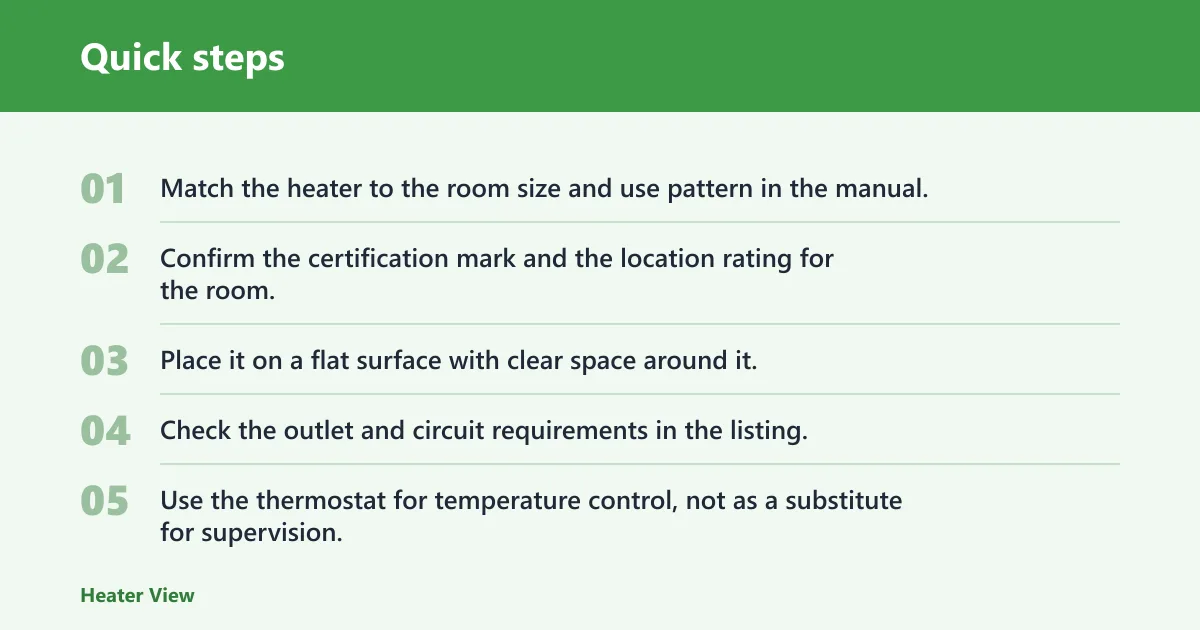
- Match the heater to the room size and use pattern in the manual.
- Confirm the certification mark and the location rating for the room.
- Place it on a flat surface with clear space around it.
- Check the outlet and circuit requirements in the listing.
- Use the thermostat for temperature control, not as a substitute for supervision.
Can you leave one on overnight?
Sometimes, but only if the model is listed for that use, placed correctly, and kept away from bedding, curtains, and traffic paths. Overnight use makes a thermostat more valuable because it prevents large swings. Still, many portable heaters should not be left unattended, so follow the manufacturer’s manual and do not assume all models are acceptable for sleep use.
When sleep use is reasonable
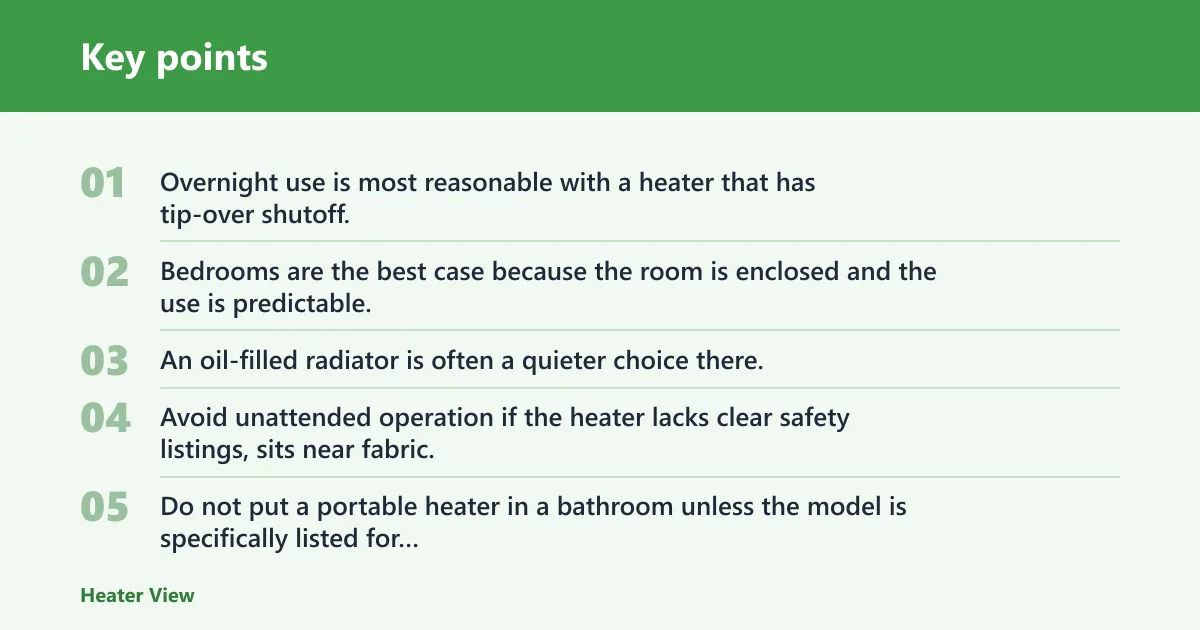
Overnight use is most reasonable with a heater that has tip-over shutoff, overheat protection, a stable base, and a thermostat that does not overshoot badly. Bedrooms are the best case because the room is enclosed and the use is predictable. An oil-filled radiator is often a quieter choice there.
When to avoid unattended operation
Avoid unattended operation if the heater lacks clear safety listings, sits near fabric, has a damaged cord, or has to run in a cramped or cluttered space. Do not put a portable heater in a bathroom unless the model is specifically listed for that location. Follow the manual and local rules for any heater you leave on while asleep.
What temperature setting to start
Start with a moderate setpoint and adjust from there. For many rooms, a lower setting that prevents chill is better than chasing a very warm target that keeps the heater cycling hard. If the room feels uneven, move the heater or improve airflow before pushing the setpoint higher.
Suppose a living room is already close to comfortable and only needs a small boost during the evening. In that case, a thermostat set conservatively can keep the room from swinging between warm and cold, while a high setting may simply force more cycling without improving comfort much.
Frequently asked questions
Is a portable heater with a thermostat worth it?
Yes, if you use the heater for more than 30 minutes or care about stable room temperature. The thermostat is most worthwhile in bedrooms, offices, and other spaces where the heater runs long enough for cycling to matter. For very short spot heat, a basic heater can be enough.
Are portable heaters with thermostats more accurate than ones without?
They are more precise in control, but not always more accurate in practice. The result depends on sensor location, room drafts, and how the control is calibrated. A digital thermostat usually gives a more repeatable setpoint than a simple manual dial, but placement can still cause overshoot or short-cycling.
Can I leave a thermostat-controlled portable heater on all night?
Only if the model’s manual says it is suitable for that use and the heater has proper safety features. The thermostat helps hold temperature, but it does not make unattended operation safe by itself. Keep it clear of bedding and curtains, and do not use it in a bathroom unless the listing specifically allows it.
How much does a portable heater with a thermostat cost to run?
At 1,500 watts, a heater costs about $0.24 per hour to run continuously at around $0.16 per kWh. A thermostat can lower that if it reduces runtime. For example, cutting runtime by 25% lowers the cost to about $0.18 per hour of elapsed time, not counting room conditions or cycling behavior.
What temperature should I set a portable heater to?
Start with a moderate setting that keeps the room comfortable without overshooting. There is no universal number that fits every room, because insulation, drafts, and room size all matter. If the heater keeps cycling too often, move it, reduce drafts, or lower the target before raising the heat further.
What are the safety benefits of a thermostat on a portable heater?
The thermostat’s main safety benefit is indirect: it can prevent the heater from running longer than needed. That lowers heat buildup in the room and can reduce unnecessary cycling. It does not replace tip-over shutoff, overheat protection, stable placement, or a recognized safety listing such as UL, ETL, or CSA.