Portable Heater with Remote Control: Do You Need One?
A portable heater with remote control is worth paying extra for only if you need to change settings from bed, a couch, or a doorway; otherwise, a good thermostat and timer cover most needs. Buy badly, and you pay for convenience you never use or end up walking across the room to make every change. This guide breaks down when a remote is genuinely useful, when it is redundant, and which controls matter more.
Remote control or not?
A remote matters when distance is the problem, not heat output. It lets you change temperature, mode, or shutoff settings without walking to the unit, which is useful if the heater sits across a bedroom, beside a sofa, or under a desk. It does not make the heater warmer, safer, or cheaper to run.
What the remote actually changes
On a portable heater with remote control, the practical gain is reach. You can adjust the set temperature, turn the heater off, switch heat levels, or start the timer from across the room. That can matter late at night, after you are already settled, or when the heater is placed where the panel is awkward to reach.
Some remote-controlled models also let you access the same functions that appear on the front panel. That is convenience, not extra heating performance. If the heater already has a clear digital thermostat and a usable timer, the remote mainly saves steps.
When standing up is the real tradeoff
If the heater sits next to your chair, desk, or bed, a remote often adds little. Manual buttons may be enough. The value rises when standing up means crossing a cold room, reaching over furniture, or disturbing someone else.
Picture a bedroom setup where the heater is on the opposite wall from the bed. A remote helps you lower the temperature or shut the unit off without getting out from under the covers. In a small office with easy access to the control panel, the same remote may sit in a drawer and stay unused.
What a remote does not change
The remote does not change wattage, fuel use, or the heater’s room suitability. A 1500W portable heater is still a common plug-in choice for small to medium rooms, and a remote does not make it cover more space. It also does not replace tip-over protection or overheat protection.
Remote control does not remove the need to follow the manufacturer’s instructions. That matters especially for overnight use. A timer can help with shutoff, but it should be used only as directed by the product guidance.
Portable heater remote checklist
Use this checklist when you are deciding whether remote control is worth the extra cost. A higher score points toward a stronger case for remote use. A low score usually means the money is better spent on a better thermostat, timer, or safety features.
| Checklist item | Yes | No |
|---|---|---|
| Room type: the heater will sit across the room, behind furniture, or out of arm’s reach | □ | □ |
| Room type: you want to adjust heat from bed, a couch, or a doorway | □ | □ |
| Mobility: standing up to reach the heater is inconvenient or difficult | □ | □ |
| Mobility: the heater may be used by someone who should not bend, reach, or cross the room often | □ | □ |
| Night use: you want to lower temperature or switch it off without getting out of bed | □ | □ |
| Night use: you expect to use the timer for programmed shutoff in the dark | □ | □ |
| Control preference: you want remote access to thermostat or timer settings | □ | □ |
| Control preference: you are comfortable using the onboard controls instead of a remote | □ | □ |
| Backup plan: if the remote is lost or the battery dies, you are fine using the panel | □ | □ |
| Value check: you would pay extra for convenience, not for more heat or lower running cost | □ | □ |
Score it: 0-3 yes answers = skip it. 4-6 yes answers = nice to have. 7-10 yes answers = worth paying extra.
In that case, the thermostat and timer do most of the useful work, while the remote mainly duplicates those controls.
What matters more than a remote?
A good thermostat, timer, and safety system usually matter more than a remote. Those features affect comfort and shutoff behavior, while the remote only changes how you interact with them. If the heater lacks a clear thermostat or timer, remote control is the wrong place to spend extra money.
Digital thermostat basics
A digital thermostat lets you set a target temperature and have the heater hold that setting within its designed control range. That is more useful than a remote by itself, because the thermostat controls the actual heat level whether you change it on the panel or from the couch.
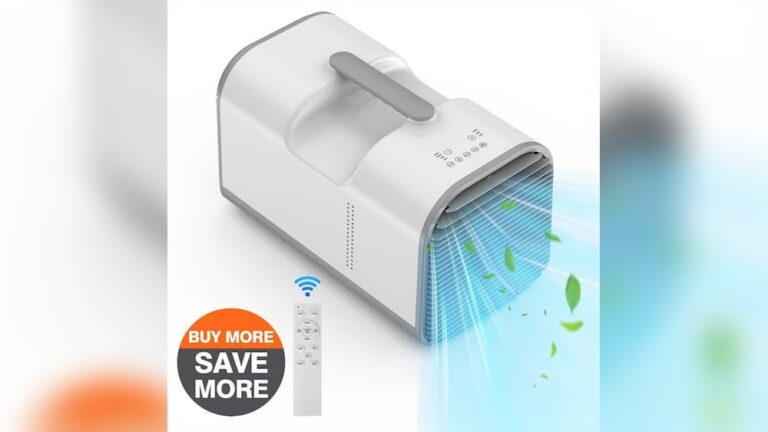
One sample remote-controlled heater lists a 60-90°F temperature range. That kind of span gives you more room to fine-tune comfort, but the real value comes from the thermostat holding the target, not from the remote that sends the command.
Timer function basics
A timer gives you programmed shutoff. The same sample model lists a 1 to 12 hour timer range. That is useful for bedtime or short heating sessions because you do not need to remember to turn the unit off manually.
That convenience can reduce trips across the room, but it is not a license to ignore the manual. Overnight use should follow the heater’s instructions, including placement, clearance, and any limits on unattended operation.
PTC ceramic heating elements
PTC ceramic heating elements are common in compact plug-in heaters. They warm up fast, limit temperature rise on their own, and often include overheat protection. That makes them a common pick for small portable heaters in bedrooms, offices, and other small rooms.
The Ortorex heater is described as using a built-in PTC ceramic heating element. The point for buyers is straightforward: that technology supports fast warm-up and thermal management, but it does not make remote control necessary.
Tip-over and overheat protection
Tip-over protection shuts the heater off if it is knocked over. Overheat protection shuts the heater off if internal temperatures rise too far. These are separate safety features, and they matter more than remote control when you are comparing heater safety.
Many portable heaters include both. That includes common 1500W ceramic models. A remote does not replace either feature, and it does not make a heater safer by itself.
Which rooms benefit most?
Bedrooms, offices, and drafty spaces tend to benefit most from a heater remote because those rooms often involve sitting, lying down, or keeping the heater out of immediate reach. Bathrooms are a special case. Only bathroom-rated heaters should be used there, and they must be kept away from water and used only as directed by the manufacturer.
Bedrooms and bedside use
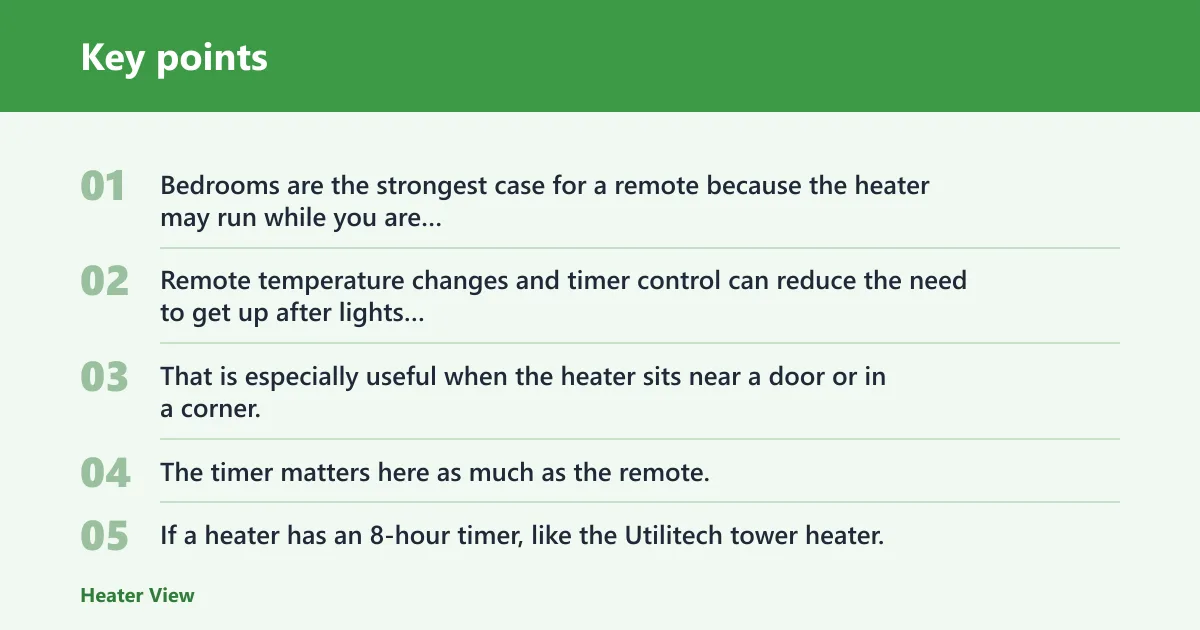
Bedrooms are the strongest case for a remote because the heater may run while you are already in bed. Remote temperature changes and timer control can reduce the need to get up after lights out. That is especially useful when the heater sits near a door or in a corner, not beside the bed.
The timer matters here as much as the remote. If a heater has an 8-hour timer, like the Utilitech tower heater, you can set a programmed shutoff without walking back to the unit. That is convenience, not a substitute for safe placement or manufacturer guidance.
Offices and desks
In a home office, remote control is helpful when the heater is not on the desk and you want to adjust it without interrupting work. It is less useful if the control panel is already within reach. In that room type, a clear thermostat often does the heavy lifting.
Suppose a small office has a compact heater under a side table. If the room warms too fast, the remote lets you lower the setpoint without kneeling down. If the heater is already at arm’s length, the remote adds less value than a readable display and simple controls.
Drafty spaces and quick warm-ups
Drafty spaces are often where small heaters earn their keep. A 1500W portable heater is a common household plug-in option for that kind of use, and the ability to start or adjust it from across the room can be helpful when the room is chilly and you do not want to keep walking back to the unit.
Some product descriptions make fast-warm claims. One sample remote-controlled heater is described as reaching temperature in 3 seconds and heating a 350 sq. ft. room in 10 minutes. Treat those claims as product-specific, not universal. Room layout, insulation, and placement still matter.
Bathrooms and water safety
Bathrooms need stricter judgment than bedrooms or offices. Only a bathroom-rated heater should be used there, and it must be kept away from sinks, tubs, showers, and any water source. A remote does not make an ordinary heater suitable for bathroom use.
If the product is not rated for bathroom conditions, do not treat it like a general small-room heater. Safety distance and the manufacturer’s instructions matter more than convenience features.
What to check before buying
Before you pay extra for remote control, check how the heater will actually be used. The best remote is the one you can reach, read, and back up with the onboard controls if the battery dies or the remote goes missing.
Remote range and button layout
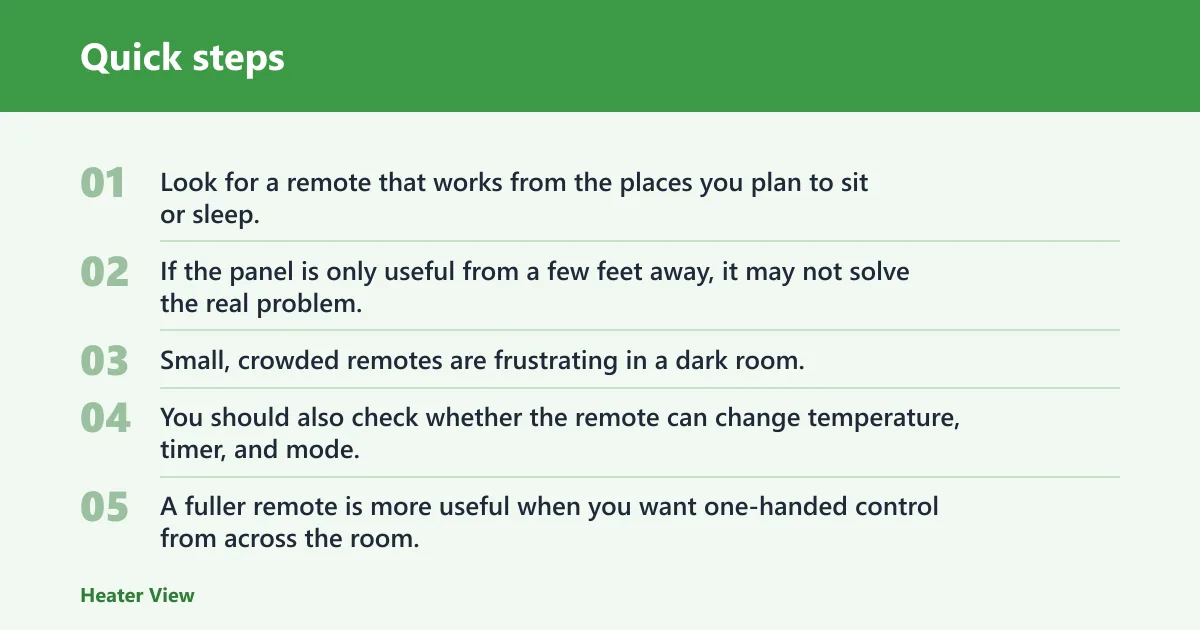
Look for a remote that works from the places you plan to sit or sleep. If the panel is only useful from a few feet away, it may not solve the real problem. Button layout matters too. Small, crowded remotes are frustrating in a dark room.
You should also check whether the remote can change temperature, timer, and mode, or whether it only handles power and fan settings. A fuller remote is more useful when you want one-handed control from across the room.
Thermostat and timer controls
Check whether the heater has a digital thermostat that holds a target temperature instead of only cycling through heat levels. Also check the timer range. A 1 to 12 hour timer gives more scheduling flexibility than a shorter shutoff window, especially for bedtime use.
If the heater has app control, that can matter more than a basic remote for some buyers. Tech Advisor’s top heater pick includes remote control among its features, and Tech Advisor notes that its top heater can be scheduled through an app. App control is useful when you want a broader control path than a handheld remote.
Wattage and room fit
Match the heater to the room, not the remote. A 1500W model is a common choice for small to medium rooms, but room shape, draftiness, and insulation still determine comfort. A remote does not fix an undersized heater or make an oversized one appropriate for a small space.
The Utilitech compact ceramic portable heater includes a remote control and uses a 1500W ceramic heating element. That is a good example of a model where the remote adds convenience, while the wattage and heating element determine the real heating job.
Battery, loss, and backup control plan
Remote controls can be lost, and batteries die. That is not a minor detail. If the heater’s panel is hard to reach or hard to see, a dead remote can turn a convenience feature into a nuisance. Make sure the onboard controls are usable without the remote.
A backup control plan matters most in bedrooms and other night-use rooms. If you cannot comfortably use the heater from the panel alone, ask whether smart app control, a wall switch where appropriate, or simply a better control layout would be a better buy than a handheld remote.
Portable heater guide
Do you need a remote? Sometimes. The right answer depends on how far the heater sits from where you spend time, how often you change settings, and whether you want to do that from bed or from across the room. If the panel is already easy to reach, remote control is optional.
Do you need a thermostat?
Yes, in most cases. A digital thermostat is what helps the heater hold a target temperature, whether you set it on the panel or with a remote. If you want steady comfort instead of constant manual adjustment, thermostat control is more important than a remote.
Do you need a timer?
Often, yes. A timer gives programmed shutoff and is especially useful when you are warming a room for a set period or want a planned stop without walking back to the heater. For overnight use, follow the product instructions and do not assume every timer setup is acceptable.
When to pay extra
Pay extra when the remote solves a real access problem: bed, couch, doorway, mobility limits, or a heater placed out of reach. Skip the premium when the heater sits close enough for easy panel use. In that case, a better thermostat, timer, and safety package usually matter more.
Frequently asked questions
Do you actually need a portable heater with remote control?
Only if reaching the heater is inconvenient or you expect to change settings from bed, a couch, or another part of the room. If the unit sits within easy reach, the remote mostly duplicates what the panel already does. A good thermostat and timer often cover the important jobs.
Is a remote control useful on a space heater?
Yes, when it saves you from standing up to change temperature, mode, or timer settings. It is less useful on a heater that sits beside your chair or desk. The benefit is convenience, not more heat, lower wattage, or better safety. That distinction is the whole buying decision.
What features matter more than remote control on a portable heater?
A digital thermostat, a timer, tip-over protection, and overheat protection usually matter more. The thermostat controls comfort, the timer controls shutoff, and the safety features protect against common hazards. A remote can make those features easier to use, but it does not replace them.
Are remote-controlled portable heaters safer?
Not by themselves. Safety comes from tip-over protection, overheat protection, proper placement, and following the manufacturer’s instructions. A remote may reduce how often you walk up to a hot unit, but that is convenience. It does not change whether the heater is safe to use.
Which room types benefit most from a heater remote?
Bedrooms benefit most, followed by offices and other rooms where the heater sits out of arm’s reach. Drafty spaces can also benefit if you want to adjust settings without crossing the room. Bathrooms are different: only bathroom-rated heaters belong there, and they must stay away from water.
Can you use a portable heater without the remote?
Usually, yes. Most remote-controlled heaters also have onboard buttons for power, temperature, and timer settings. That backup matters because remotes can be lost or need batteries. Before buying, check that the control panel is readable and practical enough to use on its own.