Are Infrared Heaters Safe for Prolonged Use?
Yes, infrared heaters can often run for prolonged periods indoors if they have tip-over and overheat protection, stay within the manufacturer’s recommended clearance distances, and are not left unattended or overnight unless the model is rated for that use. Poor setup raises burn and fire risk fast, especially near furniture, curtains, bedding, or children and pets. This guide separates the infrared heat itself from the real safety limits for daily, overnight, and room-specific use.
When long heater runtime is safe
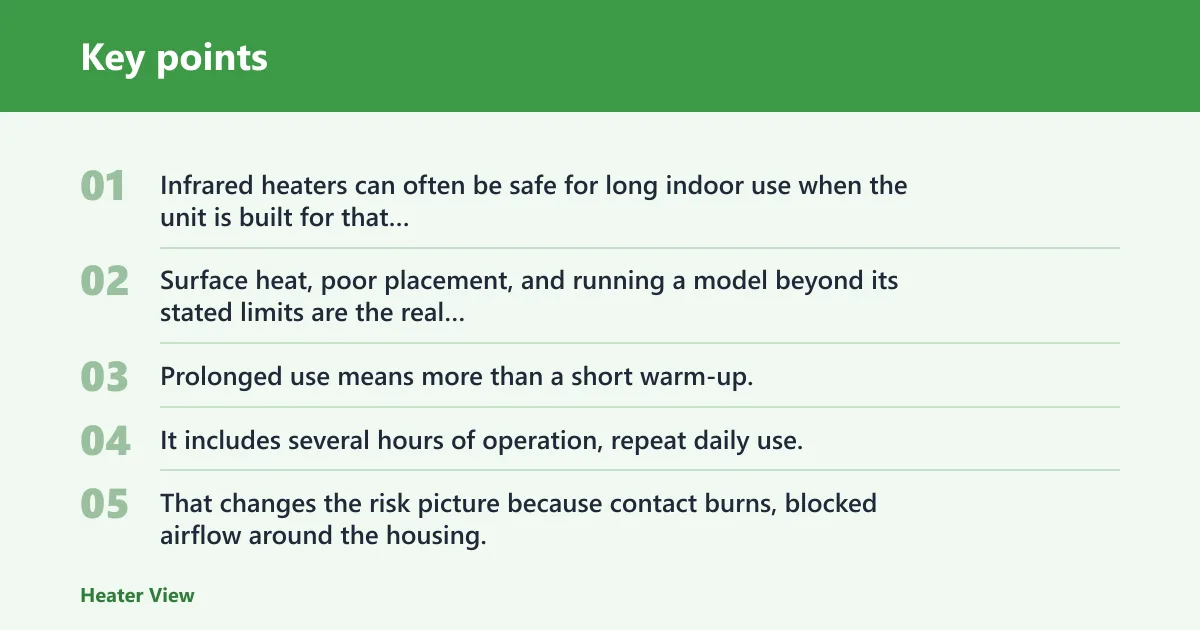



Infrared heaters can often be safe for long indoor use when the unit is built for that duty, installed correctly, and kept within the label instructions. The heat itself is not the main problem. Surface heat, poor placement, and running a model beyond its stated limits are the real issues.
What prolonged use means for indoor heaters
Prolonged use means more than a short warm-up. It includes several hours of operation, repeat daily use, and any run that overlaps with sleep or leaving the room. That changes the risk picture because contact burns, blocked airflow around the housing, and nearby combustibles matter more over time.
When long runtime is acceptable
Long runtime is generally acceptable when the heater is listed for indoor use, has automatic shutoff protection, sits at the required clearance from walls and soft furnishings, and stays on a stable surface or approved mount. It also needs a thermostat or control setting that matches the room size instead of driving the unit at full output all day.
When long runtime is a bad idea
Long runtime is usually a bad idea when the heater sits close to a sofa, curtain, blanket, crib, or pet bed, or when the room is so small that the heater and its warm zone crowd each other. It is also a bad idea when the product label does not clearly state indoor use, clearances, and overheat protection.
How infrared heat affects the room
Infrared heat can feel immediate because it warms people and objects directly, and the room air comes later. That makes it useful in living areas and drafty spaces, but it does not remove the need for clearance, room matching, or supervision when the heater is near sensitive materials.
Infrared radiation and radiant heat
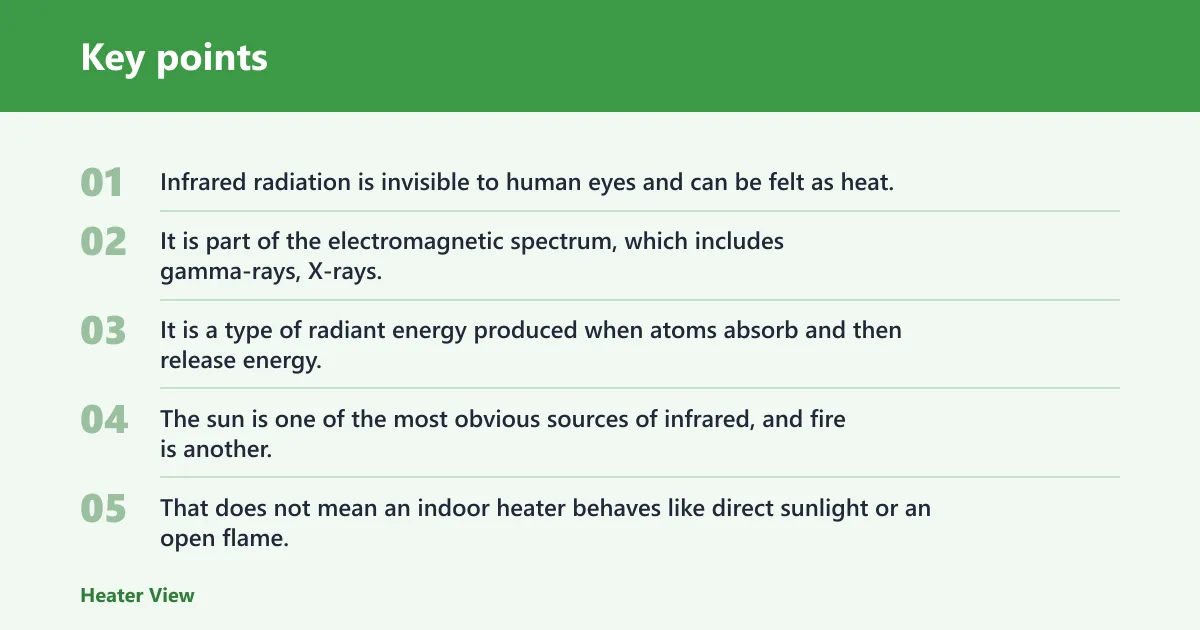
Infrared radiation is invisible to human eyes and can be felt as heat. It is part of the electromagnetic spectrum, which includes gamma-rays, X-rays, ultraviolet, visible light, infrared, microwaves, and radio waves. It is a type of radiant energy produced when atoms absorb and then release energy.
The sun is one of the most obvious sources of infrared, and fire is another. That does not mean an indoor heater behaves like direct sunlight or an open flame, but it does explain why the warmth feels concentrated on skin and surfaces instead of spreading only through the air.
Why people feel warmth before air warms up
An infrared heater directs heat toward people and objects. The skin, furniture, flooring, and nearby walls absorb that energy, so comfort can rise before the whole room temperature changes much. That is helpful in a sitting room or bedroom, but it also means the surface in the beam path can heat faster than expected.
Picture a small bedroom with a wall-mounted infrared unit above the bed. The room may feel warm quickly, but the bedding still needs to stay outside the stated clearance zone, and the heater should not be aimed where bedding, drapes, or a headboard can absorb prolonged radiant heat.
What this means for bedrooms and living spaces
Bedrooms and living rooms are common use cases because infrared heat is good at warming occupied zones. The room still needs enough space for the unit’s heat pattern and for safe airflow around the housing. A heater that feels comfortable at one distance can still be unsafe if it sits too close to soft items.
What actually makes infrared heaters risky?
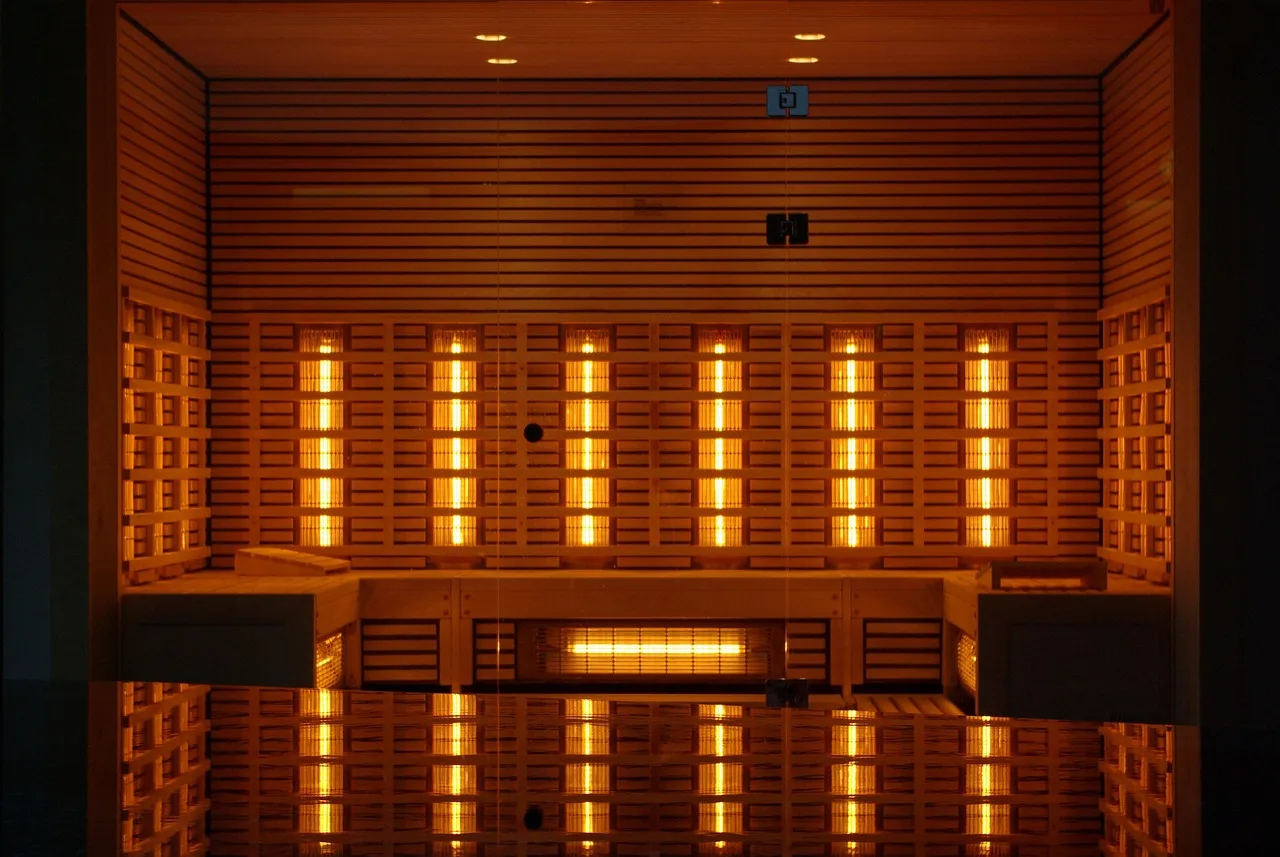
The risk comes from hardware and placement, not from infrared radiation itself. The main hazards are a hot surface, blocked clearance, and a heater that lacks reliable shutoff protection. Those are the conditions that can lead to burns, overheating, or ignition of nearby material.
Surface temperature and burn contact
Surface temperature is a direct burn and contact hazard. It varies by heater type and housing, so the metal, grille, or front panel can be much hotter on one model than another. Check the manufacturer’s specs and warnings instead of assuming one infrared design is cooler than another.
Children, pets, older adults, and people with skin sensitivity or mobility limits need extra caution because they may touch the unit, lean near it, or react later to heat discomfort. A heater that is easy to ignore in a main room can be a poor choice in a busy family space.
Clearance distance from walls and furniture
Clearance distance is the minimum space the heater needs from walls, furniture, curtains, bedding, and other combustible items. It depends on the model and installation type. For long-duration operation, treat the label’s clearance as a hard limit, not a suggestion.
A common first-timer mistake is sliding a portable infrared heater closer to a sofa because the room feels cold at the far end. That one change can put soft fabric inside the hot zone and turn a comfort heater into a contact and fire risk.
Thermal cut-off and overheat protection
Thermal cut-off or overheat protection is the automatic shutoff function that helps prevent runaway temperatures. It matters most when the heater runs for a long time, when airflow is restricted, or when someone forgets the unit is on. A heater without this feature is a weaker choice for unattended operation.
Prolonged-use safety matrix
This matrix gives a quick, room-based check before you run an infrared heater for long periods. The safest answer depends on placement, the room, and the label, not on infrared heat alone.
| Heater type | Room size | Clearance needed | Unattended use | Overnight use | Likely risk | Must-check label features |
|---|---|---|---|---|---|---|
| Wall-mounted infrared | Medium to large rooms | Follow the mount and side-clearance instructions exactly | Only if the model is rated for it and has overheat protection | Only if the manufacturer allows overnight operation | Hot surface contact, poor mount spacing, blocked radiated zone | Indoor rating, mounting instructions, clearance distances, thermal cut-off, certification label |
| Portable infrared | Rooms with open floor space | Keep away from curtains, bedding, and furniture per label | Higher caution; avoid unless the label explicitly permits it | Usually a poor choice unless specifically listed for sleeping areas | Tipping, contact burns, furniture proximity, cord strain | Tip-over shutoff, overheat protection, clearances, stable base, indoor certification |
| Bedroom use | Small to medium bedroom | Strict clearance from bed, linens, and drapes | Only with sleep-area approval in the manual | Only when the label allows overnight use | Bedding ignition risk, dry comfort, unnoticed overheating | Overnight rating, thermostat, auto shutoff, wall or floor clearance, certification label |
| Pet and kid rooms | Enclosed room with frequent movement | Extra room around the unit and its beam path | Not recommended unless the room is supervised | Usually avoid overnight use in these spaces | Touch injuries, curious contact, blocked airflow, pet bedding ignition | Cool-touch claims if documented, thermal cut-off, mounting height, clearance, indoor certification |
Are infrared heaters safe for your health?
For most healthy adults, electric infrared heaters are not a radiation-health problem in the way ionizing sources would be. The health questions are usually about comfort, dryness, heat exposure, and whether the room and the people in it can tolerate long use without contact or overheating issues.
Indoor air quality and electric heat
Electric infrared models do not produce combustion exhaust. That is an important difference from fuel-burning heaters. Still, indoor air quality is not the whole story. A room can feel dry, stuffy, or too warm even when there is no exhaust, especially if the heater runs for hours in a closed space.
Dryness and comfort in closed rooms
Dry air can make eyes, skin, and throats feel irritated. The heater is not creating smoke, but long runtime can still make a room feel less comfortable. If the space is small, closed, or already dry, use lower settings, monitor comfort, and avoid placing the heater where it will overheat one person while the rest of the room stays cool.
Who should be more cautious?
Children, pets, older adults, and people with skin sensitivity or mobility limits should be treated as higher-risk occupants. They may not move away quickly from hot surfaces, may not notice discomfort early, or may spend more time near the heater. That makes placement and supervision more important than raw heater output.
Can you leave an infrared heater unattended?
Sometimes, but only with conditions. You need the right model, the right placement, and the right safety features. If the label does not permit unattended use, treat that as a no. If the room contains bedding, curtains, or pets, the answer becomes stricter.
Unattended use and model features
An infrared heater should have thermal cut-off or overheat protection before you consider leaving it alone. Tip-over shutoff matters for portable units. Stable mounting matters for wall units. Even then, unattended use is best limited to models whose instructions clearly allow it and whose clearances are easy to maintain.
Overnight use in bedrooms
Overnight use is higher risk because people are asleep and cannot react to a hot housing, a shifted blanket, or a blocked vent. If a heater is permitted for nighttime use, it should be placed so bedding cannot reach it, and the room size should match the heater’s intended coverage.
What the label should say
Look for indoor-use instructions, the listed clearance distances, shutoff protection, and a certification mark such as UL or ETL on the product label or housing. If those details are missing, the heater is not a good candidate for long indoor operation. No label detail, no long run.
How to check a heater before you run it long term
Before long-term use, read the product label and manual with the same care you would use for any heat source. The key checks are certification, placement, shutoff protection, and room fit. If any one of those fails, do not rely on the heater for extended operation.
Look for UL/ETL-style certification
UL/ETL-style safety certification is third-party electrical safety testing, and it matters for indoor heaters. Verify that the mark is on the product label, not just in a seller description. Certification does not erase fire risk, but it is a basic filter for indoor use.
Read the clearance and placement instructions
Clearance instructions tell you how far the heater must stay from walls and furniture. Read both the front and side requirements, then check them against the room, not against guesswork. A heater that needs more open space than the room can provide should not be used for long runs.
Check the shutoff and thermostat controls
Thermal cut-off, overheat protection, and a thermostat are the controls that matter most for prolonged use. A thermostat helps prevent unnecessary full-power operation. Overheat protection helps stop the unit if internal temperature rises too far. Both are especially important in bedrooms and occupied family rooms.
- Confirm the heater is listed for indoor use on the label and manual.
- Verify UL/ETL-style certification on the product itself.
- Check the exact clearance distances for walls, curtains, bedding, and furniture.
- Look for tip-over shutoff on portable units and thermal cut-off on all models.
- Match the heater to the room size and keep it out of traffic paths.
- Do not leave it running unattended unless the manual explicitly allows it.
Frequently asked questions
How safe are infrared heaters?
They are as safe as their setup and features allow. A model with overheat protection, clear certification, and proper clearance can be a reasonable indoor heater. A poorly placed unit near bedding, curtains, or a child’s reach can become risky quickly. Safety depends on the whole setup.
Are infrared wall heaters safe?
Wall-mounted infrared heaters can be a good fit when installed exactly to the manufacturer’s instructions. The mount must keep the right distance from furniture, drapes, and bedding, and the unit should have overheat protection. A bad mount or blocked clearance removes the safety advantage fast.
Are infrared heaters safe to leave unattended?
Only sometimes, and only if the label and manual allow it. You still need overheat protection, a stable setup, and clear space around the heater. If the room has bedding, pets, or other combustibles nearby, unattended operation becomes a much worse idea. When in doubt, turn it off.
Are infrared space heaters safe?
They can be, but “space heater” is not a safety guarantee. Portable infrared space heaters add tip-over risk, cord risk, and closer contact risk than many wall units. Check the shutdown features, clearance instructions, and certification label before treating one as a long-run room heater.
Are infrared heaters safer than space heaters?
Infrared heaters are a type of space heater, so the comparison depends on the specific model. Some infrared units are safer in a room because they are wall mounted and avoid tip-over risk. Others are less safe because their surface temperature is high and their placement is easier to get wrong.