Signs Your Garage Heater Is Losing Efficiency
A garage heater can be losing efficiency if it runs longer than usual, cycles on and off, or the garage stays about 15°F or more below the thermostat setting after roughly 20 to 30 minutes. Ignoring it can mean higher utility bills, colder work space, and a service call for the wrong problem. This guide shows how to tell heater failure, blocked airflow, and garage heat loss apart before you pay for repairs.
What reduced output looks like
Reduced output is not the same as true efficiency loss. A heater can blow weaker air, recover more slowly, or shut off early because of a dirty filter, blocked vents, thermostat drift, or power problems. True efficiency loss means the unit is using more energy to deliver the same heat, which is harder to see without looking at runtime, cycling, and the garage itself.
A garage can also make a heater look worse than it is. Door gaps, thin insulation, and air leakage can pull warm air out fast enough that the heater keeps running even when the unit itself is working as designed.
Garage heater troubleshooting matrix
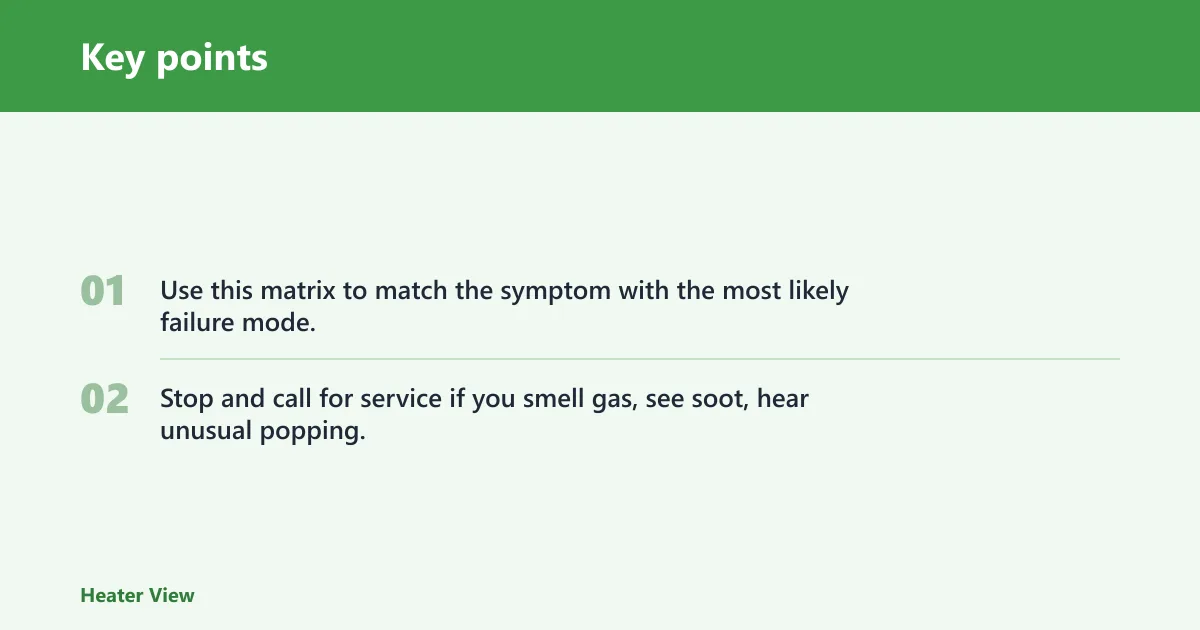
Use this matrix to match the symptom with the most likely failure mode. Start with the simplest homeowner check. Stop and call for service if you smell gas, see soot, hear unusual popping, or the heater keeps resetting.
| Symptom | Likely cause | Quick homeowner check | Gas/electric relevance | Recommended next step |
|---|---|---|---|---|
| Uneven heat | Thermostat drift, poor air circulation, or garage drafts | Walk the space and note cold corners near the door, ceiling, or side walls | Both | Check thermostat placement, seal obvious gaps, then schedule service if uneven heat remains |
| Longer warm-up time | Heat loss from insulation gaps or declining heater output | Compare warm-up on a still day and on a windy day | Both | Inspect insulation and door seals first; if the change is not weather-related, have the heater checked |
| Short cycling | Thermostat fault, overheating, or restricted airflow | Watch whether the heater shuts off before the garage reaches a stable temperature | Both | Clean the filter and clear vents, if cycling continues, stop using the unit and call for service |
| Weak airflow | Dirty air filter or blocked intake path | Look for dust on the filter and debris around the intake or blower area | Both | Clean or replace the filter, remove debris, and retest airflow |
| Higher bills | Longer runtime from heat loss, poor maintenance, or burner inefficiency | Check whether the heater now runs much more often for the same garage use pattern | Both | Review insulation, filter condition, and annual maintenance status before replacing the unit |
| Burner issues | Ignition fault, dirty burner, or gas supply problem | Look for delayed ignition, soot, or flame that is unstable | Gas | Shut the unit down and call a technician |
| Thermostat drift | Sensor error, bad placement, or calibration problem | Compare how often the heater cycles with the setting you chose | Both | Check thermostat location and settings; service may be needed if readings are unstable |
| Blocked vents | Dust, stored items, or restricted combustion and exhaust flow | Inspect visible vents and the clearance around the heater | Gas | Clear obstructions immediately; if the vent path still looks restricted, stop and call for service |
| Drafts | Door gaps, air infiltration, or weak garage insulation | Feel for moving air near the door edges and side seals | Both | Seal gaps and improve insulation before judging the heater as inefficient |
| Repeated resets | Electrical fault, overheating cutoff, or failing control board | Note whether the heater trips after a fixed period or at random | Electric, and some gas models with controls | Stop resetting it and schedule service |
Why is the heater running longer?
Longer runtime often points to heat loss before it points to heater failure. Drafts, door gaps, and weak garage insulation let warm air escape faster than the heater can replace it. A thermostat that is reading poorly or cycling at the wrong time can also make the unit run longer than needed.
Start with the garage itself. If the door seal leaks, the side weatherstripping is torn, or the ceiling and walls are lightly insulated, the heater may be doing extra work for reasons outside the unit. That matters because a replacement heater will not fix air leakage.
How to separate heat loss from heater trouble
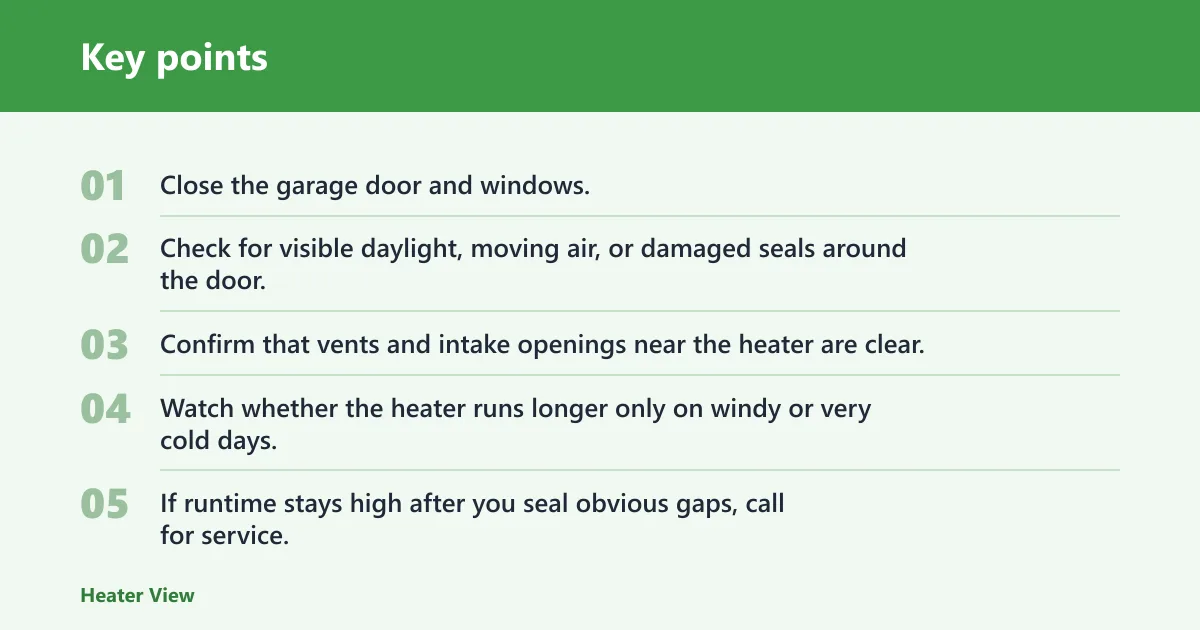
- Close the garage door and windows.
- Check for visible daylight, moving air, or damaged seals around the door.
- Confirm that vents and intake openings near the heater are clear.
- Watch whether the heater runs longer only on windy or very cold days.
- If runtime stays high after you seal obvious gaps, call for service.
Suppose a 2-car garage feels comfortable only when the heater runs nearly nonstop on a calm day. If the same unit used to cycle off more often and nothing in the garage changed except a sagging door seal, the garage is likely losing heat faster than the heater can recover it.
A common mistake is assuming the thermostat is accurate when cold spots and slow warm-up point to a struggling garage heater. If the garage door leaks along the bottom edge, a technician may find no fault in the burner or electric elements at all. In that case, insulation and sealing work may do more than a new heater.
What weak airflow usually means
Weak airflow usually means the heater is restricted, not that it has lost all output. A dirty air filter, dust buildup, or blocked intake can cut the amount of warm air reaching the garage. Professional garage heater maintenance should include cleaning air filters and removing dust and debris buildup during maintenance.
Restricted airflow can also make a heater overheat or short cycle. That lowers comfort and can damage parts over time. If the unit is gas-fired, ventilation matters too, because blocked venting can affect safe combustion and exhaust flow.
Filter, vents, and dust checks
Check the air filter first. A dirty filter is commonly cited as a clear sign that a garage heater is losing performance. Clean or replace it on the interval the manufacturer gives, and inspect nearby surfaces for heavy dust that could be pulled into the unit.
Then look at visible vents, intake grilles, and the space around the heater. The goal is simple: give the unit room to move air and, for gas heaters, room to vent safely. If the vents are blocked or you see repeated dust buildup right after cleaning, the problem may be larger than a filter change.
When heat is uneven or inconsistent
Inconsistent heating usually points to thermostat trouble, cycling problems, or uneven air movement. A thermostat check is part of garage heater maintenance, and accuracy matters because a sensor that reads poorly can make the heater start and stop at the wrong times. That creates hot and cold patches in the garage.
Thermostat placement matters too. If it sits near a supply outlet, in direct sun, or close to a draft, it may not control the heater correctly. The result can look like weak heat even when the unit is actually responding to bad feedback.
Cycle behavior to watch
Short cycling means the heater turns on, shuts off, and starts again too quickly. That can come from restricted airflow, overheating protection, or a thermostat that is not calling for heat correctly. In a garage with thin insulation, short cycling can also happen because the space cools too fast for the heater to settle into steady operation.
Electrical connections matter here as well. Loose or failing connections can disrupt performance and safety, especially on an electric garage heater. On gas models, control faults and ignition problems can produce the same stop-start pattern, but the safety stakes are higher.
Gas heater warning signs
A gas garage heater has combustion-related risks that do not apply in the same way to electric units. Gas line leaks or pressure issues, burner problems, and blocked ventilation need professional attention. If you smell gas, see soot, or notice a flame that does not look stable, stop using the heater.
Basic checks are limited here. You can look for obvious damage, listen for unusual clicking at ignition, and confirm that vents are not blocked. You should not keep testing a unit that may have a leak or a combustion fault.
What needs a technician fast
Gas line problems are not a homeowner repair. The same goes for pressure issues, repeated ignition failure, and signs of incomplete combustion. A common rule of thumb is annual professional service for these heaters, and that service should include inspection of gas lines, ventilation, thermostat function, and dust removal.
If a gas heater runs, then shuts down with little heat produced, the issue may be burner fouling, a sensor problem, or an exhaust restriction. Those are service items, not nuisance issues to ignore.
Electric heater warning signs
An electric garage heater has fewer combustion concerns, but it can still lose performance because of power delivery problems. Loose electrical connections, worn controls, and circuit limits can cut heat output or trigger repeated resets. If the heater is tripping a breaker or shutting itself off often, treat that as a warning sign.
Electric models also depend on proper wattage and the right circuit. If the heater is undersupplied, it may never reach full output even when the elements are fine. That is why electrical inspection belongs in routine maintenance, not only after a failure.
Reset and shutdown clues
Repeated resets often point to overheating protection, a failing control, or an electrical fault. Do not keep restoring power without checking the filter, air path, and visible wiring first. If the problem keeps returning, the heater needs service before it becomes a safety risk.
HECHT offers electric heater models for workshop and garage use, and it also sells infrared heaters for garages and workshops. Those product types still depend on proper installation, clear space, and correct power supply if they are to perform as intended.
What maintenance should I check before replacing a garage heater?
Before replacing a garage heater, check the maintenance items that most often cause weak performance: filter condition, dust buildup, thermostat function, ventilation, gas lines or electrical connections, and the garage’s own heat loss. Annual professional service is recommended, and that visit should include a full safety and performance inspection.
Replacement makes sense only after those basics are ruled out. Many heater complaints turn out to be maintenance gaps or building losses rather than a failed unit. That is especially true when the garage has obvious drafts or thin insulation.
Homeowner check sequence
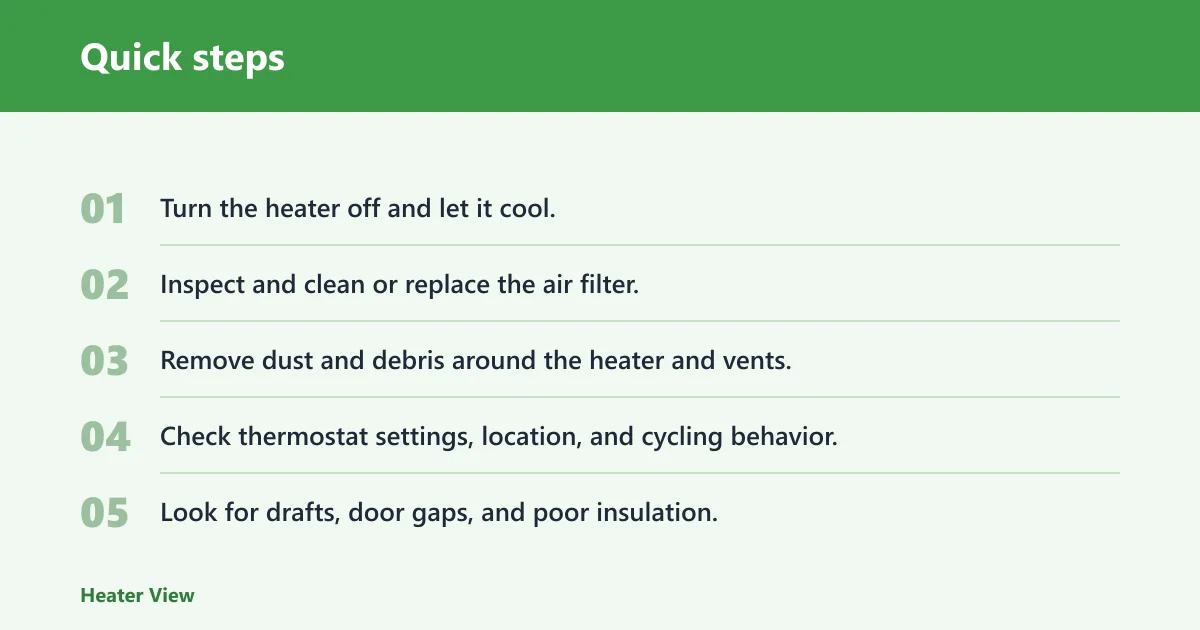
- Turn the heater off and let it cool.
- Inspect and clean or replace the air filter.
- Remove dust and debris around the heater and vents.
- Check thermostat settings, location, and cycling behavior.
- Look for drafts, door gaps, and poor insulation.
- If it is a gas heater, stop if you smell gas or see soot.
- If it is an electric heater, stop if resets or breaker trips continue.
Annual service should also look for rust or deterioration, because physical wear can help explain a heater that no longer performs as it should. Rust around the cabinet, burner area, or support parts can signal that the unit is past simple cleaning and into repair territory.
When is a garage heater too inefficient to repair?
A garage heater is too inefficient to repair when repair costs are stacking up against poor recovery, repeated short cycling, or ongoing uneven heat after the basics have been fixed. If the unit still needs frequent resets, still struggles after filter and vent service, or still leaves the garage cold because of internal faults, replacement becomes more reasonable.
For gas units, safety pushes the decision faster. Burner faults, gas line concerns, and combustion issues should not be patched repeatedly. For electric units, chronic electrical faults or overheating shutoffs are a sign that the system is no longer dependable, even if it still turns on.
Repair or replace
Repair is the better path when the problem is clearly limited to a dirty filter, thermostat issue, blocked vent, or loose connection. Replacement is more likely when the heater has recurring faults, visible deterioration, or a pattern of expensive service calls. Energy-efficient units can help avoid steep utility bills, but only after the garage itself is reasonably sealed.
If the garage has major drafts or weak insulation, a new heater may only mask the real issue. In that case, sealing the building envelope first gives you a fairer read on whether the heater itself is worth repairing.
Frequently asked questions
Why is my garage heater not heating like it used to?
It usually means one of three things: the heater is restricted, the thermostat is not controlling correctly, or the garage is losing heat faster than before. Start with the filter, vents, and visible dust. Then check for drafts, door gaps, and insulation problems before assuming the heater itself has failed.
What are the warning signs a garage heater is losing efficiency?
The main warning signs are longer runtime, short cycling, uneven heat, weak airflow, and rising utility bills without a clear change in use. For gas heaters, burner trouble and ignition faults matter too. For electric heaters, repeated resets and circuit trips often point to power delivery or overheating issues.
Can a dirty filter make a garage heater less efficient?
Yes. A dirty filter restricts airflow, which reduces heat output and can make the heater run longer to do the same job. It can also raise overheating risk. Clean or replace the filter on the manufacturer’s schedule, and check for dust buildup around the unit at the same time.
Does poor ventilation affect garage heater performance?
Yes, especially on gas models. Blocked ventilation can hurt safe combustion and exhaust flow, which affects both performance and safety. Even on electric units, blocked airflow around the heater can contribute to overheating and short cycling. Ventilation should always be part of routine maintenance.
How often should a garage heater be serviced?
Annual professional service is the right baseline for most garage heaters. That visit should include filter cleaning, dust removal, thermostat checks, ventilation inspection, and a look at gas lines or electrical connections. If you notice repeated resets, burner issues, or a smell of gas, do not wait for the yearly visit.
Could insulation or drafts make a heater seem inefficient?
Yes. Drafts, door gaps, and weak insulation can make a heater seem inefficient even when the unit is functioning normally. The heater may be running longer only because the garage is leaking heat. Seal obvious openings first so you can judge the heater on its own performance.