Are heaters safe for babies with sensitive lungs? Key types
Yes. If you need heat for a baby with sensitive lungs, use an electric heater with no combustion, no exposed flame, and little or no fan airflow; keep indoor humidity near 30% to 50% and avoid overheating. Poor heater choice can dry air, stir dust, and worsen wheeze or coughing. This guide explains the safest heater types, settings, and room conditions for babies with asthma, allergies, bronchiolitis history, reflux-related congestion, or eczema.
Are heaters safe for babies with sensitive lungs?
Yes, but only under strict conditions. A heater can be safe in a baby’s room when it is electric, placed correctly, kept clean, and used to hold the nursery in the 68°F to 72°F range. Sensitive lungs change the calculation because babies breathe faster and have smaller airways.
Why sensitive lungs change the decision
Dry air, dust, and warm air blown across the room matter more here than they do for older children. A baby with wheeze, asthma risk, bronchiolitis history, or congestion can react to irritation that would barely affect an adult. Fire safety still matters, but breathing comfort is the bigger nursery issue.
Indoor nursery use should be limited to electric heaters. Combustion heaters, including kerosene, propane, and unvented natural gas, can create carbon monoxide and other combustion byproducts. Electric heaters produce zero carbon monoxide.
📊 Space heaters cause over 1,000 residential fires yearly. Source: Are Space Heaters Safe For Babies? Essential Safety Guide.
What kind of heater is safest for a nursery?
The safest common pick for a nursery is an oil-filled radiator. It has no exposed element, no visible flame, and no fan to blow dust around, which makes it a strong choice when a baby’s lungs are sensitive. For indoor nursery use, electric models are the baseline; fuel-burning heaters do not belong there.
Oil-filled radiator vs ceramic fan-forced vs infrared vs micathermic
An oil-filled radiator is the top nursery pick in this guide because its surface temperature is listed as low, with 140°F max. A ceramic fan-forced heater can warm a room quickly, but the fan can move dust and make noise. Micathermic heaters can be a middle ground, but they still need the same clearance and cleaning rules.
Infrared heaters are described as having a high burn risk. Exposed-element and high-surface-temperature models are a poor fit for nurseries because heater surfaces can reach 200°F or higher. That matters even if the heater is electrically safe, because a curious child, a blanket, or a curtain can still contact the hot surface.
Why exposed elements and high surface temperatures matter
There are two separate risks in a nursery: airway irritation and burn risk. A heater can be electrically safe and still be a bad match for a baby room if the exterior gets very hot or the unit can scorch nearby fabric. Low-surface-temperature designs reduce that contact hazard.
Say your nursery is 11 by 12 feet and the baby sleeps near a dresser. A ceramic fan heater aimed at the crib may push warm, dry air across the mattress while also lifting lint into the air. An oil-filled radiator across the room is less likely to do both.

How do heaters affect a baby’s breathing?
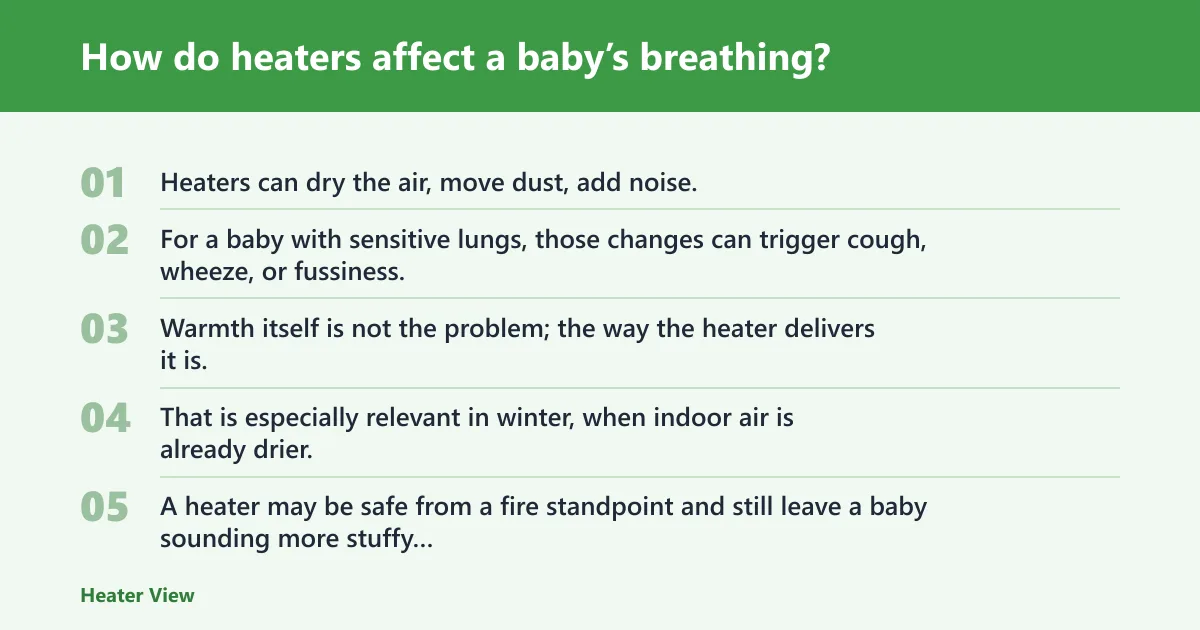
Heaters can dry the air, move dust, add noise, and make congestion feel worse even when they are not dangerous in a fire sense. For a baby with sensitive lungs, those changes can trigger cough, wheeze, or fussiness. Warmth itself is not the problem; the way the heater delivers it is.
Dry air and airway irritation
Dry air can irritate the nose and throat. That is especially relevant in winter, when indoor air is already drier. A heater may be safe from a fire standpoint and still leave a baby sounding more stuffy or more cough-prone if the room becomes too dry.
Dust circulation and fan airflow
Fan-forced heaters can move settled dust back into the room. That matters if a baby has allergies or any tendency toward wheeze. Clean filters and vents help, but they do not erase the basic issue that a fan can stir particles and push warm air directly across the sleeping space.
Noise, sleep disruption, and stress on a sensitive baby
Noise matters too. A loud heater can break up sleep, and poor sleep can make breathing symptoms seem worse or make soothing harder. For a baby already working a little harder to breathe, quiet operation is a practical comfort feature, not a luxury.
When heater warmth can make congestion feel worse
Warm rooms can make some babies look or sound more congested if the air is dry or if mucus thickens at night. That does not mean heat is causing illness. It means the room conditions may be making an existing breathing problem feel more noticeable.
What nursery temperature and humidity should you aim for?
Use 68°F to 72°F as the nursery target and check it with a separate room thermometer, not only the heater display. Stable room temperature matters, especially for infants. Overheating can be a concern even when a heater is electrically safe, so aim for steady comfort rather than the warmest possible setting.
How to think about humidity without making the room damp
Humidity can help offset dry air, and the article recommends a humidifier for that reason. The goal is balanced humidity, not a damp room. Keeping indoor humidity in a moderate range is a common comfort target, but a humidifier should not be treated as a fix-all if the baby is still coughing or wheezing.
Place the thermometer away from the heater so it reflects room conditions, not the hot air near the unit. A heater’s built-in display can be misleading if it reads the outlet stream or the temperature near the appliance.
How far should a heater be from a crib?
Keep the heater at least three feet from the crib and from curtains, furniture, and laundry piles. Put it on a flat, stable surface and keep it out of direct reach. That spacing helps with burn risk, reduces fabric contact hazards, and gives the heater room to move air without aiming heat directly at the baby.
Why extension cords are a poor fit in nurseries
Use a wall outlet rather than an extension cord, if possible. Cords can overheat, create trip hazards, and tempt parents to place the heater where it does not belong. In a nursery, the safest electrical setup is the simplest one.
- Set the heater on a level surface.
- Keep it three feet or more from the crib and soft furnishings.
- Keep it out of reach of the baby and any rolling furniture.
- Do not run the cord under rugs or across walkways.
- Use only the outlet the manufacturer allows.
Safety features to look for before you buy
Choose a model with tip-over shutoff, overheat protection, a cool-touch exterior, thermostat control, and a child lock if those features are available. These features do not solve every nursery problem, but they reduce the chance that a heater becomes unsafe when a parent is distracted or the room layout changes.
Tip-over shutoff and overheat protection
Tip-over protection matters if the unit is bumped by a sibling, pet, or piece of furniture. Overheat protection matters if airflow gets blocked or the unit runs too long. Both features are more useful in a nursery than decorative extras or complicated app controls.
Cool-touch exterior and thermostat control
A cool-touch exterior lowers the burn hazard if someone brushes past the heater. Thermostat control helps hold the room near the target range instead of cycling into excess heat. That helps both comfort and breathing stability.
Child lock and simple controls
A child lock is useful when a toddler is also in the home. Simple controls reduce the chance of a mistaken setting change. In a nursery, fewer buttons usually mean fewer surprises.
Baby-lung safety decision table
This table scores common heater types by airway irritation, dryness, noise, dust movement, carbon monoxide risk, and nursery suitability. Lower scores are better for sensitive lungs. The best overall fit is usually an oil-filled radiator, with electric, non-combustion models preferred over any fuel-burning heater.
| Heater type | Airway irritation risk | Dryness risk | Noise | Dust movement | Carbon monoxide risk | Nursery suitability |
|---|---|---|---|---|---|---|
| Oil-filled radiator | Low | Low | Low | Low | Zero if electric | Best overall |
| Ceramic fan-forced | Moderate | Moderate | Moderate | Moderate to high | Zero if electric | Use with caution |
| Micathermic | Low to moderate | Low to moderate | Low | Low | Zero if electric | Good if properly placed |
| Infrared / radiant | Low to moderate | Low | Low | Low | Zero if electric | Limited by burn risk |
| Exposed-element or high-surface-temperature model | Moderate | Moderate | Low to moderate | Low | Zero if electric | Poor choice for nursery |
| Kerosene, propane, unvented natural gas | High | Moderate to high | Moderate | Moderate | High | Do not use indoors |
Red-flag symptom checklist for stopping heater use
Stop using the heater and check the room if the baby develops wheeze, cough, increased work of breathing, unusual sleep disruption, or visible irritation such as watery eyes or a red, stuffy nose that seems worse after the heater runs. If symptoms improve when the heater is off, that is an important clue.
Suppose a baby who usually sleeps quietly starts waking every hour after a fan heater has been running for two nights, then develops a cough and noisy breathing at the chest. Turn the heater off, ventilate the room if needed, and ask a clinician for guidance before using heat again.
Babies who already need oxygen, monitoring, or specific medical instructions for breathing problems may need clinician guidance before any heater is used. That is especially important if the baby has bronchiolitis, recurrent wheeze, or other respiratory care plans in place.
Frequently asked questions
Are heaters safe for babies with sensitive lungs?
Yes, but only with an appropriate heater, safe placement, and suitable room conditions. For a baby with sensitive lungs, a safer approach is often an electric heater with no combustion, minimal fan airflow, clear distance from the crib, and a nursery kept at a comfortable temperature.
What kind of heater is safest for a nursery?
An oil-filled radiator is usually the best nursery choice because it has no exposed flame, no combustion, and no fan to stir dust. It also keeps surface temperature lower than many other heater types, which helps reduce burn risk around a baby’s room.
Can a space heater dry out a baby’s lungs?
A space heater can make the room air feel drier, and that can irritate the nose and throat. It does not literally dry out the lungs, but the resulting dryness can worsen cough, stuffiness, or discomfort in a baby who already has sensitive airways.
Do heaters make asthma or wheezing worse in babies?
They can, depending on the heater type and room conditions. Fan-forced units can move dust, hot dry air can irritate airways, and a noisy heater can disrupt sleep. Electric heaters that run quietly, stay clean, and do not blow air directly at the baby are less likely to cause problems.
How far should a heater be from a crib?
Keep the heater at least three feet from the crib, curtains, furniture, and laundry piles. That spacing helps protect against burns, reduces the chance of fabric contact, and limits direct airflow or heat radiation toward the baby’s sleeping area.
Is an electric heater safer than a gas heater for babies?
Yes. Electric heaters produce zero carbon monoxide, while combustion heaters such as kerosene, propane, and unvented natural gas can create carbon monoxide and other combustion byproducts. For a nursery, electric is the safer indoor baseline.
Should I use a humidifier with a heater in my baby’s room?
A humidifier can help offset dry air, especially when a heater is running, but it is not a cure-all. The goal is balanced humidity, not a damp room. Use it to support comfort, then keep watching for coughing, wheeze, or congestion that still seems to worsen.
What heater settings are safest for a nursery?
The safest setting is the one that keeps the room steady at 68°F to 72°F without overheating. Use thermostat control if available, avoid running the heater while parents are asleep or away, and turn it off if the room starts feeling too warm or the baby shows breathing irritation.