Gas Pool Heater vs Electric Pool Heater: Which Should You Buy?
Choose gas if you want fast, on-demand heating and electric only if you swim often enough and your electrical service can support the unit. Pick the wrong one and you can pay more to heat less, or wait too long for the pool to reach usable temperature. This guide compares operating cost, heat-up speed, climate fit, and installation limits so you can choose the better heater for your pool.
| Decision factor | Gas pool heater | electric pool heater | Winner |
|---|---|---|---|
| Heat-up speed | Fast. Good for quick recovery and irregular use. | Resistance units heat slowly; heat pumps are slower still. | Gas pool heater |
| Operating cost for steady use | Usually higher fuel cost, especially for frequent long runs. | Heat pumps can be lower cost in warm air; resistance units are expensive to run. | electric pool heater |
| Electrical demand | Needs gas line, venting, and electrical power only for controls. | Needs 240V or 220V supply; some setups need a panel or service upgrade. | Gas pool heater |
| Cold-weather performance | Works regardless of outdoor air temperature. | Heat pumps slow down as air gets colder; resistance heaters are unaffected but costly. | Gas pool heater |
| Install friction | Gas line, venting, and in some regions permit or certified installer requirements. | Dedicated circuit, breaker sizing, and possible panel work. | Tie |
| Best use case | Season extenders, large pools, windy sites, and occasional swimming. | Steady swimming with warm ambient air and manageable utility capacity. | Depends on usage |
Heating speed and running costs
Gas wins when speed and recovery matter more than fuel cost. Electric only makes sense when your use pattern is steady and your utility setup can support the unit without a costly service change. That split matters more than brand loyalty or a simple “gas versus electric” label.
Heat-up speed and recovery
Gas heaters recover a cold pool quickly, even in cool air or wind. Standard residential models are often in roughly the 200,000 to 400,000 BTU range, which is why they are commonly used for faster warm-up and for helping take the edge off a pool that has sat uncovered overnight. In practical terms, BTU capacity is the heater’s heating output, so bigger numbers generally mean faster recovery when the rest of the setup can support it.
Electric resistance heaters are the opposite. They are silent, and a COP of about 1 means they convert electricity to heat at a one-to-one rate, without the heat-multiplying effect of a heat pump. That makes them simple, but usually practical only for small spas or hot tubs.
Operating cost and efficiency
For steady swimming, the better electric choice is usually a heat pump, not resistance heat. Air-to-water heat pumps are listed at COP values of 3.0 to 6.0, and the supplied operating figure is $0.47 per hour under the listed assumptions, while resistance heat is listed at $1.47 per hour. COP, or coefficient of performance, is the output heat divided by the electricity used, so a higher COP means lower running cost for the same delivered heat.
Gas heaters are best compared on thermal efficiency, not COP. Standard gas units are listed at 0.80 to 0.85 thermal efficiency, and high-efficiency gas units at 0.95 to 0.97. That does not mean gas is always expensive; it means gas is usually the speed-first option, while a heat pump can be the lower-running-cost option when warm air gives it time to work.
Gas pool heater vs electric pool heater comparison
| Factor | Gas pool heater | electric pool heater | Winner |
|---|---|---|---|
| Fuel source | Natural gas or propane | 240V or 220V electricity | Tie |
| Typical installed cost | $3,500 to 6,500 | $2,500 to $4,500 for resistance; $5,500 to $9,500 for air-to-water heat pumps | Depends on type |
| Cold-weather use | Works regardless of outdoor air temperature | Heat pumps depend on ambient air; resistance units do not, but cost more to run | Gas pool heater |
| Speed | Fast recovery | Resistance: slow; heat pump: slower than gas | Gas pool heater |
| Best fit | Seasonal, irregular, or colder-climate use | Steady use where electrical capacity and air conditions fit | Depends on use pattern |
Fuel source and power requirements
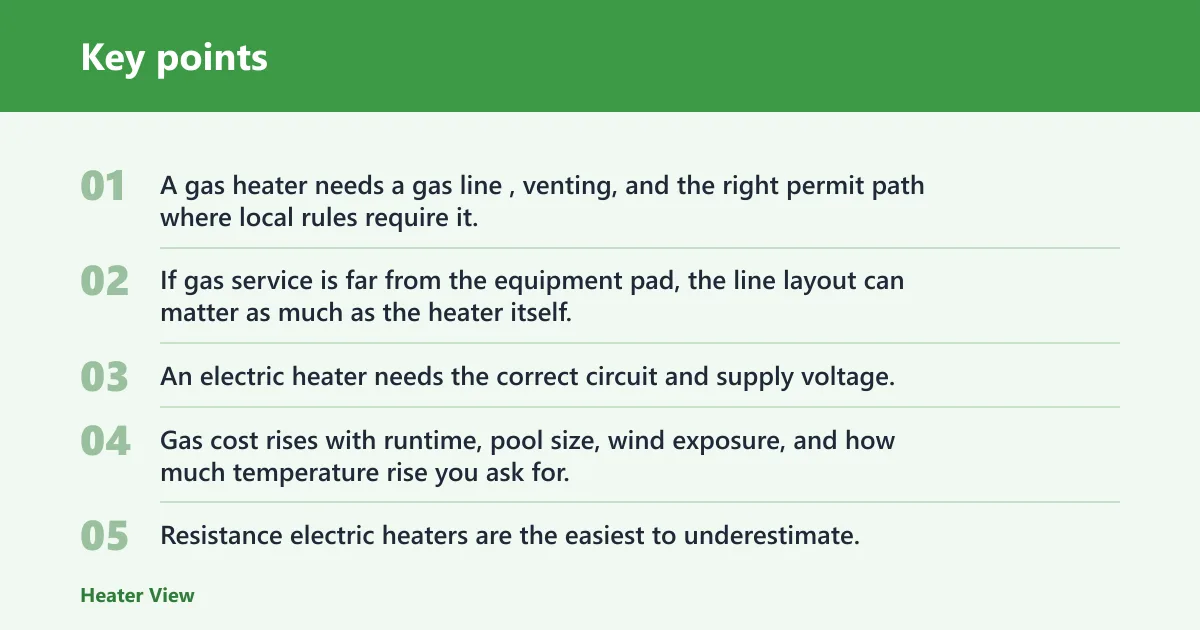
A gas heater needs a gas line, venting, and the right permit path where local rules require it. Propane is the fallback where natural gas service is absent, but fuel cost is often higher in some markets, so it is usually chosen because service is available, not because it is cheap. If gas service is far from the equipment pad, the line layout can matter as much as the heater itself.
An electric heater needs the correct circuit and supply voltage. Heat pumps usually need a dedicated electrical circuit, and resistance models can drive a panel or service upgrade when the load calculation says the existing service is too small.
Operating cost drivers
Gas cost rises with runtime, pool size, wind exposure, and how much temperature rise you ask for. Heat pumps are far more efficient in warm air, but their output falls as the air cools, so shoulder-season costs can move around more than many buyers expect. That is why air temperature and cover use can change the real-world bill more than the nameplate rating alone.
Resistance electric heaters are the easiest to underestimate. The listed $1.47 per hour is a reminder that simplicity does not equal low cost, and that figure can become hard to accept on a large pool or a long swim season.
Installation and site constraints
Gas heater installation is listed at $3,500 to 6,500, while electric resistance heater installation is listed at $2,500 to $4,500. Air-to-water heat pump installation is listed at $5,500 to $9,500, which is one reason heat pumps often cost more upfront than gas even before any wiring changes are added.
If the heater sits far from service, trenching, vent routing, or a service upgrade can change the budget more than the heater shell itself. That is why the utility layout should come before brand choice.
Which pool heater warms water faster, gas or electric?
Gas warms water faster. That is the cleanest answer, and it holds up for cold pools, short notice use, and overnight recovery. Heat pumps can heat a pool, but they do it more slowly, while electric resistance units are simple but still limited by their lower practical heat output on larger pools.
Michigan figures in the supplied facts put gas around 1.5°F per hour and heat pumps around 0.5°F per hour. Those numbers are useful because they show the real buying question: do you need quick recovery, or do you need a lower operating cost over many hours?
Cold pool recovery
Suppose your pool dropped overnight and you want it comfortable by afternoon. A gas unit is the safer choice because it can push heat into the water quickly without waiting for outdoor air to cooperate. That matters most when the pool is uncovered and the night air is cool or windy.
Heat pump timing versus resistance heat
Heat pumps are better thought of as steady heaters, not quick recovery machines. Resistance heaters can make heat directly, but the operating cost is the trade-off, so they fit small spas better than family pools.
What does each heater cost to buy and install?
Gas and electric do not differ only in equipment price. Gas often brings line and venting work, while electric often brings breaker, circuit, or panel work. Once you add utility work, the cheaper sticker can stop being the cheaper project.
Gas line, venting, and permit friction
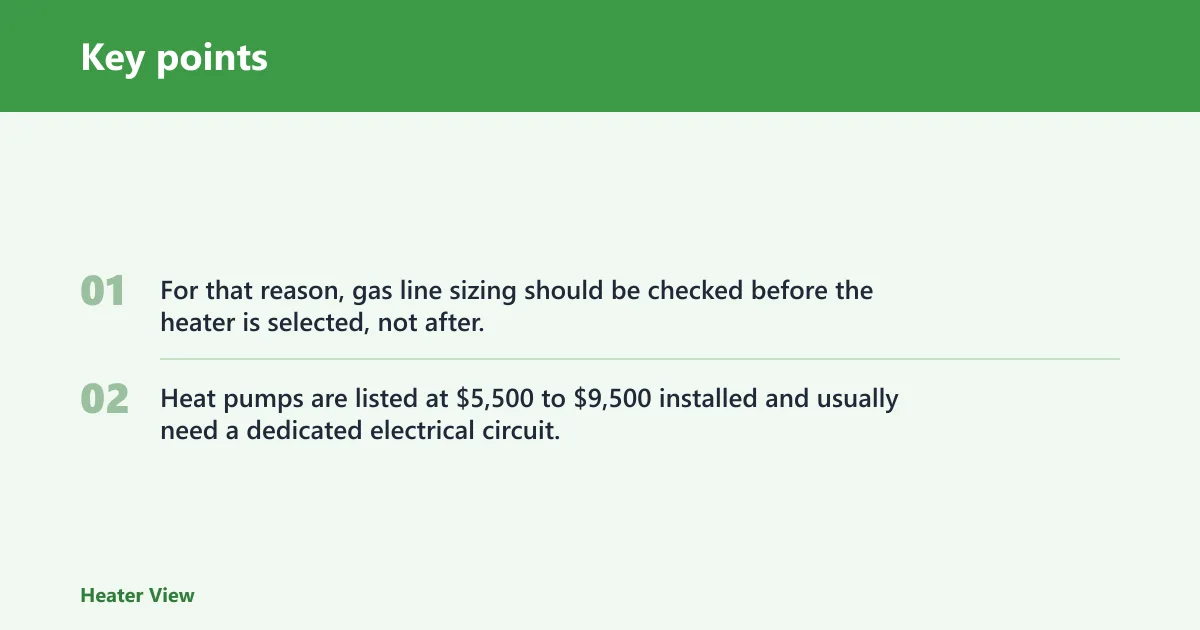
Gas heater installation is listed at $3,500 to 6,500, and some regions add gas permit or certified-installer requirements. Natural gas units can also reach up to 400,000 BTU, which is useful for quick recovery but can make sizing and vent planning more important. For that reason, gas line sizing should be checked before the heater is selected, not after.
Electrical service, breaker, and circuit needs
Electric resistance heater installation is listed at $2,500 to $4,500, but that does not include every possible service upgrade. A 200 amp panel is not automatic, and a proper load calculation should decide whether your current service can carry the heater along with the rest of the house.
Heat pumps are listed at $5,500 to $9,500 installed and usually need a dedicated electrical circuit. That is why the “electric” label is not enough on its own; the cost and load profile depend on whether you mean resistance heat or a heat pump.
What will it cost to run each heater?
Running cost depends on heater type, pool size, target temperature rise, climate, and runtime. A cover changes the math because it cuts overnight heat loss and reduces how long the heater must run, which matters for every system. A simple way to think about monthly cost is heater hourly cost multiplied by run hours per month, adjusted upward or downward for wind, exposure, and cover use.
Monthly cost inputs for gas heaters
Gas costs depend on fuel price and duty cycle, so a universal monthly number would be misleading. As a practical example, a seasonal-use pool that runs a gas heater for short, high-demand sessions can keep the bill manageable, while a pool that stays warm all month will spend much more.
Natural gas is usually the lower-fuel-cost option compared with propane in markets where service is available. Propane is the backup where gas service is absent, not the first choice for low running cost.
Monthly cost inputs for electric resistance heaters
Electric resistance is the costliest steady-use electric option in this comparison. The supplied operating figure is $1.47 per hour, which means a few long sessions each week can add up quickly for a full-size pool.
Monthly cost inputs for heat pump heaters
Air-to-water heat pumps are listed at $0.47 per hour and COP values of 3.0 to 6.0. They are usually the electric option to consider when you swim often and the air is warm enough for the unit to hold output for long enough to matter.
How a pool cover changes runtime
A pool cover lowers overnight heat loss and cuts heater runtime. That helps gas, resistance, and heat pump systems alike, and it often matters as much as one step of heater upsizing because every lost degree has to be bought back later.
A common first-timer mistake is to size the heater for daytime use and ignore overnight wind. The next morning the water feels colder than expected, and the owner blames the heater instead of the uncovered surface.
How do climate and season length change the choice?
Climate decides whether speed or efficiency matters more. Warm places with longer swim seasons favor heat pumps if electrical service is available, while cool, windy, or shoulder-season use pushes the choice back toward gas because the heater has to fight more heat loss. Ontario and similar cold-climate guidance points in the same direction: gas is the faster, more weather-proof option when the season is short or the nights are cold.
Warm climates and heat pump fit
Heat pumps are best in warm air because they move heat from the air into the water. If your pool stays open for many months and you swim often, the lower operating cost can outweigh the slower heat-up rate.
Cool weather, windy pools, and gas advantage
Gas is the safer pick when the weather is unreliable or the pool sits in wind. In colder climates, that extra speed matters because the heater is not fighting the ambient air for long stretches in the same way a heat pump does.
Shoulder-season use in Ontario and similar climates
The Ontario facts also say heat pumps can cost roughly one-third as much as gas in warm shoulder weather. That makes heat pumps appealing for frequent swimmers during mild periods, but the slower heat-up rate still leaves gas ahead when the goal is quick, occasional heating.
Pool heater decision matrix
| Scenario | Pool size and use | Climate and utility setup | Best heater | Simple monthly cost estimate | Do not buy warning |
|---|---|---|---|---|---|
| Small pool or spa | Up to spa size; frequent short sessions | Any mild climate; strong electric service; no gas line | electric pool heater, resistance if the vessel is small enough | Use the $1.47 per hour figure as the starting point for resistance heat; heat pumps are often lower if the air stays warm | Do not buy resistance heat for a full-size pool. |
| Medium pool with regular weekend use | One or two swims each week | Warm to moderate climate; electrical service can support a dedicated circuit | electric pool heater, heat pump | Use the $0.47 per hour heat-pump figure for warm-air periods | Do not buy resistance heat if you plan long run times. |
| Large pool or irregular use | Full-size pool; fast recovery needed | Cool nights, wind, or short swim notice; gas service available | Gas pool heater | Monthly cost varies with fuel price and runtime; gas is usually the practical choice when speed matters most | Do not buy a heat pump if you need fast recovery after idle periods. |
| Season extender in cold climate | Pool stays open into shoulder season | Ontario-like weather or similar; fuel access favors gas | Gas pool heater | Gas usually covers the cold-weather load better than electric heat pumps | Do not buy a heat pump if you need dependable cold-weather heat-up. |
-
Check your utility first.
Confirm gas-line access, venting path, or electrical service before you price a heater. If the only feasible option needs a panel upgrade or trenching, the “cheap” heater can become the expensive project.
-
Match the heater to use pattern.
Choose gas for short-notice, irregular swimming and choose electric only if you heat often enough for the operating cost to make sense. Heat pumps fit steady use in warm air; resistance heat fits small volumes only.
-
Size from water volume.
Use pool volume or surface area, desired temperature rise, climate, and swim-season length to decide BTU or heat-pump capacity. Bigger pools, colder nights, and longer desired runtimes all push the size upward.
-
Add a cover.
Use a cover if you want shorter runtime and lower overnight heat loss. It helps every heater type and often does more for comfort than a small upsizing decision.
Choose Gas pool heater if… / Choose electric pool heater if…
Choose Gas pool heater if you need quick recovery, swim irregularly, face cool nights or wind, or want a season-extender that works regardless of outdoor air temperature. It is also the better fit when your pool is large and your gas service is already in place.
Choose electric pool heater if you swim often, your electrical service can support the load, and you are evaluating a heat pump for warm-air efficiency or a resistance heater for a small spa. If you need fast warm-up, or you are trying to heat a full-size pool with resistance heat, skip it.


Frequently asked questions
Is a gas pool heater or electric pool heater cheaper to run?
For frequent heating, a heat pump is usually cheaper to run than gas when the air is warm enough for good output. Electric resistance is usually the most expensive electric option. Gas often wins on speed, while heat pumps win on efficiency in mild weather.
Do I need a 200 amp panel for an electric pool heater?
Not always. Electrical needs vary by heater size, existing loads, and the local load calculation, so a 200 amp panel is not a blanket rule. A heat pump may fit a modest service better than a resistance heater, but the exact answer depends on the model.
How much does it cost to install a gas pool heater vs an electric one?
Gas heater installation is listed at $3,500 to 6,500. Any gas-line extension, vent work, or panel upgrade can move those totals higher.
Will an electric pool heater work in cool weather?
A heat pump will work, but less effectively as air temperature drops. Electric resistance heating still works in cool weather, but it is costly to run. If you need dependable cold-weather output, gas is the stronger choice.
What size heater do I need for my pool?
Size depends on pool volume or surface area, the temperature rise you want, local climate, and how long you plan to keep the pool comfortable. Standard gas heaters are often around 200,000 to 400,000 BTU, while heat-pump sizing should follow the manufacturer’s listing for your model and climate. A practical sizing workflow is to start with gallons, add the desired temperature rise, then adjust upward for exposure, wind, and whether a cover will be used consistently.