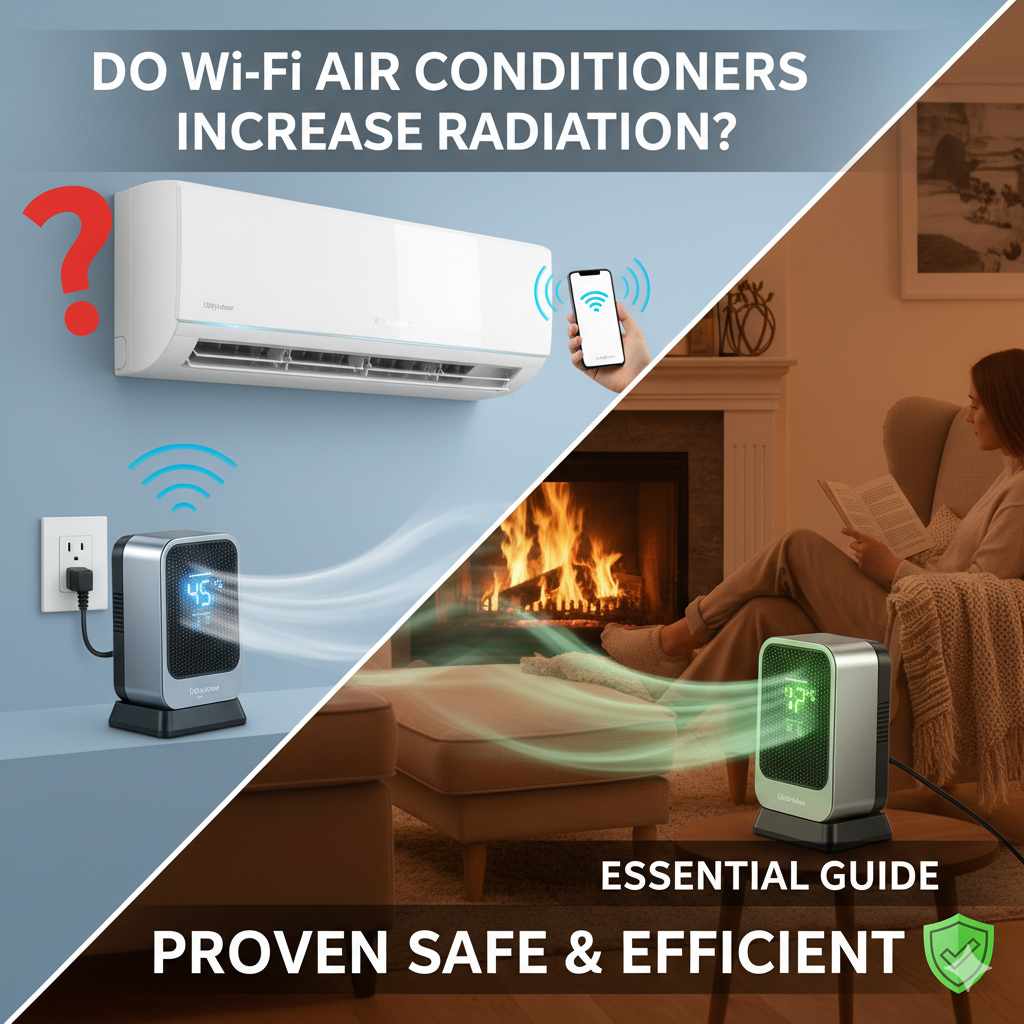
Do Wifi Air Condition Units Increase Radiation? Essential Guide
Worried about radiation from your smart AC? The good news is that Wi-Fi air conditioners emit very low levels of electromagnetic radiation, comparable to your router or phone. These levels are well within safety standards and pose no known health risk. This guide will explain how they work, what the science says, and how you can enjoy your smart AC without worry.
Understanding Your Wi-Fi Air Conditioner
Wi-Fi air conditioners, also known as smart air conditioners, are a modern marvel for home cooling. They offer convenience, energy savings, and enhanced control, all thanks to their connectivity features. But what makes them “smart,” and how does that relate to radiation?
How Smart ACs Work
At their core, these units are still air conditioners. They have compressors, fans, and refrigerant to cool your space. The “smart” part comes from an added component: a Wi-Fi module. This module allows your air conditioner to communicate with your home network and, more importantly, with you via a smartphone app.
Here’s a simple breakdown of their smart functions:
- Remote Control: Adjust temperature, fan speed, and modes from anywhere using your phone.
- Scheduling: Set timers for your AC to turn on or off automatically, saving energy and ensuring comfort.
- Smart Home Integration: Connect with other smart devices like voice assistants (e.g., Alexa, Google Assistant) for hands-free control.
- Energy Monitoring: Some models track energy usage, helping you identify ways to save money.
The Role of Wi-Fi in Your AC
The Wi-Fi module in your air conditioner is essentially a small radio transmitter and receiver. It uses the same radio frequencies that your wireless router and other connected devices use to send and receive data. This data includes commands from your app, status updates from the AC, and information for smart home integration.
Think of it like this: your phone “talks” to your router, and your router “talks” to your AC. All this communication happens wirelessly, using radio waves.

What is Radiation Anyway?
The term “radiation” can sound intimidating, but it’s a broad scientific concept. It refers to energy that travels through space or matter in the form of waves or particles. We encounter different types of radiation every day, from the light we see to the heat we feel from the sun.
Types of Radiation
Radiation is broadly categorized into two main types:
- Non-ionizing Radiation: This is low-energy radiation. It doesn’t have enough energy to remove electrons from atoms or molecules. Examples include radio waves, microwaves, and visible light. The Wi-Fi signals from your AC, router, and phone fall into this category.
- Ionizing Radiation: This is high-energy radiation that does have enough energy to remove electrons from atoms or molecules. This can potentially damage cells and DNA. Examples include X-rays, gamma rays, and ultraviolet (UV) radiation.
It’s crucial to understand this distinction. Wi-Fi air conditioners, like all Wi-Fi devices, only emit non-ionizing radiation.
Electromagnetic Fields (EMFs) and Radiofrequency (RF) Radiation
Wi-Fi devices, including smart ACs, produce electromagnetic fields (EMFs). Specifically, they emit radiofrequency (RF) radiation, which is a type of non-ionizing EMF. These RF waves are used to transmit data wirelessly.
The intensity of these RF waves decreases significantly with distance. The further you are from the source, the weaker the signal becomes.
Do Wi-Fi Air Conditioners Emit Significant Radiation?
This is the core question many people have. The answer, backed by scientific consensus, is a reassuring “no.” Wi-Fi air conditioners emit very low levels of RF radiation, comparable to other everyday wireless devices.
Comparing Wi-Fi AC Radiation to Other Devices
To put it into perspective, consider the radiation levels from common household items:
- Wi-Fi Router: Your home’s Wi-Fi router constantly emits RF signals to provide internet access to all your devices. A smart AC’s Wi-Fi module emits at a similar or even lower strength when actively communicating.
- Smartphone: When you make a call or use data on your mobile phone, it emits RF radiation. The power output of a smartphone can be significantly higher than a Wi-Fi AC unit, especially if you’re holding the phone close to your body.
- Microwave Oven: While microwaves use RF radiation for heating, they operate at much higher power levels. However, they are designed with shielding to contain this radiation when the door is closed.
The United States Food and Drug Administration (FDA) provides valuable information on this topic, stating that “the energy from radiofrequency devices is not enough to damage DNA and hence not considered a cause of cancer.” You can learn more about RF radiation and health from their safety guidelines.
Safety Standards and Regulations
Electronic devices that emit RF radiation, including Wi-Fi air conditioners, must comply with safety standards set by regulatory bodies. In the United States, the Federal Communications Commission (FCC) sets these limits. These limits are designed to ensure that the devices operate at power levels well below those that could cause harm.
The FCC enforces Specific Absorption Rate (SAR) limits, which measure the rate at which energy is absorbed by the body when exposed to RF fields. These limits are based on extensive scientific research and are considered very conservative, providing a large margin of safety. For more details, you can consult the FCC’s official site on radiofrequency exposure.
Potential Radiation Sources and Levels
Let’s look at the specific ways your Wi-Fi AC emits RF radiation and what influences its level.
When Does a Wi-Fi AC Emit Radiation?
A Wi-Fi air conditioner emits RF radiation primarily when it is actively communicating wirelessly. This happens in a few scenarios:
- Initial Setup: During the process of connecting your AC to your home Wi-Fi network.
- Receiving Commands: When you use your smartphone app to turn it on/off, change settings, or schedule operations.
- Sending Status Updates: Periodically, the AC may send information back to the app or your smart home hub.
- Software Updates: If the AC needs to download firmware or software updates.
It’s important to note that the unit does not constantly broadcast at its maximum power. It uses power efficiently, transmitting only when necessary for communication.
Factors Affecting Radiation Levels
Several factors can influence the strength of the RF radiation emitted by your Wi-Fi AC, though generally these levels are very low:
- Distance: As mentioned, RF signal strength decreases rapidly with distance. The further you are from your AC unit, the less you are exposed.
- Transmission Power: Like any wireless device, the AC has a transmitter. However, for home appliances, these are typically set to low power to conserve energy and meet regulations.
- Obstacles: Walls, furniture, and other obstructions can block or weaken RF signals, further reducing exposure.
- Activity: The AC emits more when actively sending or receiving data, and less when it’s idle.
What Does the Science Say About EMFs and Health?
Concerns about EMFs and health have been around for decades. Major health organizations and scientific bodies have conducted extensive research on the topic. The consensus among these organizations is that the low levels of non-ionizing radiation emitted by devices like Wi-Fi ACs are not harmful.
Scientific Consensus and Health Organizations
Leading health organizations, such as the World Health Organization (WHO) and the American Cancer Society, have reviewed the available scientific literature. Their findings consistently indicate no established link between exposure to low-level RF radiation from wireless devices and adverse health effects.
The WHO states in its section on electromagnetic fields and public health: “To date, and after much research performed, no adverse health effect has been causally linked with exposure to mobile phone signals.” While this specifically refers to mobile phones, the principle applies to all low-power RF emitting devices, including your smart AC.
Understanding Anecdotal Evidence vs. Scientific Studies
It’s easy to find anecdotal evidence or personal stories online suggesting harm from Wi-Fi or other EMF sources. However, these are personal accounts and not scientific proof. Scientific studies are conducted under controlled conditions, with large sample sizes, and undergo peer review to ensure reliability and validity.
When looking at EMFs, it’s crucial to rely on the findings from reputable scientific institutions and health authorities rather than isolated claims.
Minimizing Exposure: Practical Tips
Even though Wi-Fi ACs are considered safe, it’s natural to want to minimize your exposure to any form of electromagnetic radiation if possible. Here are some simple, practical tips:
Smart Usage Habits
Adjusting how you use your smart AC can help reduce its wireless activity:
- Use Wi-Fi Only When Needed: If you don’t require remote control or smart features, you can often disable the Wi-Fi function on your AC. Check your user manual for specific instructions.
- Limit Remote App Usage: Use the app when you genuinely need it for scheduling or remote adjustments, rather than constantly checking or interacting with it.
- Strategic Placement: Install the AC unit where its Wi-Fi signal strength is least likely to be directly in your primary living or sleeping areas if you are particularly concerned.
Understanding Your Device’s Settings
Some advanced users might be interested in delving deeper into their device’s capabilities. Always refer to your specific model’s manual:
- Disable Wi-Fi: Many models allow you to turn off the Wi-Fi module completely via the unit’s interface or the mobile app. This completely eliminates RF emissions from the AC.
- Airplane Mode: Some smart appliances may have an “Airplane Mode” which is the equivalent of disabling wireless communication.
For example, a user manual for a popular smart AC brand might include a section like this (example shown within the text):
“To disable Wi-Fi connectivity, navigate to Settings > Network > Wi-Fi > Disable. This will prevent the unit from connecting to your wireless network and emitting RF signals.”
Consulting your product’s manual is the best way to learn about its specific features related to wireless connectivity.
General EMF Reduction Strategies
These tips apply not just to your AC but to all your wireless devices:
- Maintain Distance: Keep a reasonable distance between yourself and wireless devices whenever possible.
- Reduce Usage Time: Limit the time you spend in close proximity to active wireless devices.
- Use Wired Connections: Wherever feasible, opt for wired Ethernet connections over Wi-Fi for devices that don’t need to be mobile.
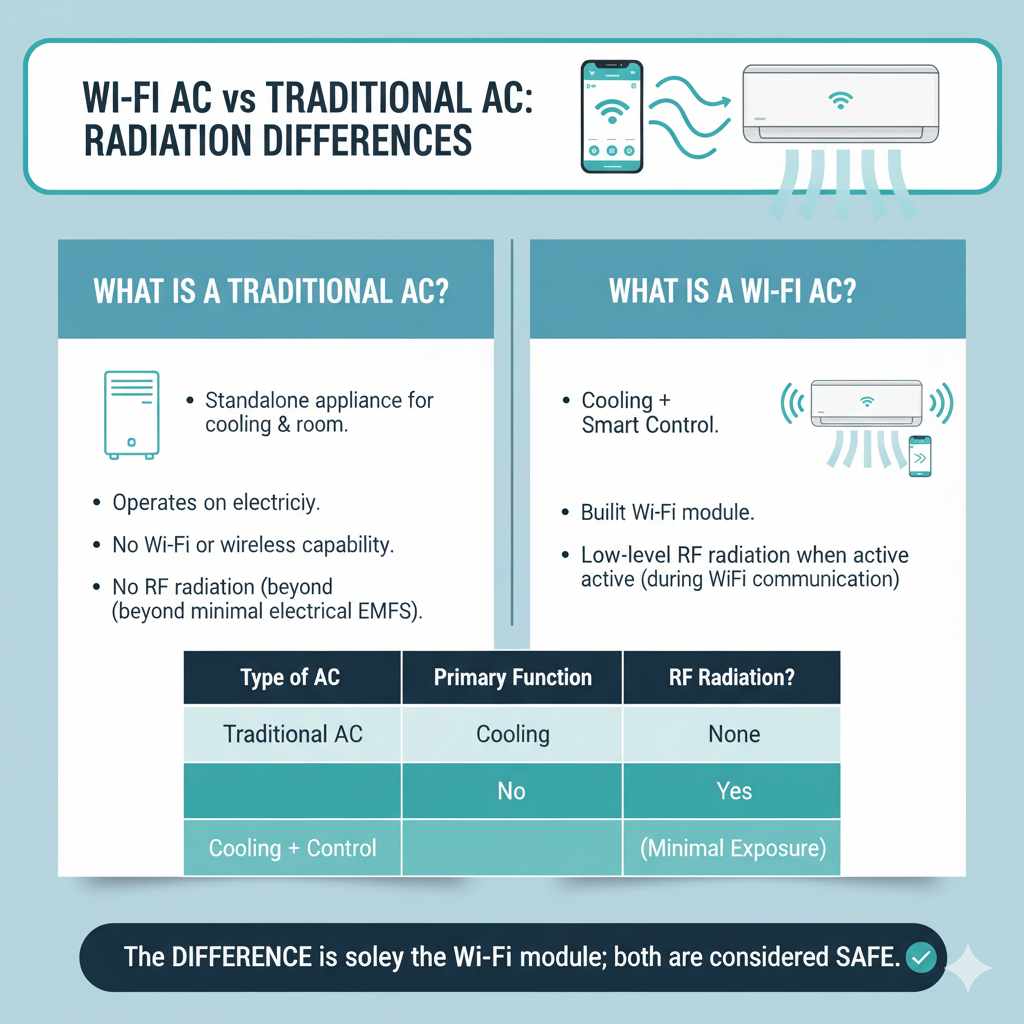
Wi-Fi AC vs. Traditional AC: Radiation Differences
The primary difference in radiation between a Wi-Fi AC and a traditional AC lies solely in the presence of the Wi-Fi module. A traditional AC unit has no wireless communication capabilities and therefore emits no RF radiation.
What is a Traditional AC Unit?
A traditional air conditioner is a standalone appliance designed to cool a room. It operates on electricity to perform its cooling function. It has no built-in capability to connect to the internet or any other wireless network. Therefore, it does not emit any RF radiation beyond the very minimal EMFs generated by its electrical components, which are not related to wireless communication.
Comparison Table: Radiation Output
Here’s a simple comparison:
| Type of Air Conditioner | Primary Function | Wi-Fi/Smart Capability | RF Radiation Emission | Potential Exposure Concerns |
|---|---|---|---|---|
| Traditional AC | Cooling | No | None relevant to wireless | Standard electrical safety considerations |
| Wi-Fi/Smart AC | Cooling + Smart Control | Yes | Low-level RF radiation when active | Minimal, well within safety limits; primarily during Wi-Fi communication |
The key takeaway is that the cooling mechanism itself is identical. The added “radiation” from a Wi-Fi AC is solely from its wireless communication module, which operates at very low power levels.
Frequently Asked Questions (FAQ)
Q1: Do Wi-Fi air conditioners emit harmful radiation?
A1: No, Wi-Fi air conditioners emit non-ionizing radiofrequency (RF) radiation, which is very low-level. Scientific consensus and health organizations confirm that this type of radiation, at levels emitted by these devices, is not known to cause harm.
Q2: How much radiation does a Wi-Fi AC unit produce compared to a smartphone?
A2: Generally, a Wi-Fi air conditioner emits significantly less RF radiation than a smartphone, especially when the phone is in active use (e.g., during a call or using cellular data). The AC’s transmitter is much lower power and usually further away from you.
Q3: Can I turn off the Wi-Fi on my smart air conditioner?
A3: Yes, most smart air conditioners allow you to disable the Wi-Fi feature through the unit’s settings menu or the companion mobile app. This will stop it from emitting RF radiation.
Q4: Are there any health risks associated with long-term exposure to Wi-Fi AC radiation?
A4: Based on current scientific understanding and extensive research by global health organizations, there are no established health risks associated with long-term exposure to the low-level non-ionizing RF radiation from Wi-Fi AC units.
Q5: Is the radiation from a Wi-Fi AC unit stronger when I’m far away?
A5: No, the opposite is true. Radiofrequency radiation strength decreases significantly with distance from the source. The further you are from the Wi-Fi AC, the weaker the signal and your exposure.
Q6: Do Wi-Fi air conditioners pose a higher radiation risk than a standard Wi-Fi router?
A6: The radiation levels are often comparable, and sometimes a router might emit slightly more when dealing with multiple devices, but both are considered very low. Your smart AC only transmits when needed for commands or updates.
Conclusion
It’s completely understandable to be curious, and perhaps a little concerned, about new technology and its potential impact on your home environment. When it comes to Wi-Fi air conditioners, you can rest assured that the “smart” features do not introduce a significant radiation risk.
These units emit very low levels of non-ionizing radiofrequency radiation, which is consistent with government safety standards and the findings of major health organizations worldwide. The science is clear: the RF emissions from your Wi-Fi AC are comparable to, and often less than, those from your everyday devices like smartphones and Wi-Fi routers, and they are not known to cause adverse health effects.
By understanding how these devices work and following a few simple tips, like disabling Wi-Fi when not in use or maintaining a little distance, you can confidently enjoy the convenience and comfort of your smart air conditioner. Your home can remain a safe and cool sanctuary, powered by modern convenience without unnecessary worry.