Do Bathroom Heaters Need GFCI Protection? Bathroom Code
Yes. If a bathroom heater plugs into a 125V, 15- or 20-amp bathroom receptacle, that outlet typically needs GFCI protection under NEC 210.8(A), and there is generally not a heater exception. The code is aimed at the bathroom receptacle and the shock hazard around water, not at the heater as a special appliance class.
Do bathroom heaters need GFCI protection?
What the code is actually regulating
Ground Fault Circuit Interrupter protection watches the difference between hot and neutral conductors. If some current leaks to ground, often through a person, the device trips when the difference exceeds approximately 5 milliamps and opens the circuit within about 1/40th of a second. That fast shutoff is what makes GFCI protection useful in bathrooms, laundry rooms, and other places where water can reach the cord or plug.
NEC 210.8 is generally the main section for GFCI requirements in dwelling-unit receptacles at 1000V or less. In bathrooms, the rule is simple: all bathroom receptacles in dwelling units require GFCI protection. The requirement applies to the room, not just the area near the sink.
Why the heater itself is not the main code target
A bathroom heater is usually a portable or plug-in appliance with a high-wattage resistive load. The heater does not get its own special GFCI rule. The question is whether the outlet feeding it is protected, whether the cord and plug are suitable, and whether the room conditions make the setup reasonable or risky.
According to NEC 210.8 GFCI Requirements: Where GFCI Protection Is Required — A GFCI trips when the difference exceeds approximately 5 milliamps.
What NEC 210.8 says about bathroom receptacles
In dwelling units, bathroom receptacles need GFCI protection. That means the receptacle the heater uses must be protected, either by a GFCI receptacle or by a GFCI breaker upstream. Older homes often have plain receptacles in bathrooms, but that does not match current code for new work or many replacement situations.
Bathroom receptacles in dwelling units
The bathroom definition includes a basin plus a toilet, tub, or shower. That matters because the protection applies to the bathroom as a room. It is not limited to receptacles beside the sink, and it is not avoided by placing the outlet farther away from the water source.
GFCI receptacle vs GFCI breaker
A GFCI receptacle protects the outlet it is installed at and often downstream outlets wired from its load terminals. A GFCI breaker protects the whole branch circuit from the panel. Both can satisfy the bathroom receptacle rule when installed correctly.
What changes in older homes
Older bathrooms often have non-GFCI outlets, mixed wiring, or circuits shared with lights and nearby rooms. That is where homeowners get into trouble. A bathroom outlet without GFCI protection is a code-versus-best-practice problem at minimum, and in a room with steam and splashing it can be a stop-and-call-an-electrician situation.
Can you plug a space heater into a bathroom GFCI outlet?
Sometimes, but only when the outlet is GFCI protected, the heater is listed for that use, the cord reaches without being stretched across wet areas, and the room is dry enough that the heater is not sitting in splash, puddle, or heavy steam. A GFCI outlet does not make any bathroom heater automatically safe.
When it is acceptable
A plug-in heater is more reasonable in a bathroom that is dry, well ventilated, and away from the tub or shower. The cord should stay clear of the floor where water collects, and the heater should be used only on a properly protected receptacle. Do not plug other devices into that same outlet while the heater is running.
When it is a bad idea
If the bathroom is small, foggy, wet underfoot, or built so the only outlet is close to the sink or shower, the answer shifts toward no. A heater used in a room with standing water or heavy steam raises shock risk for cord-and-plug appliances, and steam or splashes can make nuisance tripping more likely.
What makes a heater trip the GFCI
Heaters can trip GFCIs if moisture gets into the plug, cord, or internal wiring and creates leakage current. They can also trip if the heater itself has a fault. That trip is doing its job. Repeated tripping is a sign to stop using the setup and inspect the circuit, not to bypass protection.
What bathroom electrical devices need GFCI protection?
Bathroom receptacles need GFCI protection. Bathroom lights are not explicitly required to be GFCI protected by the NEC, although fixture listings and local rules still matter. The key distinction is between receptacles, which the code targets directly, and hardwired fixtures, which are judged under different rules.
Receptacles, fixtures, and appliances are different
Do not treat a heater, a vanity light, and a wall outlet as the same problem. A receptacle is what the NEC 210.8 bathroom rule addresses most directly. A damp-rated or wet-rated fixture is a moisture-resistance decision for the fixture itself. It is not a substitute for GFCI protection.
Where the room condition matters
Bathrooms with splashing, steam, and condensation raise the risk for cord-and-plug appliances. Damp-rated or wet-rated markings help judge whether a fixture can tolerate moisture exposure. They do not change the fact that a bathroom receptacle feeding a heater still needs GFCI protection.
Does a bathroom heater need a dedicated circuit?
Not always by code, but it often makes practical sense. A bathroom heater is a high-wattage load, and if it shares a circuit with lights, a fan, or another receptacle, nuisance tripping and overload risk go up. A dedicated branch circuit can reduce those problems and make the setup easier to live with.
High wattage and overload risk
Portable heaters usually draw much more current than a phone charger or toothbrush. On a shared bathroom circuit, that load can combine with a hair dryer or other device and push the circuit too far. If the breaker trips often, the circuit design is telling you the load is too heavy.
Nuisance tripping from shared loads
GFCIs can trip from real faults, but nuisance trips happen too when a heater and moisture meet, or when several appliances share one branch circuit. A bathroom heater that keeps tripping a GFCI should not be “solved” by replacing the GFCI with a standard outlet. The circuit needs review.
When a dedicated circuit becomes the safer answer
If the heater is permanent, high load, or used in a bathroom with other heavy electrical loads, a dedicated branch circuit may be the better answer. Local code or the manufacturer’s instructions may require more than the bare minimum. That is the point where an electrician should evaluate the circuit layout.
Can a heater be used in a bathroom at all?
Yes, but only with careful limits. A bathroom heater can be used when the receptacle is GFCI protected, the room is dry enough, the cord and plug stay away from water, and the heater is not being placed where steam, spray, or wet floors can reach it. A small, wet bathroom changes that answer fast.
Steam, splash, and condensation
Steam and condensation do not look as dramatic as a splash, but they matter. Moisture on a cord or plug can create a leakage path. That is exactly the kind of condition GFCI protection is meant to catch. It is also why a heater in a steamy bathroom deserves a stricter yes-or-no check.
Cord and plug exposure
Heater cords should not cross a wet floor, sit near a sink basin, or hang where they can be pulled into water. A short cord is better than a long one draped through the room. If the cord layout forces unsafe placement, the answer is not to improvise with an extension cord.
Placement near tubs, showers, and sinks
Receptacles within 6 feet of a bathtub or shower stall require GFCI protection, and receptacles within 6 feet of any sink in a dwelling unit were added in the 2023 NEC. Those rules reinforce the same practical idea: the closer the heater is to water, the less forgiving the setup becomes.
What does the NEC say about bathroom receptacles?
NEC 210.8 says bathroom receptacles in dwelling units require GFCI protection. The requirement applies to the room itself, not only a narrow area around the sink. In practice, any receptacle feeding a bathroom heater in a dwelling-unit bathroom should be GFCI protected, whether by outlet or breaker.
Code versus best practice in older homes
In an older home with a non-GFCI bathroom outlet, the safest answer is usually not to use the heater until the circuit is updated. The code question and the safety question line up here. If the outlet is old, the bathroom is wet, or the wiring is unclear, stop and call an electrician.
GFCI protection and regular testing
GFCI devices should be tested regularly with their built-in test function. That check is simple and worth doing in bathrooms, kitchens, garages, and outdoors. If a GFCI will not trip and reset normally, the outlet or breaker should be inspected before any heater is plugged in again.
GFCI, AFCI, and wet-rated fixtures are not the same thing
GFCI protects against shock from leakage current. AFCI protects against certain arc faults that can start fires. A damp-rated or wet-rated fixture is built to tolerate moisture exposure better than a standard fixture. Those three protections solve different problems, and none of them replaces the others.
What GFCI protects against
GFCI looks for current leaving the intended path and heading toward ground. That makes it especially important in bathrooms and other places where water can reach the cord or plug, where a person can become the path to ground. It is shock protection first, not a cure-all for every electrical hazard.
What AFCI protects against
AFCI is about arcing conditions that can ignite wiring or materials. Homeowners often confuse AFCI and GFCI because both involve protection at the breaker or outlet, but they are not interchangeable. A bathroom heater can be on an AFCI-protected circuit and still need GFCI protection at the receptacle.
Why damp-rated or wet-rated does not replace GFCI
A damp-rated or wet-rated fixture may be appropriate for a bathroom light or fan in certain places. It does not make a receptacle safe for a portable heater. The heater still depends on the outlet, the branch circuit, and the wetness of the room around it.
Bathroom heater decision table
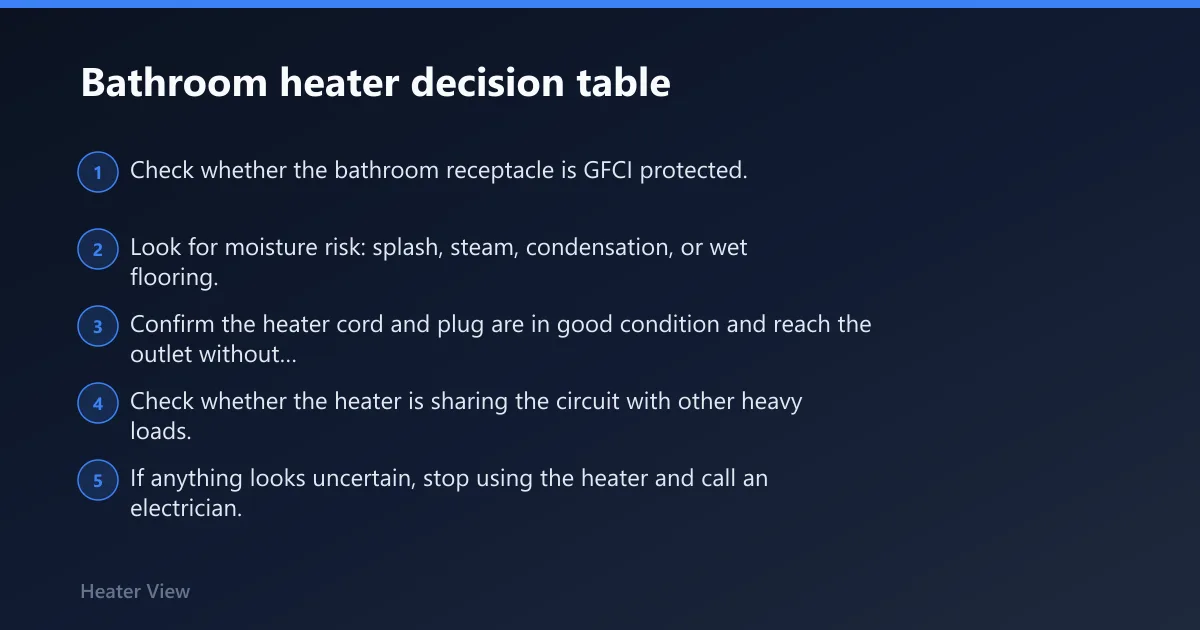
Use this table as a quick screen. If the setup lands in the stop column, do not keep using the heater as-is. The decision is based on the heater type, outlet condition, outlet GFCI status, and how wet the room is at the moment of use.
| Heater type | Bathroom outlet condition | Outlet GFCI status | Room wetness | Acceptable to use? | Stop and call an electrician? |
|---|---|---|---|---|---|
| Portable plug-in heater | Good cord, tight plug, outlet not loose | GFCI receptacle or breaker | Dry floor, low steam | Usually yes, with normal caution | No, if all conditions stay stable |
| Portable plug-in heater | Good cord, but outlet is shared with other loads | GFCI protected | Dry to lightly humid | Maybe, but monitor for overload or nuisance trips | Yes, if breaker trips or outlet feels loose |
| Portable plug-in heater | Outlet is old, ungrounded, or non-GFCI | No GFCI protection | Any bathroom moisture present | No | Yes |
| Portable plug-in heater | Outlet is near sink, tub, or shower | GFCI protected | Heavy steam, splash, or wet floor | Usually no | Yes |
| Wall-mounted heater | Hardwired on a proper circuit | Depends on circuit protection | Dry room, listed for bathroom use | Maybe, if installed to code and listing | Yes, if listing or wiring is unclear |
| Any heater | Extension cord or power strip in use | Any status | Any wetness | No | Yes |
- Check whether the bathroom receptacle is GFCI protected.
- Look for moisture risk: splash, steam, condensation, or wet flooring.
- Confirm the heater cord and plug are in good condition and reach the outlet without stretching across water.
- Check whether the heater is sharing the circuit with other heavy loads.
- If anything looks uncertain, stop using the heater and call an electrician.
Frequently asked questions
Is a bathroom heater required to be on a GFCI outlet?
If it is a plug-in heater using a bathroom receptacle in a dwelling unit, yes, the receptacle should be GFCI protected. That protection can come from the outlet itself or the breaker feeding it. The heater is not the code target; the bathroom receptacle is.
Should I call an electrician before using a heater in the bathroom?
Yes, if the outlet is not clearly GFCI protected, the bathroom is small or very wet, the heater needs an extension cord, or the circuit already trips. Those are stop signs, not minor inconveniences. An electrician can verify the circuit, the protection type, and whether the setup matches local code.