How to Tell If Your Garage Heater Is Too Small
If your garage heater cannot raise the space by about 20°F above outdoor temperature with the doors shut, or it runs nonstop and still never reaches the thermostat setting, it is likely undersized or losing heat faster than it can replace it. That wastes power, shortens equipment life, and leaves the garage too cold for tools, cars, or work. This guide shows how to separate capacity problems from insulation loss, airflow issues, and bad thermostat placement.
Start with the symptom
The fastest check is simple: close the garage, set the heater to a higher target, and watch whether the space warms through the middle of the room or only near the unit. A heater that never satisfies the thermostat, or one that leaves the floor cold while the ceiling feels warm, usually points to a capacity or distribution problem.
Do not assume the heater is the only issue. A thin metal door, threshold gaps, an uninsulated ceiling, or a thermostat mounted too high can make a properly sized heater look weak. Start by separating true undersizing from heat loss.
What you’ll need
- Tape measure
- Thermometer
- Notepad or phone notes
- Heater nameplate or manual
How do I know if my garage heater is undersized?
A garage heater is usually undersized when it runs continuously, the air near the ceiling warms faster than the working area, and the set temperature is never reached during normal cold weather. Those signs matter more than the heater’s label alone, because garage size, insulation, ceiling height, and door losses all change the result.
Check the three most telling signs
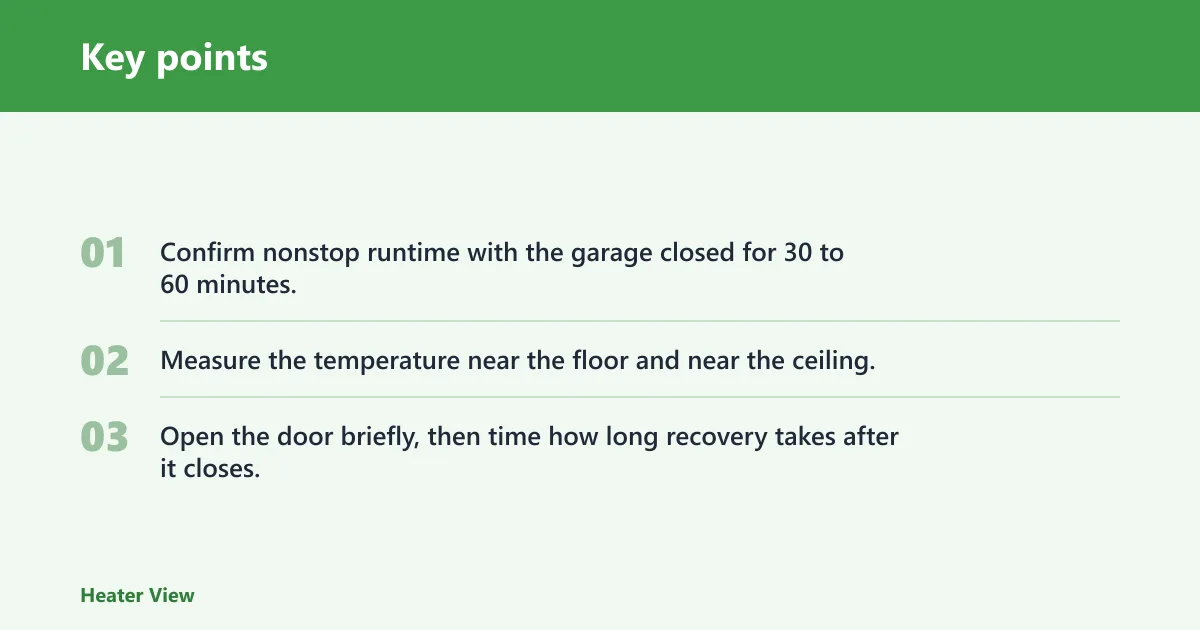
- Confirm nonstop runtime with the garage closed for 30 to 60 minutes.
- Measure the temperature near the floor and near the ceiling.
- Open the door briefly, then time how long recovery takes after it closes.
Say your 24-by-24 two-car garage has a 240V wall heater that runs for an hour, yet the floor still feels chilly while the ceiling is warm. That pattern points to either true undersizing or poor air mixing, not a thermostat problem alone.
Step 1: Measure the garage
Record square footage and ceiling height before changing anything. A single-car garage is often around 200 to 300 square feet, a two-car garage often around 400 to 600 square feet, and a three-car garage can be larger still. A 7-foot ceiling can behave very differently from a 10-foot ceiling, because taller rooms leave more warm air above the work area.
Step 2: Check heat loss points
Inspect the garage door, then the walls, ceiling, slab edges, and any gaps around framing. Thin metal doors lose heat quickly, and threshold gaps can pull in cold air. Attached garages get some heat help from the house they share a wall with, but an attached garage can still lose heat fast if it is leaky or uninsulated.
Undersized garage heater diagnostic matrix
| Symptom | Likely cause | Quick test | Next fix |
|---|---|---|---|
| Nonstop runtime | True undersizing or major heat loss | Set the thermostat 5°F higher and watch whether the unit cycles off within 30 to 60 minutes | Add insulation, seal gaps, or move to higher output |
| Uneven floor-to-ceiling temperatures | Airflow issue or heater mounted too high | Measure temperature at waist height and near the ceiling | Add circulation, lower mounting where allowed, or use directed airflow |
| Slow warm-up after opening the door | Heat loss from the door, slab, or a low-output unit | Open the door briefly, then time recovery with the door shut | Insulate the door, seal the threshold, or increase capacity |
| Comfort only near the heater | Forced-air reach too short or infrared coverage too narrow | Walk the space and note where comfort drops off | Reaim airflow, change placement, or use a different heater type |
| High energy use | Heat loss, wrong thermostat reading, or true undersizing | Compare runtime before and after sealing obvious leaks | Fix losses first, then re-evaluate output |
What size heater for my garage is enough for winter?
The right size depends on square footage, ceiling height, insulation, and how cold your winters get. A small electric space heater may work in some garages with outlets inside, but a 120V plug-in heater is typically limited to about 1,500W. For many garages, a 240V hardwired unit heater is the practical choice.
Match output to the space
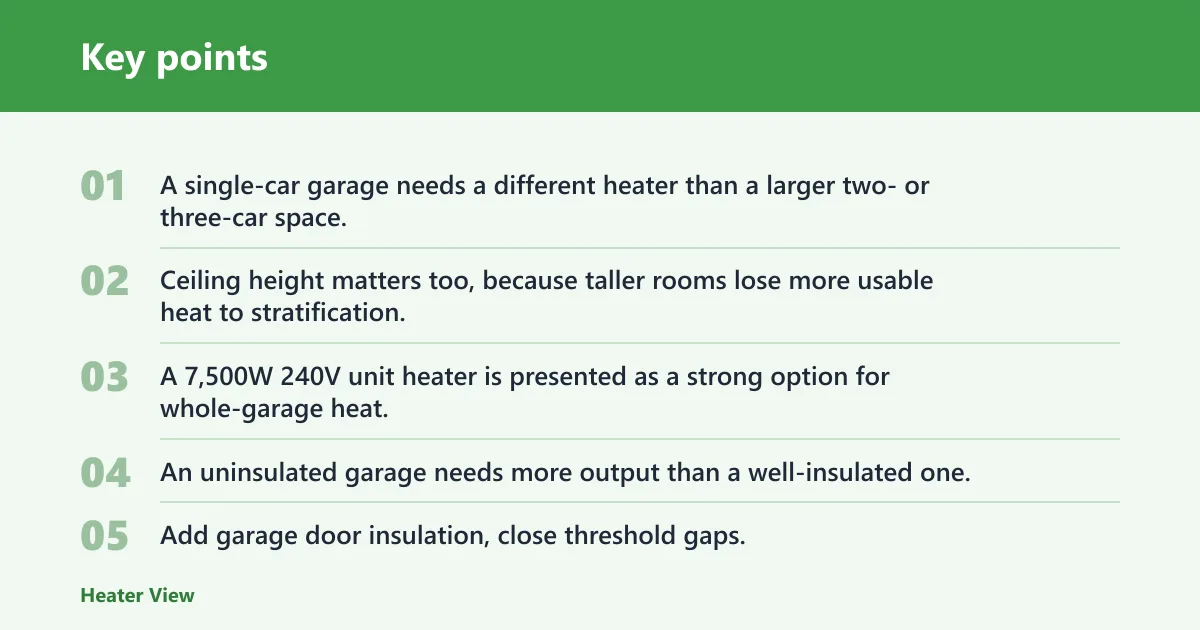
A single-car garage needs a different heater than a larger two- or three-car space. Ceiling height matters too, because taller rooms lose more usable heat to stratification. A 7,500W 240V unit heater is presented as a strong option for whole-garage heat, especially where the room is large, poorly insulated, or used as a workspace.
Adjust for insulation and climate
An uninsulated garage needs more output than a well-insulated one. Add garage door insulation, close threshold gaps, and air seal obvious leaks before you size up again. If the garage is attached, the shared wall helps somewhat, but it does not cancel poor insulation elsewhere.
Factor in thermostat placement
A heater with an internal thermostat can read the wrong temperature when mounted high. Wall-mounted thermostats can work better than relying on a control mounted near the ceiling. Poor thermostat placement can make a heater look undersized even when the output is close to adequate.
How to size an electric garage heater for an uninsulated garage
Start by treating the garage as a heat-loss problem first, not a heater-buying problem. Uninsulated walls, an unsealed garage door, and a bare slab can erase output quickly. If the garage has only a 120V household outlet, the heater choice is constrained before you even calculate comfort.
Use this order
- Seal door, wall, and slab gaps.
- Insulate the garage door with panels or kits rated for that use.
- Confirm whether the circuit is 120V or 240V.
- Choose output that matches the remaining load, not the raw square footage alone.
Suppose a storage-only one-car garage stays cold even with a small heater near the door. If the door is thin metal and the threshold leaks air, a larger heater may only mask the problem while the wall and floor keep shedding heat.
How to size a garage unit heater for my space
Unit heaters work best when their airflow reaches the working area without blasting one corner. Wall-mounted and ceiling-mounted models free floor space, which is useful in garages, but they also raise thermostat and discharge placement issues. A unit heater that blows across the room can feel stronger than one mounted where warm air shorts back to the sensor.
Check the electrical and mounting limits
For a 240V hardwired heater, verify the breaker size and wire gauge before installation. Hardwired install requirements vary by model, so use the nameplate and manual rather than guessing from the outlet type. A 120V plug-in unit may be easy to place, but it often lacks the output needed for a full garage in winter.
Use airflow to your advantage
Forced-air unit heaters warm air quickly but need a clear path. Infrared heaters feel warmer in the line of sight and can help in work zones, but they do not heat hidden corners as well. If your comfort only exists near the heater, placement or heater type may be wrong even if the wattage seems large enough.
Common mistakes
Most sizing failures come from diagnosing the wrong problem. A garage can feel too cold because the heater is weak, but it can also feel too cold because heat is escaping faster than the unit can replace it.
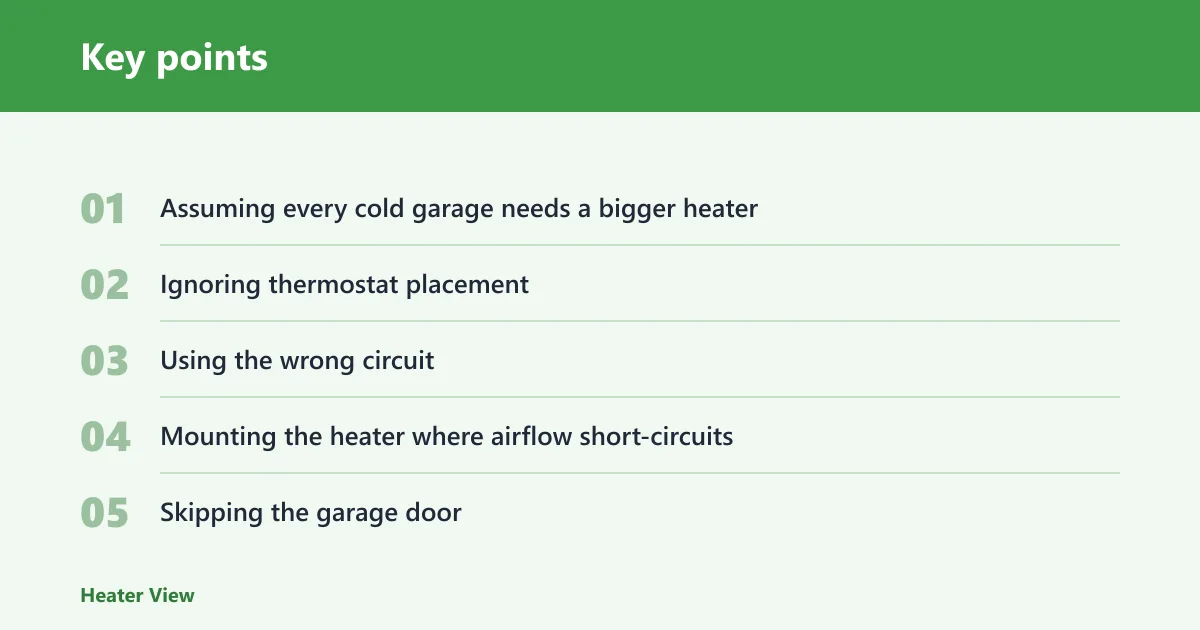
- Assuming every cold garage needs a bigger heater. Check insulation, door gaps, and slab leaks first.
- Ignoring thermostat placement. If the sensor sits near the ceiling, the unit may shut off before the floor area feels warm.
- Using the wrong circuit. A 120V household outlet is not a substitute for a 240V dedicated circuit when the load is higher.
- Mounting the heater where airflow short-circuits. Keep discharge aimed across the room, not directly into a corner or back toward the sensor.
- Skipping the garage door. Thin metal doors and threshold gaps are common heat-loss sources.
A common mistake is assuming the heater is undersized after one freezing morning, when the real problem is an uninsulated garage door and drafts sneaking in around the window frame. Fix the loss path first, then reassess the heater.
If that didn’t work, try this next
- Lower the thermostat setpoint by 2°F to 3°F and recheck runtime so you can see whether the control is reading too early or too late.
- Move or remote-mount the thermostat to wall height, ideally where it samples the occupied zone instead of the hottest air.
- Add insulation to the garage door panels and seal threshold gaps, then repeat the warm-up test.
- Upgrade to a higher-output 240V heater only after the garage loss points are under control.
Keep the garage closed during heat-up, and inspect the door seals at the start of the cold season so recovery stays predictable.
Frequently asked questions
What size heater for my garage if it has high ceilings?
High ceilings raise heating needs because warm air collects farther from the floor. That means the working area can stay cold even while the top of the room warms. A wall-mounted thermostat and a unit that pushes air across the occupied zone usually work better than ceiling-only sensing.
Why does my garage heater run constantly but never get warm?
That pattern usually points to undersizing, major heat loss, or bad thermostat placement. Check whether the sensor is mounted near the ceiling, whether the door leaks, and whether the garage is uninsulated. If the heater cannot recover after the door opens, the output is likely too low for the space.
Is a 120V garage heater too small for a two-car garage?
Often, yes. A 120V plug-in heater is typically limited to about 1,500W, which can be enough for a small, insulated zone but not always for a full two-car garage. For many garages, a 240V hardwired unit heater is the more practical choice, especially in colder climates.