What safety codes apply to home heaters? by heater type
Portable electric heaters usually need only product listing and the manufacturer manual, plus clearances; hardwired electric heaters often require NEC rules plus a permit and inspection; gas-fired heaters typically need fuel-gas code, venting rules, and a licensed installer. Ignoring the right code stack can mean fire risk, carbon monoxide, failed inspections, denied insurance claims, and costly rework. This guide breaks down which codes, permits, inspections, and manufacturer instructions apply by heater type.
What safety codes apply to home heaters?
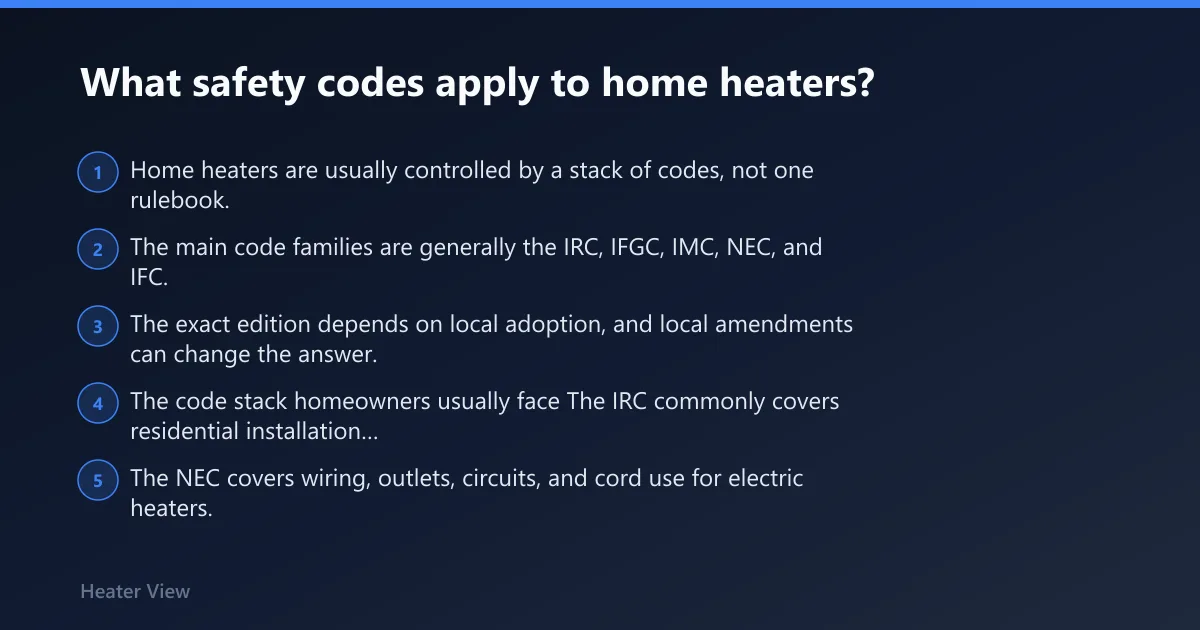
Home heaters are usually controlled by a stack of codes, not one rulebook. The main code families are generally the IRC, IFGC, IMC, NEC, and IFC. The exact edition depends on local adoption, and local amendments can change the answer.
The code stack homeowners usually face
The IRC commonly covers residential installation and clearance requirements. The NEC covers wiring, outlets, circuits, and cord use for electric heaters. The IFGC governs gas piping and fuel-gas appliance installation, while the IMC addresses mechanical equipment, venting, and combustion air. The IFC can affect placement and operating limits where the fire department enforces it.
Why the heater type changes the rule set
A plug-in space heater is treated very differently from a wall-mounted electric heater or a gas-fired unit. A portable heater often hinges on listing, cord use, and clearances. A hardwired electric heater brings electrical permit and inspection questions. A gas heater adds venting, combustion air, and fuel-gas requirements.
How local adoption changes the answer
Code edition matters. A city may be on one code edition while a neighboring county uses a different one. Glenwood Springs adopted the 2021 International Building Code on June 5, 2022, and that city also adopted the 2021 International Residential Code. The adopted code list includes the International Plumbing Code and International Mechanical Code, plus the International Fire Code and International Fuel Gas Code. The city uses the 2020 National Electrical Code for electrical inspections.
Which code family applies to your heater?
Start with fuel source and installation method. Portable plug-in electric heaters usually point to the NEC and local fire rules. Hardwired electric heaters may involve the IRC, NEC, and a local permit process. Gas-fired heaters usually involve the IFGC and IMC, and sometimes the IRC when residential installation rules apply.
Portable plug-in electric heaters and the NEC
For a plug-in heater, the big questions are whether the product is listed, whether the cord is used correctly, and whether the branch circuit can carry the load. The NEC is the electrical rule set most likely to matter. Local fire code may also limit placement near exits, curtains, or combustibles.
Hardwired electric heaters and the IRC or NEC
Fixed electric heaters are not just “bigger space heaters.” They are building or electrical equipment. Depending on the jurisdiction, the IRC and NEC can both apply, and the work may require a permit and inspection. Wall-mounted, baseboard, and radiant units often trigger installation rules that portable units do not.
Gas-fired heaters and the IFGC plus IMC
Gas-fired heaters bring fuel-gas installation rules, venting, combustion air, and carbon monoxide risk into the picture. The IFGC usually governs gas piping and appliance installation. The IMC often covers venting and combustion air. Residential work can also fall under the IRC, especially when the unit is part of a home installation.
Where the IFC can affect placement and use
The IFC can restrict where heaters sit and how they are operated, especially in rooms with combustibles or in spaces used for storage. Fire departments may enforce spacing, access, and operating limits. That matters for both portable and fixed heaters, because a code-compliant appliance can still be used in a bad location.
Do space heaters need to meet electrical code requirements?
Yes. Portable space heaters may be covered by electrical and fire rules even though they plug in and move from room to room. The NEC affects outlet use, cord use, circuit loading, and overcurrent protection. Local fire code can add placement limits, and the heater’s listing and instructions are part of the rule set.
Listed product and label checks
Look for a safety certification mark and read the nameplate. A listed heater is not just a marketing claim; it is part of how inspectors and code officials decide whether the appliance can be used as installed. The manual may also specify the only acceptable mounting position, cord type, or room use.
Outlet, cord, and circuit rules
Portable heaters should generally be plugged directly into a suitable receptacle. The NEC is the code family to think about when outlets, branch circuits, and cords are involved. If a heater repeatedly trips a breaker, warms the cord, or shares power with other heavy loads, the circuit may be wrong for the appliance.
When extension cords and power strips fail the test
Extension cords and power strips can be a weak point for heaters because they can add heat, resistance, and poor-contact risk. They also invite overloads. For a heater, the safe answer is usually the shortest direct connection the manual allows. If the manual does not permit an extension cord, do not improvise one.
What clearance do heaters need from walls and furniture?
Clearance depends on heater type, listing, and installation instructions. There is no single safe distance that fits every unit. The code answer is usually “follow the listing and manual,” then apply any local fire or building rules on top. Walls, curtains, bedding, furniture, and clutter all count as combustibles.
How clearances change by heater type and listing
A portable heater may need open space on several sides. A wall-mounted electric heater may allow smaller side clearances but require a very specific mounting height. A gas-fired heater may have front, side, rear, and venting clearances that vary by model. The label and manual matter more than generic advice.
What to keep away from the heater
Keep curtains, bedding, clothing, paper, furniture, and stored items out of the heater’s clearance zone. If the heater has a fan, intake, or front discharge, do not block it. Restricting airflow can raise surface temperature and create shutdowns, odor, or ignition risk. Clear space is a code issue, not just a housekeeping habit.
Why the manual can be stricter than general advice
The manufacturer instructions are part of the installation rules. A manual may require more space than a local minimum or may prohibit placement in a bathroom, closet, or sleeping area. When the manual is stricter than the generic rule, the manual generally controls for that appliance.
Do heater installations require a permit?
Often, yes, for hardwired or gas-fired equipment and for some replacements. Local building permits are commonly required for new installations, swaps, or changes to venting, electrical circuits, or gas piping. Portable plug-in heaters usually do not need a permit because they are not permanently installed.
Common permit triggers for replacement and new installs
A permit is more likely when the work changes wiring, gas piping, venting, or the appliance location. Replacing a hardwired heater with a different model can trigger inspection questions. Gas heater replacement usually draws more attention because fuel-gas code, venting, and combustion air all have to line up.
When inspection comes after the permit
Inspection commonly follows permitted work and verifies that the installation matches the approved scope. That can include clearances, secure mounting, electrical connections, venting, and proper shutoffs. If the work fails inspection, the correction usually has to happen before the heater is approved for use.
Who usually signs off on the work
Depending on the job, sign-off may come from a building department inspector, electrical inspector, mechanical inspector, or fire official. Some jurisdictions split those roles. The homeowner should ask which department issues the permit and which office performs the final inspection before work begins.
Use this heater-code decision table before you buy or install
This table is a fast way to sort the heater into the right rule set. It is not a substitute for the manual or the local code office, but it will usually point a homeowner to the right questions before money is spent.
| Heater type | Likely code family | Permit trigger and required professional | Homeowner checks before purchase or install |
|---|---|---|---|
| Portable plug-in electric space heater | NEC; possible IFC | Usually no permit; may still need fire-code compliance if used in a restricted area | Listing mark, cord condition, outlet rating, no extension cord, clearance from combustibles |
| Hardwired electric heater | IRC; NEC | Permit often required; electrician or qualified installer usually needed | Correct circuit, thermostat compatibility, mounting rules, manufacturer clearance instructions |
| Gas-fired vented heater | IFGC; IMC; often IRC | Permit often required; licensed gas fitter or HVAC contractor usually needed | Venting method, combustion air, shutoff valve, gas supply sizing, clearance label |
| Wall-mounted or built-in electric unit | IRC; NEC | Permit commonly required; licensed electrician often needed | Stud support, wiring method, breaker size, room location, listed installation method |
| Room heater with fan or combustion air intake | IMC; IFC; product listing | May require inspection if tied to a permitted job | Airflow path, intake clearance, dust and lint control, location near exits or storage |
How do gas heater codes work?
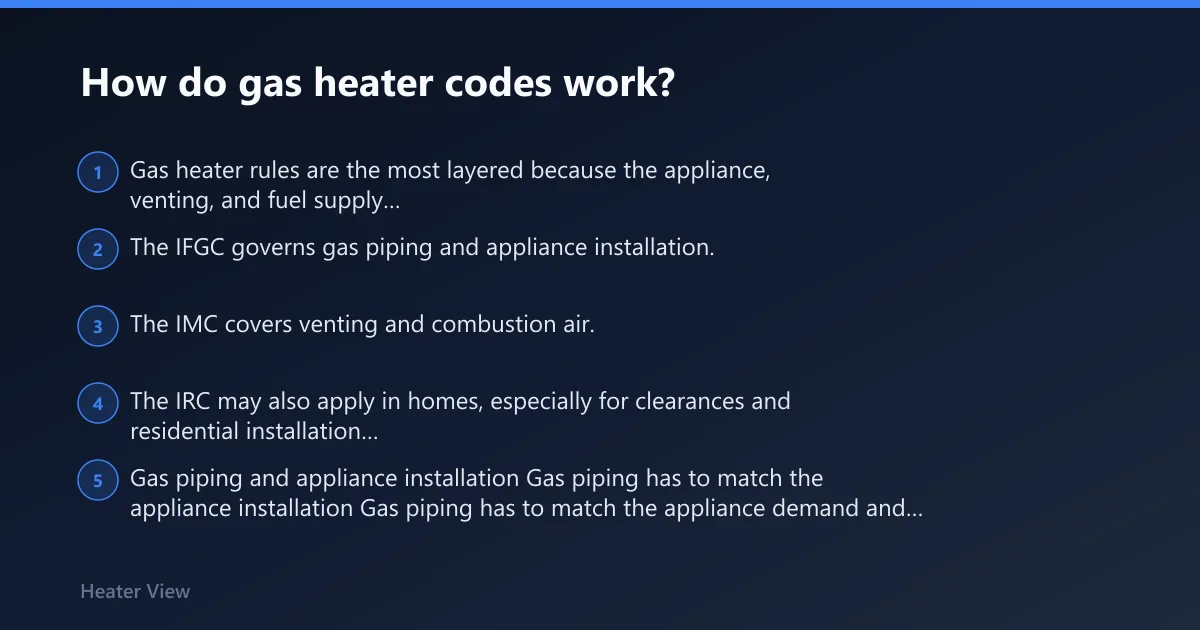
Gas heater rules are the most layered because the appliance, venting, and fuel supply all have to work together. The IFGC governs gas piping and appliance installation. The IMC covers venting and combustion air. The IRC may also apply in homes, especially for clearances and residential installation details.
Gas piping and appliance installation
Gas piping has to match the appliance demand and be installed correctly. Shutoff valves, connector type, and joint integrity matter. A fuel-gas installation that looks tidy can still fail code if the pipe sizing, connector choice, or appliance location is wrong.
Venting and combustion air
Vented gas heaters need a proper exhaust path and enough combustion air to burn safely. Poor venting can cause backdrafting, soot, shutdowns, or carbon monoxide problems. If a heater has a vent collar, flue connection, or draft hood, the installation has to match the listing and the local mechanical or fuel-gas rules.
Carbon monoxide alarms and warning signs
Gas-fired heaters should be paired with working smoke alarms and carbon monoxide alarms in the locations required by local code and the alarm instructions. Soot marks, yellow flames, headaches, or repeated shutdowns are warning signs, not normal behavior. A gas heater that smells wrong or burns wrong needs attention fast.
Temperature and pressure relief valves on water heaters
If the heater in question is a water heater, the temperature and pressure relief valve matters. Discharge piping rules are code-specific. For example, one local code may require water heater discharge piping to terminate through an air gap near the heater, avoid direct connection to the drainage system, match the valve outlet diameter, prevent injury or damage, and remain easy for occupants to observe. Those details are for water heaters, not room heaters, but they show how specific discharge rules can be.
Are there local fire code rules for portable heaters?
Yes. Local fire rules can limit where portable heaters are used, especially near curtains, exits, sleeping areas, or storage. The IFC is the code family to check when a fire department inspects or enforces room-use restrictions. A heater can be electrically fine and still be a fire-code problem in the wrong spot.
Placement and operating limits
Fire rules often focus on how the heater is used, not only what it is. A portable heater in a hallway, under a table, or beside a bed may violate local restrictions even if it is listed and in good condition. Clear airflow and clear exits matter as much as the appliance itself.
What the local authority may inspect
Depending on the jurisdiction, the fire department, building department, or electrical inspector may be the authority that matters most. Some cities enforce product placement and room-use limits aggressively; others focus on permitted installations. The homeowner needs the local office, not a general internet answer.
When does a heater need inspection or replacement?
A heater should be inspected after permitted installation, after any venting or gas-line change, and whenever it shows damage or abnormal operation. Replacement is often the safer choice when a unit is overheating, tripping breakers, producing odor or soot, or has a damaged cord, cabinet, or venting component.
Signs the heater should not stay in service
Frequent shutdowns, scorch marks, melted insulation, loose wiring, rust-through, soot, or a burned smell all point to trouble. For gas units, yellow flames, pilot problems, or exhaust staining are also warning signs. If the unit cannot stay within its listing and code conditions, it should come out of service.
Manufacturer instructions and listing are part of the rule set
Homeowners often treat the manual as optional. It is not. The listing, label, and instructions tell the installer where the heater may go, how it must be mounted, and what clearances are required. If those instructions are missing or unreadable, replacement is usually safer than guessing.
Frequently asked questions
Which code applies to gas heaters and venting?
Gas heaters usually fall under the IFGC for fuel gas work and the IMC for venting and combustion air, with the IRC often involved in residential installations. The installer also has to follow the manufacturer’s instructions and the local edition adopted by the city or state.