Can Infrared Heaters Help with Frozen Pipes?
Infrared heaters can help prevent frozen pipes if they keep the pipe area above freezing, but they are a temporary fix, not pipe-specific protection. Used poorly, they can leave cold spots, overheat nearby materials, or fail when a pipe bursts. This guide explains when infrared heat is a reasonable choice, when insulation or heat tape is better, and how to use it without creating a fire hazard.
When infrared heat helps with pipes


Yes, but only as prevention in the right setting. An infrared heater warms objects directly, so it can raise the temperature of pipes, fittings, and nearby surfaces in a small enclosed space. It is generally a poor answer for pipes that are already frozen, for leaky areas, or for spaces too open to hold heat.
That distinction matters. Prevention means keeping the pipe zone above freezing before ice forms. Thawing means dealing with a pipe that has already frozen, and that needs more caution because the pipe may already be split or blocked. An infrared heater is a room heat source, not a pipe repair method.
What infrared heat does around pipes
Infrared radiation transfers energy to cooler objects in its line of sight. In a closet, utility room, or enclosed basement nook, that can help the pipe surface and nearby walls stay warmer than the air alone would suggest. The effect drops fast if the space is drafty or the pipe is hidden behind bulky storage.
Where it can help, and where it cannot
Infrared heat can help most in a small pipe zone with limited air leakage and a short run of exposed pipe. It can help least in garages, crawl spaces, and attics with major air exchange, because the warmth is stripped away faster than the heater can replace it. Exterior wall cavities are even less forgiving.
Prevention versus thawing
For prevention, the goal is simple: keep the vulnerable zone above freezing. For thawing, the goal is different, and a portable heater may only warm the room while the ice plug remains in the pipe. If the pipe is already frozen and inaccessible, a plumber is the safer call.
Why pipes freeze in the first place
Frozen indoor pipes often happen when the surrounding temperature drops to 32°F or below. Water expands as it freezes, and that expansion can burst the pipe. The highest-risk areas are basements, garages, crawl spaces, attics, and exterior walls, especially where drafts and missing insulation let cold air move freely.
The 32°F threshold and ice expansion
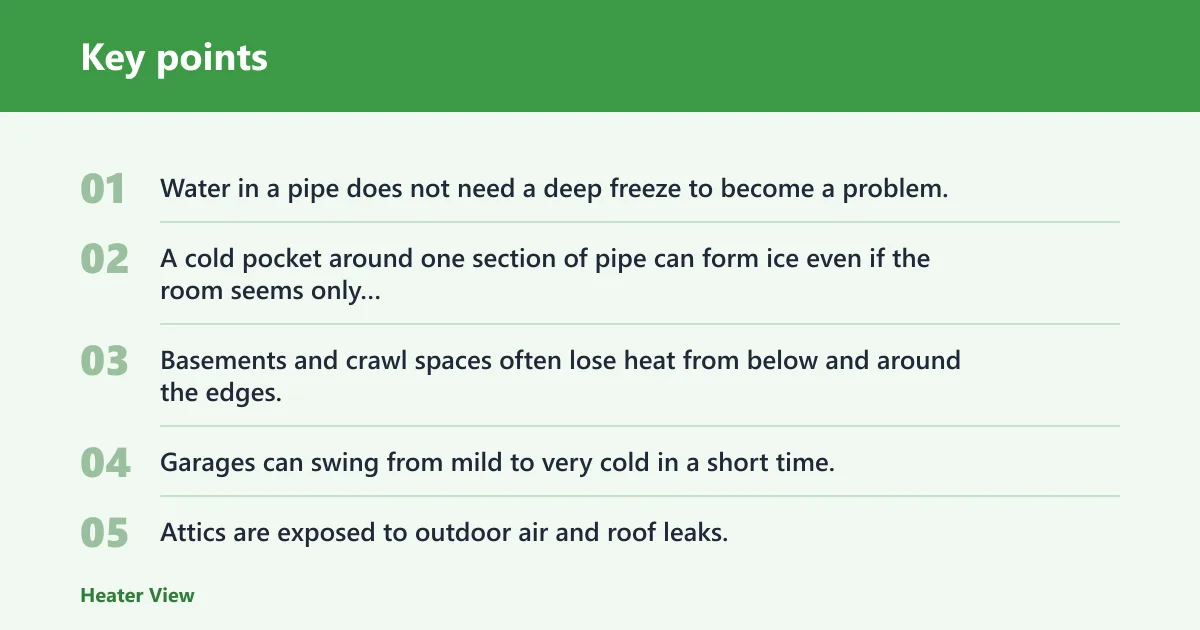
Water in a pipe does not need a deep freeze to become a problem. A cold pocket around one section of pipe can form ice even if the room seems only “chilly.” Once ice starts to build, pressure can rise in the closed line and split copper, PEX, or another material at a weak point.
High-risk locations
Basements and crawl spaces often lose heat from below and around the edges. Garages can swing from mild to very cold in a short time. Attics are exposed to outdoor air and roof leaks. Exterior walls are risky because pipe runs there can sit close to the cold side of the wall assembly.
Why drafts and missing insulation make it worse
Air leaks matter because they carry heat away from the pipe zone. Missing insulation does the same by letting the pipe surface track the outdoor temperature more closely. If a heater is fighting drafts, it may run constantly and still leave cold corners near elbows, fittings, and wall penetrations.
Picture a half-open utility closet on a 20°F night. A heater in the room can warm the air near the door, while the pipe behind stored boxes stays cold. That is why heat source placement and enclosure quality matter as much as wattage.
When an infrared heater is enough
An infrared heater can be enough when the pipe zone is small, enclosed, and only moderately vulnerable. A common 1,500-watt heater produces roughly 5,100 BTU per hour and is often cited as suitable for about 150 square feet, but the real fit depends on room size, leaks, insulation, and how cold the space gets.
Small enclosed spaces with limited air leakage
Infrared heat works best when it can stay in the room and reach the pipe directly. A closed utility room with a door, a tight basement corner, or a cabinet with enough clearance may be workable. A wide-open garage bay or vented crawl space usually defeats the idea.
How wattage fits the decision
Do not treat 1,500 watts as a universal answer. It is a common size, not a guarantee. If the area is larger than expected, poorly insulated, or exposed to a very low outdoor temperature, the heater may keep one patch warm while another section of pipe still drops below freezing.
When the space is occupied and supervised
An infrared heater is more acceptable when someone is present, can check the setup, and can adjust the thermostat or shut the unit down if conditions change. Portable heaters should not be left unattended. That is especially true near stored cardboard, plastic bins, or pipe runs hidden behind clutter.
Infrared pipe freeze decision table
This table separates short-term heating from pipe-specific protection. Use it to decide whether infrared heat is enough, or whether heat tape or a permanent fix is the safer choice.
| Pipe location | Insulation quality | Expected outdoor low | Space occupied? | Heater safety features needed | Recommended action |
|---|---|---|---|---|---|
| Small enclosed utility closet | Good | Near 32°F | Yes | Tip-over protection, overheat protection | Infrared heater can be a temporary prevention step if monitored. |
| Basement wall run with light drafts | Fair | 20s°F | Sometimes | Tip-over protection, overheat protection, wall outlet only | Use heat only as a short bridge while adding insulation and air sealing. |
| Garage with exposed pipe | Poor | Below 20°F | No | Tip-over protection, overheat protection | Heat tape or a permanent fix is the safer call. |
| Crawl space with open vents | Poor | Any freeze risk | No | Tip-over protection, overheat protection | Infrared heat alone is usually too weak and too risky here. |
| Attic near exterior wall | Fair to poor | Below freezing | No | Tip-over protection, overheat protection | Use insulation, air sealing, or a fixed solution instead of a portable heater. |
How to use an infrared heater safely near pipes
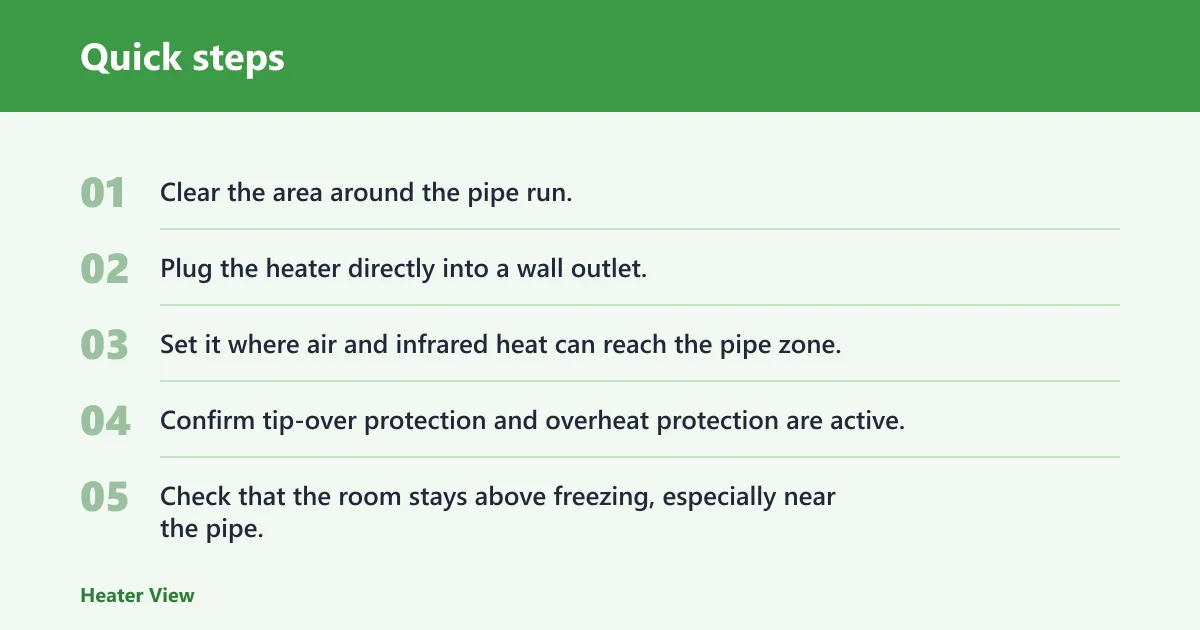
Use a portable infrared heater only with direct wall power, enough clearance, and constant supervision. It should be plugged directly into a wall outlet, not an extension cord. It also needs tip-over protection and overheat protection, because those features reduce fire risk if the unit is bumped or runs too long.
Wall outlet only and no extension cords
Space heaters should be plugged directly into a wall outlet. Extension cords can overheat and create a fire risk. If the cord does not reach, the setup is wrong for a heater, not a problem to solve with a longer cord or power strip.
Clearance from combustibles
Keep the heating zone clear of cardboard, paper, plastic storage bins, clothing, and other combustibles. Do not point the heater at loose materials or place it where bedding, curtains, or stored items can drift into the hot zone. Drywall openings and pipe chases should also stay clear.
Why tip-over protection and overheat protection matter
Tip-over protection matters because portable heaters can be bumped, moved, or knocked over in cluttered areas. Overheat protection matters when the unit runs for longer winter periods or sits near materials that hold heat. Together, those controls help reduce one of the biggest risks of using a portable heater indoors.
Placement limits around pipe runs
Do not hide the heater behind boxes or tuck it into a tight pocket where airflow is blocked. The goal is to warm the pipe zone, not trap heat against one surface. If the pipe run is spread along a long wall, one portable heater may only protect the nearest section.
A common first-timer mistake is placing a heater in the room doorway and assuming the whole basement is protected. The door area may warm up, but the pipe line near the outer wall can stay cold enough to freeze.
- Clear the area around the pipe run.
- Plug the heater directly into a wall outlet.
- Set it where air and infrared heat can reach the pipe zone.
- Confirm tip-over protection and overheat protection are active.
- Check that the room stays above freezing, especially near the pipe.
Should you use heat tape instead?
Yes, in many exposed or hard-to-heat locations. Pipe heat tape or heat cable wraps around the pipe, connects to an electrical source, and uses a thermostat that turns it on when temperatures drop. That makes it more targeted and more reliable for a pipe run than a room heater.
When pipe heat cable is the better fit
Use heat tape when the pipe is exposed, the space is cold, or the heater would have to run in an open garage, crawl space, or attic. It is also the better option when you need protection without keeping a portable heater on in the room all day.
What a thermostat-controlled setup does
A thermostat keeps heat tape from running all the time. It turns on when temperatures drop and shuts off when the pipe zone warms up enough. That is useful for freeze protection because the system reacts to the actual cold condition rather than heating the whole room nonstop.
Where a Thermocube switch fits
A Thermocube thermostat switch is a control option for freeze protection. It turns on at about 35°F and shuts off at about 45°F. That makes it useful when you want a simple automatic trigger for a heater or heating device in a pipe-prone area, though the rest of the setup still has to be safe and properly sized.
What if the pipe is already frozen?
If the pipe is already frozen, an infrared heater may only help by warming the surrounding area first. It is not a fast fix for an ice plug inside the pipe. Do not keep heating and wait if the pipe is bulging, the wall is wet, the line is inaccessible, or the setup feels unsafe.
When to stop and call a plumber
Call a plumber if the pipe may be burst, if you cannot access the frozen section, or if the line runs through a wall or ceiling where damage could spread unseen. A heater cannot confirm whether the pipe has cracked, and continued heating can delay a repair while water damage grows.
Safe thawing is different from freeze protection
Preventive heating aims to keep the pipe zone above 32°F. Safe thawing aims to melt a known ice blockage without overheating nearby materials. Those are different jobs. If you are unsure which one you are dealing with, treat it as a repair problem, not a heater-placement problem.
Frequently asked questions
How do I use an infrared heater safely near pipes?
Place it so the heat reaches the pipe zone directly, keep combustibles away, and plug it into a wall outlet only. Make sure the unit has tip-over protection and overheat protection. Do not leave it unattended, and do not rely on it to heat a leaky or wide-open space.
How close can an infrared heater be to pipes?
There is no single safe distance that fits every model or room. The heater should not sit so close that it overheats nearby materials, and it should not be blocked by boxes or drywall openings. Use the manufacturer’s clearance guidance and keep the pipe area open to air movement.
Do infrared heaters work better than ceramic heaters for pipes?
Infrared heaters are often better for a pipe zone because they warm objects directly, not just the air. Ceramic heaters can still warm a room, but the best choice depends on enclosure size, leakage, and how much of the pipe line you need to protect. Neither should be treated as permanent pipe protection.
What temperature should I keep a room to prevent frozen pipes?
Keep the space above 32°F at the pipe location, not just at the thermostat on the wall. A temperature between 40 and 50°F for pipe protection. Raising the home a few degrees higher than normal can help if the pipe run sits in a vulnerable area.
Should I use heat tape instead of an infrared heater?
If the pipe is exposed, the space is cold, or the room is hard to keep enclosed, heat tape is usually the better choice. It is pipe-specific, thermostat-controlled, and less dependent on warming the whole room. Infrared heat is more of a temporary room solution.
Can I leave a heater on overnight to protect pipes?
It is safer not to. Portable heaters should not be left unattended, even with safety controls. If overnight freeze protection is needed, a thermostat-controlled pipe solution, better insulation, or a fixed heating option is a more reliable plan than a portable heater sitting near storage and combustibles.