Are Infrared Heaters Safe for Curtains and Furniture?
Yes. Infrared heaters can be safe for curtains and furniture if fabric stays out of the heater’s direct line of sight and you follow the manufacturer’s clearance distances for that model. Too little clearance can dry, discolor, or scorch fabric, and in a bad setup it can ignite it. The right answer depends on the heater, the room, and the placement.
How infrared heat can warm nearby fabric
They can be, but only in the right setup. Infrared heaters send radiant heat straight to surfaces, so curtains, sofas, and upholstered chairs can warm up even if the room air still feels cool. Safety depends on the heater’s output, mounting height, line of sight, and the clearances printed in the manual.
Why fabric risk depends on the exact heater
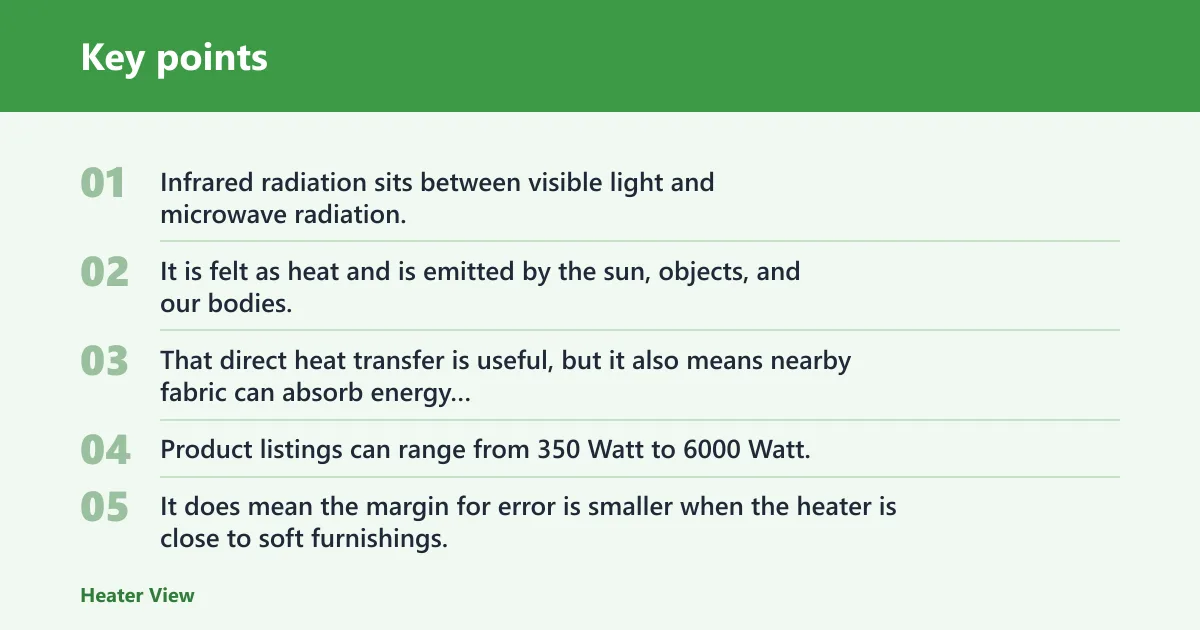
Infrared radiation sits between visible light and microwave radiation, with wavelengths from approximately 700 nanometers to 1 millimeter. It is felt as heat and is emitted by the sun, objects, and our bodies. That direct heat transfer is useful, but it also means nearby fabric can absorb energy quickly if it sits in the beam path.
Power matters too. Product listings can range from 350 Watt to 6000 Watt, and higher-output units create more intense heating around the target area. That does not make them unsafe by default. It does mean the margin for error is smaller when the heater is close to soft furnishings.
How infrared heat reaches fabric
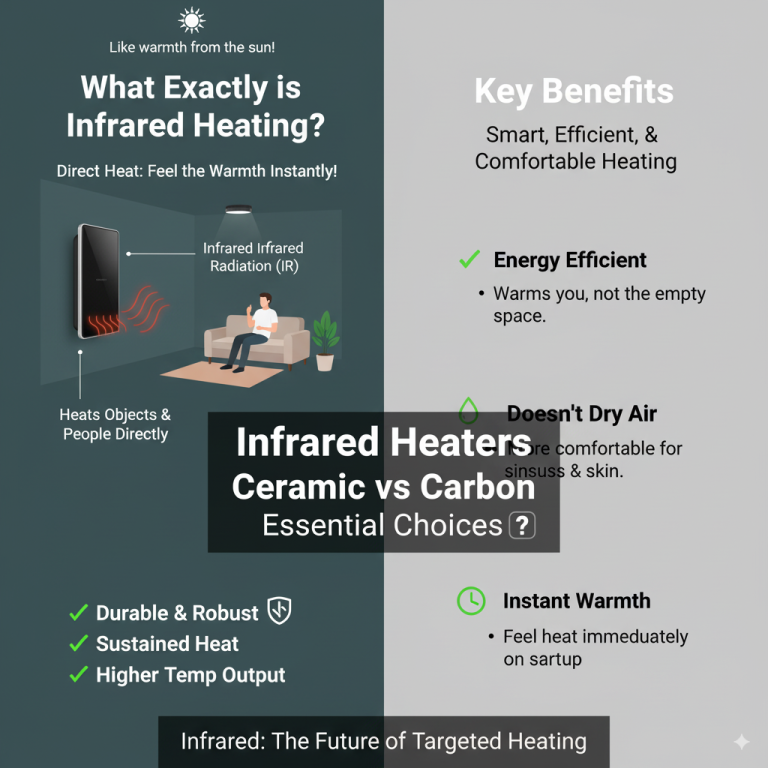
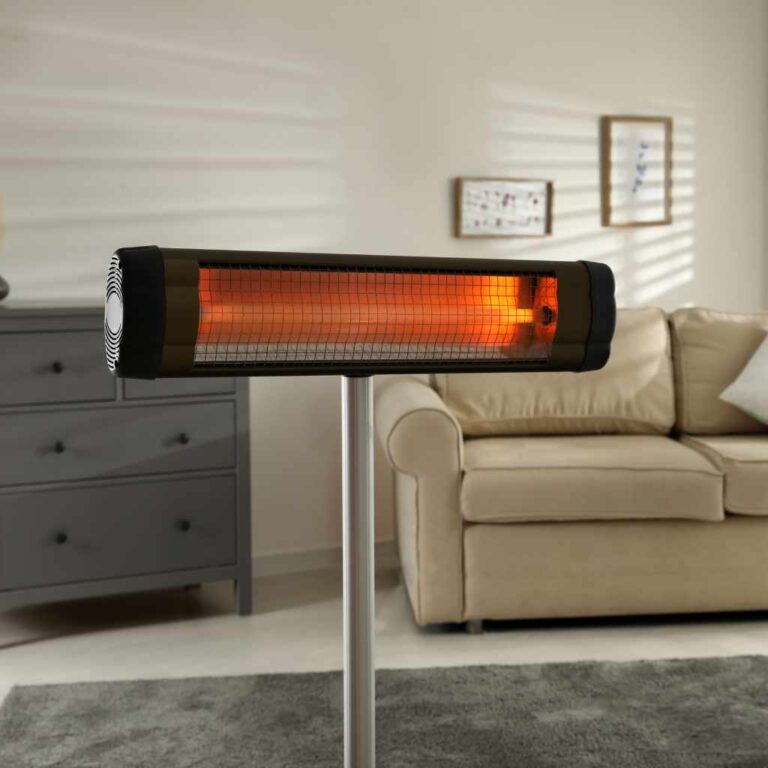
Infrared heaters heat materials directly instead of warming surrounding air first. That is why line of sight matters so much. If a curtain panel, sofa backrest, or textile wall hanging can “see” the heater, it can heat up faster than the rest of the room.
Air temperature is not the only issue. A chair can feel fine for a while, then develop warm spots on the upper back or arm nearest the heater face. That is the kind of surface heating you want to catch early.
How far should curtains be from an infrared heater?
There is no single safe distance that fits every infrared heater. Start with the manufacturer’s required front, side, top, and rear clearances, and treat those as the minimum. Curtains need extra attention because they can move with drafts, ceiling fans, and door traffic, which may pull them into the heat path.
Lightweight drapes versus heavier curtains
Lightweight curtains are often the higher-risk case because they can flutter or billow toward the heater. Heavy drapes may stay in place better, but they still heat up if they hang within the beam. Fabric thickness helps, yet it does not cancel out a bad placement.
If the curtain edge can sway toward the front of the heater, the setup fails the safety check. A rigid rule of thumb cannot replace the manual here. Wall-mounted and portable units have different clearance needs, and the mounting surface also matters.
Why the manual comes first
Check the listed front, side, top, and rear clearances before you decide where the heater goes. Some models require noncombustible mounting surfaces. Others are intended for indoor use only, while outdoor models may be rated for wet or splash-prone conditions with an IP rating such as IP 65. That rating speaks to moisture resistance, not fabric safety.
Can an infrared heater scorch fabric or upholstery?
Yes. Curtains, upholstered furniture, and textile wall hangings can scorch, dry out, fade, or discolor if they sit too close or directly in front of a heater. Foam and fabric covers on sofas and chairs can also hold heat on the surface, especially where the heater has a clear view of the furniture.
Signs a sofa or chair is too close
Watch for a seat or backrest that feels unusually warm compared with the rest of the room, a dry or stiff patch of fabric, or a faint hot smell. Those are warning signs, even if nothing looks visibly damaged yet. Stop using that placement and move the heater before the fabric changes color or texture.
Suppose a wall-mounted infrared panel faces a sofa in a living room. If the armrest and top cushion warm first while the room air remains comfortable, that is not a safe “normal” effect. It means the surface is receiving direct radiant heat and the distance should be increased.
When a sofa placement fails the safety check
A sofa setup fails if any part of the upholstery sits inside the heater’s direct beam, if the back cushions are close enough to warm quickly, or if the heater is mounted so low that the furniture blocks or traps heat. This is especially important with higher-wattage units, because they are better suited to zone heating than to tight placement near soft goods.
Curtain and furniture clearance checklist
Use this table as a pass/fail screen, then confirm the exact distances in the heater manual. The minimum practical setback below is a safety-minded starting point for common room setups, but the model’s own instructions always win.
| Heater type | Curtain or furniture material | Minimum practical setback | Warning signs to watch | Pass/fail decision notes |
|---|---|---|---|---|
| Portable electric infrared panel | Lightweight curtains | Keep completely out of the direct beam; use the manual’s front and side clearances | Edge flutter, warm fabric, faint odor | Fail if curtains can move into line of sight or brush the heater |
| Portable electric infrared heater | Heavy drapes | Set back beyond the manual’s front clearance and beyond any swing path | Hot spot near hem, fading, dryness | Pass only if the cloth cannot drift toward the heater |
| Wall-mounted infrared heater | Sofa or armchair upholstery | Use the listed rear, top, and front clearances; increase space if the face points at the seat | Warm cushion top, drying, discoloration | Fail if the heater shines directly on the backrest or arm |
| Outdoor infrared heater | Textile wall hanging | Keep outside the heater’s direct line of sight | Heat buildup, waviness, odor | Fail unless the hanging is well outside all clearances and cannot move |
| Gas-powered infrared heater | Upholstered furniture | Follow the model manual exactly; do not rely on a generic room rule | Surface heating, smell, softening fabric | Pass only when the listed clearances are respected on every side |
Common room setups to test against
In a bedroom, curtains often hang closer to the heater than people expect, especially beside a window. That makes the manual’s side clearance and the curtain’s swing path more important than the room size alone. In a sunroom, glass and moving air can shift where the fabric hangs, so check the setup again after the heater runs.
In a living room, a sofa may look far enough away from the wall, yet still sit directly in the radiant path. Picture a wall-mounted unit above a low console with a chair off to one side. The chair may be safe while the console-side curtain is not. The layout matters more than the room label.
What placement mistakes create risk?
The biggest mistakes are simple: pointing the heater directly at drapes, mounting it too close to soft furnishings, and using the wrong heater type for the room. Infrared heat is directional, so a bad angle can turn an otherwise normal setup into a fabric hazard very quickly.
Pointing the heater at drapes
Even a well-made curtain can warm too much if it sits in the beam for long periods. Drafts and fans can pull the fabric into that path. If the curtain touches the heater, or even sways close enough to heat up repeatedly, move either the heater or the curtain before using the unit again.
Using the wrong heater for the room
Indoor and outdoor infrared heaters are not interchangeable in safety terms. Outdoor models may have moisture protection, and some listings show an IP rating such as IP 65 or rain or splash-water resistance. That helps with placement in damp locations, but it does not make a heater safe beside curtains or a sofa.
Mounting on the wrong surface
If a manual requires a noncombustible mounting surface, do not substitute drywall, fabric panels, or other soft finishes. A heater that is secure on the wall can still be unsafe if the mounting zone lets heat build behind the unit or too close to fabric trim.
How do infrared heaters heat objects more than the air?
They send radiant energy directly to surfaces, so the object in the beam warms first. That is different from convection heaters, which mainly warm the air and then let the air circulate through the room. With infrared, the direct target matters more than the room’s average air temperature.
Why this matters for fabric safety
Because fabric absorbs radiant energy, the safety check is about what the heater can “see.” A curtain, upholstered headboard, or sofa back can heat even if the thermostat does not feel extreme. That is why a temperature spot-check is useful instead of guessing by touch alone.
How to check for overheating
Use an infrared thermometer or another surface temperature check to spot whether nearby fabric is warming too much. Check the curtain edge, sofa back, armrest, or any textile panel closest to the heater after it has been running long enough to stabilize. If the surface keeps climbing, the placement is wrong.
- Confirm the model’s front, side, top, and rear clearances in the manual.
- Make sure no curtain, sofa, or fabric panel sits in direct line of sight.
- Run the heater at normal setting for the room.
- Measure the nearest fabric surface with an infrared thermometer, or spot-check several points.
- Look for fading, drying, odor, warping, or unusually warm patches.
- Move the heater immediately if any warning sign appears.
A common first-timer mistake is assuming a heater is safe because the air still feels comfortable. For example, a roughly 2000 W wall-mounted unit may be used in a small seating area, and the nearest curtain panel may start warming at the hem first. That is a placement problem, not a comfort feature.
Another common mistake is treating an outdoor-rated model as automatically safe indoors near textiles. The IP rating can tell you about moisture resistance, and a catalog may list a 2000 W heater intended for about 15 square meters, but neither detail replaces the fabric-clearance rules in the owner’s manual.
Frequently asked questions
Are infrared heaters safe for curtains and furniture?
They can be safe when fabric stays outside the heater’s direct line of sight and the model’s clearances are followed. They are risky when drapes, sofas, or textile panels sit too close, drift into the beam, or warm noticeably during use. The manual decides the minimum distance.
Do infrared heaters heat objects more than the air?
Yes. They transfer heat directly to objects and surfaces instead of warming surrounding air first. That is why curtains and furniture near the beam can heat up even when the room itself still feels mild. For safety, judge the setup by the fabric’s exposure, not just air temperature.
Are infrared heaters safe to leave near a sofa?
Only if the sofa is outside the direct beam and beyond the heater’s required clearances. Upholstery and foam can warm, dry out, or discolor if the heater faces the seat or backrest. If the sofa surface becomes noticeably warm, the placement should be moved immediately.
What materials should not be placed in front of an infrared heater?
Keep curtains, drapes, textile wall hangings, upholstery, and other combustible soft furnishings out of the beam. Lightweight fabrics are especially likely to move into the heat path, but heavier textiles can still overheat if they hang too close. Do not use fabric as a shield or barrier.
How hot do infrared heaters get?
The heater face and nearby surfaces can become hot enough to damage fabric or start a fire if clearance is ignored. Exact temperatures vary by model, wattage, and design, so the owner’s manual is the only reliable source for safe spacing. Use temperature checks if you are unsure.