Water heater maintenance for low-use homes checklist
For low-use homes, inspect the water heater before each occupied stay, flush sediment about once a year, test the TPR valve yearly, and drain or isolate the tank if the home will sit empty for a couple of months or more. Skip that, and you often get rusty water at the tap, valves that stick shut, leaks around old seals, and a heater that quits on arrival day. This guide gives a practical maintenance cadence and the exact steps to take before and after long idle periods.
What low use changes about water heater maintenance
Low use changes the order of operations. In a regularly occupied home, wear comes from daily heat cycles. In a low-use home, the bigger risks show up while the unit sits still and when it starts back up: sediment settles, water goes stale, valves stick, and hidden leaks show only after pressure returns.
That means the best-maintained low-use heater is not the one with the most attention. It is the one checked at the right moments: before a stay, after a long idle period, and on a hardness-based schedule that fits the water, not the usage habit.
What still matters even when hot water is rarely used
Several tasks still matter. Sediment buildup forms in the bottom of tank heaters over time, even if the burner or elements barely run. The sacrificial anode rod keeps dissolving during idle time. The T&P valve can stick. Gas units still collect dust and lint around the burner area and air intake screen.
For tankless units, low use does not remove scale risk. It often makes startup checks more important, because a unit that has sat can show flow issues, stale water, or a pressure relief valve problem the first time it is asked to run again.
How to think about risk by usage pattern
Weekend homes, seasonal homes, vacant-for-months homes, and guest houses do not need the same cadence. A weekend place usually needs pre-stay checks and normal annual service. A home that sits empty for months needs a restart plan. A guest house often sits in the middle, with partial use that can hide problems until the next booking.
📊 DIY maintenance tool cost is said to be under $100. Source: Waterclue.
How often should I maintain a low-use water heater?
The right cadence depends on how long the heater sits idle and how often someone actually draws hot water. For low-use homes, inspect before occupied stays, flush on a hardness-based schedule, test the T&P valve annually, and inspect the anode more often in hard water. Low use changes timing, not the need for care.
Low-use home maintenance decision table
| Usage pattern | Flush tank heater | Test T&P valve | Inspect anode rod | Pre-return startup steps |
|---|---|---|---|---|
| Weekend home | Every 2 years in soft water; annually in hard water | Once a year | Start in the first 2-3 years, sooner in hard water | Run hot water at each fixture, check for leaks, verify ignition or element operation |
| Seasonal home | Before seasonal opening if the last flush is stale; otherwise by water hardness schedule | Once a year before opening | Inspect before each season if hard water is present or the tank is older | Flush a few gallons if water sat, watch for rusty water, confirm safe drain flow |
| Vacant-for-months home | Drain and flush before vacancy if practical; flush again at return if sediment is visible | Test at shutdown or return, then yearly | Inspect before long vacancy if the heater is older or water is hard | Isolate power or gas, close supply if needed, drain to a safe location, relight or restore only after leak checks |
| Occasionally used guest house | By hardness schedule, with an extra flush if water sits between bookings | Once a year | Inspect earlier than a main house if the unit is underused and water quality is hard | Run fixtures long enough to clear stale water, check temperature delivery, look for odor or discoloration |
When to flush
For tank heaters, flushing is the sediment-removal task. Hard water means more frequent flushing: greater than 11 gpg should be treated as hard water, and flushing is recommended annually. Soft water means less than 7 gpg, and flushing every 2 years is the usual target. Low use does not erase sediment; it can let it settle more completely.
When to test the T&P valve
Tank heaters should have the temperature and pressure relief valve tested annually by lifting the handle briefly. It should discharge water through the drain tube. If it dribbles continuously after testing, replace it. A valve that does not move for long idle periods is one of the first parts to fail when the system is put back into service.
When to inspect the anode rod
The anode rod is the single highest-ROI maintenance task. Inspect it by unscrewing the top access point and looking for heavy pitting, deep wear, or exposure down to the core wire. In hard water, inspect earlier and more often. In soft water, inspection can start later in the tank’s service life, but it should not be ignored.
What should you check before a long idle period?
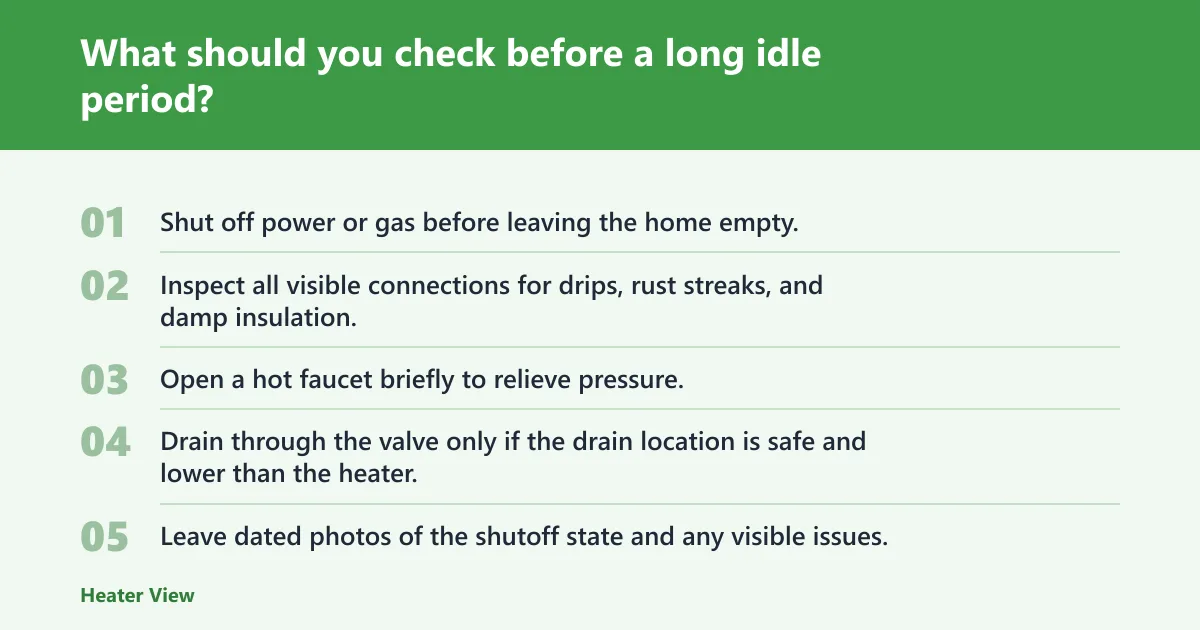
Before a long idle period, shut the system down in a controlled way, check for leaks, and decide whether to leave the tank full or drain it. For tank heaters, confirm the drain path is safe and that the drain valve opens cleanly. For tankless units, isolate supply lines, clear out standing water where appropriate, and protect against hidden leaks.
Tank water heater prep
Turn off the fuel source or power, then inspect the tank, shutoff, and nearby piping for seepage. If the home will sit empty for months, draining the tank can make sense, but only if the drain valve works and the drain location is lower than the heater. A garden hose may be needed to move water to a safe place.
Drain slowly. A clogged drain valve can turn a simple task into a mess. If sediment is heavy, the first water out may look cloudy or gritty. That is another sign the tank should be flushed before vacancy, not after the next occupied stay.
Tankless unit prep
For tankless units, long idle periods make descaling and startup checks more important than tank draining. If the unit has an inline pressure relief valve, test it as part of annual maintenance. Before reopening the home, confirm supply valves, venting, and controls are set correctly and that the first hot-water draw is stable.
Shutoff, leak, and drain checks
- Shut off power or gas before leaving the home empty.
- Inspect all visible connections for drips, rust streaks, and damp insulation.
- Open a hot faucet briefly to relieve pressure.
- Drain through the valve only if the drain location is safe and lower than the heater.
- Leave dated photos of the shutoff state and any visible issues.
Does a water heater need flushing if nobody uses hot water much?
Yes. Low use does not stop sediment from forming in the bottom of a tank. In fact, long idle periods give particles more time to settle, which can lead to popping or rumbling noises when the heater runs again. Flushing removes that layer and helps protect efficiency and tank life.
Sediment buildup in low-use tanks
Sediment buildup forms at the tank bottom over time. When the burner or elements fire, trapped water flashes through the layer and can make a popping or rumbling sound. That sound is not harmless decoration; it is a clue that heat transfer is getting worse and the tank bottom is working harder than it should.
For a low-use home, sediment may sit undisturbed for months, then settle tighter after each brief heating cycle. That is why a heater that “hardly gets used” can still have thick buildup.
How hard water changes flush timing
Water hardness should set the schedule. Greater than 11 gpg means hard water, and annual flushing is the better choice. Less than 7 gpg means soft water, and a 2-year interval is usually acceptable. If the home is vacant for long periods, it can be smart to flush before vacancy so the tank does not sit with settled debris.
How to drain and flush safely
Use the drain valve and a flushing hose to direct water to a safe drain location lower than the heater. If the valve is sluggish, do not force it. A failed drain valve can turn routine maintenance into a replacement job. Keep an eye on discharge color and debris until the water runs clear.
Why the anode rod matters more than most owners think
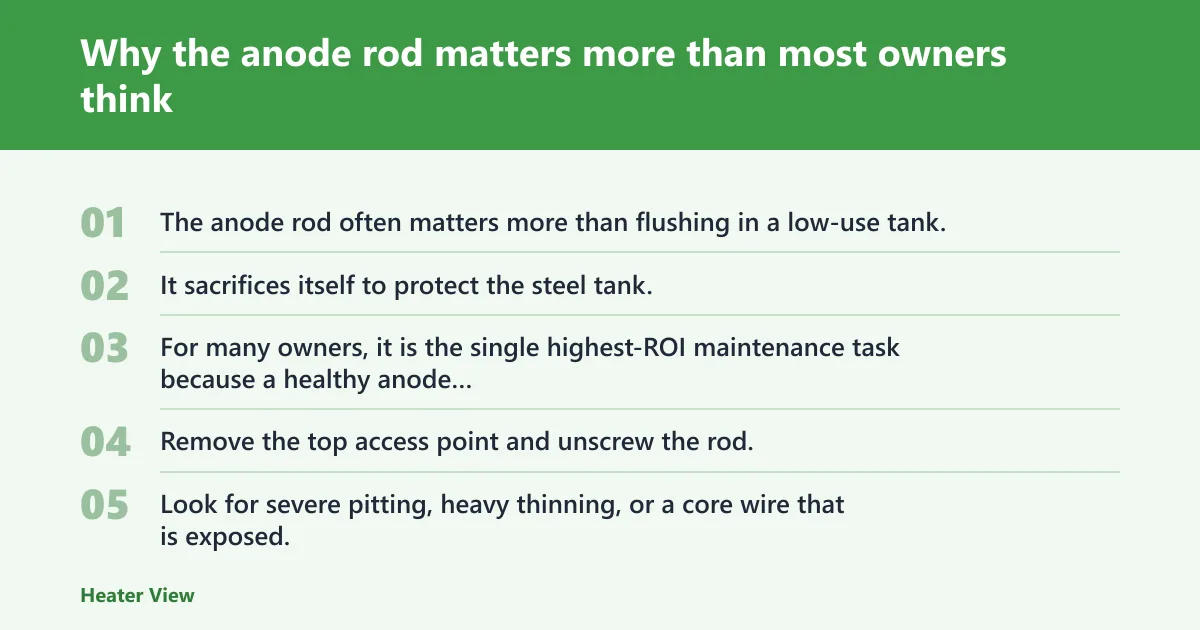
The anode rod often matters more than flushing in a low-use tank. It sacrifices itself to protect the steel tank, and it keeps doing that even when hot water demand is low. For many owners, it is the single highest-ROI maintenance task because a healthy anode can buy far more tank life than a perfect-looking exterior.
How to inspect the rod
Remove the top access point and unscrew the rod. Look for severe pitting, heavy thinning, or a core wire that is exposed. A rod that is badly eaten away is past its useful life. Low use can hide this problem because the heater still looks quiet and clean from the outside.
When to replace it
Replace the rod when it is severely pitted or down to the core wire. Hard water pushes that timeline sooner. The common mistake is waiting for a leak, but by then the tank has already taken the damage the rod was meant to absorb.
How low use affects inspection timing
Low use does not protect the anode. Stagnant water can still attack it, and seasonal shutdowns can leave the tank exposed to long periods with little circulation. In hard water, inspect it more often than you would in a full-time home. In soft water, inspection can start later, but it should still be on the calendar.
What maintenance matters most after a long vacation?
After a long vacation, the first task is not a full overhaul. It is a safe restart. Check for leaks, run enough hot water to clear stagnant water, verify the burner or elements operate normally, and make sure no valve stuck while the home was empty. Weak flow or rusty water usually shows up right away.
Restart steps for tank heaters
- Inspect the tank, drain valve, T&P valve, and nearby piping for leaks.
- Open hot taps to purge stale water until flow steadies.
- Listen for popping or rumbling that points to sediment.
- Confirm the burner or elements cycle normally.
- Check the T&P discharge tube for signs of dribbling after the first heat cycle.
Restart steps for tankless units
For tankless units, confirm supply valves are fully open, check venting and draft on gas models, and run hot water long enough to confirm stable ignition or heating. If the unit has been idle for months, plan on descaling according to water hardness and the service interval, not on a guess based on low occupancy.
When to watch for leaks, odors, or weak hot water
Watch the first few hours after restart. Rusty water can point to tank corrosion or an anode that is spent. A sulfur smell can mean stale water. Weak hot water can mean sediment, scale, or a burner or element problem. These are the moments when low-use homes reveal issues that stayed hidden during vacancy.
What is the safest water heater maintenance checklist for an infrequently used home?
The safest checklist is short and specific. Focus on the tasks that prevent idle-time damage and restart failures: flush sediment on schedule, inspect the anode rod, test the T&P valve, check for leaks before each stay, and use a structured restart after long vacancy. Add gas-side cleaning if the unit is gas fired.
Tank heater checklist
- Flush sediment on the correct hardness-based schedule.
- Test the T&P valve annually.
- Inspect the anode rod and replace it if heavily worn.
- Vacuum dust and lint from the gas burner area and air intake screen on gas units.
- Check venting and draft on gas models.
- Inspect for leaks at the tank, valves, and connections before each occupied stay.
Tankless checklist
- Descale as the main maintenance task.
- Use annual service in hard water and every 2 years in soft water.
- Expect the descaling job to take about 60-90 minutes.
- Test the pressure relief valve if installed inline.
- Check venting, intake, and startup behavior after idle periods.
DIY or hire a pro
DIY maintenance tools are often under $100, while annual service contracts are commonly framed at $150-300 per year. A homeowner can usually handle basic flushing, visual inspections, and startup checks. A pro makes more sense when the anode is seized, the drain valve fails, the venting is questionable, or the tankless unit needs a full descale and combustion check.
Documentation that helps later
Keep dated photos and receipts. That record helps with warranty questions and shows reasonable upkeep if a claim is ever disputed. A photo of a clean drain, a worn anode, or a tested valve is worth more than a vague memory of “doing maintenance sometime last year.”
Can a water heater sit unused for months without damage?
It can sit unused for months, but that does not mean it is protected. The risks shift from daily wear to stagnation, sediment settling, valve sticking, and hidden corrosion. The safest approach is to prep it before vacancy and treat the first restart as a real maintenance event, not a casual flip of the switch.
For tank heaters, long vacancy is where drain decisions matter. For tankless units, the concern is stale water, scale, and startup reliability. The unit may survive a long quiet period just fine, but only if the owner checks it before and after.
Do tankless water heaters in low-use homes still need annual service?
Yes. Tankless units still need service in low-use homes because scale, dust, venting issues, and relief-valve problems do not disappear when hot water demand drops. Descaling is the main task, and it is still a 60-90 minute job. Annual service is the better fit in hard water; soft water can stretch to every 2 years.
Low use can hide tankless problems longer, which is why startup checks matter. A unit that sat through a season may fire, then still have restricted flow or a dirty intake screen. A brief run test is not enough. The unit should be serviced on schedule and checked again before the next occupied stay.
Frequently asked questions
How often should I maintain a water heater in a low-use home?
Inspect before each occupied stay, test the T&P valve yearly, and follow the water-hardness schedule for flushing or descaling. For tank heaters, annual flushing fits hard water and 2-year flushing fits soft water. Low use changes timing around vacancy and restart, not the need for maintenance.
Does a water heater need flushing if nobody uses hot water much?
Yes. Sediment still settles at the bottom of the tank, even when the heater sits idle. In low-use homes, that sediment can compact and make the first restart noisier and less efficient. Flushing removes it and helps prevent the rumbling that points to buildup.
What maintenance matters most after a long vacation?
The first priority is a safe restart: check for leaks, run water until it clears, confirm normal heating, and look for odd odors or noises. A stuck T&P valve, rusty water, or weak flow needs attention right away because those are the problems long idle periods tend to reveal.
Is low use better or worse for an anode rod?
Worse, in a quiet way. The rod still sacrifices itself during idle time, and stagnant conditions can leave the tank more exposed to corrosion than a home with regular turnover. Hard water makes the wear happen sooner, so inspection should start earlier rather than later.
Should I drain my water heater if I only use it seasonally?
Sometimes. If the home will sit empty for months, draining can be a good option, but only if the drain valve works and the drain location is safe and lower than the heater. If the tank is left full, it should still be checked before the next opening and flushed if needed.
Can a water heater sit unused for months without damage?
It can, but only if the owner plans for the return. Long idle time can leave sediment settled, valves stuck, and water stale. Before turning it back on, inspect for leaks, run hot water to purge the lines, and confirm the heater responds normally.