
What to Know Before Buying a Garage Heater
Buy the heater that fits your garage’s insulation, available power, and use pattern; an oversized unit wastes money, and an undersized one will not hold temperature. Choose wrong, and you pay for cold starts, high bills, nuisance trips, or unsafe clearances. This guide covers sizing, fuel and power options, venting, mounting, safety clearances, and the checks to make before you buy.
What a garage heater does
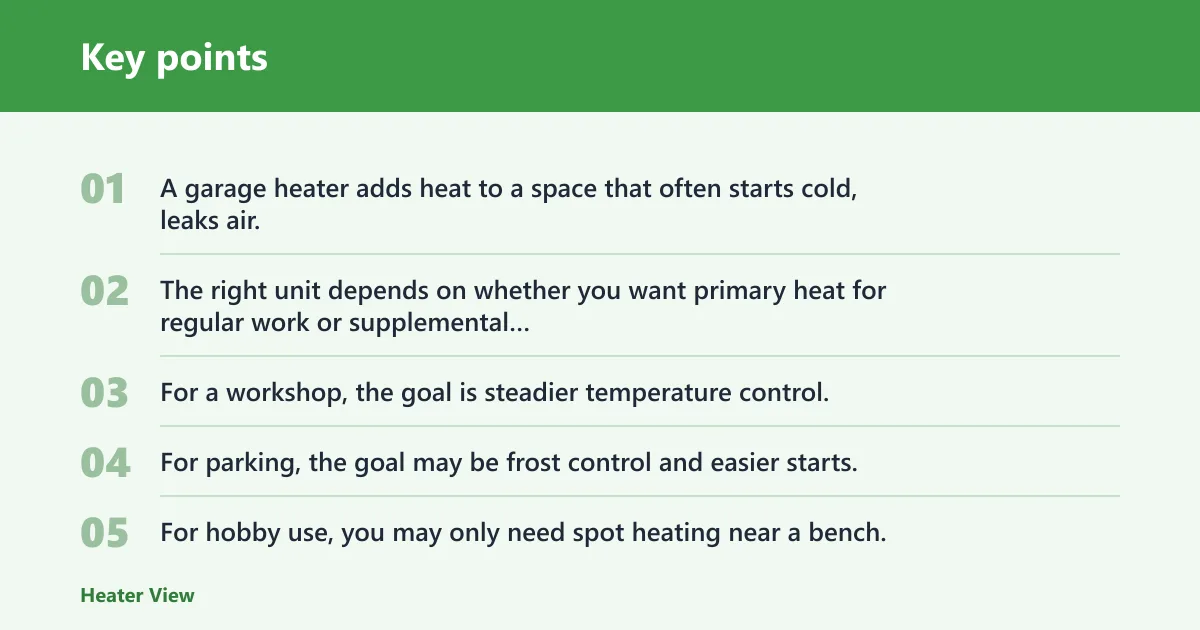
A garage heater adds heat to a space that often starts cold, leaks air, and has more open surfaces than a living room. The right unit depends on whether you want primary heat for regular work or supplemental heat for short sessions and milder days.
For a workshop, the goal is steadier temperature control. For parking, the goal may be frost control and easier starts. For hobby use, you may only need spot heating near a bench, which changes the output and mounting choice.
Primary heat vs supplemental heat
Primary heat means the heater must carry most of the load on its own. Supplemental heat means it helps an already-conditioned space or a garage that only needs a temperature bump for part of the day. Insulation level decides which category makes sense more than brand names do.
Some 1500W units can heat up to 300 sq. ft. as a primary heater. That same 1500W unit can cover up to 750 sq. ft. as supplemental heat. Those two figures are not interchangeable; the larger number assumes the garage already holds heat well and you are not trying to recover from a deep freeze.
Workshop, parking, and hobby-space use cases
A workshop usually needs the most consistent output because you are present for longer stretches. Parking use often needs freeze protection and quick warmup, while a hobby space may only need localized comfort near the occupied area.
Say your 20-by-24-foot garage has exposed studs, a bare slab, and a leaky door. That 480 sq. ft. space can be very different from a similarly sized insulated garage with drywall and an insulated overhead door. The first case usually pushes you toward more output or a different heating strategy altogether.
Garage heater checklist
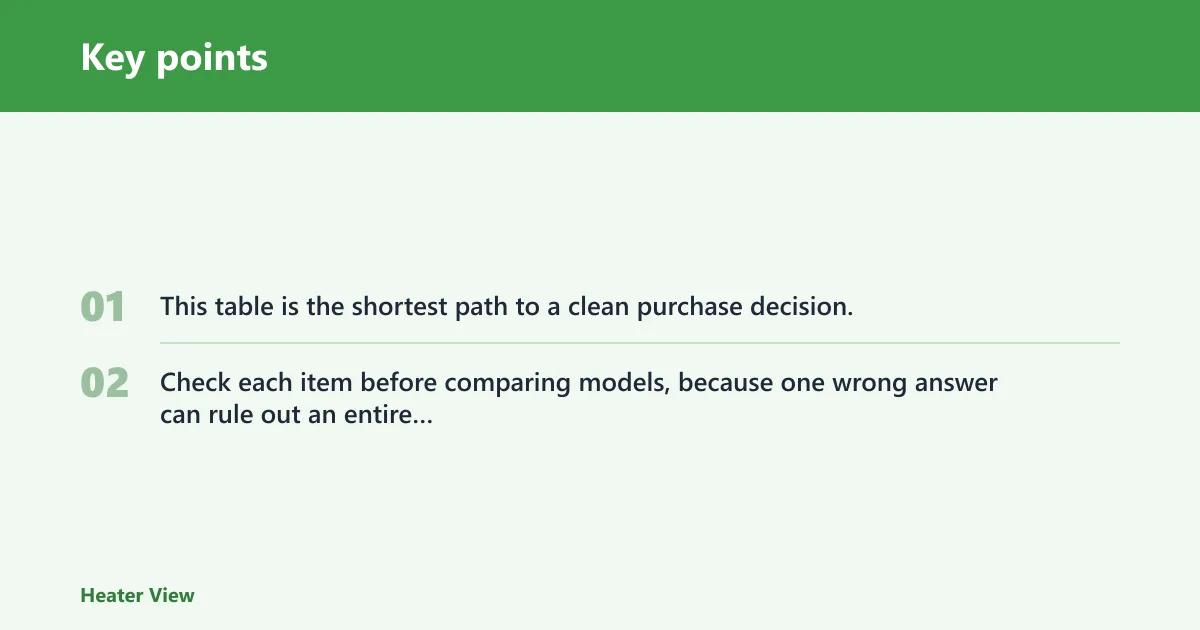
This table is the shortest path to a clean purchase decision. Check each item before comparing models, because one wrong answer can rule out an entire heater type.
| Decision point | What to verify | Why it matters | Which heater type it favors |
|---|---|---|---|
| Garage size | Measure length × width in feet and calculate square footage. | Output must match the actual air volume and heat loss. | All types, but output size filters the field first. |
| Insulation level | Check walls, ceiling, door, and whether gaps are sealed. | Better insulation lowers required output and stabilizes temperature. | Lower-output electric or infrared in insulated spaces; higher-output systems where insulation is poor. |
| Ceiling height | Measure floor to ceiling and note any high-bay storage. | Higher ceilings increase the air volume you must heat. | Ceiling-mounted forced-air or infrared units in taller garages. |
| Power availability | Confirm whether you have a 120V outlet, a 240V circuit, or gas service. | The heater cannot work without the right supply. | 120V plug-in electric, 240V hardwired electric, or gas/propane where supply exists. |
| Venting need | Check whether the heater requires combustion exhaust to leave the space. | Combustion units may need venting and may not fit every garage layout. | Electric and infrared where venting is difficult; vented gas only where allowed. |
| Mounting location | Identify wall space, ceiling structure, and floor clearance. | Mounting limits decide whether a unit can be installed safely. | Wall-mounted, ceiling-mounted, or portable floor units based on layout. |
| Clearance constraints | Measure distance to vehicles, shelves, lumber, and stored chemicals. | Heat sources need open space around them. | Portable units in open zones; ceiling or wall units where floor space is tight. |
| Runtime expectations | Decide whether you need short bursts or multi-hour heating. | Fuel use, tank size, and power draw change with runtime. | Electric for steady daily use; propane where longer runtime and fuel portability matter. |
| Noise tolerance | Decide whether fan noise will interfere with work or conversation. | Forced-air units can be loud enough to matter in a small garage. | Infrared or quieter electric options where noise is a concern. |
| Winter lowest temperature | Note the coldest expected outdoor temperature in your area. | Colder climates need more output and better heat retention. | Higher-output gas or hardwired electric in colder regions. |
| Primary vs supplemental heating | Decide whether the heater must carry the full load or just assist. | This determines whether a small unit is enough or not. | Supplemental electric or infrared for mild use; larger output for primary heat. |
| Safety and code checks | Confirm clearances, thermostat control, overheat protection, and whether combustion exhaust or carbon monoxide controls are required. | Safety failures are often installation failures, not product-size failures. | Heaters with clear manufacturer installation instructions and garage-specific approval. |
How much heater output do you need?
Start with square footage, then adjust for insulation and ceiling height. A small insulated garage can work with far less output than a similar-sized uninsulated one. For gas and forced-air units, BTU output is the capacity number to compare; for electric units, wattage is the key figure.
Square footage and insulation level
Measure length × width to get the floor area. Then sort the garage into three rough categories: insulated, semi-insulated, or uninsulated. Insulated garages hold heat better and can use lower output; exposed garages lose heat faster and usually need more capacity or more run time.
For fixed electric heat, a common 1500W baseline is useful only for small or well-retained spaces. In harder conditions, that level is often best treated as supplemental heat rather than the main source.
BTU output for gas and forced-air units
BTU output tells you how much heat a gas or forced-air unit can produce. A propane forced-air heater example is described as having variable output in the rough range of 30,000 to 60,000 BTU and being able to heat about 1,500 sq. ft. That figure depends on insulation, ceiling height, and how cold the garage gets.
Do not treat the top BTU number as a guarantee. If the garage is drafty, tall, or only partly insulated, the practical coverage drops. If the space is tightly sealed and used as a workshop, the same heater may feel more capable.
Wattage ranges for electric units
Electric heaters are sized by wattage, not BTU. A hardwired electric garage heater example is rated at 3000W/6000W on 240V. That type of unit is built for more sustained output than a small plug-in model and is usually better suited to larger or colder garages.
That same hardwired unit is described as wall or ceiling mounted, with an adjustable thermostat, high and low settings, and five adjustable louvers for directing airflow. Those features matter because a heater that can move air where you need it often performs better than one with only raw output.
Garage heater gas vs electric
Electric heaters are simpler to place where power exists, while gas and propane heaters can deliver higher output where fuel access and venting are workable. The better choice depends on your garage’s wiring, fuel supply, and whether you need fixed installation or movable heat.
Fuel access and operating cost tradeoffs
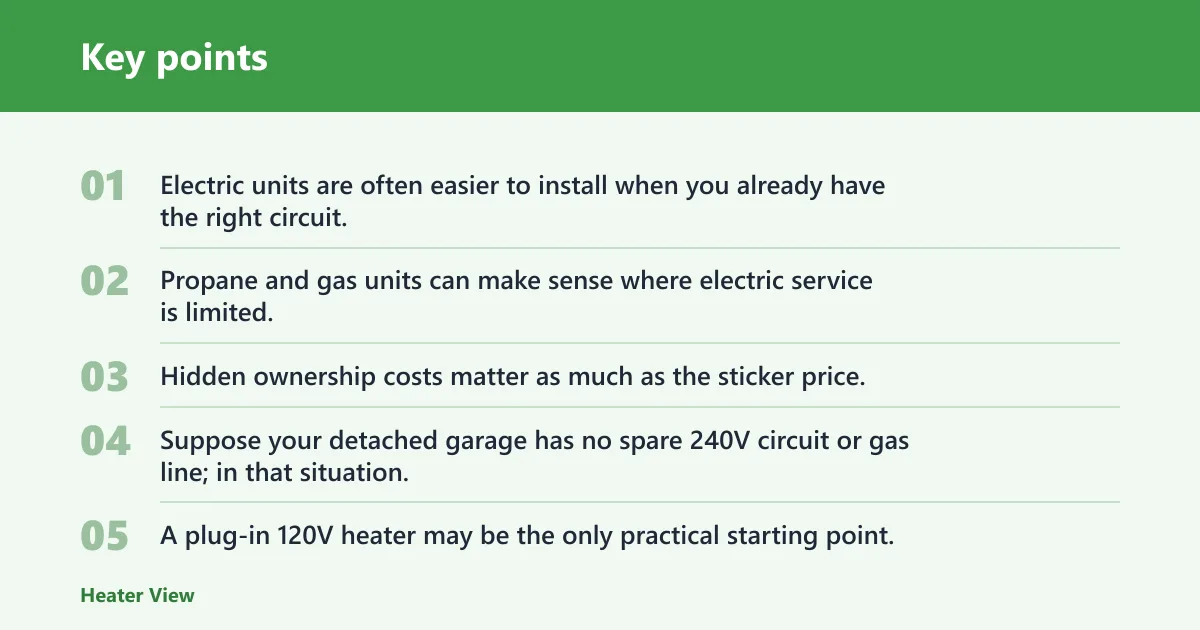
Electric units are often easier to install when you already have the right circuit. Propane and gas units can make sense where electric service is limited, but you must account for fuel supply, combustion exhaust, and any install labor. Hidden ownership costs matter as much as the sticker price.
Suppose your detached garage has no spare 240V circuit or gas line; in that situation, a 120V plug-in heater may be the most practical starting point. A plug-in 120V heater may be the only practical starting point, even if its output is modest. In that case, the “best” heater is the one that fits the building, not the one with the highest rating.
120V plug-in vs 240V hardwired models
120V plug-in units are the easiest to place, but they are limited by the circuit they use. 240V hardwired models can deliver more power, but they need compatible wiring and usually a dedicated circuit. Fixed electric heat also needs attention to continuous-load sizing, because the circuit must be able to carry the heater’s running demand for long periods.
If the garage already has a suitable 240V circuit and the heater is meant to be permanent, hardwired electric often fits the use case better than a portable unit. If not, do not force the choice; the installation cost can outweigh the convenience.
When combustion heat is a poor fit
Combustion heat is a poor fit when the garage is tightly packed, the ceiling is low, or venting is difficult. It is also a poor fit when the space will contain fuel containers, solvent storage, or other conditions that complicate safe clearance and exhaust routing.
Check whether the manufacturer specifically states garage suitability. A general listing alone does not mean a heater is approved for every garage environment.
Mounting, clearance, and venting
Mounting type matters as much as output. Wall-mounted, ceiling-mounted, and portable floor units each solve a different space problem, and each comes with different clearance and placement limits.
Wall-mounted, ceiling-mounted, and portable options
Wall-mounted units free up floor space and can work well near a bench or side wall. Ceiling-mounted units keep heat out of the way and are useful where cars or storage block the lower walls. Portable floor units are the least permanent option and are easier to move, but they take up usable space.
Choose the mount that fits the garage, not the one that looks simplest online. A heater mounted too low can interfere with storage or vehicle clearance, while a portable unit can be awkward in a narrow bay.
Clearance around walls, vehicles, and storage
Every heater needs open space around it. That includes distance from walls, vehicles, shelving, cardboard, lumber, and anything else that can obstruct airflow or create a hot-surface hazard. Read the manufacturer’s minimum clearance numbers before planning the install.
The output may be fine; the location is not.
When venting is required
Venting is required for many combustion heaters because exhaust gases cannot be left in the garage air. That is a different problem from moving warm air around. If a heater burns fuel indoors, confirm the exhaust path before purchase, not after delivery.
Electric and infrared units avoid combustion exhaust, which can simplify installation. That is one reason they are often the cleaner choice in code-constrained spaces or garages with limited wall and roof access.
Are garage heaters safe?
Garage heaters can be safe when the heater type, mounting, and installation match the space. The main failure cases are carbon monoxide from combustion units, lack of clearance around hot surfaces, and a heater that is not suitable for the garage environment in the first place.
Carbon monoxide risk and exhaust handling
Any fuel-burning heater needs careful attention to exhaust and ventilation. Carbon monoxide risk is not a side note. It is a primary reason to verify that the unit is approved for the intended garage use and that the venting plan is correct.
If the garage is detached and often closed, the need for correct exhaust handling becomes even more important. A heater that is easy to buy is not necessarily easy to place safely.
Safe-to-touch grills and surface temperature
Look for a grill or housing design that reduces accidental contact with hot parts, especially in garages used for tools, bikes, or family storage. “Safe to touch” should never mean “warm enough to ignore”; it means reduced burn risk, not no risk.
Clearances still matter even when the outer shell feels manageable. A heater can have a guarded face and still require substantial open space around it.
Thermostat control and overheat protection
A built-in thermostat helps keep the garage near the target temperature instead of swinging hot and cold. High and low settings add another layer of control, which is useful when the space only needs a small bump or when outside temperatures change through the day.
Thermostat control also helps avoid waste. If you only need a mild hold temperature for parking, a heater that runs flat out all the time is the wrong tool.
Hidden costs before you buy
The sticker price is only part of the cost. Wiring, gas supply, venting, mounting hardware, and installation labor can change the real budget by a lot, especially for hardwired or combustion units.
Electrical work and circuit upgrades
A 240V hardwired heater may need a dedicated circuit, new breaker work, or upgraded wiring. If the current panel is full or the run is long, the labor can cost more than expected. A lower-priced heater can become the expensive option after installation.
Gas supply, venting, and installation labor
Gas or propane heating can add line work, vent parts, and labor for placement and final setup. That is especially true when the garage was not built for fixed heat. The more complex the exhaust path, the more the installed cost matters.
Ongoing fuel or power costs
Ongoing cost depends on runtime and output level. A propane heater example can run up to 14 hours on a 20-lb. tank at low setting, and its QBT technology is claimed to make it 50% quieter than standard propane heaters. That may help in a workspace, but fuel cost and noise still belong in the decision.
Electric units shift the cost to your utility bill, which can be easier to predict if you only heat the garage for short sessions. Propane can be attractive where electricity is limited, but tank refills and runtime become part of the ownership equation.
Frequently asked questions
How much does a garage heater cost?
Heater price varies by fuel type, output, and mounting style, and the installed cost can be much higher than the unit alone. Electric plug-in models usually cost less to install, while hardwired electric, gas, or propane systems can add wiring, venting, or labor that changes the real budget.
How do I size a garage heater?
Measure the garage length and width, then decide whether the space is insulated, semi-insulated, or uninsulated. After that, compare the heater’s BTU or wattage rating to the use case. Primary heat needs more output than supplemental heat, and higher ceilings usually need more capacity too.
What is a good garage heater for my space?
A good heater is the one that matches your power source, mounting limits, and insulation level. For a small insulated garage, a 1500W unit may be enough as primary or supplemental heat. For larger or colder spaces, a 240V hardwired unit or a vented gas option may fit better.
Garage heater gas vs electric: which is better?
Electric is usually simpler if you already have the right circuit and want easier installation. Gas or propane can suit larger spaces or garages without strong electrical service, but you must plan for fuel supply, venting, and combustion safety. The better choice depends on the building, not the category.
Are garage heaters safe to use in a garage?
Yes, if the heater is specifically suitable for the garage, installed with required clearances, and matched to the space. Combustion heaters need special attention to carbon monoxide and exhaust handling. Electric and infrared units avoid exhaust, but they still need clearance and mounting checks.
What should I know before buying a garage heater?
Check the garage size, insulation, ceiling height, power availability, venting needs, mounting location, and the coldest winter temperature you expect. Then decide whether you need primary heat or only supplemental heat. Those filters matter more than marketing claims or review scores.