Should You Buy an Infrared Heater or a Ceramic Heater?
Buy an infrared heater for targeted warmth in a drafty or open area. Buy a ceramic heater for enclosed rooms and steadier comfort across more of the space. Pick the wrong type, and you can waste electricity, feel cold spots, or place the heater where its heat pattern works against the room. This guide compares room type, drafts, placement, noise, safety, and running cost so you can pick the better fit.
Infrared vs ceramic: the core trade-off


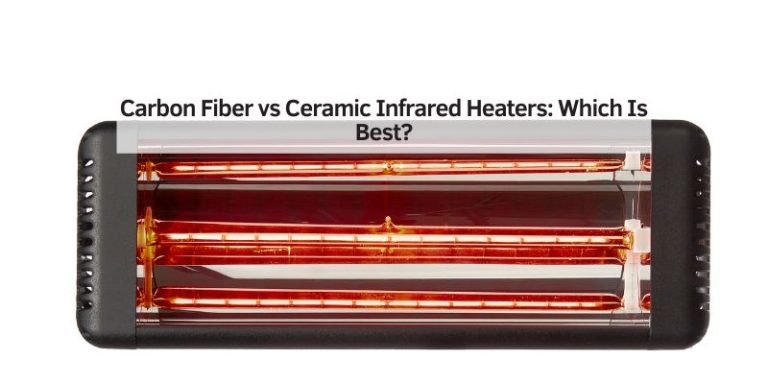
Infrared heaters warm people and surfaces directly. Ceramic heaters warm air with a heated element and a fan, then move that air through the room. That difference matters more than wattage alone, because the better choice depends on whether you need personal heat, whole-room comfort, or something that keeps working in a draft.
Infrared heat is radiant heat. It feels strongest in the heater’s line of sight, so it can send quick warmth to a chair, desk, or work zone without waiting for the whole room to fill with warm air. Ceramic heat is convection heating with fan assistance, which usually feels steadier across a closed room but can lose ground in open, leaky, or breezy spaces.
Room type changes the answer. A small bedroom with a closed door asks for different heat delivery than a garage with a wide opening or a living room with a hallway draft. Higher wattage does not automatically make either heater a better fit. Room size, insulation, occupancy, and where people sit matter more.
Heater comparison matrix
Use this matrix as a practical decision table, not a brand ranking. Scores run from 1 to 5, where 5 is the stronger fit for that row’s use case.
| Buying criterion | Infrared heater | Ceramic heater |
|---|---|---|
| Warm-up speed | 5 | 3 |
| Line-of-sight dependence | 2 | 5 |
| Fan noise | 5 | 2 |
| Whole-room coverage | 2 | 5 |
| Draft tolerance | 5 | 2 |
| Safety features | 3 | 5 |
| Bedroom suitability | 3 | 5 |
| Garage or patio suitability | 5 | 3 |
| Portability | 4 | 4 |
| Typical wattage range | 500 to 1500 watts | 750 to 1500 watts |
Warm-up speed and felt heat
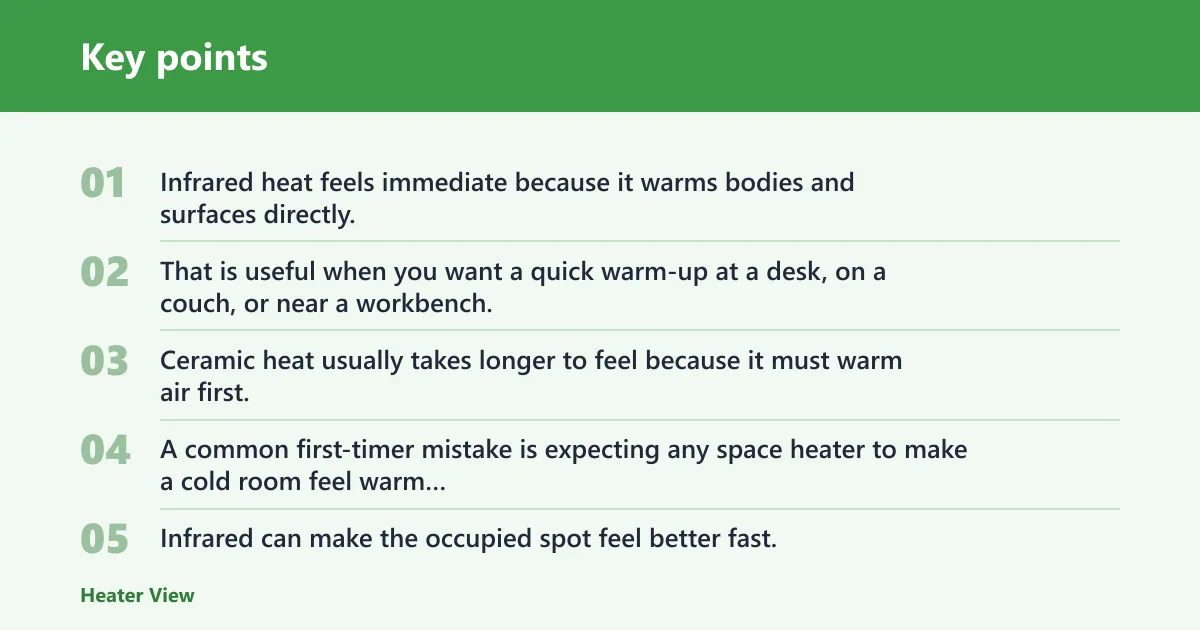
Infrared heat feels immediate because it warms bodies and surfaces directly. That is useful when you want a quick warm-up at a desk, on a couch, or near a workbench. Ceramic heat usually takes longer to feel because it must warm air first, then move that air around the room.
A common first-timer mistake is expecting any space heater to make a cold room feel warm everywhere in the first few minutes. Infrared can make the occupied spot feel better fast. Ceramic can make the room feel more balanced over time, but only if the room can hold that warmed air.
Line-of-sight dependence and coverage
Infrared heat travels in a straight path. Furniture, walls, and other barriers can block it, so the heater works best when you sit or stand in its path. That makes placement a big part of the purchase decision. If the heat must bend around a room, infrared is the weaker fit.
Ceramic heaters are less sensitive to direct line of sight because the fan moves heated air. That gives them better coverage across a room, especially when the space is enclosed. The trade-off is that airflow can feel less immediate than radiant heat at close range.
Noise, wattage, and portability
Infrared heaters are described as quiet because they do not use fans. Ceramic heaters use a fan to distribute warm air, so some noise is normal. If quiet matters for sleep, reading, calls, or a nursery, that difference can matter more than raw heating power.
Wattage should be read as a range, not a scorecard. Infrared heaters commonly appear in competitor examples at 500 to 1500 watts, while ceramic heaters commonly appear at 750 to 1500 watts. A competitor patio-heater page also lists infrared models at 1500 watts, 2000 watts, 3000 watts, 4000 watts, 4500 watts, and 6000 watts, plus a ceramic heater at 1950 watts. Those figures show that watts alone do not decide fit.
Portability is often similar for both. Many small space heaters are light enough to move from room to room, but the better question is where the heater can actually work well once it is placed.
Safety, bedroom fit, and draft tolerance
Ceramic heaters often include overheat protection and tip-over switches, and many have a cool-to-the-touch exterior. Those features matter in homes with pets or children, especially in bedrooms or shared rooms where the heater may sit closer to traffic. Infrared heaters can also include safety features, but the heat pattern and hot surfaces still require careful placement.
Draft tolerance tilts toward infrared because radiant heat is less affected by drafts or wind than air-warming heaters. Bedroom fit tilts toward ceramic when you want broader room comfort and built-in shutoff features. A bedroom with a closed door and a small footprint can still be a good infrared use case if you want targeted warmth rather than whole-room heat.
Which heater is better for your room?
Choose based on room size, insulation, occupancy, and where people sit. Infrared is the stronger pick for a person in a drafty or open area. Ceramic heaters are often the stronger pick for a closed room when steadier comfort across more of the space is the goal.
Small rooms and well-insulated bedrooms
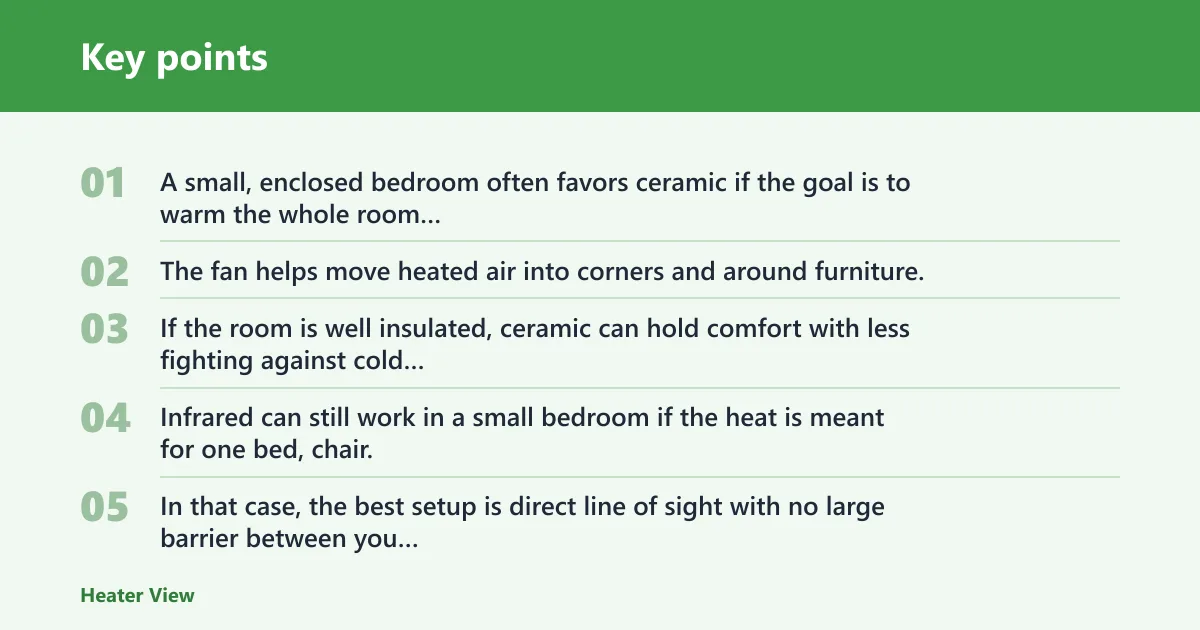
A small, enclosed bedroom often favors ceramic if the goal is to warm the whole room evenly. The fan helps move heated air into corners and around furniture. If the room is well insulated, ceramic can hold comfort with less fighting against cold air leakage.
Infrared can still work in a small bedroom if the heat is meant for one bed, chair, or reading spot. In that case, the best setup is direct line of sight with no large barrier between you and the heater.
Medium rooms and open living areas
Medium living rooms often split the difference. If the room is closed off and you want general comfort, ceramic usually makes more sense. If you only need warmth for one seat, one desk, or a sofa zone, infrared can do the job with less attention to the rest of the room.
Suppose a 14-by-18-foot living room has a couch against one wall and a hallway opening on the other side. A ceramic heater may need to run longer to keep the whole room comfortable, while an infrared unit can make the couch area feel warm sooner if nothing blocks its path.
Drafty garages and patios
Drafty garages and patios usually favor infrared. Air escapes fast in those settings, which makes convection heat harder to keep around. Radiant heat still reaches the person or object in front of the heater, so the effect is more useful when the space itself cannot hold warm air well.
That does not mean every garage or patio should get infrared by default. Distance matters. If the seating area sits too far from the heater, or if tools, shelving, or patio furniture block the beam, the result can feel weak even at higher wattage.
Do infrared heaters heat a room or just people?
Infrared heaters mainly heat people and surfaces, not the air first. That is why they feel fast and direct. They can warm part of a room, but they are best understood as spot heat or zone heat rather than a full-room solution.
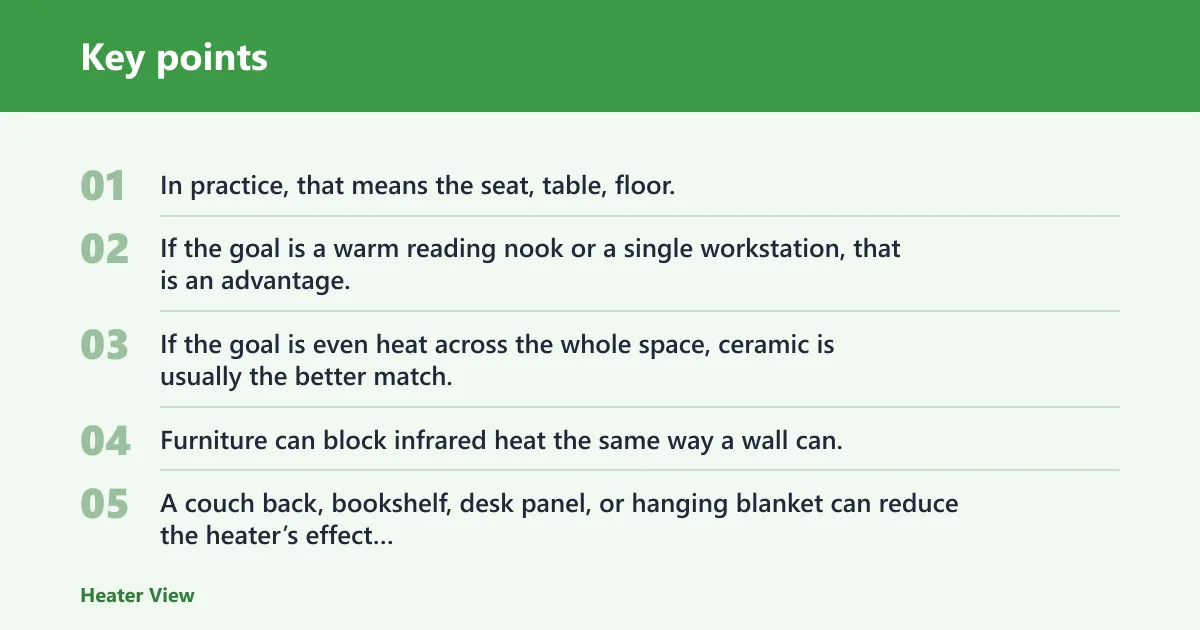
In practice, that means the seat, table, floor, and nearby walls can feel warmer before the whole room air temperature changes much. If the goal is a warm reading nook or a single workstation, that is an advantage. If the goal is even heat across the whole space, ceramic is usually the better match.
When furniture blocks performance
Furniture can block infrared heat the same way a wall can. A couch back, bookshelf, desk panel, or hanging blanket can reduce the heater’s effect because the beam cannot pass through solid objects. That is the clearest failure case for infrared heaters in ordinary homes.
Think of the heater as aiming at a target, not filling the room like a cloud. If the target keeps moving or the path keeps getting blocked, the heater can seem weaker than its wattage suggests.
Why spot heating can feel faster
Spot heating feels faster because the body does not wait for the whole room to warm up. Infrared heat reaches the person directly, and that can improve comfort quickly even when the surrounding air still feels cool. For many buyers, that is the real value of infrared.
That is also why infrared can work well in large or drafty areas where a whole-room heater would struggle. The room may stay cool overall, but the occupied spot can become comfortable faster than with a fan-driven heater trying to warm all the air.
Which heater is quieter?
Infrared heaters are quieter. They do not use fans, so they avoid the steady airflow sound that comes with most ceramic heaters. If you care about low noise more than room-wide coverage, infrared has the clear edge.
Ceramic heaters make more noise because the fan moves warm air. The sound is often modest, but it is still part of the comfort equation. Some people accept that trade-off for broader room heating; others find the fan distracting in sleep spaces or quiet work areas.
Fan noise in ceramic heaters
The fan helps ceramic heaters spread heat through the room, but it also creates sound and airflow. That airflow can feel useful in a cold room. It can also feel dry or noticeable if you sit close to the heater for long periods.
Silent operation in infrared heaters
Infrared heaters avoid the fan noise and the moving-air feel. That makes them a better fit for very quiet spaces, provided the placement works. Silence does not make them better in every room, but it can be a real comfort benefit in the right setting.
Safety features that matter most
Safety is not a tie breaker by itself. It depends on the heater’s features and on placement. For homes with pets or children, the most useful features are tip-over protection, overheat protection, and a cool-to-the-touch exterior when available.
Tip-over switches and overheat protection
Tip-over switches shut the heater off if it falls. Overheat protection shuts it down if internal temperatures climb too high. Ceramic heaters often include both features, which helps in bedrooms, family rooms, and other places where a heater may sit near foot traffic.
Cool-to-the-touch exteriors
A cool-to-the-touch exterior lowers the chance of accidental contact burns, especially in tight rooms. Ceramic heaters commonly have this feature. That does not mean they can be placed carelessly, but it does improve everyday handling and placement options.
Pet and child placement basics
Keep the heater away from curtains, bedding, toy piles, and walkways. Give it clear space around the intake and output areas. Never rely on safety features alone if the heater is crowded by furniture or placed where children or pets can brush against it.
Choose infrared if… / Choose ceramic if…
Use the room, the draft, and the way you sit in it to make the call. The better heater is the one that matches the space you actually have, not the one with the biggest watt number or the broadest marketing claim.
Choose infrared if…
- You want targeted warmth for one person, chair, desk, or work zone.
- The room is open, drafty, or poorly insulated, such as a garage or patio area.
- You want quiet operation with no fan noise.
- The heater can face the occupied spot without furniture blocking the beam.
Best if: you need immediate, direct heat in a draft-tolerant setting.
Avoid if: you need even heat across a closed room or the heater will sit behind furniture or barriers.
Choose ceramic if…
- You want more even room comfort in an enclosed space.
- The room is medium-sized, closed off, or reasonably insulated.
- You want common safety features such as tip-over protection and overheat shutoff.
- You are placing the heater in a bedroom, family room, or other shared indoor area.
Best if: you want the room to feel more uniformly warm with fan-assisted air circulation.
Avoid if: the space is very drafty, too open, or you need near-silent operation.
Picture a 10-by-12-foot bedroom with the door closed and the bed in the center. Ceramic is usually the more practical choice if you want the whole room to feel comfortable. Now picture a breezy garage with one chair near a workbench. Infrared is the better fit because the person, not the air, is the target.
Frequently asked questions
Should I buy an infrared heater or a ceramic heater for my room?
Buy infrared if you want targeted warmth in a drafty or open area, and buy ceramic if you want more even comfort in an enclosed room. The room itself drives the choice. If you heat one person in one spot, infrared usually fits better. If you heat the whole room, ceramic usually fits better.
Which heater is cheaper to run, infrared or ceramic heater?
There is no universal winner. Running cost depends on wattage, runtime, insulation, and how much space needs heat. A lower-watt heater that runs for hours can cost more than a higher-watt heater that shuts off sooner. The better question is how long the heater must run to keep you comfortable.
Are ceramic heaters safer for bedrooms and kids?
Often, yes, if the model includes tip-over protection, overheat shutoff, and a cool-to-the-touch exterior. Those features are common on ceramic heaters and matter in rooms with traffic, children, or pets. Even then, placement still matters. Keep the heater clear of bedding, curtains, and toys.
Which heater is better for a drafty garage or patio?
Infrared is usually better in drafty garages and patios because radiant heat is less affected by moving air. It warms the person or object in its path instead of trying to fill the whole space with warm air. That makes it a better match when air escapes quickly.
Can a ceramic heater heat a large room evenly?
It can do a better job than infrared at spreading warmth through a room, but large or open rooms still take more time and runtime. If the room is big, leaky, or full of barriers, even a strong ceramic heater may struggle to hold a steady temperature across every corner.