How to Clean Dust From a Space Heater Safely
Unplug the heater, let it cool fully, and clean only the exterior grille, air intake, and reachable vents with a vacuum brush or soft brush. If dust is packed inside or a panel must come off, stop and replace the heater. Poor cleaning can drive dust into hot parts, clog airflow, and raise fire or shock risk. This guide shows which surfaces you can clean, what to leave closed, and when dust means the heater should be retired.
Why heater dust matters
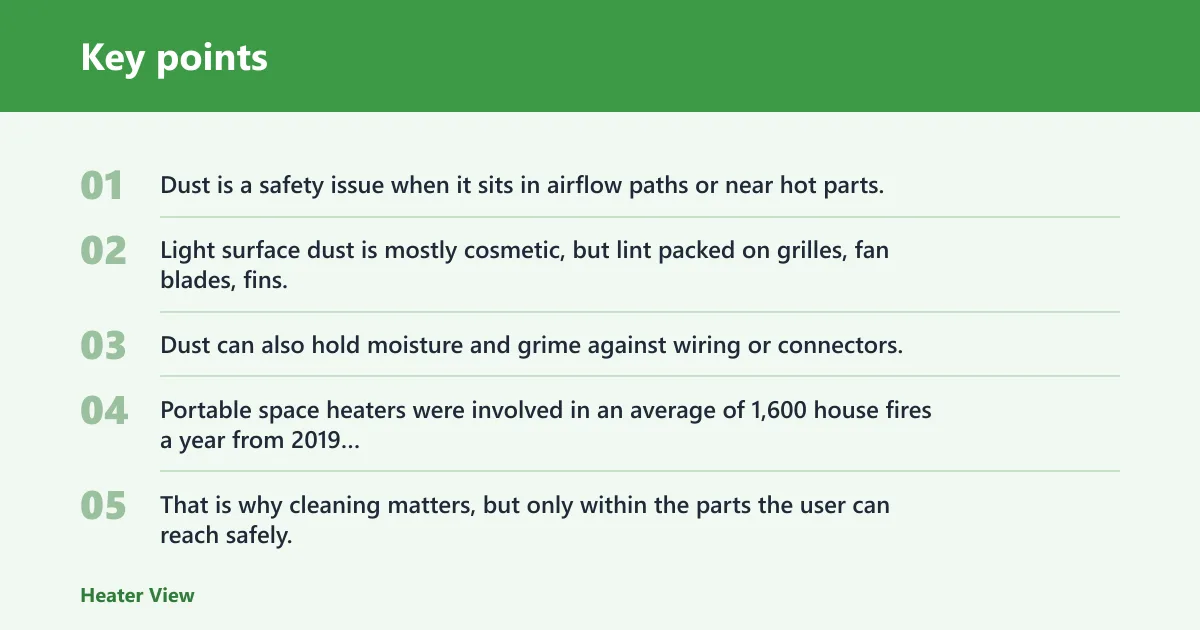


Dust is a safety issue when it sits in airflow paths or near hot parts. Light surface dust is mostly cosmetic, but lint packed on grilles, fan blades, fins, or intakes can restrict airflow, raise surface temperatures, and make a heater cycle badly. Dust can also hold moisture and grime against wiring or connectors.
Portable space heaters were involved in an average of 1,600 house fires a year from 2019 to 2021, and those fires resulted in an average of 70 deaths annually. That is why cleaning matters, but only within the parts the user can reach safely. (Consumerreports)
Dust that blocks airflow
Look for dust mats on intake slots, outlet grilles, fan blades, and the front face of the heater. That buildup works like a filter over the heater itself. It is the dust most worth removing with a vacuum and soft brush attachment.
Dust that points to damage
Dark soot, melted dust, a burned smell, or dust stuck to a warped grille can point to overheating or a failing part. That is not a cleaning job. It means the heater may already have heat damage, a loose connection, or a blocked internal path that a homeowner should not open.
When cleaning is not enough
If dust returns quickly because the heater rattles, smells hot, sparks, or blows weakly after cleaning, stop using it. Cosmetic dust can be removed. Dust tied to smoke, burning odor, or electrical damage should not be treated as routine maintenance.
📊 Consumer Reports recommends a 3-foot kid- and pet-free zone around a space heater. Source: How to Use a Space Heater Safely.
What you’ll need
- Vacuum with brush attachment
- Soft brush attachment
- Crevice tool
- Dust mask
- Dry microfiber cloth
A vacuum with brush attachment is the main tool for loose dust removal. Use soft contact only. The brush loosens dust from vents and grilles without the scraping that can bend fins or nick an element housing. A dust mask can help reduce inhalation during cleaning, especially for allergy-prone users.
How do you prepare the heater?
Unplug the heater or shut off power first, then let it cool completely. For portable heater cleaning, keep the unit stable on a level surface so it does not tip while you work. Move curtains, bedding, furniture, and toys away so airflow stays open before and after reassembly.
- Turn the heater off at its control, then unplug it or shut off the circuit breaker if it is a baseboard-style unit.
- Wait until the housing feels fully cool before touching grilles, vents, or covers.
- Set the heater on a flat, steady surface and clear nearby combustibles within at least 3 feet.
- Inspect the cord, plug, grille, and housing for cuts, scorch marks, cracks, or loose parts.
Do not rely on the thermostat alone for electrical isolation on baseboard units. Consumer Reports recommends a 3-foot kid- and pet-free zone around a space heater, and space heaters should be kept at least 3 feet away from combustible materials. Consumer Reports also says not to plug another electrical device or an extension cord into the same outlet as a heater.
Which heater parts are safe to clean?
You can clean grilles, vents, the outer cover if it is removable by design, and dust around intake and exhaust openings. Do not open sealed compartments, remove panels that are not meant to be user-accessed, or reach toward wiring, coils, motors, or ceramic elements. Those parts can stay hot or live even after the outside feels cool.
Electric space heaters can have hot internal parts and wiring, and some have a fan, grille, coil, or ceramic element behind the outer shell. Clean the reachable surfaces only. If a panel must be forced, or a screw is buried in a way the manual does not show, stop there.
Heater cleaning decision table
| Heater type | User-safe cleaning steps | Stop/call-service warning signs |
|---|---|---|
| Ceramic fan heaters | Unplug, cool fully, vacuum the intake and outlet grilles with a brush attachment, then use a crevice tool around the edges and a dry microfiber cloth on the shell. | Burning smell after cleaning, smoke, sparking, weak airflow that stays weak, or a fan that scrapes or stalls. |
| Radiant/quartz heaters | Unplug and cool, then dust the external grille and housing only. Keep the brush well away from glowing tubes and reflective elements. | Cracked quartz tube, dark spots on the element, flickering that is not normal, smoke, or a broken grille that exposes the element. |
| Oil-filled heaters | Unplug and cool, wipe the casing dry, vacuum the fins or slots that are reachable from outside, and leave the sealed oil chamber closed. | Any oil leak, bent panel, rusted seam, hissing, smell of hot oil, or distorted housing. |
| Baseboard-style units | Shut off the circuit breaker, confirm the unit is cool, vacuum the top and bottom openings with a brush attachment, and clear dust from the front fins without bending them. | Damage to the heating element, scorch marks, buzzing, repeated breaker trips, or dust packed deep behind the front panel. |
How do you clean dust from a space heater?
Vacuum loose dust first, then brush vents and grilles gently, then clear narrow corners with the crevice tool, and wipe the outside surface last. If dust is inside a sealed chamber or packed against an element, do not force access. That is where cleaning turns into damage.
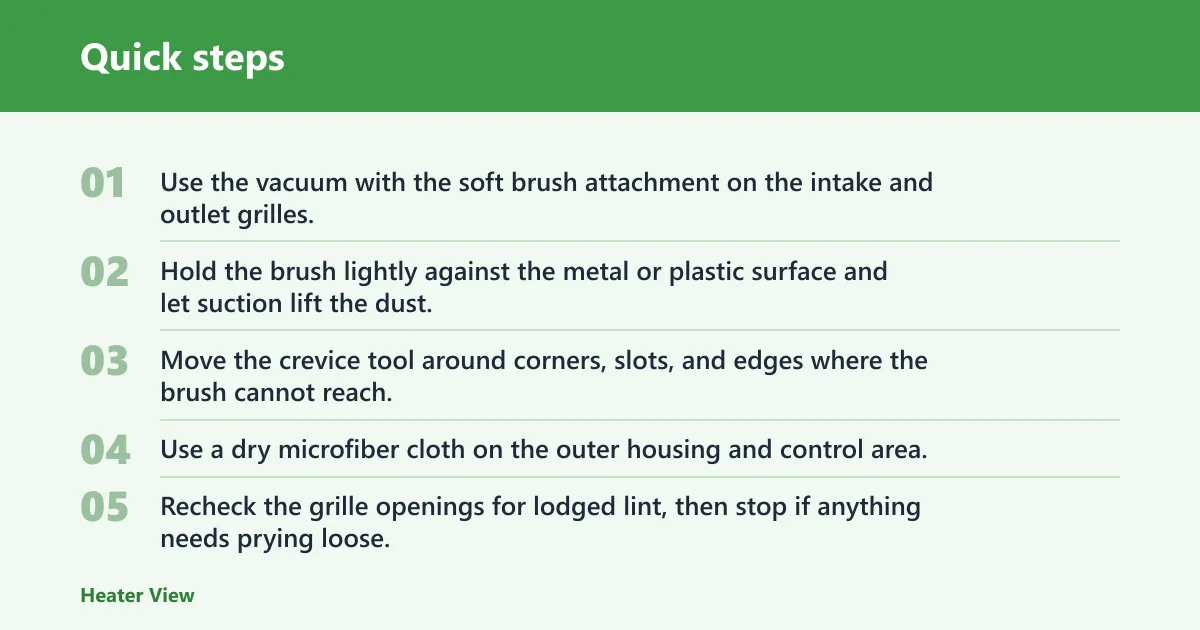
- Use the vacuum with the soft brush attachment on the intake and outlet grilles.
- Hold the brush lightly against the metal or plastic surface and let suction lift the dust.
- Move the crevice tool around corners, slots, and edges where the brush cannot reach.
- Use a dry microfiber cloth on the outer housing and control area.
- Recheck the grille openings for lodged lint, then stop if anything needs prying loose.
Suppose a ceramic fan heater has a visible dust ring on the front grille and weak airflow from the outlet. Start with the vacuum brush on the grille, then use the crevice tool on the slot edges. If the fan still sounds strained after that, the problem may be inside the housing.
Say your oil-filled heater has dust on the fins near the bottom but no smell, leak, or noise. Vacuum the reachable fins from the outside only, then wipe the casing dry. Do not try to pry open the sealed seam to reach deeper dust.
Common mistakes
Opening sealed panels is the biggest mistake. The next is using liquid cleaner, spray, or damp cloths on electrical parts. Scraping fins or heating elements can bend them, damage coatings, or leave metal fragments where heat builds.
- Do not remove panels beyond user-accessible areas unless the manual explicitly shows that step.
- Do not spray water, cleaner, or compressed air into vents or electrical openings.
- Do not scrape dust with a knife, screwdriver, or hard brush.
- Do not skip the breaker on baseboard-style units.
- Do not block airflow with furniture, bedding, curtains, or toys after cleaning.
For electric baseboard heaters, the breaker should be shut off before cleaning. The thermostat alone does not isolate the circuit. That matters because hidden live parts can still be present even when the room feels warm or the dial is set low.
When should you stop and get help?
Stop if you smell burning after cleaning, see smoke or sparking, find a damaged cord or plug, or notice a broken grille that exposes internal parts. Stop as well if an oil-filled heater leaks or the housing looks distorted. Those signs point to failure, not dust.
- Turn the heater off immediately.
- Unplug it, or switch off the breaker for a baseboard unit.
- Move combustibles away from the heater area.
- Do not restart it to “see if it clears up.”
Common first-timer mistake: a heater smells hot right after cleaning, and the response is to run it on high for 10 minutes. That can make a damaged cord, loose wire, or overheated element worse. If the smell does not fade quickly and the heater runs normally, stop using it and have it checked.
Frequently asked questions
How to clean a portable heater
Put the heater on a level surface after it is fully cool. Brush and vacuum the intake, outlet, and outer grille, then wipe the housing dry. Check the cord and plug before restarting. Burning smell, smoke, or sparking means the unit should stay off.
How to clean dust from inside radiators
For radiator-style heaters, clean only the reachable exterior fins, slots, or grilles with a vacuum brush and crevice tool. Do not force tools between tightly packed heating parts. If dust is buried deep enough that the tool cannot reach it without bending metal, stop and service the unit.
How to remove dust from the air
Use a vacuum with a brush attachment for the heater itself, then reduce room dust with regular vacuuming and good airflow around the unit. A dust mask can help during cleaning if dust stirs up easily. If the heater still blows dusty air after cleaning, the filterless design may be normal, but soot is not.