Why Is My Heater Making a Clicking Noise?
A heater that clicks once at startup or shutdown is often normal ignition, relay, or metal expansion noise, but repeated rapid clicking, clicking without heat, or clicking with gas odor can point to a fault. Ignoring the wrong pattern can leave you with no heat, a failed igniter, or a safety risk. This guide shows how to sort normal heater cycling from trouble by heater type, timing, and sound pattern.
Why is my heater making a clicking noise?

- Detects voltage without direct contact
- Helps reduce ghost-voltage false readings
- Backlit display for dim areas
A single click often comes from normal switching or metal movement. Repeated clicking, clicking that never leads to heat, or clicking paired with a smell, smoke, or weak airflow points to a problem that needs closer attention.
What a single click usually means
One click at startup or shutdown is often a relay switch, thermostat, or expansion and contraction in the cabinet or ductwork. In electric units, a heating element can also make a brief hum or click as it warms and shifts slightly. That pattern is usually brief and does not repeat fast.
When repeated clicking points to a fault
Repeated clicking usually means a control is trying and failing to complete a cycle. In a gas furnace, that can be the igniter or pilot assembly trying to light. In fan-driven electric units, it can be a loose relay, blade, or housing, especially if airflow also drops.
When to shut the heater off
Shut the unit off if the clicking is loud, sudden, rapid, or paired with burning smell, smoke, gas odor, or no heat. Repeated ignition clicks without a lighted burner are generally a stop-use warning on a furnace. A hot, rattling cabinet is another sign to stop using the unit and inspect it after power is disconnected.
Is the click normal or a warning sign?
Timing matters more than the sound name. A click at the start or end of a normal cycle is often expected, while a click that repeats during the run cycle or continues after shutdown is more likely to point to a loose part, control fault, or ignition problem.
Startup and shutdown clicks
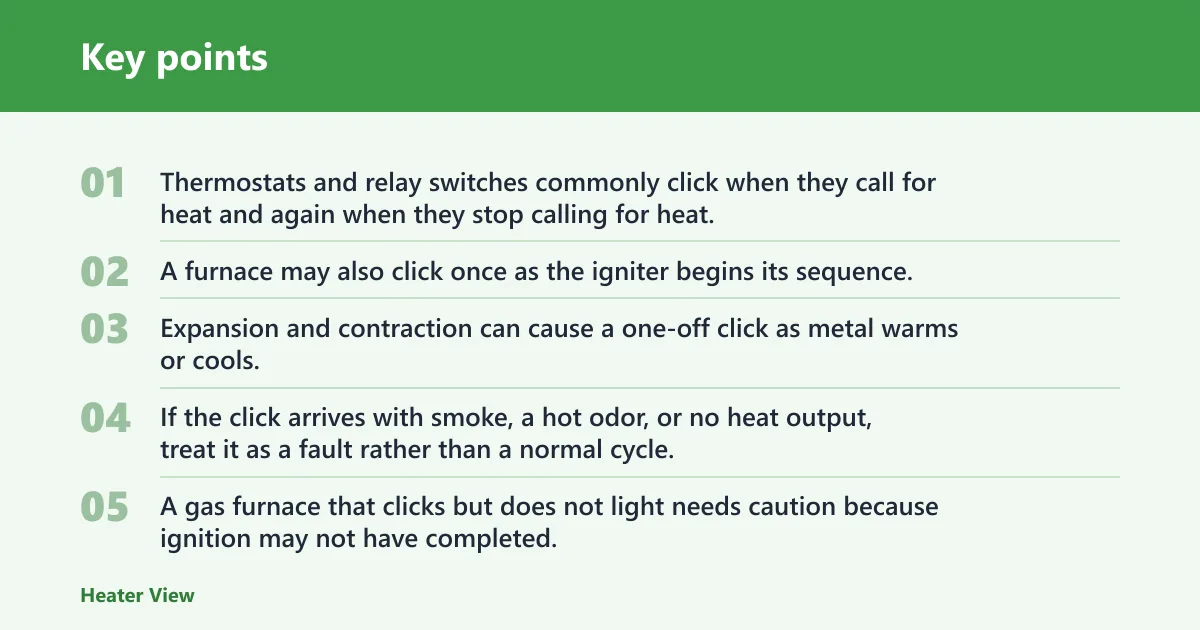
Thermostats and relay switches commonly click when they call for heat and again when they stop calling for heat. A furnace may also click once as the igniter begins its sequence. Those sounds should stay brief. They should not turn into fast, repeated ticking.
Heat-up and cool-down metal movement
Expansion and contraction can cause a one-off click as metal warms or cools. That is more common at startup and shutdown, when parts change temperature fastest. A baseboard heater can click as its housing moves slightly, and a wall heater can do the same if panels or fasteners are under stress.
Clicks that come with burning smell, smoke, or no heat
If the click arrives with smoke, a hot odor, or no heat output, treat it as a fault rather than a normal cycle. A gas furnace that clicks but does not light needs caution because ignition may not have completed. An electric heater that clicks but never warms may have a control or element issue.
Picture a 1500-watt electric space heater that clicks once when the thermostat calls for heat, then runs quietly. That pattern can fit normal switching. Now picture the same unit clicking every few seconds while the fan slows and the air stays cool. That pattern points to a fault, not normal cycling.
Why your heater clicks by type
Different heater types make different sounds for different reasons. A click can mean a harmless relay on one unit and a failed ignition sequence on another. Identify the appliance type first, then compare the timing.
Electric space heater
An electric space heater can click from the thermostat, relay switch, or heating element. A loose heating element can vibrate and hum or click, especially if wear or poor installation lets it shift. Dust and debris can also make the fan or blades tap the housing after storage or seasonal inactivity.
Wall heater
A wall heater often clicks at startup as the control closes and again at shutdown as it opens. If the sound is repeated or paired with reduced airflow, look for a blower motor issue, loose blade, or dust contact. A wall unit that rattles after a long off-season may only need cleaning, but only after power is off.
Baseboard heater
A baseboard heater usually makes the most harmless clicks from expansion and contraction. The sound often appears when the unit first heats and again as it cools. If the clicking becomes sharp, frequent, or tied to a burning smell, the issue is no longer a simple metal movement sound.
Gas furnace
A gas furnace can click as ignition begins, but repeated clicking without flame is a warning sign. The igniter or pilot assembly may be trying to light, and a no-light condition is a shutdown risk. If the furnace clicks but will not turn on, stop use and check the thermostat setting only; do not keep resetting it over and over.
Heater clicking matrix
This table separates the common click patterns by heater type so you can match the sound to a likely cause and decide what is safe to check at home.
| Heater type | Click timing | Likely cause | Safe homeowner check | Stop-use threshold |
|---|---|---|---|---|
| Electric space heater | Single click at startup or shutdown | Thermostat, relay switch, or heating element movement | Unplug it, let it cool, then inspect the cord, grille, and visible element area for looseness or dust | Rapid repeated clicking, no heat, burning smell, or visible damage |
| Wall heater | Clicking during heat-up or with fan start | Blower motor, loose blade, loose housing, or control relay | Turn power off at the breaker, then check for debris at the intake and grille | Reduced airflow, scraping, smoke, or repeated start-stop clicking |
| Baseboard heater | One-off click at warm-up or cool-down | Expansion and contraction of metal parts | With power off, look for contact between the cover and mounting points | Loud, sudden, or repeated clicking that starts with a hot odor |
| Gas furnace | Repeated click during ignition | Igniter or pilot assembly not lighting, or a control fault | Check the thermostat setting and confirm the filter and vents are not blocked; do not open gas components | No light, gas odor, repeated ignition clicks, or shutoff after failed starts |
What parts can make the noise?
The sound often comes from a small part that is cycling, shifting, or failing to settle. The part matters because each one points to a different next step, and some can be checked safely while others should be left alone.
Heating element
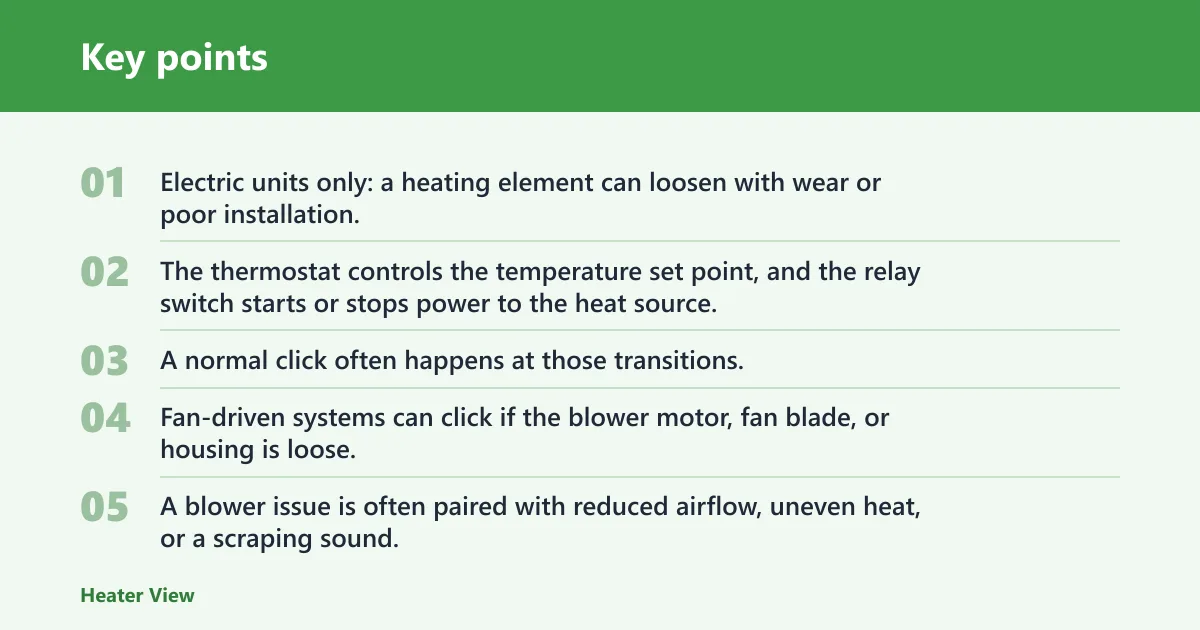
Electric units only: a heating element can loosen with wear or poor installation. It may vibrate, hum, or click as current heats it and the surrounding metal moves. If the unit is unplugged and cool, a visible loose element or mounting point is a sign to stop using the heater until it is repaired or replaced.
Thermostat and relay switch
The thermostat controls the temperature set point, and the relay switch starts or stops power to the heat source. A normal click often happens at those transitions. A stuck relay or miscalibrated thermostat can cause rapid cycling, short run times, or repeated clicks without steady heat.
Blower motor
Fan-driven systems can click if the blower motor, fan blade, or housing is loose. A blower issue is often paired with reduced airflow, uneven heat, or a scraping sound. If the fan seems weak, clean debris only after the power is disconnected; do not reach into a running unit.
Igniter or pilot assembly
Gas furnaces only: a repeated click can be the igniter or pilot assembly trying to light the burner. If the furnace never reaches flame, stop use. A no-light condition is a safety risk because repeated ignition attempts mean the control sequence has not completed.
Dust and debris
Dust and debris can cause tapping or clicking when a fan blade brushes the housing or a loose particle moves through the air path. This is common after storage or seasonal inactivity. Cleaning requires power disconnection first, because even a small fan can start unexpectedly if power remains on.
Suppose a wall heater sat unused for months and now clicks only when the fan starts. If airflow also sounds weaker than usual, dust contact or a loose blade is more likely than a thermostat problem. By contrast, a baseboard unit that clicks once as it cools is more likely showing normal metal movement.
What you can safely check before calling for help
Safe checks should stay outside live electrical parts and gas components. If any step requires opening a panel on an energized unit, stop there and use a qualified repair path instead.
-
Turn power off first.
Unplug portable electric heaters or switch off the breaker for wall and baseboard units before inspecting anything. Let the unit cool fully so you can separate heat-related expansion noise from a loose or damaged part. -
Check the sound pattern.
Note whether the click happens once, repeats, or shows up only at shutdown. A single click at the start or end of a cycle is different from rapid clicking that lasts several seconds. -
Inspect visible openings.
Look through the grille for dust buildup, loose screws, or a bent panel. If a fan blade is visible and seems to brush the housing, do not try to realign it while the unit is powered. -
Confirm airflow is steady.
Fan-driven heaters should move air without a scraping or rattling sound. Reduced airflow with clicking often points to the blower motor, a loose blade, or blockage. -
Check the thermostat setting.
Make sure the set point is above room temperature if heat is expected. If the heater clicks on and off quickly, a thermostat problem or miscalibration may be shortening the cycle. -
Record the warning signs.
Note any gas odor, smoke, burning smell, weak heat, or repeated ignition clicks. Those details help separate a normal switch sound from a fault that needs immediate service.
Frequently asked questions
Why is my electric heater making a clicking noise?
An electric heater can click when the thermostat closes, when a relay switch changes state, or when a heating element shifts slightly as it warms. If the sound repeats rapidly, check for dust, a loose panel, or a loose element after unplugging the unit and letting it cool.
Why is my furnace making a clicking noise but not turning on?
A furnace that clicks but does not turn on may be trying to start the igniter or pilot assembly without reaching flame. That is a stop-use condition if it repeats. Check the thermostat setting once, then stop resetting the unit and arrange service if ignition still fails.
Why is my heater making a popping noise?
Popping usually points to expansion and contraction when metal heats or cools, especially in baseboard or cabinet-style heaters. If the popping is loud, sudden, or repeated during normal operation, it may be a loose panel, dust contact, or another mechanical issue rather than harmless thermal movement.
Why is my heater making a ticking noise?
Ticking often means a repeating light contact, such as dust brushing a fan blade, a loose housing panel, or a relay cycling on and off. A slow tick at warm-up can be normal expansion. Fast ticking that continues while the heater should be steady is a warning sign.
Why does my furnace make a popping noise when it shuts off?
A furnace can pop at shutdown because hot metal contracts as the unit cools. A one-time pop is often a thermal movement sound. If the pop is followed by repeated clicking, a failed shutdown sequence, or the smell of gas or smoke, stop using the furnace and get it checked.