Heater Repair Basics
Heater repair basics start with four checks: thermostat, power, airflow, and filter; stop and call for service if you smell gas, see soot, trip a breaker, or the burner will not stay lit. Miss the cause and you can waste fuel, overheat parts, or turn a simple airflow restriction into a no-heat service call. This guide lays out a safe path for no heat, weak heat, and unusual noises on gas, oil, and forced-air systems without opening sealed panels or touching live wiring.
A good triage flow separates air-movement faults from ignition, fuel, and electrical faults early. That matters because today’s forced-air heating systems use a furnace to heat the air and a large blower to circulate it, with ducts sending heated air to rooms and a return vent bringing cooler air back for reheating.
How a forced-air heater works
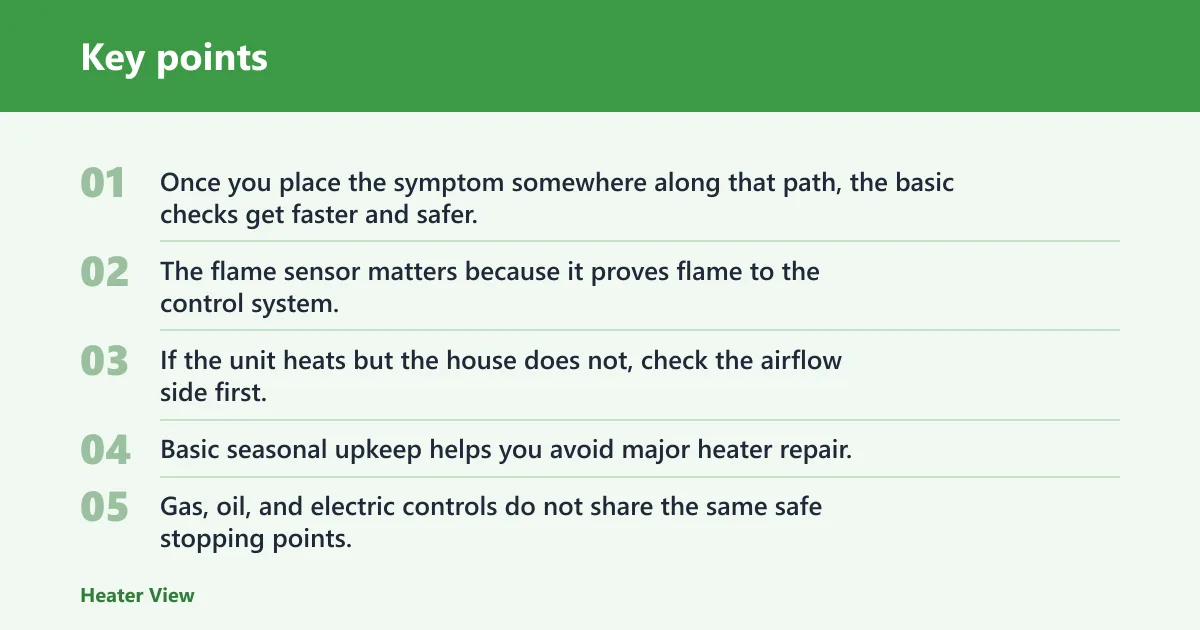


In a forced-air system, the furnace makes heat, the blower motor moves that heated air, supply ducts deliver it, and the return path pulls cooler room air back to the unit. Once you place the symptom somewhere along that path, the basic checks get faster and safer.
Where heat problems start
If the thermostat is calling for heat but the burners never stay lit, the fault is usually on the ignition, flame-proving, fuel, or control side. On gas equipment, that can include a dirty flame sensor, pilot trouble on older units, burner issues, or a technician-level problem such as a gas supply valve failing with age.
The flame sensor matters because it proves flame to the control system. When dust coats the sensor, it may stop proving flame from the pilot or burner, which can shut the burner down right after ignition. That is one common no-heat path, not the only one.
Where airflow problems start
If the unit heats but the house does not, check the airflow side first. The filter, return air vent, closed registers, blower compartment intake, blower motor, and on some fan-equipped furnaces the fan belt can all cut air movement.
Weak airflow can trip high-limit safety controls and cause short cycling, where heat starts, stops too soon, and then repeats. A clogged filter, lint at the return, and dust buildup around the intake are routine causes, and replacing filters on schedule is one of the main preventive steps. Basic seasonal upkeep helps you avoid major heater repair.
Why system type changes the safe checks
Gas, oil, and electric controls do not share the same safe stopping points. Gas units add burner tubes, pilot components on older equipment, a heat exchanger, and a gas train that should not be adjusted by a homeowner. Oil units add fuel-supply concerns and a transformer voltage output check that belongs to a trained technician unless the homeowner is trained and equipped.
Many residential furnaces are direct-drive and have no belt at all. Belt-driven fans still exist on some older or larger fan-equipped furnaces, so a broken belt remains a real failure point, but only on that design.
What should you do before opening the unit?
Before any inspection, stop the call for heat at the thermostat, then shut off the unit with the furnace service switch or breaker if needed. Do not continue if there is a gas odor, smoke, soot, scorch marks, repeated breaker trips, loud banging, or any carbon monoxide concern.
Heater repair basics checklist
- Set thermostat to off. Cancel the heat call first so the unit does not try to restart while a panel is off. If the thermostat uses batteries, leave the display powered; only stop the heating demand.
- Use the service switch. Turn off the furnace switch mounted on or near the unit if you need to remove a basic access panel. If the switch is missing or unclear, use the correct breaker instead.
- Watch for red flags. Stop immediately for gas smell, visible soot, smoke, scorch marks, or a breaker that trips again after reset. Those signs move the problem out of homeowner-safe triage.
- Wait for moving parts. Give the blower time to coast to a stop before reaching near the filter slot or blower access area. Fan blades and belt drives can keep spinning briefly.
- Limit the inspection. Check only homeowner-access parts such as thermostat settings, filter, visible vents, the service switch, and an obvious loose panel or door. Do not open sealed burner compartments or probe live wiring.
What a homeowner can inspect without special tools
Safe checks are visual or simple functional checks: thermostat mode and setpoint, breaker position, service switch position, filter condition, open registers, blocked returns, and whether the blower runs when there is a heat call. A flashlight and the filter size printed on the old filter are usually enough.
Say your hallway return grille is covered by stacked storage bins and the furnace starts but shuts off after a short run. Moving the bins changes one variable, return airflow. If the short cycling stops after a new filter and a clear return path, the symptom fits an airflow restriction rather than a burner failure.
Why is your heater not turning on?
If the forced-air unit will not turn on at all, start with the call-for-heat path: thermostat mode, setpoint, batteries, power at the breaker, and the furnace service switch. For gas or oil units, then confirm fuel availability only at a basic level and stop before any combustion or live-voltage work.
Thermostat checks first
The thermostat is one of the first places to check because a wrong setting, weak batteries, or a loose faceplate can stop the heat call before the furnace does anything. Set the thermostat to Heat, raise the setpoint above room temperature by a few degrees, check that the programmed schedule is not canceling your change, and make sure the cover or snap-on face is fully seated if your model uses one.
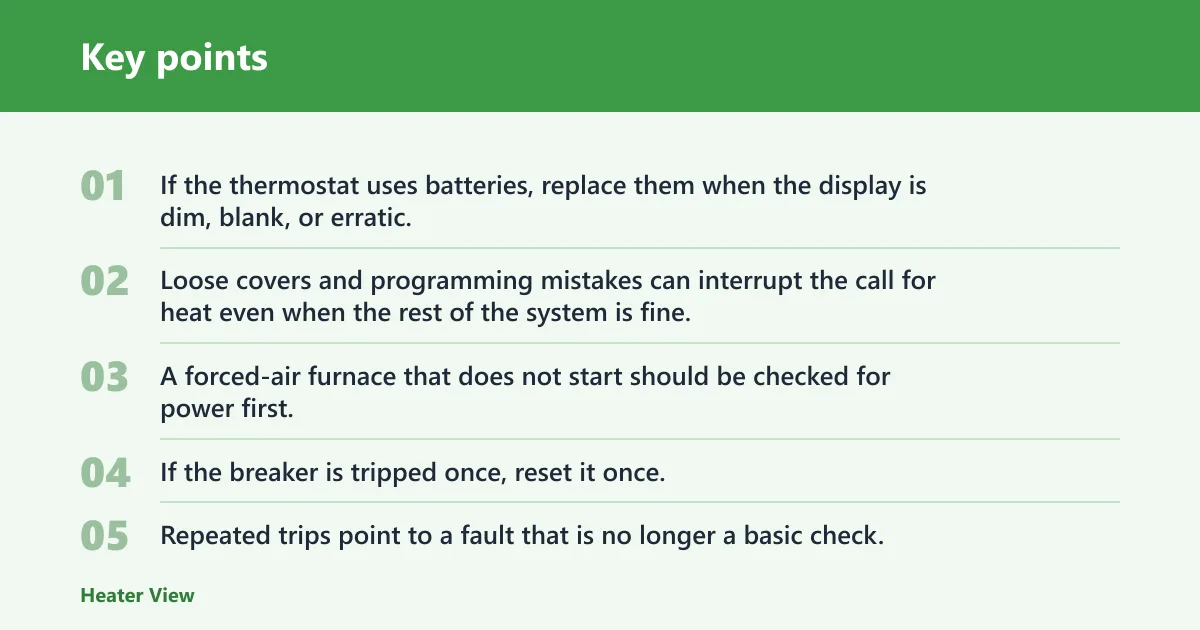
If the thermostat uses batteries, replace them when the display is dim, blank, or erratic. Loose covers and programming mistakes can interrupt the call for heat even when the rest of the system is fine.
Power and service switch checks
A forced-air furnace that does not start should be checked for power first. In a forced-air furnace setting, the homeowner-safe part of that sequence is breaker first, then the furnace service switch, then only a visual check for thermostat wire that is fully outside the cabinet, obviously disconnected, and can be seen without touching any wiring at all.
If the breaker is tripped once, reset it once. If it trips again, stop. Repeated trips point to a fault that is no longer a basic check.
Gas and oil supply checks
On a gas unit, check only whether the external gas supply valve appears open and whether another gas appliance in the home is also affected. Do not force the valve, disconnect piping, or try to diagnose a failing gas supply valve; that requires professional diagnosis.
On an oil furnace, verify there is fuel in the tank before anything else. Oil-furnace guidance also includes checking transformer voltage output, but that is a technician task unless the person doing it is trained and properly equipped.
Reset limits and lockouts
Repeated resets raise cost and risk. If an oil burner reset has already been used and the unit still will not fire, do not keep pressing it. Recurring no-heat events, ignition failures, and repeat lockouts are usually uneconomical to chase with DIY retries because the likely causes are now in fuel delivery, combustion, or controls.
Suppose an older gas furnace clicks, lights for two seconds, then shuts off three times and locks out. That pattern points away from a thermostat battery and toward flame proving or burner-side trouble. The safe move is to stop after the basic filter and vent checks, then book service.
What should you check before calling for heater service?
Before calling for service, check the filter, return and supply airflow, thermostat setup, power switch, breaker, and whether any door or panel is sitting loose. These checks can solve simple no-heat or weak-heat calls and help describe the symptom clearly if a technician is needed.
Filter condition and replacement
A dirty filter can absolutely cause heater problems. It reduces airflow, can cause the furnace to overheat and trip limit controls, and may show up as weak heat, short cycling, or a blower that runs with little warm air reaching the rooms.
- Remove the old filter. Pull it out only after the unit is off. Read the size and airflow arrow on the frame before discarding it.
- Check for loading. If the filter is gray, packed with dust, or bowed inward, replace it rather than trying to clean a disposable filter. A heavily loaded filter is enough to create airflow faults by itself.
- Install the new filter. Match the printed airflow arrow to the air-moving direction toward the furnace or blower cabinet. A backward filter can still pass air, but it can fit poorly and collect debris the wrong way.
- Restart and observe. Restore power, call for heat, and watch one full cycle. If heat output and airflow improve, the restriction was likely central to the symptom.
Return vents, supply registers, and visible blockages
Check that the return air vent is not blocked by furniture, rugs, boxes, or a closed door arrangement that starves return airflow. Then check supply registers in the problem rooms. Several closed registers can change static pressure enough to worsen weak airflow symptoms.
Look for lint or debris near the blower compartment intake if it is safely visible from a basic access point. Do not reach into the blower assembly or remove internal shields.
Loose panels, doors, and obvious damage
A blower door or burner access panel that is not seated can prevent operation on many furnaces. Check for a panel left ajar after filter service, a disconnected condensate tube on a high-efficiency gas unit, or a furnace switch shut off by accident nearby.
Noisy operation also belongs in this pre-service check. A noisy furnace can come from simple maintenance issues or a failed part, so note whether the sound is a rattle from a loose panel, a squeal from a belt-driven fan, or a hum with no airflow from the registers.
How do you tell if the problem is airflow or ignition?
Airflow problems usually show up as weak air, hot-cold swings, short cycles, or heat that seems trapped in the furnace. Ignition problems usually show up as burners that never light, light briefly and shut off, or a blower that runs but sends only cool air.
Blower runs but air is cold
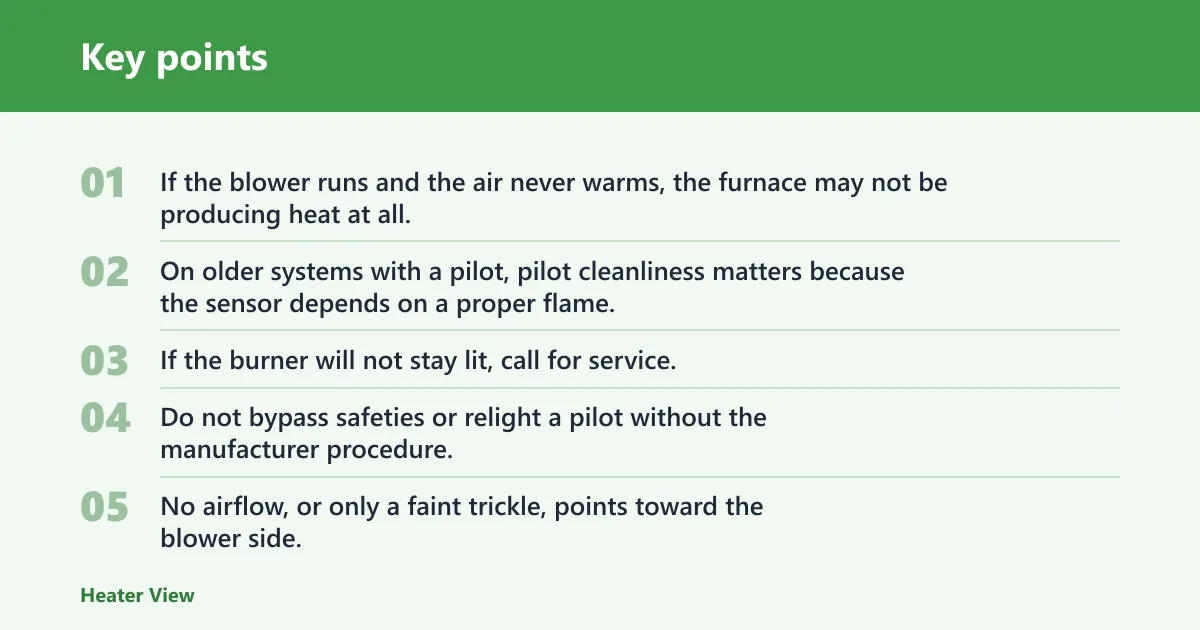
If the blower runs and the air never warms, the furnace may not be producing heat at all. On gas units, listen for a normal start sequence followed by burner ignition; if there is no flame or it drops out, the issue is on the ignition or combustion side.
On older systems with a pilot, pilot cleanliness matters because the sensor depends on a proper flame. Gas furnace repair can be reduced by having the thermocouple, pilot, and burner tubes cleaned during service, but internal burner cleaning and adjustment are not homeowner tasks.
Burners try to light but shut off
This symptom often points to flame sensing rather than airflow. A flame sensor can collect dust and grime and may then fail to prove flame from the pilot or burner, causing the burner to shut down after lighting.
Homeowner-safe action stops at observing the pattern and checking for a dirty filter or blocked returns that might also cause odd cycling. If the burner will not stay lit, call for service. Do not bypass safeties or relight a pilot without the manufacturer procedure.
No airflow from registers
No airflow, or only a faint trickle, points toward the blower side. The blower motor circulates heated air and can fail mechanically; fan motor failure is a listed heater problem. On belt-driven units, a broken belt is another listed cause.
Signs include humming with little or no air movement, an overheated smell, intermittent airflow, or squealing before the fan stops. If the unit seems to heat internally but does not distribute air, the blower motor or belt path deserves attention.
Short cycling after a brief heat call
Short cycling often starts with restricted airflow, especially a clogged filter or blocked return path. It can also point to limit control trips, venting problems, or combustion faults, so the stop point matters.
Picture a direct-drive furnace with all bedroom registers open except one shut nursery vent, a packed filter, and a return grille blocked by a bench. Replace the filter and clear the return first. If the unit still fires briefly and stops, the symptom has moved beyond a basic airflow fix.
Which heater parts commonly fail?
Common failure points include the thermostat, filter, blower motor, flame sensor, pilot components on older systems, and on some furnaces a fan belt. Other faults, such as a gas supply valve, heat exchanger issues, burner problems, and transformer output faults, belong to a technician.
Thermostat, filter, and blower motor
These are the highest-yield homeowner checks because they affect the whole system path. A wrong thermostat setting or weak thermostat batteries can stop the heat call, a loaded filter can choke airflow, and a failed blower motor can leave heat stuck in the cabinet instead of moving through the ducts.
If the thermostat calls for heat and the blower never moves air, note whether there is only silence, a hum, or a failed start. That description helps separate control issues from motor issues.
Flame sensor, pilot, and burner tubes
On gas furnaces, the flame sensor proves burner operation. Older pilot systems also depend on a stable, clean pilot flame. Burner tubes should be kept clean as part of preventive gas-furnace upkeep, but that work is part of service rather than homeowner adjustment.
Fan belt, transformer, gas supply valve, and heat exchanger
A belt-driven fan can squeal, slip, or stop if the belt breaks. Oil burners add a transformer output check as a diagnostic item. A gas supply valve can fail with age. The heat exchanger is also part of gas-furnace upkeep, but cleaning, crack inspection, and repair are professional work only because the safety stakes are higher.
The heat exchanger is not a DIY cleaning target. It matters for efficient heating and safe operation, and damage there is one of the clearest reasons to stop basic troubleshooting.
Heater triage decision table
| Symptom | Likely cause | What a homeowner can safely check | What tool is needed | Stop point for calling a technician |
|---|---|---|---|---|
| No heat, unit silent | Thermostat setting, dead batteries, tripped breaker, off service switch | Mode on heat, setpoint above room temp, battery change, breaker and service switch position | Flashlight, replacement batteries | Breaker trips again, thermostat still blank, or no response after power checks |
| Blower runs, air is cold | Ignition failure, flame sensor issue, pilot trouble, fuel interruption | Filter condition, visible return blockage, listen for ignition attempt | Flashlight, new filter | Burner never lights or will not stay lit |
| Heat starts, then stops quickly | Dirty filter, blocked return, limit trip, combustion fault | Replace filter, open registers, clear return vent, confirm blower door is shut | New filter, flashlight | Short cycling continues after airflow checks |
| Weak airflow at registers | Loaded filter, blocked return, blower motor issue, closed registers | Filter replacement, open supply registers, remove obstructions at return vent | New filter | Motor hums, overheats, or airflow stays weak after restriction is removed |
| Squealing or flapping noise on fan-equipped heater | Broken or slipping fan belt on belt-driven unit | Confirm whether the heater is belt-driven and look for visible belt damage with power off | Flashlight | No belt movement, damaged belt, or uncertainty about access |
| Gas furnace lights, then shuts off | Dirty flame sensor, unstable pilot on older unit, burner issue | Observe ignition pattern only; replace filter if dirty | Flashlight, new filter | Any repeated flame dropout, soot, delayed ignition, or uneven flames |
| Oil furnace will not fire | Empty tank, control lockout, burner problem, transformer output fault | Check fuel level and whether reset has already been used | Flashlight | Second lockout, repeated reset need, or any transformer diagnosis |
| Burning smell or smoke | Dust burnoff, motor trouble, wiring issue, belt issue | Shut system down and note whether smell clears quickly | None | Smoke, persistent odor, scorch marks, or breaker trip |
| Soot near furnace or vents | Combustion problem, burner issue, venting issue | None beyond shutdown | None | Immediate service call; do not restart |
When does a basic check become a professional repair?
A basic check becomes a professional repair as soon as the fault points to combustion, fuel delivery, repeated electrical trips, burner instability, transformer output, or the heat exchanger. After thermostat, power, filter, and airflow checks, many furnace and heater repairs require a service professional.
Combustion, gas, and oil boundaries
Stop when there is gas odor, soot, scorch marks, rumbling ignition, burner flames that look uneven, repeated lockouts, or an oil burner that needs another reset. Those symptoms point toward burner setup, fuel delivery, venting, or control faults outside homeowner-safe repair.
Gas furnace repair prevention includes having the pilot and burner tubes cleaned during service, and oil furnace repair can be limited by oil-burner cleaning during service. That cleaning belongs in service work when access is internal or combustion adjustment is involved.
Electrical boundaries
A single off breaker or switch is a basic check. Repeated breaker trips, signs of overheated wiring, control-board faults, or transformer output diagnosis are not. Oil-furnace guidance includes checking transformer voltage output, but only with training and proper meter use.
Cost and repeat-failure context
Repeated DIY attempts become poor value quickly when the same no-heat symptom keeps returning. Each restart can waste fuel, stress ignition parts, and delay a repair that is already moving toward a service call. If the unit has the same failure after the simple checks are corrected, the low-cost part of the process is over.
Seasonal maintenance that helps prevent repairs
Seasonal maintenance lowers the odds of no-heat calls by keeping airflow normal and catching small faults early. Basic seasonal maintenance helps avoid major heater repair, and cleaning dust from return grilles and replacing filters at the right interval are specifically listed preventive steps.
Priority tasks for homeowners
- Replace filters on time. Check the filter regularly during heating season and replace it when loaded. This prevents airflow restriction that can lead to weak heat and limit trips.
- Clear return and supply paths. Keep return grilles open and supply registers unblocked by rugs, furniture, or storage. Air has to leave and return for the furnace to heat evenly.
- Check thermostat basics. Replace thermostat batteries where relevant when the display is dim, blank, or erratic, and confirm schedule settings before cold weather starts. A thermostat that cannot hold a reliable heat call can imitate a furnace fault.
- Vacuum surrounding dust. Clean dust around the exterior cabinet, filter slot, and nearby floor area with power off. This reduces debris that can be drawn into the blower section.
- Book annual service. Have combustion appliances serviced in line with the manufacturer’s guidance and system needs. That service can include burner inspection, flame-sensor cleaning where applicable, pilot evaluation on older systems, heat-exchanger inspection, and oil-burner service.
What maintenance should stop at the service line
Do not open sealed compartments beyond basic access panels, clean burner tubes internally, relight a pilot without the unit procedure, bypass door or rollout switches, or work on the heat exchanger. The same limit applies to testing transformer output and diagnosing a gas supply valve.
Frequently asked questions
How to fix a broken heater
Start by matching the symptom: silent unit, blower with no heat, weak airflow, short cycling, or burner dropout. Safe fixes are limited to thermostat correction, power restoration, filter replacement, and clearing blocked vents. If the fault points to combustion, fuel, or repeated breaker trips, stop and call for service.
What are the basic checks for heater repair?
The basic checks are thermostat mode and setpoint, thermostat batteries where used, breaker and furnace service switch, filter condition, blocked return vents, closed supply registers, and a loose furnace door or panel. Those checks separate simple airflow or control problems from faults that need a technician.
How do I know if my heater needs professional repair?
Your heater needs professional repair if you smell gas, see soot or scorch marks, hear loud banging, get repeated lockouts, trip the breaker again after one reset, or the burner will not stay lit. Heat exchanger work, burner work, transformer diagnosis, and gas valve faults are also technician-only territory.
Can a dirty filter cause heater problems?
Yes. A dirty filter can reduce airflow enough to overheat the furnace and trip the high-limit control, causing short cycling, weak heat, and poor room comfort. It can also make a healthy burner look faulty because the heat is produced but not moved through the ducts properly.
Why does my heater make noise before failing?
Noise often appears before full failure because moving parts, airflow restriction, and loose panels change the way the system starts and runs. Squealing can point to a belt-driven fan problem, humming can suggest blower motor trouble, and rattling may be as simple as a loose access panel.
What parts commonly fail in a home heater
Common failures include the thermostat, filter-related airflow path, blower motor, flame sensor, pilot parts on older gas systems, and on some units the fan belt. Less homeowner-safe faults include burner issues, gas supply valve problems, transformer output faults, and heat exchanger defects.