Furnace Keeps Shutting Off: Common Causes
A furnace that starts then stops is often associated with a dirty flame sensor, ignition trouble, blocked venting, an overheating limit switch, or a pressure switch problem. First note whether the burners, blower, inducer, or whole unit quits. Ignoring the pattern can waste money on the wrong part and leave you without heat when the system locks out. This guide shows how to read the shutdown pattern, match it to the most likely cause, and check the safest homeowner fixes first.
How different shutdown patterns point to faults


The pattern matters more than the complaint. A furnace that runs, shuts down, and then restarts is short cycling; a furnace that loses flame in seconds points to ignition or flame sensing; a unit that runs for a while and then quits often points to overheating or airflow limits.
Normal cycling versus a fault
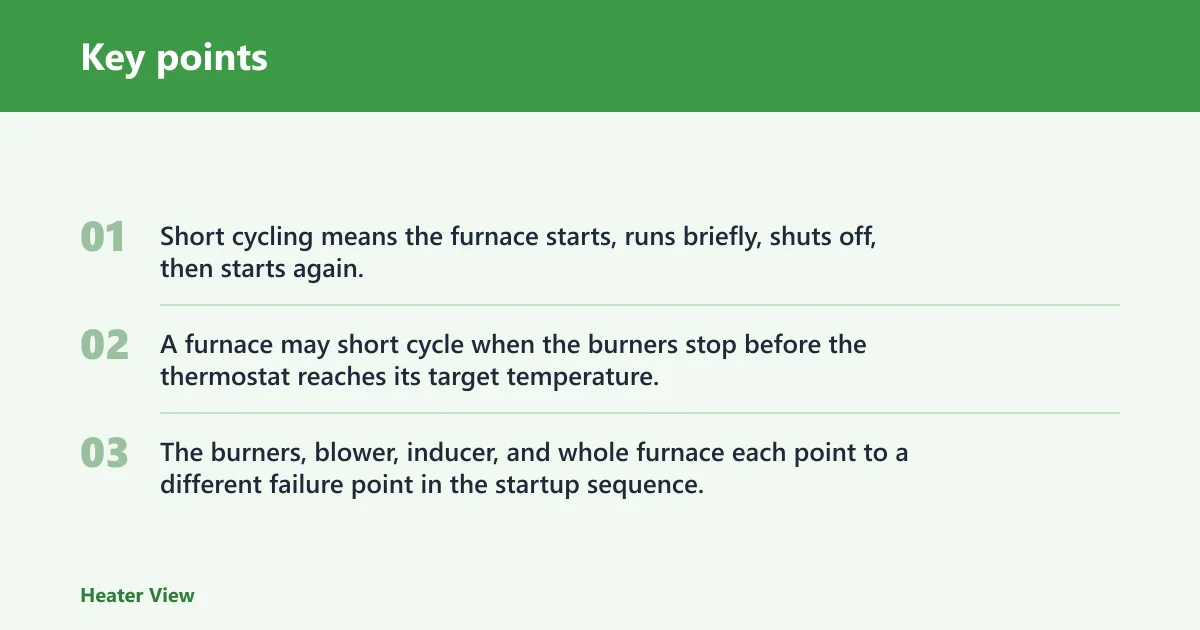
Short cycling means the furnace starts, runs briefly, shuts off, then starts again. That differs from normal thermostat cycling, where the burner stops after the room reaches the set temperature and stays off until heat is needed again.
A furnace may short cycle when the burners stop before the thermostat reaches its target temperature. That early stop can come from a safety device, an ignition fault, or a control issue, so the shutoff timing helps narrow the search.
Which shutdown pattern do you see?
Start by watching what quits first. The burners, blower, inducer, and whole furnace each point to a different failure point in the startup sequence. That sequence usually runs through the inducer, pressure circuit, ignition, flame sensor, and blower.
If your furnace lights for about 3 to 5 seconds, then the flame drops out and the blower keeps running, that can point to flame-sensing or ignition trouble. That pattern fits flame sensing or ignition trouble far better than a blower fault.
Furnace shutdown matrix
| Shutdown pattern | Likely causes | Safe homeowner checks | Technician-only checks |
|---|---|---|---|
| Burners stop only | Dirty flame sensor, gas valve issue, ignition fault, control board lockout | Check thermostat mode, replace batteries, confirm filter condition, look for fault light pattern | Measure flame-sensor signal, test gas valve operation, read board codes, verify ignition sequence |
| Flames die in seconds | Dirty flame sensor, weak igniter, gas valve not staying open, control board relay failure | Confirm thermostat is calling for heat, inspect the filter, note how long flame stays on | Clean or test flame sensor, test igniter resistance or spark output, check gas pressure and board output |
| Inducer starts but no stable ignition | Pressure switch problem, vent blockage, tubing fault, igniter failure, lockout logic | Check vents, returns, and visible vent terminations; look for condensate backup on high-efficiency units | Verify draft, test pressure switch, inspect tubing, confirm inducer performance, read code history |
| Whole furnace dies at once | Thermostat, wiring, control board, power loss, safety switch opening | Check thermostat batteries and settings, reset the breaker once, inspect condensate float if accessible | Test low-voltage circuit, board relays, safeties, power supply, and lockout logic |
What should you check first?
Start with the simplest airflow and control items. A dirty air filter is one of the first checks when heating starts cycling abnormally, and a bad thermostat setting can mimic a furnace fault. If those are fine, move to vents, drains, and visible lockout clues.
Air filter and airflow
A dirty or incorrect filter size can choke airflow through the furnace. If the filter has a higher MERV rating than the system can handle, airflow loss can raise cabinet temperature and trigger a safety shutdown. Closed or obstructed supply vents can also contribute to overheating.
Check the filter size printed on the frame and match it exactly. Many homes use 1-inch filters that need replacement every 1 to 3 months, but the correct interval depends on dust load, pets, and run time. If the filter is visibly loaded or bowed inward, replace it before calling for service.
-
Shut the thermostat off.
Turn the system to Off, then remove the filter and inspect its size, dirt load, and airflow direction. A clogged filter can be enough to trip a limit switch or make the blower work against restricted flow. -
Open supply and return paths.
Make sure key supply vents are open and return grilles are not blocked by rugs, furniture, or storage. Restricted airflow can lead to overheating, and overheating can open the limit switch as a safety shutdown. -
Check the condensate drain.
On high-efficiency furnaces, look for standing water, a backed-up drain, or a float switch trip. Water in the drain system can stop operation even when the rest of the furnace looks normal.
Thermostat settings and batteries
Verify the thermostat is in Heat mode and the setpoint is above the room temperature. Weak batteries, loose wiring, or a thermostat placed near sunlight, supply registers, or exterior doors can distort readings and make the furnace cycle at the wrong time.
If the whole furnace dies at once, the thermostat, wiring, or control board may be involved. That differs from a burner-only shutdown, which usually points lower in the ignition chain.
Why does the flame go out fast?
Fast flame loss usually points to the flame sensor, the igniter, the gas valve, or the control board. If the burners light and then shut off within seconds, the furnace is seeing a failed ignition sequence or it is not proving flame reliably.
Dirty flame sensor
A malfunctioning flame sensor is listed as a common cause of short cycling. When the sensor cannot confirm flame, the control board closes the gas valve as a safety move, often after only a few seconds of burner operation.
Common signs include flame that lights normally, then drops out before the blower has a chance to settle into steady heating. The sensor can often be cleaned by a technician or a careful homeowner if it is easy to access, but the burner compartment should not be opened beyond safe access points.
Igniter failure
A hot surface igniter can crack or glow weakly, and a spark igniter can misfire if the ignition path is weak or contaminated. If the furnace tries to light, then pauses, then tries again, the igniter may be failing before the flame is established.
That matters because ignition timing and flame sensing are separate. A furnace that never gets a stable flame is not the same as one that lights and then loses flame after a few seconds.
Gas valve or control board lockout
The gas valve opens and closes gas flow. If its electrical control is intermittent, or if the control board sees repeated failed ignition attempts, the furnace may enter safety lockout and stop trying until power is cycled or the fault clears.
Repeated resets are a warning sign, not a fix. If the same flame-loss pattern returns, the board’s diagnostic LEDs or codes usually point to the area that failed last.
Why does it shut down after it runs awhile?
Late shutdowns often point to overheating protection. When the burners stop after several minutes rather than seconds, the limit switch, blower, or airflow path is usually higher on the list than the igniter or flame sensor.
Limit switch trips from overheating
The limit switch protects the furnace from excessive heat. If the heat exchanger or cabinet gets too hot, the switch opens and shuts off the burners. Some furnaces reset automatically after cooling; others require attention because the underlying airflow problem remains.
Restricted airflow causes are common here: a dirty filter, blocked vents, closed registers, or a dirty evaporator coil can all reduce heat movement enough to trip the limit.
Blower motor or capacitor problems
The blower motor moves heated air through the ducts. If it runs at low speed, starts weakly, or overheats, air delivery drops and the furnace may shut down on a limit switch even though the burner system is fine.
A failing capacitor or motor can also produce repeated heating shutdowns. The cabinet may feel hotter than usual, and the air from the registers may seem weaker than expected.
Restricted airflow and blocked ducts
Closed or blocked supply vents are an easy thing to miss. The evaporator coil can also restrict heating airflow even when the air conditioner is off, because air still passes through that coil during furnace operation.
If a furnace runs for about 12 to 15 minutes, then the burners shut off while the blower keeps moving air for a short cool-down period, that can fit overheating protection. That pattern often fits overheating protection better than ignition trouble.
What venting or draft problems cause lockout?
Pressure-switch and venting problems are among the common causes of short cycling. These problems often show up as an inducer that starts, followed by failed ignition or repeated lockout codes.
Pressure switch problems
The pressure switch verifies draft before ignition proceeds. If the switch does not close, the control board may refuse ignition and post a fault code or lockout behavior. Tubing leaks, condensate in the tube, or a blocked port can confuse the switch.
Inducer issues
The inducer must establish proper draft before the furnace can light. If it is weak, noisy, or slow to start, the pressure circuit may never prove, and the unit can stop before ignition is stable.
Clogged venting or tubing faults
Blocked vent terminations, ice, bird nests, or damaged vent pipes can all affect draft. On condensing furnaces, a partially clogged condensate trap or drain can also interfere with pressure readings because the tubing and trap share the draft path.
-
Inspect the vent ends.
Check exterior intake and exhaust terminations for snow, debris, or visible blockage. Do not open sealed combustion sections; only inspect accessible outside terminations and exposed piping. -
Look for fault codes.
Read the control board LED or display code if the furnace has one. The code can point toward pressure switch, ignition, or lockout logic, which narrows the next step. -
Watch the startup sequence.
Note whether the inducer starts first, whether ignition begins, and whether flame stays on. That sequence is one of the clearest clues for a technician.
What happens in high-efficiency furnaces?
High-efficiency furnaces add a condensate drain system, and that changes the shutdown pattern. Water backup, a clogged drain, or a float switch trip can stop operation even when the burner, igniter, and gas valve are working.
Condensate drain clogs
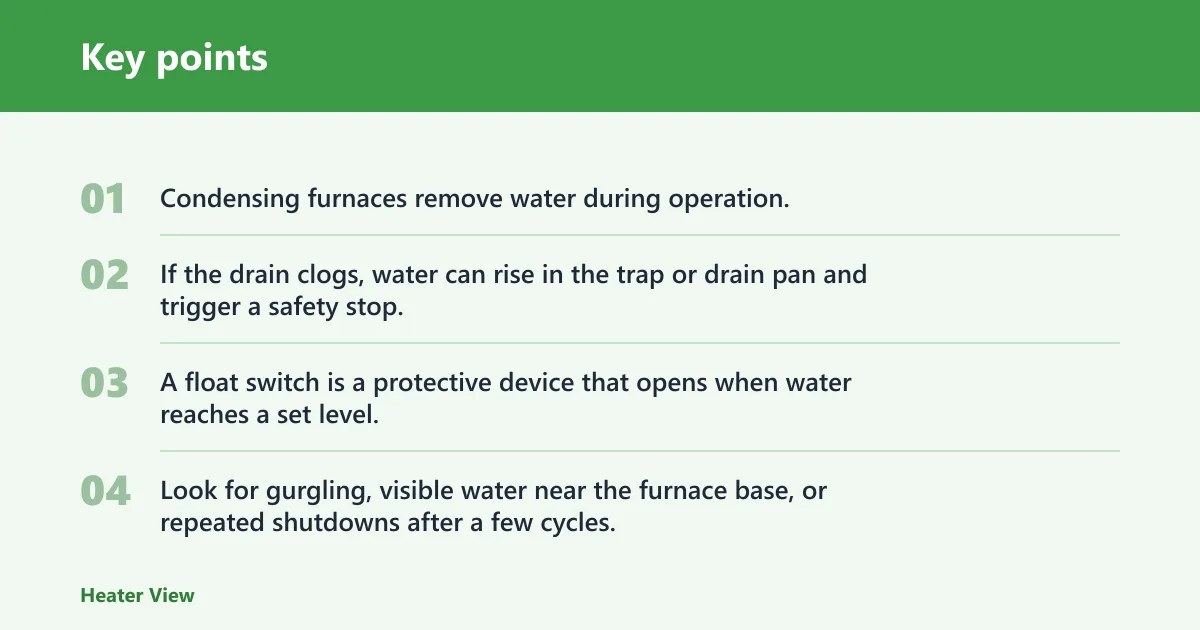
Condensing furnaces remove water during operation. If the drain clogs, water can rise in the trap or drain pan and trigger a safety stop. That is one reason these furnaces can shut off even when the thermostat is still calling for heat.
Float switch trips
A float switch is a protective device that opens when water reaches a set level. When it trips, the furnace may shut down completely or refuse to restart until the water level drops and the drain problem is fixed.
Water backup symptoms
Look for gurgling, visible water near the furnace base, or repeated shutdowns after a few cycles. Those signs point to drainage trouble more than ignition trouble, especially on high-efficiency units with PVC venting and condensate lines.
What causes a furnace to stop working?
A furnace can stop working because a safety circuit opens, a control signal drops out, or a component fails during the sequence. The most useful question is not whether it stopped, but where it stopped: before ignition, during flame proofing, after a few minutes of heat, or all at once.
Competitor pages often flatten every failure into “short cycling,” but the timing matters. Immediate flame loss points to ignition or flame sensing. Later shutdowns point more often to airflow limits, overheating, or a blower problem. Whole-system shutdowns push attention toward the thermostat, wiring, control board, or power.
Frequently asked questions
Why does my furnace keep shutting off?
Most repeated shutdowns come from one of four places: ignition, flame sensing, airflow, or pressure proving. Check whether the burners die, the inducer fails to advance, or the whole furnace loses power. That pattern usually reveals whether the issue is a dirty filter, a flame sensor fault, a limit trip, or a control problem.
Why is my gas furnace keeps shutting off?
A gas furnace that starts and then stops often has a dirty flame sensor, weak igniter, gas valve issue, or venting problem. If the flame goes out within seconds, that points away from airflow and toward flame-proving or ignition. Repeated lockouts mean the problem needs service.
Why does my furnace keep turning off?
Frequent shutoffs can be normal if the thermostat is satisfied, but a furnace that turns off before the room reaches set temperature is short cycling. Look first at the filter, thermostat settings, and vents. If the burners stop early, overheating or a safety switch is more likely than a thermostat problem alone.
Why is my furnace starting and stopping?
Starting and stopping in short bursts usually means the furnace is failing one part of the startup sequence. That could be a pressure switch, flame sensor, igniter, or limit switch. The exact stop point matters, because a flame that dies in seconds suggests a different fix than a unit that runs 10 minutes and quits.
Why does my furnace fire up then shut off?
If the furnace fires up and then shuts off quickly, the flame is often not being proved. A dirty flame sensor is a common gas-furnace cause, and an igniter or gas valve issue can produce the same symptom. If the shutdown happens after several minutes instead, look harder at airflow and overheating.
Why does my oil furnace keep shutting off?
An oil furnace can shut off from fuel delivery trouble, ignition failure, or a safety control opening after poor combustion. The same timing rule still helps: immediate loss after start points to ignition or flame detection, while later shutdowns point more toward overheating, airflow, or a control lockout.