Best Battery-Powered Portable Heater for Off-Grid Use
For true cordless spot heat, the Tent Town’s Battery Powered Space Heater is the clearest named pick here: it uses a 12000mAh battery and a 170W output, which puts it in the small-zone category rather than whole-tent heating. For sleeping warmth, a heated pad or blanket is usually the better off-grid answer.
That split matters. A battery heater can be portable and handy, but runtime, wattage, noise, and safety limits decide whether it does useful work or just drains a pack. Most battery heaters only suit very small spaces, and the wrong pick can empty the battery fast without adding enough heat to matter.
Why portable heat matters off the grid

- Fast heating for quick warmth
- 12000mAh battery supports cordless use
- Quiet, wireless design suits outdoor use
Quick picks by use case
| Use case | Pick | Why it fits | Best caution |
|---|---|---|---|
| Small shelter spot heat | Tent Town’s Battery Powered Space Heater | 170W output and a 12000mAh battery make it the strongest named cordless space-heater option in this set. | Still small-zone heat only. |
| Battery ecosystem users | DEWALT 20V MAX Heat Gun | Runs on a 20V MAX battery system and offers up to 42 minutes of continuous run time per charge. | It is a heat gun, not a room heater. |
| Sleep warmth | Maichis battery heater pad | Uses 60 watts and turns on at 32°F and off at 122°F for localized warmth. | Pad heat is not tent heat. |
| Food warming, not space heating | Quessa cordless heated lunch box | Uses a 13,500mAh rechargeable battery and heats food up to 220°F. | Not a heater for people or shelters. |
| Large enclosed area | Heat Hog portable propane radiant heater | Rated at 9,000 BTUs and can warm spaces up to 225 square feet. | Use only where the manufacturer allows it. |
Tent town’s battery powered space heater
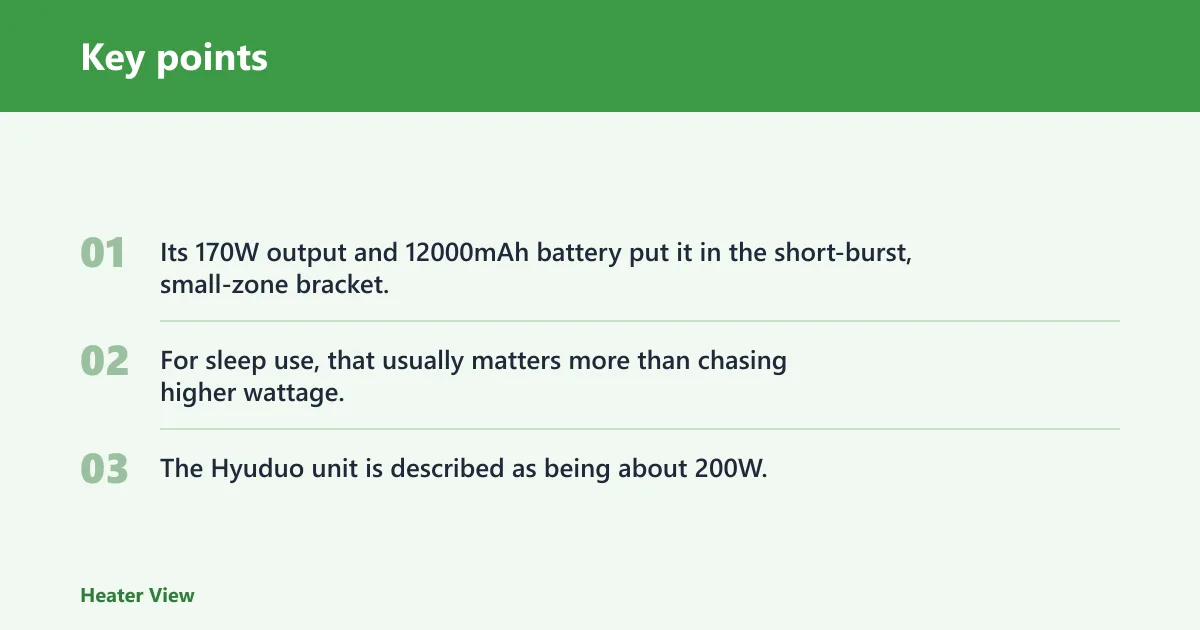
This is the best match if you want a named cordless space heater rather than a pad, lunch box, or tool accessory. Its 170W output and 12000mAh battery put it in the short-burst, small-zone bracket. That makes it a better fit for brief personal warmth than for trying to hold a sleeping tent at a stable temperature.
Maichis battery heater pad
This is the better off-grid choice when you want direct, localized warmth instead of room heat. The 60W rating is far below a space heater, and the on/off control at 32°F and 122°F shows it is meant to regulate a small heated surface, not warm a shelter. For sleep use, that usually matters more than chasing higher wattage.
DEWALT 20V MAX Heat Gun
This belongs on a workbench, not in a tent. It runs on a 20V MAX battery system and offers up to 42 minutes of continuous run time per charge, but it also reaches up to 990°F. That is useful for heat-shrink and drying jobs, and wrong for enclosed living space heat.
Hyuduo 200W battery powered heater
The Hyuduo unit is described as being about 200W. On paper, that makes it the closest thing here to a portable spot heater with a basic safety feature, but the 200W class still points to small-area use rather than dependable shelter heat.
Heat Hog portable propane radiant heater
This is the clear propane comparison point. It is rated at 9,000 BTUs and can warm spaces up to 225 square feet, which is far beyond the output of the battery models listed here. If you need real enclosed-space heat, propane is often the more capable tool, provided the model and manual allow the space you plan to heat.
Which battery-powered heater is actually enough?
For off-grid use, “enough” depends on the space, not the marketing label. A 170W or 200W battery heater can make a small zone feel warmer, but it is not the same as heating a tent, car, or micro-shelter evenly. For sleeping spaces, a pad or blanket usually makes more sense than a small fan heater.
| Use case | Battery type | Wattage | Expected runtime band | Heat coverage | Safety features | When to choose propane instead |
|---|---|---|---|---|---|---|
| Tent | Built-in battery | 170W | Short session only; published runtime not listed | Small-zone heat, not tent-wide heat | Check the listing for overheat, thermostat, and shutoff details | Choose propane only if the manufacturer approves the exact shelter use and ventilation plan. |
| Car | Built-in battery | 200W | Short session only; published runtime not listed | Directed warmth near the user | Tip-over protection is listed on the Hyuduo model | Choose propane only for approved outdoor or ventilated use, never as a casual substitute in a closed vehicle. |
| Micro-shelter | Built-in battery | 170W to 200W | Short session only; published runtime not listed | Spot heat, not full coverage | Look for tip-over, overheat, and thermostat control | Choose propane if you need more than brief personal warmth and the manufacturer allows the setup. |
| Worksite trailer | 20V MAX ecosystem battery | Heat gun output, up to 990°F | Up to 42 minutes per charge | Directed tool heat only | Check the manual for safe use and clearances | Choose propane if you need actual space heat rather than tool heat. |
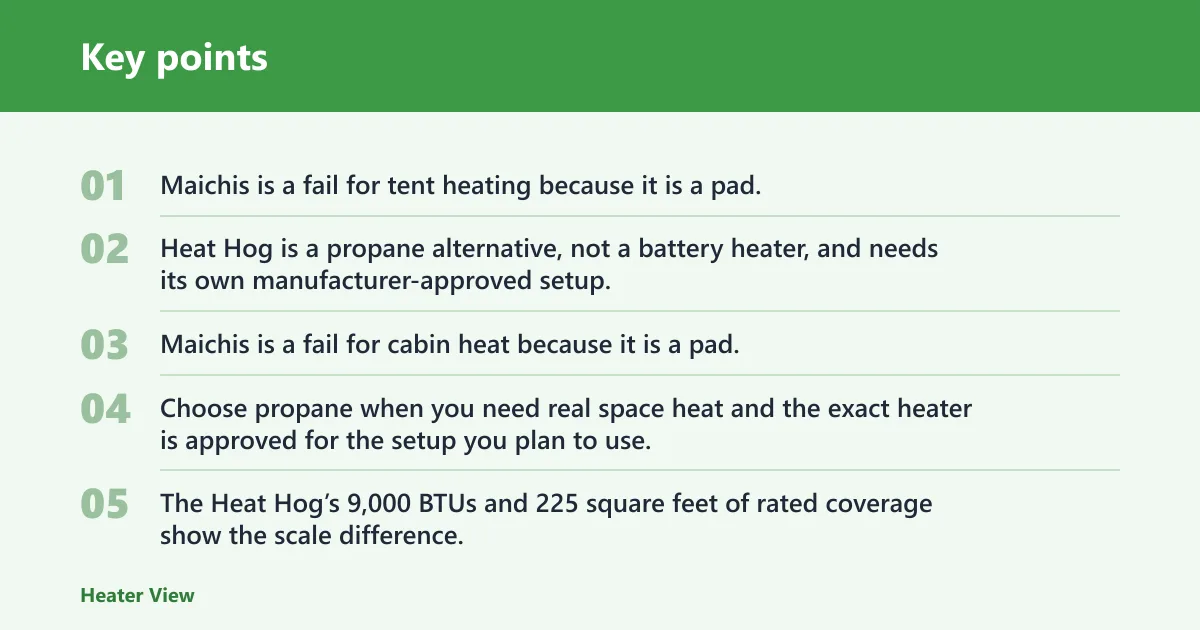
Pass/fail note for tents: Tent Town’s Battery Powered Space Heater is a fail for sleeping tents because the listing data support small-zone heat, not safe whole-tent heating. Maichis is a fail for tent heating because it is a pad. DEWALT is a fail because it is a heat gun. Heat Hog is a propane alternative, not a battery heater, and needs its own manufacturer-approved setup.
Pass/fail note for cars: Hyuduo 200W is at best a cautious maybe for brief personal warmth in a very small area, but the listing data do not support broad cabin heating. DEWALT is a fail for vehicle heating. Maichis is a fail for cabin heat because it is a pad.
Pass/fail note for micro-shelters: Tent Town and Hyuduo are the only true battery space-heater style options here, and both remain small-zone tools. That makes them a conditional pass for personal spot heat and a fail for heating the whole shelter.
When to choose propane instead
Choose propane when you need real space heat and the exact heater is approved for the setup you plan to use. The Heat Hog’s 9,000 BTUs and 225 square feet of rated coverage show the scale difference. Battery heat is for short, limited warmth; propane is the more realistic choice when you need more heating reach than a pack can provide.
Can a battery-powered heater warm a tent?
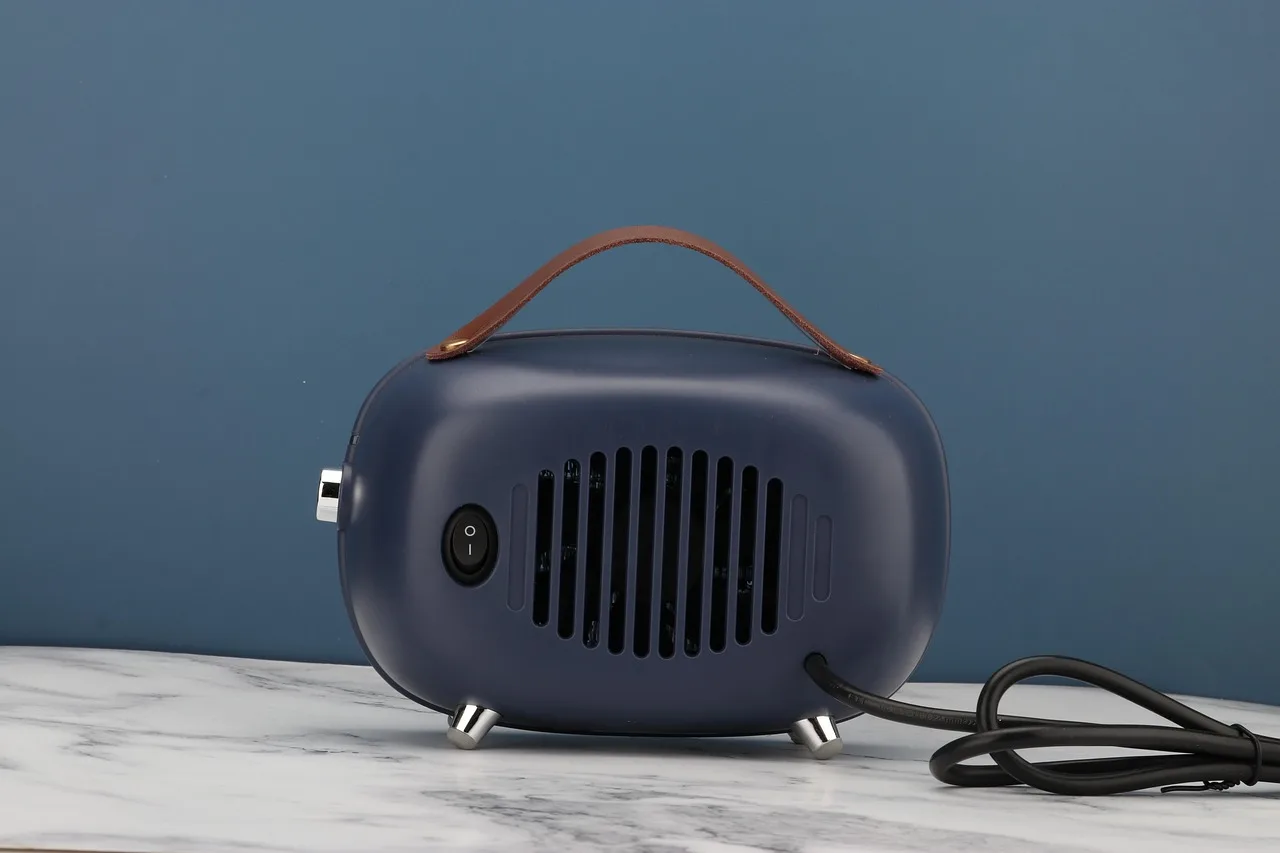
Usually, no, not in the way most buyers mean. A battery-powered heater can warm a small patch of air or a person nearby, but published specs for the units here point to small-zone heating, not reliable tent-wide warmth. That matters even more in cold weather, where heat loss rises fast and runtime drops in practical use.
If the shelter is a one-person tent and the outside temperature is near freezing, a 170W to 200W unit is the kind of small heater being discussed. A 170W or 200W unit may make the air near the heater feel less harsh, but it will not turn the tent into a heated room. A pad or blanket gives you direct warmth with less wasted energy.
For sleeping spaces, the safer question is often “Can it warm me?” rather than “Can it warm the tent?” Those are different goals. A fan-forced unit spreads heat a little wider, while a radiant or pad-style option puts warmth where your body actually is.
Sleep-space limits
Battery heaters are poor substitutes for approved sleep-safe heating. Even when a model includes tip-over protection or thermostat control, that does not make it suitable for leaving on all night inside a tent. Check the manufacturer’s listing for exact clearances, enclosed-space approval, and shutoff behavior.
Heat coverage limits
Coverage is the weak point. If you need even warmth across a tent floor or cabin, the output is usually too low, and the battery drains before the whole space stabilizes.
When the answer is no
The answer is no when the heater is a heat gun, a lunch box, or a small pad sold as “portable heat.” It is also no when the tent is large, the weather is very cold, or the product listing does not clearly approve enclosed-space use. In those cases, insulation, sleeping-bag rating, or a different heat source is the better fix.
What runtime should you expect on a charge?
Runtime depends on battery capacity, wattage, and heat setting. A higher-capacity pack usually lasts longer, but a higher-wattage heater drains faster. Published runtime should always be treated as a best-case number, because real cold weather, fan use, and startup draw can shorten it.
Capacity and wattage basics
Battery capacity appears in mAh or Ah. The Quessa cordless heated lunch box uses a 13,500mAh rechargeable battery, and the Tent Town’s Battery Powered Space Heater uses a 12000mAh battery. Those figures help you compare portability against expected endurance, but they do not tell the full runtime story without the voltage and heat setting.
Wattage shows how hard the heater works. The Maichis battery heater pad uses 60 watts of heating power. The Tent Town unit is 170W, and the Hyuduo is 200W. Higher wattage usually means more immediate heat and less runtime per charge.
Low-mode versus high-mode runtime
When a model has modes, low mode is the only setting that may deliver a meaningful runtime on a small battery. The Hyuduo 200W Battery Powered Heater has 2 modes, but the listing data supplied here do not give exact minutes. That means buyers should expect the higher mode to cut runtime sharply.
DEWALT provides the clearest runtime figure: up to 42 minutes of continuous run time per charge. That is useful for short jobs, not extended off-grid heating. It is also a good reminder that even a known runtime can be short once the output climbs.
Why published runtime often falls short in cold conditions
Cold weather makes batteries less efficient, and heaters often cycle more in wind or drafty spaces. Suppose a compact unit is advertised for short bursts indoors. Outside, or in a leaky shelter, the same pack may feel much shorter because the heater is fighting heat loss instead of warming a sealed space.
How do battery heaters compare with tool-battery models?
Tool-battery heaters are a different category from built-in battery space heaters. They are usually better for users who already own the battery platform, and they are often sold as bare tools. Built-in battery units are simpler to carry, but the battery may not be swappable or part of a larger ecosystem.
18V and 20V MAX compatibility
The DEWALT 20V MAX Heat Gun is the clearest ecosystem example here. It runs on a 20V MAX battery system, which makes it useful for people already invested in that platform. For off-grid users, that compatibility matters more than a marketing label because it determines whether you can reuse existing packs.
Bare tool only versus built-in battery
Always check whether the battery is included or sold separately. Tool-platform products are often bare tools, while built-in battery heaters usually arrive ready to run. That affects cost, carry weight, and how many packs you need for a trip or job site.
Best fit for users already in an ecosystem
If you already own compatible batteries, a tool-platform model may be the smarter purchase. If you do not, a built-in battery heater is easier to start with. Just keep the category straight: the DEWALT model is a heat gun, so it is for directed tool heat, not shelter heating.
How to choose a battery heater
Start with the actual use case. Tent sleeping, vehicle warmth, worksite drying, and micro-shelter spot heat are different problems, and they need different outputs. Then check whether the product is a true space heater, a pad, a heat gun, or a warmer pretending to be one.
-
Match the heat type.
Choose fan-forced heat if you need a little air movement and a broader patch of warmth. Choose radiant or pad-style heat if you need direct personal warmth with less waste. Do not buy a lunch box or heat gun as a space-heating substitute.
-
Check the battery first.
Look for the capacity in mAh or Ah, and confirm whether the battery is built in or sold separately. If you already own 18V or 20V MAX packs, an ecosystem model may fit better than a standalone unit.
-
Demand the safety list.
Look for tip-over protection, overheat protection, thermostat control, and temperature lock where available. The Hyuduo listing includes tip-over protection, and the Maichis pad includes on/off temperature points. If the listing does not spell out the feature, do not assume it is present.
-
Respect size limits.
Compact size and cordless design improve portability, but they do not create more heat. A 170W or 200W heater is still small-zone equipment. Use it for personal warmth, not for heating a whole tent or trailer.
Safety note: follow the product manual, keep the heater on a stable surface, leave clear space around the unit, and only use it in the shelter, vehicle, or enclosure the manufacturer explicitly allows. Never assume a battery heater is automatically safe for overnight tent use just because it is cordless.
A common first-timer mistake is buying the highest wattage available and expecting room heat. A 200W battery heater can still feel weak in a drafty shelter because wattage is only part of the problem. Heat spread, insulation, and runtime matter just as much.
Frequently asked questions
What is the best battery-powered portable heater for off-grid use?
For a true cordless space heater, the Tent Town’s Battery Powered Space Heater is the strongest named pick here because it combines a 12000mAh battery with 170W output. For sleep warmth, a heated pad is usually better. For larger spaces, battery heat is usually the wrong tool.
How long does a battery-powered heater last on a charge?
It depends on battery size, wattage, and mode. The clearest published figure here is the DEWALT 20V MAX Heat Gun, which offers up to 42 minutes of continuous run time per charge. Other models list capacity or wattage, but not exact minutes, so expect short sessions rather than all-night heat.
Are battery-powered heaters safe to use in a tent?
Not automatically. A battery heater may be cordless, but that does not make it safe for a sleeping tent. You need model-specific approval, clearances, and shutoff features from the manufacturer. If the product is a heat gun, lunch box, or pad, it is not a tent heater.
Can a battery-powered heater really heat a camping tent?
Usually not in a useful way. The battery models here are small-zone heaters, not tent-wide solutions. They may warm the area near the unit or the person using it, but they are not a substitute for proper insulation, a warm sleeping system, or a model that the manufacturer explicitly approves for enclosed shelter use.
Which battery-powered heater works best with tool batteries?
The DEWALT 20V MAX Heat Gun is the clearest fit for users already in a battery ecosystem because it runs on a 20V MAX battery system. Just keep in mind that it is a heat gun, not a room heater. If you want shelter heat, tool compatibility alone is not enough.
What safety features should I look for in a cordless heater?
Look for tip-over protection, overheat protection, thermostat control, and temperature lock where available. The Hyuduo 200W Battery Powered Heater lists tip-over protection. If the listing does not name the feature, do not assume the heater has it, especially in a tent or vehicle.
Is a battery-powered heater better than a propane heater for off-grid use?
Battery heat is better for portability, quiet operation, and short personal warmth. Propane is better when you need much more heat output and longer space coverage. The Heat Hog portable propane radiant heater is rated at 9,000 BTUs and can warm spaces up to 225 square feet, which shows why propane usually wins on raw heating power.
What is the quietest battery-powered heater for sleeping?
A pad-style heater is usually the quietest choice because it does not rely on a fan. The Maichis battery heater pad uses 60 watts and focuses heat at the body instead of blowing air around. For sleeping, quiet and direct warmth usually beat a noisy mini fan heater.