Infrared Heater Installation Cost Guide
Infrared heater installation cost is often reported at roughly $150 for a plug-in portable unit to $4,500+ for a gas-fired install, with hardwired electric panels often falling in between. Bad sizing or wiring can turn a cheap quote into higher utility bills, nuisance trips, or a failed inspection. This guide breaks costs down line by line and compares portable, hardwired electric, and gas-fired options by risk and budget.
Infrared heater installation cost overview
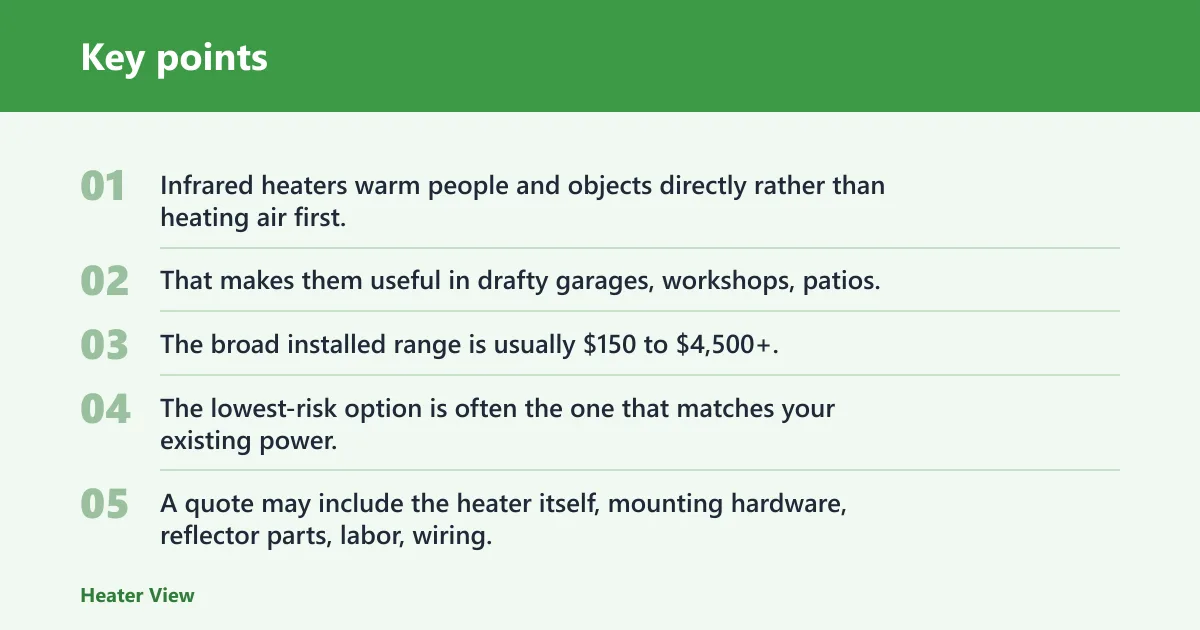


Infrared heaters warm people and objects directly rather than heating air first. That makes them useful in drafty garages, workshops, patios, and some whole-room applications, but the install cost depends on the heater type, mounting method, electrical work, permits, and, for gas-fired units, venting plus gas piping.
The broad installed range is usually $150 to $4,500+, with some simple portable setups below that and some gas-fired projects above it. The lowest-risk option is often the one that matches your existing power, mounting surface, and clearance space without forcing new wiring or gas work.
What the installed price usually includes
A quote may include the heater itself, mounting hardware, reflector parts, labor, wiring, permit fees, and inspection time. For gas-fired units, it may also include a gas line extension, regulator work if needed, and venting components. If the quote omits any of those, ask whether they are excluded or simply not needed.
Why infrared heater type changes the quote
Electric infrared heaters cost $150–$1,200 for residential units, and they may be plug-in or hardwired. Gas-fired infrared heaters cost $500–$2,500, but the install usually adds more work because the project can require a gas line installation, venting, regulator setup, and more labor.
How much does infrared heater installation cost?
For a simple plug-in portable unit, the installed cost can be close to the heater price alone. A hardwired electric install usually costs more because a 240V heater generally needs its own circuit, and most jurisdictions require an electrical permit for hardwired installations. Gas-fired installs cost the most when line extension and venting are part of the job.
Broad installed cost ranges by project type
- Plug-in portable: about $150 to $600 in common homeowner use, depending on unit price and whether a stand or simple bracket is needed.
- Hardwired electric wall or ceiling unit: often about $900 to $2,500 once wiring, permit, and mounting are included.
- Gas-fired unit: often about $1,800 to $4,500+ when gas line, venting, and labor are included.
What changes the total fastest
The biggest cost jumps usually come from new electrical service, a long wire run, a ceiling mount, or gas piping that has to cross more distance than expected. Ceiling-mounted units are especially sensitive to structure. Drywall anchors alone are generally not sufficient for units over about 20 pounds.
Picture a 20-by-22-foot garage with an open ceiling and no spare 240V circuit. A wall-mounted electric unit can become a circuit project first and a heater project second. If the panel is already full, the quote changes fast.
Infrared heater quote calculator
Use this table to compare line items before you accept a quote. The totals below are sample budgets built from the ranges in this guide, so you can see where each cost comes from and which hidden work gets triggered.
| Scenario | Unit price | Mounting hardware | Electrical work | Permit / inspection | Labor | Total installed cost | Hidden-cost trigger |
|---|---|---|---|---|---|---|---|
| Plug-in portable | $150 | $0 | $0 | $0 | $0 | $150 | No mounting, no dedicated circuit, no permit if it stays plug-in and portable. |
| Hardwired wall or ceiling unit | $450 | $100 | $600 | $100 | $250 | $1,500 | Needs a dedicated circuit, breaker and wire sizing, and an electrical permit with inspection. |
| Gas-fired unit | $1,200 | $100 | $0 | $100 | $1,500 | $2,900 | Needs gas line extension, regulator and piping work, plus venting and test-up labor. |
What is included in an installation quote?
A good quote separates the heater price from the work needed to make it safe and legal. At minimum, you should see the unit price, mounting hardware, labor, wiring or gas work, and any permit or inspection fee. If the quote is vague, you may be looking at add-ons later.
Unit price and mounting hardware
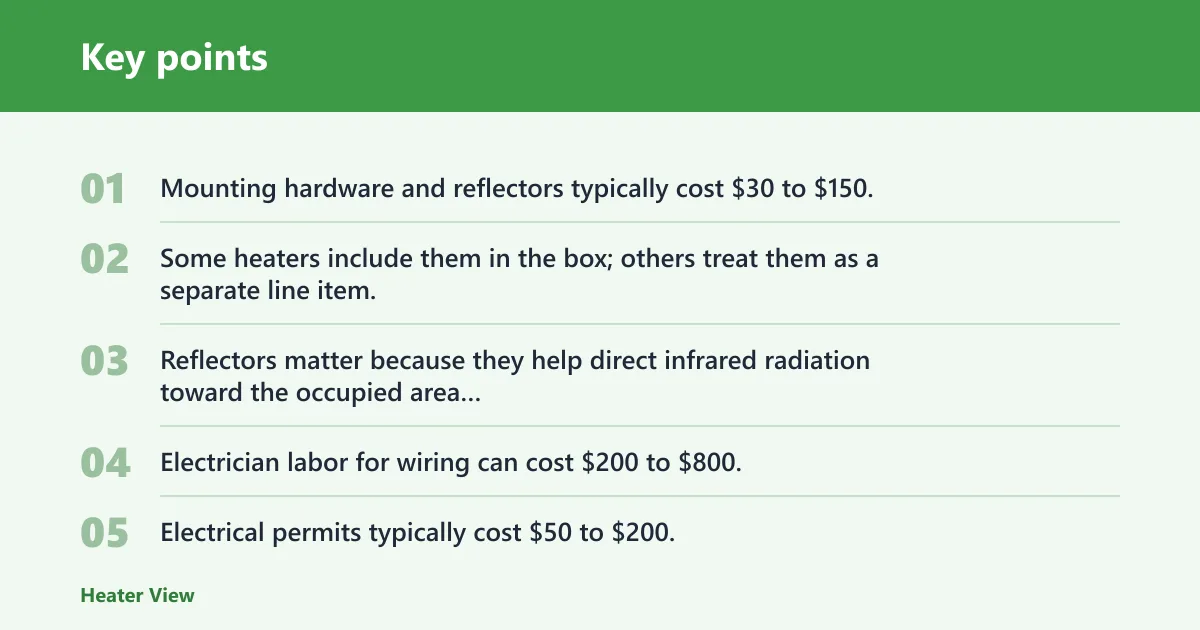
Mounting hardware and reflectors typically cost $30 to $150. Some heaters include them in the box; others treat them as a separate line item. Reflectors matter because they help direct infrared radiation toward the occupied area instead of wasting output into the structure above it.
Labor, wiring, permits, and inspection
Electrician labor for wiring can cost $200 to $800. Electrical permits typically cost $50 to $200, and most jurisdictions require an electrical permit for hardwired installations. If the unit is ceiling mounted, the quote should also account for structural attachment to joists or beams.
Gas line, venting, and regulator costs
Gas line installation can cost $300 to $1,200. Gas-fired heaters also need regulator and piping work when needed, and the venting requirement depends on the model and local code. That is why a gas quote can look low on the unit and high on the install.
Suppose a homeowner buys a $300 wall heater and assumes the job is done. If the room needs a new 240V circuit and a permit, the final bill is no longer a simple product purchase. The quote should spell that out before work starts.
Do infrared heaters need a dedicated circuit?
Many 240V hardwired residential infrared heaters need their own breaker and circuit run. That matters because the breaker, wire gauge, and load calculation have to match the heater’s nameplate amperage, continuous-load rules, conductor type, and local code. If the heater shares a circuit with other loads, nuisance trips or overheated wiring can follow.
120V versus 240V electrical needs
Electric infrared heaters can run on 120V or 240V, depending on size and output. A 120V portable unit may plug into an existing outlet if the circuit has room. A 240V hardwired unit usually needs a dedicated circuit and professional electrical work.
Breaker size, wire gauge, and load calculations
Breaker size and wire gauge for 240V units have to be selected from the heater’s nameplate amperage, conductor type, continuous-load rules, and local code. If the panel is crowded or the circuit is undersized, the electrician may need to upgrade the run instead of simply landing the unit.
When an existing circuit is not enough
An existing circuit is often not enough when the heater shares power with outlets, lights, or a garage door opener. If the load calculation shows too little spare capacity, the installation moves from a quick mount to a new circuit project. That is one of the fastest ways for cost to rise.
Mounting and clearance requirements
Clearance and structure control safety as much as price. Manufacturer specifications and local code set the required clearances, so the install quote should be based on the actual heater model and room geometry, not a generic rule.
Front, side, and ceiling clearance
Do not assume all infrared heaters need the same spacing. A wall unit in a tight basement corner may fit one set of clearances, while a ceiling unit in a garage needs another. The install quote should reflect the actual room geometry, not a generic rule.
Ceiling-mounted units and joist attachment
A ceiling-mounted infrared heater raises complexity because it must attach to joists or beams. That can mean extra layout time, better fasteners, and a higher labor bill. If the ceiling is finished and the framing is hard to reach, the install gets slower and more expensive.
How to decide between mount types
Low-intensity infrared heaters are common in garages and workshops where the goal is targeted heat near the working area. High-intensity infrared heaters are more common in commercial or outdoor use, where wind, exposure, and larger open areas may push the project toward gas-fired or specialized hardware. The environment shapes the install more than the label does.
Electric vs gas-fired installation costs
Electric units usually cost less to install because there is no gas piping or venting work, but hardwired models still need a circuit, breaker sizing, and a permit. Gas-fired units cost more because the project may need a gas line extension, regulator work when needed, piping changes, venting, and a more complex startup.
What adds cost to electric infrared units
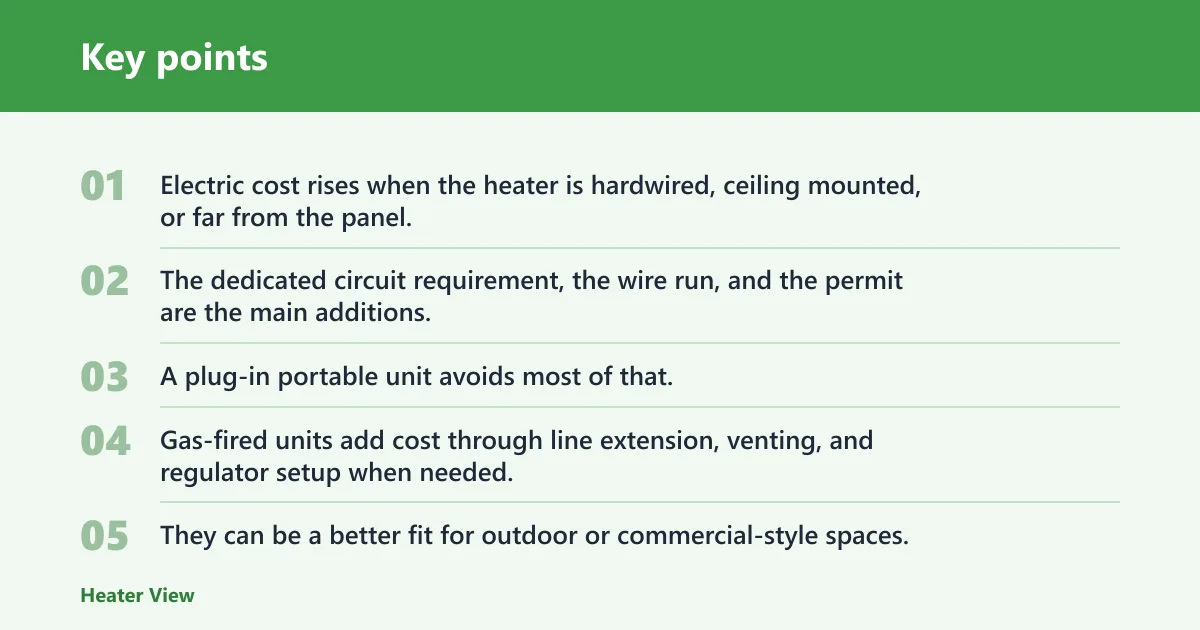
Electric cost rises when the heater is hardwired, ceiling mounted, or far from the panel. The dedicated circuit requirement, the wire run, and the permit are the main additions. A plug-in portable unit avoids most of that, but it also gives up fixed coverage and usually lower output area.
What adds cost to gas-fired units
Gas-fired units add cost through line extension, venting, and regulator setup when needed. They can be a better fit for outdoor or commercial-style spaces, but only when the piping, combustion path, and exposure conditions are right. If those pieces are not already in place, the install is rarely cheap.
Which option fits garages, workshops, and outdoor areas?
For a small garage or workshop, a hardwired electric heater is often the middle ground if the panel has capacity and the mounting surface is solid. For a patio or open-sided area, gas-fired or high-intensity units may fit better because weather exposure and airflow reduce the value of a low-output electric unit. For temporary or low-use spaces, portable can be the safer budget choice.
Frequently asked questions
What is included in an infrared heater installation quote?
A complete quote should list the unit price, mounting hardware, labor, wiring or gas work, and any permit or inspection fee. For gas-fired systems, it should also call out gas line installation, regulator work when needed, and venting. If those items are missing, ask whether they are excluded or unnecessary.
How much does electric wiring add to infrared heater installation cost?
If the panel lacks spare capacity or the wire run is long, costs rise again. The biggest difference is whether the install needs a new dedicated circuit or only a short connection.
Do infrared heaters require permits or inspections?
Most jurisdictions require an electrical permit for hardwired installations, and inspections are common. That matters most for wall and ceiling units because they are permanent fixtures tied to a circuit. Plug-in portable units usually avoid that layer, but local code still controls the final answer.
What size infrared heater do I need?
The right size depends on room size, ceiling height, insulation, and how open the space is. A larger room or taller ceiling usually needs more output or better placement. Check the heater’s coverage rating against the actual area, then confirm clearances and power before you buy.
Can a portable infrared heater avoid installation costs?
Yes, a portable infrared heater can avoid most installation costs because it usually does not need hardwiring, a permit, or structural mounting. The tradeoff is coverage and permanence. It is often the lowest-risk choice for temporary use, but it is not the same as a fixed heating system.