Can Infrared Heaters Be Used Under a Desk?
Yes, but only if the infrared heater is made for under-desk use, kept clear of fabrics and legs, and aimed so the hot face cannot point at the chair, cords, or anything inside the manufacturer’s clearance limits. Misuse can overheat carpet, melt cables, or create a fire risk. This guide covers safe placement rules, when to avoid under-desk infrared heat, and better desk-area warming options.
Clearance matters more than the space itself


Only in an open footwell, and only when the heater’s clearances are respected. A cramped or enclosed under-desk cavity is a poor fit because radiant heat still needs space to escape, and desk clutter creates contact risk. The safer rule is simple: if knees, fabric, cables, or the underside of the desk sit inside the heater’s clearance zone, do not place it there.
How infrared heat behaves at desk height
Infrared heaters warm people and objects directly, instead of waiting for room air to warm up. That matters at a desk because your feet, shins, chair base, and nearby panels can absorb the heat even when the room still feels cool. Placement matters more than the room’s overall temperature.
Infrared radiation can excite vibrational motion in molecules. Conventional ovens use infrared radiation to heat food. Microwaves heat by exciting rotational motion of water. Those facts point to the same practical idea: radiant energy acts on the target in front of it, so line of sight and nearby surfaces matter under a desk.
Short-, medium-, and far-infrared are usually discussed as different bands, but for desk use the key point is practical, not technical. Shorter-wave units tend to feel stronger at a given distance, while far-infrared panels are often lower profile and softer in appearance. None of those labels makes a heater safe if it is pressed against fabric or boxed in under a desk.
Say your desk has a narrow, boxed-in footwell with a soft chair mat, loose charging cables, and a hanging backpack. That setup is not a fit for under-desk infrared heat. The same heater in an open footwell, with a clear front and nothing touching the housing, is a different case.
Under-desk heater decision table
| Heater type | Minimum safe clearance | Likely use case | Risk level | Suitable for enclosed desk space? | Suitable for open footwell use? |
|---|---|---|---|---|---|
| Portable infrared heater | Follow the manual; keep clear of legs, fabric, and cords on every side, with open front clearance | Desk-adjacent spot heating for feet or shins | Moderate if poorly placed | No | Yes, if the footwell is open |
| Wall-mounted infrared heater | Keep mounted clear of the desk underside and anything below it; follow top and front clearance in the manual | Fixed zone heating in a nearby area | Low to moderate, depending on layout | No | Usually no for true under-desk use |
| Far-infrared panel | Needs unobstructed line of sight and safe mounting space | Perimeter or wall use for steady supplemental heat | Lower when mounted correctly | No | Only if it is not treated as an under-desk device |
| Oil-filled or fan-free low-profile electric heater | Keep away from fabric and cords; allow room for heat rise and side clearance | Foot-area warmth in a desk zone | Moderate | Sometimes, if the manual allows it | Often better than infrared for enclosed spots |
What clearance and placement rules matter most?
The main rule is to obey the manufacturer’s minimum clearance from the desk underside, your legs, fabric, and wiring. If a heater does not list a safe placement for under-desk use, treat that as a no. Front, top, and side space all matter because radiant heat and grille heat need room to move away from the unit.
Minimum distance from legs, fabric, and wiring
Keep the heater far enough from knees, socks, curtains, chair upholstery, and cable bundles that nothing can touch the housing or sit in the direct radiant path. The front of the heater is the most important zone, but the sides and top matter too. A cable brushed against a hot housing is a real hazard, even if the heater never tips.
- Check the manual for the exact clearance numbers before placing the heater.
- Clear the floor of paper, fabric, storage boxes, and cable slack.
- Place the heater so the hot face points into open foot space, not at the chair base.
- Confirm that your feet can move away from the heater without contacting it.
- Recheck the layout after any desk, chair, or cable change.
A common first-timer mistake is sliding the heater under the desk until it looks tidy, then tucking a power strip behind it. That creates a hidden contact point. If the heater needs to be nudged into place to fit, the space is probably too small for it.
Thermostat and shutoff features to look
A thermostat matters because under-desk use is often set-and-forget. Thermostat control lowers the chance that the unit stays hot long after your feet are warm enough. Look for automatic shutoff, tip-over protection, and clear controls that you can reach without reaching near the grille.
New Electric lists an infrared under-desk heating panel model. The same source says infrared heaters are available with thermostat and remote control. New Electric offers Wi-Fi control for infrared heaters. Those features can help with convenience, but they do not replace safe clearance or a suitable footprint.
Which infrared heater type fits a desk setup?
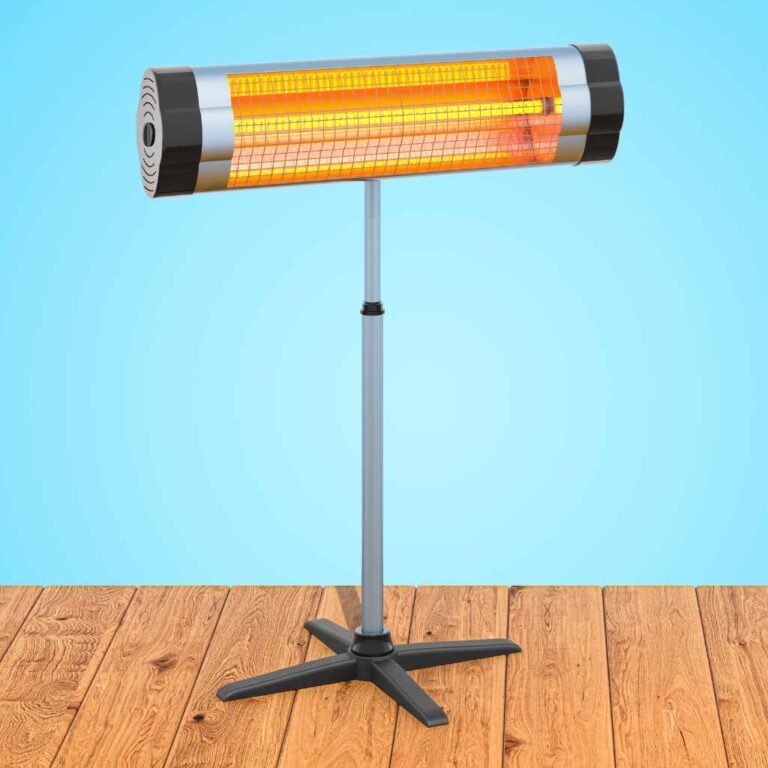
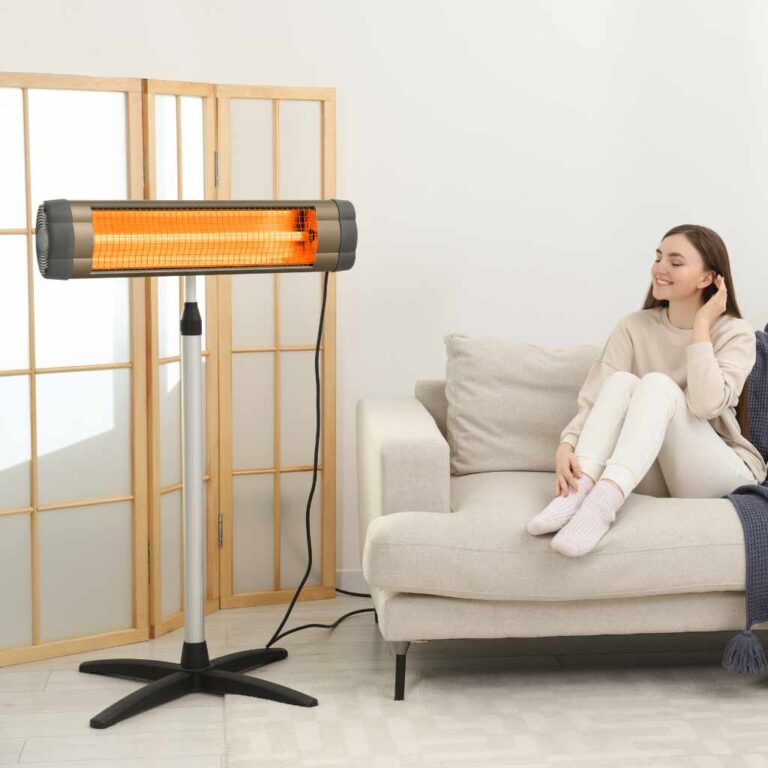
A portable infrared heater is the closest match for desk-area warmth, but only in an open footwell where the face, grille, and housing stay clear of fabric and wiring. Wall-mounted infrared heaters are usually a poor under-desk fit because they are built for fixed mounting, not for a cramped floor space under your knees.
Portable infrared heaters for open footwell use
Portable models can work when they are truly desk-adjacent, with nothing enclosed around them. That means the heater sits in front of your feet, not jammed against the desk brace or hidden behind storage. Some portable units are marketed with cool-to-the-touch or grille-safe designs, but the safe decision still starts with placement and manufacturer rules.
Heat Storm Phoenix runs at 750 to 1500 watts. Heat Storm Phoenix is rated for 150 square feet of coverage. The Heat Storm Phoenix is 4 by 18.75 by 12.75 inches. Those figures show why size and power matter: even a compact unit can draw enough power to deserve a careful circuit check and enough output to be too much for a small enclosed space.
Why wall-mounted infrared heaters rarely fit under-desk needs
Dr Infrared Heater DR-268 uses 1500 watts. The Dr Infrared Heater DR-268 is wall or ceiling-mounted. The DR-268 is IP55 water-resistant rated. The DR-268 is described as suitable for garage workspaces. Those details point to a fixed-space heater, not a device meant to live under a desk among shoes, cables, and chair movement.
Wall-mounted infrared heaters make more sense when you want a fixed zone of heat on a wall, over a bench, or in a garage-style work area. Under a desk, the mounting style and line-of-sight pattern usually work against the space available. Even if a wall unit has a compact housing, it is not the same as a purpose-built footwell heater.
When far-infrared panels make more sense elsewhere
Far-infrared panels are better thought of as room or zone heaters than under-desk gadgets. They fit better on a wall or in a fixed position where they can warm a seated area without blocking floor movement. If your goal is steady background warmth in a home office, a panel at the room edge may be the better choice.
Will an infrared heater work well in an office?
Yes, when the office layout gives the heater line of sight and room to breathe. Drafts, shared-space rules, cable management, and foot traffic all change the answer. Infrared can be effective for local warmth at seated height, but it is a poor answer when the heater must live inside a crowded desk cavity or where other people could brush past it.
Drafts, shared-space safety, and cable management
Infrared is less dependent on air movement than a fan heater, so it can feel useful in drafty spaces where warm air gets pulled away. That said, a drafty office does not make an unsafe under-desk layout safe. In shared spaces, the heater should not sit where someone can kick it, trip on the cord, or place a bag against it.
When the goal is only foot warmth, safer alternatives may fit better. Oil-filled heaters and fan-free low-profile electric heaters can be easier to place because they do not rely on direct radiant aim. They still need clearance, but they may suit a desk area with more predictable heat spread and less focused radiation at shin level.
Wattage, circuit load, and comfort at seated height
Common portable indoor models are often about 750 to 1500 watts, so power draw matters on circuits that are already carrying other equipment. A 1500-watt heater can be too much for an overloaded outlet strip or a shared workspace circuit if other equipment is already drawing heavily. The manual should state the electrical requirements clearly.
Do infrared heaters work well? They can, when the goal is targeted warmth on a seated person or a small work zone. Are infrared heaters economical for desk use? Sometimes, but only in the narrow sense that they warm the occupied area instead of the whole room. That is not a blanket savings claim, because runtime, wattage, and circuit use still matter.
Picture a home office with a cold tile floor, a desk against an exterior wall, and a narrow open footwell. A portable infrared heater aimed across that open space can make sense. Change one detail so the footwell is packed with a printer cart and loose cords, and the same heater becomes the wrong fit.
Frequently asked questions
Can infrared heaters be used under a desk?
Yes, but only in an open footwell and only if the heater’s manual allows that placement. If the space is enclosed, crowded with cords, or lined with fabric, the answer should be no. Under-desk infrared heat depends on clear line of sight and safe spacing, not on squeezing the unit into any available gap.
Are infrared heaters safe to use under a desk?
They can be safe in the right setup, but they are not automatically safe under a desk. The main risks are fabric contact, cable contact, kneecap burns from close radiant exposure, and trapped heat near the desk underside. A heater with thermostat control and shutoff features helps, but placement still decides the outcome.
How close can you sit to an infrared heater?
Close enough to feel heat does not mean close enough to be safe. The exact distance depends on the model, its wattage, and the manufacturer’s clearance rules. For desk use, sit where the heat reaches your feet or shins without the grille or housing coming near your legs or chair materials.
What kind of infrared heater is best for under a desk?
A compact portable infrared heater is usually the closest fit, but only for an open footwell with safe clearance. Wall-mounted models are usually a poor match because they are built for fixed positions. If the space is tight, a low-profile oil-filled or fan-free heater may be the safer desk-area choice.
Can an infrared heater heat just my feet under a desk?
Yes, in an open footwell where the beam can reach your shoes and lower legs without being blocked. It is less reliable in a closed cavity, where the heat can reflect off nearby surfaces or warm the underside of the desk instead. That is why placement matters more than advertised room coverage.
Will an under desk infrared heater overheat a small space?
It can, especially if the heater is boxed in by panels, bags, or cable bundles. Small spaces trap radiant and grille heat faster than open ones, and the result can be hot surfaces rather than useful foot warmth. A thermostat helps, but it cannot fix a bad layout or missing clearance.
How do I safely place a heater under a desk?
Start by checking the manual for the exact clearance limits, then place the heater in an open footwell with no fabric, cords, or storage in front of it. Keep the hot face aimed away from the chair and legs, and make sure the power cord cannot touch the housing or create a trip path.
Infrared heaters vs electric heaters: which is better for desk heating?
For a targeted foot zone, infrared can be better if the space is open and the heater can aim directly at the occupied area. For a tighter or more enclosed desk space, a low-profile electric heater without a strong radiant face may fit better. The safer choice is the one that matches the space, not the brand of heat.