Best Smart Garage Heaters for Remote Control
Choose a hardwired, Wi‑Fi or app-controlled garage heater if you want scheduled heat and remote changes; pick a handheld-remote model only for simple on/off control in a small, insulated garage. A bad control choice wastes power, leaves the bay cold, or pushes you into unsafe wiring work. This guide compares control methods, wiring needs, and the garage conditions that matter most.
Heat Storm garage heater top pick
Best overall: the Heat Storm garage heater is the strongest fit for this query because it combines Wi‑Fi control, app access, 6000 watts of heat, and wall- or ceiling-mount installation in one unit. Heat Storm says it can cover up to 1,000 square feet as primary heat, which puts it in the range most homeowners are actually shopping for.
It also gives you a true smart-control setup, not just a handheld remote. Heat Storm says the heater works with the Smart Life app, can be controlled from a phone, includes an external thermostat, and is recommended for professional installation by a licensed electrician.
Who should skip it?
Skip it if you only want plug-in convenience with no electrical work. Skip it too if your garage has weak Wi‑Fi, because app scheduling and remote adjustment depend on a stable connection. In that case, a simpler thermostat or handheld-remote heater is less frustrating.
Quick picks by garage type
| Best for | Pick | Key control type | What matters most |
|---|---|---|---|
| Small insulated garages | Dreo wall heater | Thermostat control | 1500 watts, 120-degree oscillation, 41°F to 95°F range, 1-degree temperature accuracy |
| Medium garages with 240V wiring | Heat Storm garage heater | Wi‑Fi and app control | 6000 watts, up to 1,000 square feet primary heat, wall or ceiling mount |
| Simple remote use | Handheld-remote heater category | Included remote | Good for on/off and basic temperature changes, but range is limited |
| Big heating load | VEVOR garage heater | Higher-output electric heat | 10,000 watts, better suited to hardwired high-demand spaces than app-first control |
Best for small insulated garages
The Dreo wall heater is the cleanest fit for a small, enclosed garage where you want basic remote convenience and tight temperature control, but you should still verify the listing and installation guidance before treating it as a garage-specific model. Brown’s Hardware lists it at 1500 watts, with 120-degree oscillation, a 41°F to 95°F temperature range, and 1-degree temperature accuracy.
Best for medium garages with 240V wiring
The Heat Storm garage heater is the better match when the garage needs real output and permanent installation. Its 6000-watt rating and 20,400 BTU output put it well above typical portable heaters, and Heat Storm says it can be wall- or ceiling-mounted.
Best for app control and scheduling
Heat Storm is the clear fit here. It is Wi‑Fi enabled, works with the Smart Life app, and can be controlled from a phone. That makes it the strongest app-first option in this roundup for scheduled preheating before you open the door, or for changing the setpoint without walking across a cold floor. By comparison, the Dreo and Shinic options below are better aligned with thermostat-style local control than with app-based scheduling.
Best for simple handheld remote use
If you only want to turn the heater on and off from across the room, a handheld-remote model such as the Dreo wall heater is the closest match in this guide for simple local control. Keep expectations in line: handheld remotes are limited by range, line of sight, and battery life, and they do not replace app-based scheduling or true phone control.
Smart garage heater decision matrix

This matrix separates garage size, insulation, wiring, and control method so you can stop comparing wattage in isolation. Ceiling height, drafty doors, and whether the bay is attached or detached change the result fast.
| Garage condition | Wiring available | Control preference | Best heater type |
|---|---|---|---|
| 200 to 750 sq. ft., insulated, normal ceiling height | 120V only | Basic remote or thermostat | 1500-watt PTC ceramic or wall heater |
| 500 to 1,000 sq. ft., insulated to lightly insulated | 240V available | Wi‑Fi, app, scheduling | 6000-watt hardwired electric garage heater |
| 1,000 sq. ft. and above, or drafty space | 240V available | Remote plus thermostat | Higher-output hardwired heater, often 10,000 watts or more |
| Detached workshop with weak Wi‑Fi | Any usable circuit | Handheld remote, not app-first | Remote-controlled heater with local thermostat fallback |
| Space-saving wall or overhead install | 240V and proper circuit | Set-and-hold temperature | Wall- or ceiling-mounted heater with external thermostat |
Garage size and insulation
Insulation changes the answer as much as square footage does. A 600-square-foot insulated garage may hold its edge with a 1500-watt heater for maintenance heat, but that is not a full-heating answer for many garages, and the same size with an unsealed overhead door can feel underheated even with a much larger unit.
Power supply and wiring
Do not choose by output alone. A 6000-watt garage heater usually points toward a 240V hardwired setup, while a 120V unit is more likely to stay in the 1500-watt class. If the breaker panel is already full, installation may become the real deciding factor.
Control method and app features
True smart control means more than a remote in the box. Look for phone app control, remote on/off, temperature adjustment, and scheduling. If those functions are missing, the heater is convenient, but it is not really a smart garage heater.
Mounting and installation path
Wall-mounted and ceiling-mounted heaters save floor space in the garage, which matters when you park, store tools, or move carts around. Heat Storm says its heater can be wall- or ceiling-mounted, while many smaller electric heaters stay wall-only.
Say your garage is 22 by 24 feet with a drafty sectional door and bare drywall. A 1500-watt heater may warm the space near the unit, but it will struggle to hold temperature across the room. The fix is not a bigger remote; it is more output and better sealing.
What size garage heater do you need?
The right size depends on square footage, insulation, and air leakage. For 200 to 750 square feet, a 1500-watt class heater can work in a closed, insulated garage. Up to 1,000 square feet calls for a stronger hardwired heater. Past that, or in a leaky bay, you usually need more output than a basic smart heater provides.
200 to 750 sq. ft. garages
This is the range where compact PTC ceramic heaters or small wall units make sense. They are better for spot heating, short sessions, and garages that do not lose heat quickly. They also fit owners who want a simple temperature setpoint instead of a full app workflow.
Up to 1000 sq. ft. garages
Heat Storm says its garage heater covers up to 1,000 square feet as primary heat. That makes it a better match for larger one- or two-bay garages that already have some insulation and a workable 240V circuit.
Up to 1800 sq. ft. as secondary heat
For a much larger garage or shop, look at higher-output heaters as secondary heat, not the only heat source. At this size, a heater may take the edge off cold air or hold a working zone near the bench, but the rest of the bay may stay cool.
Why drafty doors change the answer
Big doors leak heat. So do uninsulated ceilings, concrete slabs, and loose weatherstripping. If your garage has all four, the claimed square-foot coverage on the box matters less than the heat loss around it.
Can you use Wi-Fi control in a workshop?
Yes, if the workshop has steady Wi‑Fi and the heater is installed where the app can stay connected. Wi‑Fi control is useful for phone app control, remote on/off, temperature adjustment, and scheduling. It is less useful when the connection drops, because then the heater behaves like a basic local unit.
Phone app control and scheduling
App control makes the most sense when you want the space warm before you arrive. That is where scheduled start times and temperature holds matter. Heat Storm’s Smart Life app support fits that use case better than a plain remote.
Voice assistant compatibility
Do not assume every smart garage heater works with Alexa or Google Home. If that feature matters, verify it on the exact listing. App support alone is not the same thing as voice control.
Weak Wi-Fi in detached spaces
Detached garages are a common failure case. The app may still open, but weak signal can slow command response or break scheduling. If that sounds likely, a local thermostat or handheld remote is safer than depending on cloud control.
When a remote is better than an app
Choose a remote when the heater will live in a small, simple space and you only need quick changes from across the room. A remote does not need a network, passwords, or a phone. It also avoids the most common complaint with app-based control: weak garage Wi‑Fi.
Best smart garage heaters by control type
Wi-Fi and app-controlled heaters
The Heat Storm garage heater is the clear pick here. It is Wi‑Fi enabled, works with the Smart Life app, and can be controlled from a phone. It also includes an external thermostat and can be wall- or ceiling-mounted, which makes it more flexible than a tabletop unit.
Handheld remote heaters
Handheld-remote models suit owners who want the simplest possible control path. The remote is convenient, but it is limited by range and battery power. It should be viewed as local convenience, not full smart control.
Thermostat-controlled heaters
The Dreo wall heater and the Shinic ceiling heater fit this group better than app-first units. Brown’s Hardware lists the Shinic at 1500 watts / 750 watts with coverage of 400 to 600 square feet, while the Dreo has 1-degree temperature accuracy and a 41°F to 95°F range.
PTC ceramic forced-air heaters
PTC ceramic heating is a good fit for smaller garages and workshops where you want quick forced air and quieter operation than many open-coil heaters. The tradeoff is output. These units usually live in the 120V, 1500-watt range, so they are not the answer for a drafty two-car garage.
Suppose a homeowner wants to heat a 24-by-24-foot garage with a workbench on one wall and a car parked on the other. A ceiling-mounted 240V heater makes more sense than a small floor unit, because the floor unit gives up space and often moves heat only near the outlet.
Do smart garage heaters need hardwiring?
Many of the best smart garage heaters do. A 240V electric garage heater is usually hardwired, especially when output climbs into the 6000-watt class or higher. Hardwiring supports higher output, but it also means circuit planning and, often, a licensed electrician.
120V plug-in limits
120V plug-in units are simpler to install, but they are usually limited in wattage and coverage. That makes them better for small, insulated garages or supplemental heat, not for a cold detached bay with a big overhead door.
240V hardwired setups
A 240V hardwired setup is the normal path for serious garage heat. Heat Storm recommends professional installation by a licensed electrician, which is a sensible call when the heater is wall- or ceiling-mounted and pulling 6000 watts.
Circuit capacity and electrician needs
Check the breaker panel before buying. A heater with the right output still fails if the circuit is undersized or already committed to other loads. If you need a new circuit, the heater price is only part of the total cost.
Ceiling mount versus wall mount
Ceiling mounting keeps the heater out of the way and can spread warm air over parked vehicles and work areas. Wall mounting is easier to service and often simpler to aim. Heat Storm supports both, which is a strong fit for crowded garages.
How to compare cost and coverage
Compare wattage, BTU output, and coverage together. Heat Storm lists 20,400 BTU and 6000 watts, which is a useful check because BTU output gives you another way to judge whether a heater fits the space. If the room is leaky or tall, the nameplate coverage number is only a starting point.
| Heater type | Nameplate draw | Energy used in 1 hour | Typical fit |
|---|---|---|---|
| 120V smart heater | 1500 watts | 1.5 kWh | Small insulated garage or workshop |
| 240V smart garage heater | 6000 watts | 6.0 kWh | Medium garage with stronger heating demand |
| Higher-output electric garage heater | 10,000 watts | 10.0 kWh | Large or drafty garage that needs more heat headroom |
Wattage to BTU output
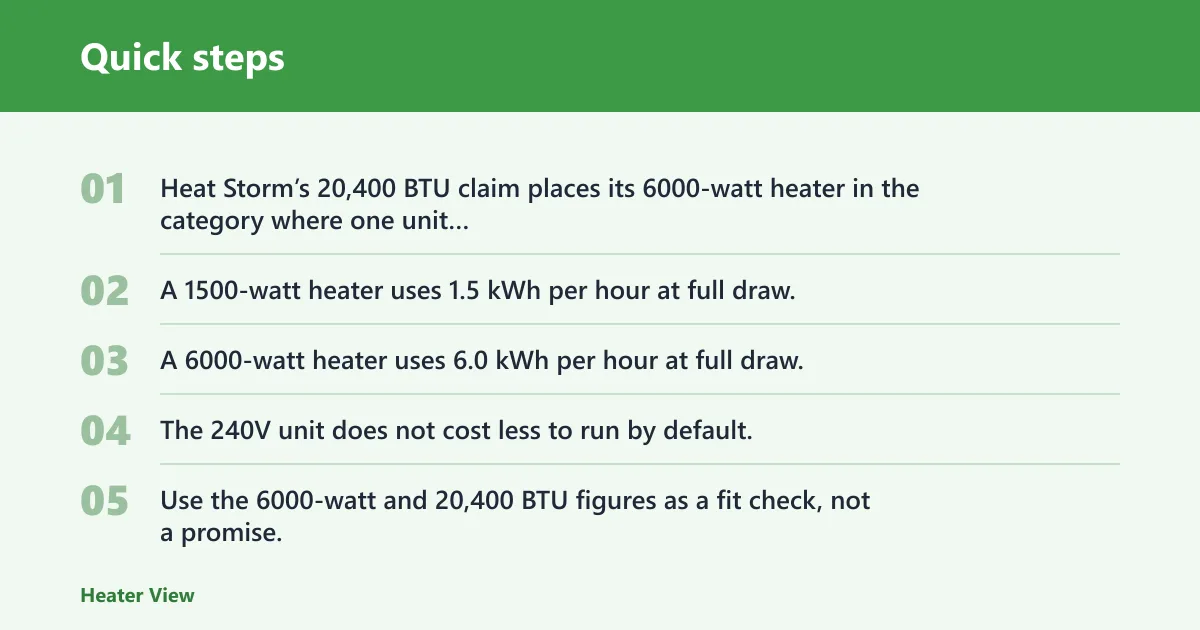
Wattage tells you electrical draw. BTU output tells you heating capacity. Heat Storm’s 20,400 BTU claim places its 6000-watt heater in the category where one unit can serve a medium garage if the building envelope is decent.
120V versus 240V cost-to-run comparison
A 1500-watt heater uses 1.5 kWh per hour at full draw. A 6000-watt heater uses 6.0 kWh per hour at full draw. The 240V unit does not cost less to run by default; it usually costs more per hour because it moves more heat.
6000-watt and 20,400 BTU fit checks
Use the 6000-watt and 20,400 BTU figures as a fit check, not a promise. That output is much better for a one- or two-car garage with some insulation than for a leaky barn-style bay. Coverage claims drop quickly once the ceiling gets high or the door seals poorly.
When higher output still falls short
Higher output does not fix bad heat retention. If the garage door leaks cold air or the ceiling is tall, the heater may run longer without making the space comfortable. In that case, weatherstripping and insulation matter as much as the heater choice.
Frequently asked questions
What is the best smart garage heater with remote control?
The Heat Storm garage heater is the best fit here because it combines Wi‑Fi control, phone access, an external thermostat, wall- or ceiling-mount options, and 6000 watts of output. It is the clearest match for buyers who want true smart control instead of a simple handheld remote.
Can I use a Wi-Fi garage heater in a workshop?
Yes, as long as the workshop has reliable Wi‑Fi and the heater is installed on a circuit that can handle it. App control works well for scheduling and setpoint changes, but a weak signal can make the smart features feel unreliable. In that case, local controls matter more.
What size garage heater do I need for a large garage?
For a large garage, look beyond simple square footage and check insulation, ceiling height, and air leaks. A 6000-watt unit can suit up to 1,000 square feet in better conditions, while a larger or draftier space may need a higher-output heater or a second heat source.
Can I control a garage heater from my phone?
Yes, if the heater has Wi‑Fi and app support. Heat Storm says its garage heater works with the Smart Life app and can be controlled from a phone. That lets you change temperature and schedule heat without being in the garage.
Are wall-mounted garage heaters better than ceiling-mounted ones?
Neither is always better. Wall-mounted heaters are easier to reach for service and sometimes easier to aim, while ceiling-mounted heaters save floor and wall space. In a crowded garage, ceiling mounting often makes more sense if the model supports it and the circuit is installed correctly.