Tankless Water Heater Scale Prevention Tips
Descale a tankless water heater every 12 months at 7–10 grains per gallon (gpg), every 6 months above 10 gpg, and install a softener at 10+ gpg if you want real scale prevention. Ignore scale, and you get lower hot-water output, higher gas or electric use, and early heat-exchanger failure. Use a hardness reading to choose between descaling, softeners, and salt-free anti-scale systems.
What water hardness means for tankless heaters


Hard water carries more dissolved calcium and magnesium, and those minerals form scale inside a tankless water heater. USGS classifies water above 180 mg/L as very hard, while many homeowners use 7 gpg as a soft-to-hard decision point and 11 gpg as a manufacturer-limit warning level.
That matters because most tankless warranty language is tied to maintenance and water quality. Many manufacturers specify that water exceeding 11 gpg requires treatment to maintain warranty coverage, so hardness is not just a comfort issue. It changes what you should install, how often you should descale, and what records you should keep.
Which tankless parts take the most scale?
The tankless water heater heat exchanger is the main scale accumulation point. It is where water heats quickly, so mineral fouling collects there first and can reduce efficiency and flow. A scale layer as thin as 1/32 inch can reduce heat transfer efficiency by 10 percent.
Inlet-side parts also matter. Flow sensors, small passages, and valves can misread flow or restrict it when mineral buildup starts upstream. Once scale forms near the inlet, the heater can short-cycle, overheat, or throw error behavior even before output falls enough for a homeowner to notice.
Tankless water heater scale table
| Water hardness | Severity or symptom level | Heater type or setup | Best next step |
|---|---|---|---|
| 0–7 gpg | No symptoms; normal flow and stable temperature | Any tankless unit | Record hardness, keep annual maintenance, monitor for change |
| 7–10 gpg | Light scale risk; no error codes yet | Single tankless heater or whole-house tankless system | Descale every 12 months; consider point-of-entry treatment if the home has multiple fixtures or heavy use |
| 10–11 gpg | Moderate risk; minor flow loss or temperature swings | Any residential tankless heater | Install an ion-exchange softener for prevention, or a TAC system if salt use is not desired and the heater scope fits the treatment size |
| Above 11 gpg | High risk; recurring descaling needs or error behavior | Whole-house tankless or high-demand home | Treat water before it reaches the heater, then keep a shorter descaling interval and service log for warranty support |
| Above 180 mg/L | Very hard water by USGS category | Any unit with frequent draw cycles | Use point-of-entry prevention, not only cleaning, because repeated fouling is likely |
Use that table as a decision path, not a slogan. If hardness is below 7 gpg and the unit has no symptoms, descaling may be enough. Once readings move past 10 or 11 gpg, prevention becomes the better answer because cleaning alone does not stop new deposits from forming.
Say your test strip reads 8 gpg and the shower temperature drifts by a few degrees during long use. That points to early fouling, not a dead heater. A yearly flush may hold for now, but the next step should be whole-house treatment if the home has multiple hot-water draws each day.
How often should I descale a tankless water heater?
At 7–10 gpg, a tankless heater may need descaling about every 12 months. Above 10 gpg, a common rule of thumb is to shorten that to about every 6 months if no softener or TAC system is installed. Descaling clears scale that already formed, but it does not stop new mineral buildup from returning.
How to descale tankless hot water heater
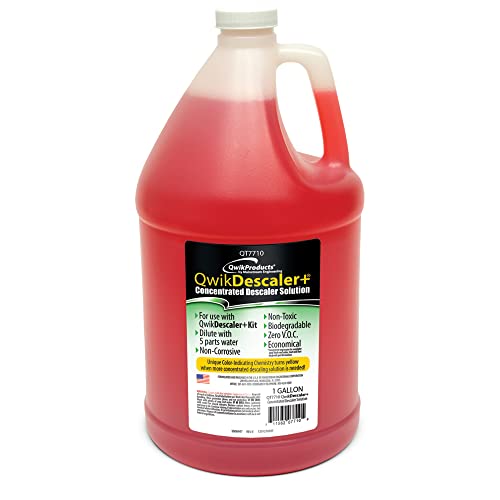
Use food-grade citric acid or white vinegar, circulated with a submersible pump, to flush the heat exchanger and internal water path. This is maintenance, not prevention. In hard-water regions, annual descaling is common because the heat exchanger is the first place fouling shows up.
-
Shut off the heater. Turn off power and gas, then close the water isolation valves. That prevents firing while the service loop is open and keeps the pump flush directed through the heater instead of the plumbing system.
-
Connect the service hoses. Attach the flush kit or service valves to a bucket and submersible pump. Use a cleaning solution made with food-grade citric acid or white vinegar, then circulate it through the unit long enough to dissolve scale from the heat exchanger.
-
Flush clean water through. After the cleaning cycle, rinse the unit until the discharge runs clear and no odor remains. Clear flushing residue matters because leftover solution can affect startup and may leave the system looking dirty on the next service check.
-
Restore and test. Open the valves, relight or repower the heater, then run a hot-water tap and check for stable flow and temperature. If the unit still hesitates or trips error behavior, the problem may be beyond simple scale removal.
A common mistake is waiting until the hot water starts running lukewarm before scheduling a descaling flush. By then, the issue may be severe enough that cleaning alone no longer restores performance. If hot water arrives late, then drops, the heat exchanger may already have enough fouling to need repeated service.
Do you need a softener or TAC system?
If your goal is prevention, not cleanup, choose treatment before the heater. An ion exchange water softener replaces calcium and magnesium with sodium or potassium and is installed upstream as point-of-entry treatment. TAC, or template-assisted crystallization, is the salt-free alternative when you want anti-scale treatment without a regeneration cycle or backwash drain.
Ion exchange softeners
A softener is the strongest prevention choice for homes with hard water and whole-house tankless equipment. It treats all incoming water, so the heater sees less calcium and magnesium from every fixture. Some manufacturers reference softening in warranty terms, especially when hardness exceeds their stated limit.
Softeners are best when hardness is high, hot-water use is heavy, or more than one tankless-fed fixture depends on stable output. They also make recurring descaling less frequent, though a heater may still need maintenance service after long use.
TAC systems
TAC is commonly described as a salt-free anti-scale system. It does not remove minerals the way a softener does. Instead, it changes how minerals behave so they are less likely to form hard scale on the heat exchanger and other surfaces.
That makes TAC a good fit when salt use is undesirable or where a drain for regeneration is not practical. It is still a point-of-entry strategy for whole-house tankless protection. Point-of-use TAC units may help one fixture or one heater branch, but they do not protect every hot-water run in the house.
Navien PeakFlow is a useful example of how TAC-style systems are sold. PeakFlow is described as a chemical-free, salt-free anti-scale water treatment system. PeakFlow S is designed for residential point-of-use applications with flow rates up to 6 gpm, PeakFlow A offers flow rates up to 10 gpm, and PeakFlow C is recommended for larger residential and commercial applications up to 20 gpm.
That scope matters. A point-of-use device may be enough for one compact heater serving a single bath. A whole-house tankless system usually needs point-of-entry protection so every high-demand fixture sees treated water, not just one branch line.
Picture a 2-bath home with a tankless heater and 9 gpg water. If only the kitchen branch gets a point-of-use anti-scale unit, the showers and laundry lines can still feed scale into the heat exchanger. The heater is protected only where the treatment reaches.
What should you record for warranty protection?
Keep proof after every service event. Tankless water heater warranty coverage can depend on maintenance documentation, and some manufacturers set hardness or treatment limits that affect coverage. A clean service record helps show that the heater received the care required by the manual.
Checklist for maintenance records
| Event | What to record | Why it matters |
|---|---|---|
| Water test | Date, hardness reading in gpg or mg/L, test method used | Shows whether the home is above the soft-to-hard threshold or manufacturer limit |
| Descaling | Date, cleaning solution used, whether a submersible pump flush was completed | Proves the heat exchanger received periodic maintenance |
| Softener installation | Model, install date, whether it is point-of-entry | Documents that calcium and magnesium were treated before reaching the heater |
| TAC installation | Model, flow rating, install date, treated area | Shows which branch or whole-house area receives anti-scale treatment |
| Service visit | Error codes, symptoms, technician notes, replaced parts | Links a problem to maintenance history instead of guesswork |
Save the water test result, the service invoice, and any serial-number photo for the heater or treatment device. If you install a softener or TAC system, keep the spec sheet with the flow rate and treatment scope. If the manufacturer asks for proof, those records are easier to produce than memory.
How do you know scale prevention is failing?
Scale prevention is failing when symptoms start appearing before the next scheduled maintenance. Common signs may include flow reduction, longer wait time for hot water, temperature swings, and error behavior or lockouts. Those symptoms mean buildup is already affecting the heat exchanger or upstream components.
Do not wait for a full shutdown. Once scale changes flow or temperature control, the heater is already doing extra work. That is the point to shorten the descaling interval and check whether water treatment should move from optional to necessary.
Failure signs to watch
- Lower hot-water output. Faucets run hot for less time, or the shower cools sooner than before.
- Temperature swings. Water shifts from hot to warm during a steady draw, especially at higher flow rates.
- Reduced flow. A fixture that used to fill quickly now feels restricted, even when plumbing valves are fully open.
- Error codes. The unit starts locking out, cycling, or displaying service behavior tied to overheating or ignition problems.
Suppose the heater shows no error code, but a tub fill now takes several minutes longer than it did after the last service. That can still be scale-related. The heat exchanger may be fouled enough to hurt heat transfer before the control board flags a fault.
Frequently asked questions
What is the difference between descaling and water softening?
Descaling removes mineral buildup that already formed inside the heater. Water softening treats the incoming water before it reaches the heater by replacing calcium and magnesium with sodium or potassium. One cleans the problem. The other stops new scale from forming.
Can an anti-scale filter prevent tankless water heater buildup?
Yes, if it is a true anti-scale system such as TAC and it is sized for the heater’s flow and whole-house demand. It does not remove minerals, but it changes how they behave so scale is less likely to stick. A point-of-use unit only protects the branch it serves.
What water hardness level is too high for a tankless heater?
Many manufacturers treat water above 11 gpg as a threshold that requires treatment to maintain warranty coverage. USGS classifies water above 180 mg/L as very hard. Once hardness reaches that range, a softener or TAC system is usually a better plan than descaling alone.
How do I know if hard water is hurting my tankless heater?
Watch for lower flow, temperature swings, and error behavior that gets worse over time. If hot water delivery changes before the next scheduled flush, scale may already be affecting the heat exchanger. Test the water, check the manual’s limit, and move to treatment if the reading is above your action threshold.