Heater Keeps Running with No Temperature Change
If a heater keeps running and the room temperature does not change, check the thermostat call for heat first, then look for blocked airflow, then verify that the burner, element, or gas supply is actually producing heat. Ignoring the symptom can waste power and leave the room cold. This guide separates command, airflow, and heat-production failures so you can narrow the fault fast.
Common reasons a heater runs nonstop


A heater can run nonstop for three broad reasons: the thermostat still wants heat, warm air is not moving through the system, or the heater is running but not producing enough heat to change room temperature. The symptom matters because a command problem looks different from a heat-output problem at the registers, vents, or flame window.
Separate command from output
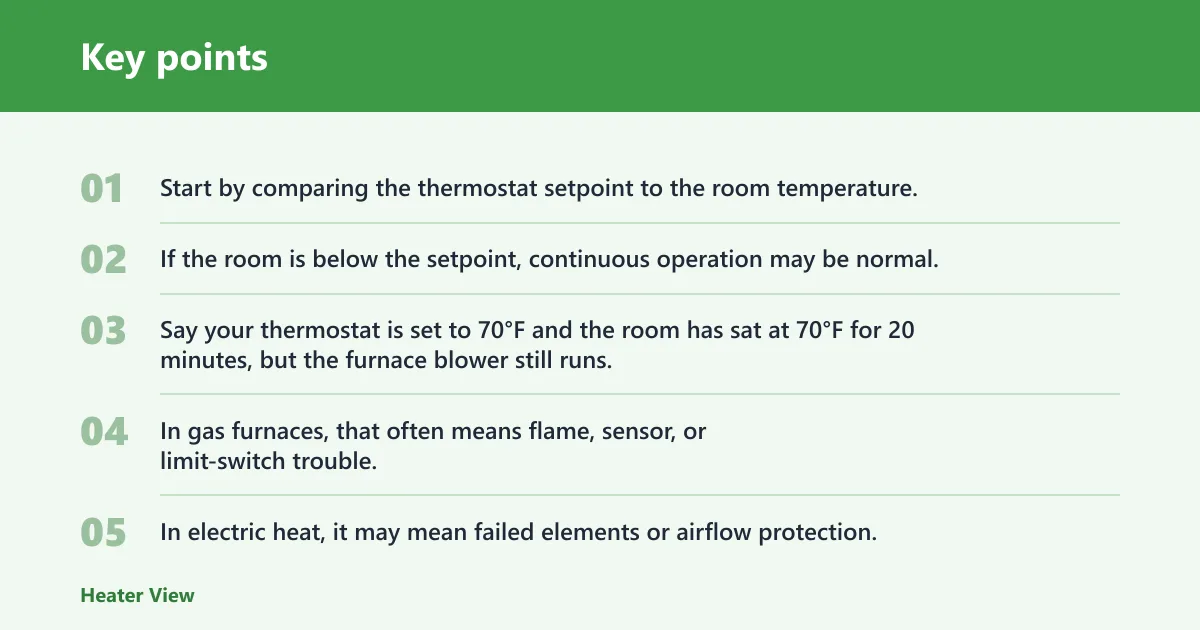
Start by comparing the thermostat setpoint to the room temperature. If the room is below the setpoint, continuous operation may be normal. If the room is already at or above the setpoint and the unit still runs, check thermostat placement, wiring, control logic, airflow, and heating parts before assuming the system is simply working harder.
Say your thermostat is set to 70°F and the room has sat at 70°F for 20 minutes, but the furnace blower still runs. That points away from ordinary heating demand and toward a stuck relay, a bad temperature reading, a fan-only setting, or a control board that is not ending the call for heat.
Why the room may stay unchanged
A room can stay flat even while the heater runs if supply air never gets hot enough, if the air volume is too low, or if heat is lost in ducts before it reaches the living space. In gas furnaces, that often means flame, sensor, or limit-switch trouble. In electric heat, it may mean failed elements or airflow protection. In heat pumps, low output can come from defrost problems, auxiliary heat faults, or a bad compressor call.
Check the thermostat first
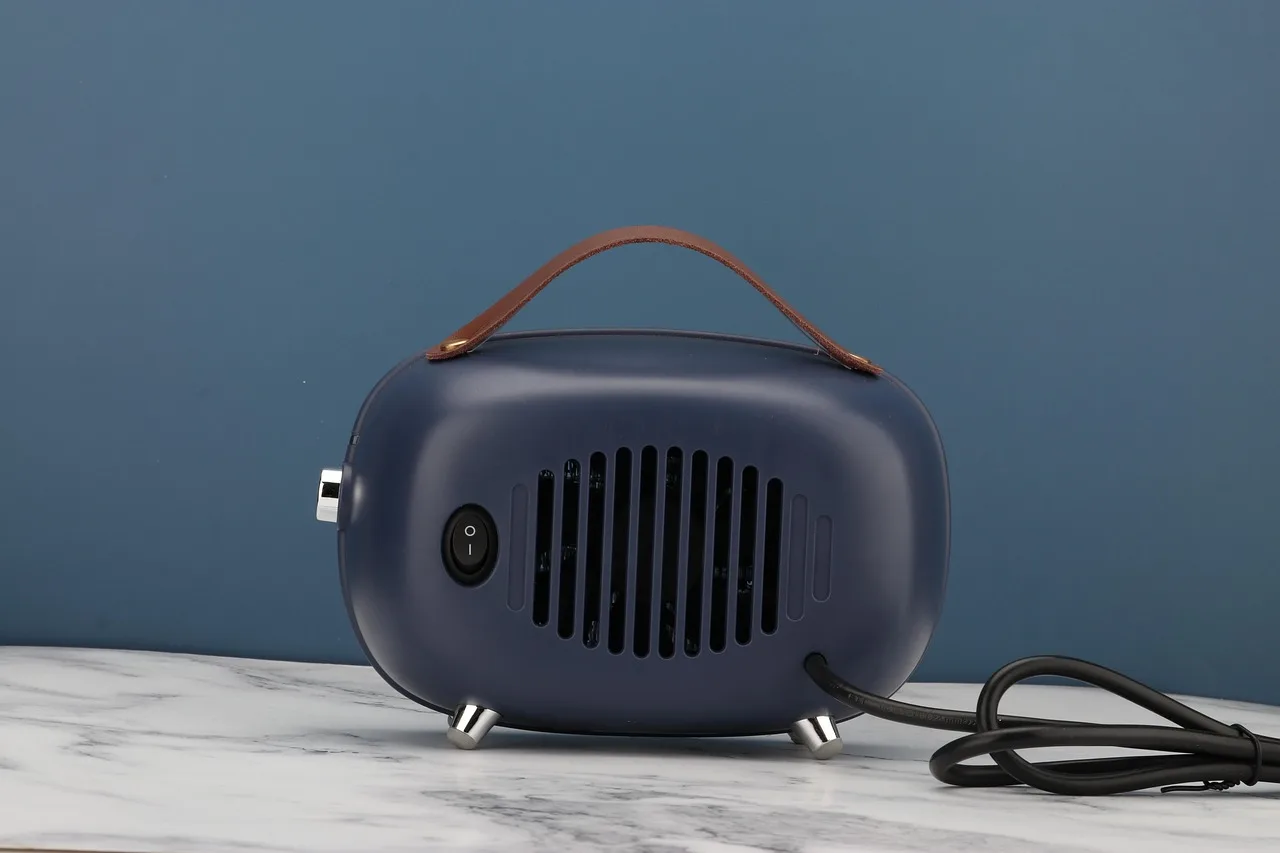
A thermostat that is not reading the room correctly can keep a heater running at the wrong time or make it stop before the space warms. Check the setpoint against the actual room temperature, then look at placement, power, and wiring before moving to the heater itself. That keeps you focused on the right system.
Setpoint, calibration, and placement
Confirm that the thermostat is truly asking for heat. A display that reads lower than the room can call for heat continuously, while a calibration error can make it think the room is colder than it is. Placement also matters: drafts, sunlight, and supply vents can skew the reading and stretch the run time.
Battery, power, and communication faults
Low batteries, interrupted power, loose wiring, or lost communication can leave the thermostat sending bad signals. On wired systems, check that the thermostat is firmly mounted and that the furnace control wiring is intact. On smart controls, a communication fault can prevent the thermostat from ending the call even when the setpoint is reached.
- Compare setpoint and room temperature. Read the thermostat and a separate room thermometer in the same room. If the room is about 1 to 2 degrees of the setpoint but the heater still runs, the problem is less likely to be simple demand.
- Check thermostat placement. Look for direct sun, a nearby supply vent, or a draft from a door or window. Move the thermostat only if it is clearly exposed, because bad placement can force the system to run longer than the room needs.
- Inspect power and wiring. Replace batteries if the model uses them, then confirm the thermostat is powered and secure. If the display is blank, erratic, or losing communication, the fault may be in the thermostat, the wiring, or the control board.
Could airflow be the problem?
Yes. Restricted airflow can make a heater run longer without raising the room temperature because heat is not moving through the system as designed. A clogged filter, weak blower, blocked return, closed damper, or leaky ductwork can all cut delivered heat enough to keep the unit running and the room unchanged.
Filter restriction and MERV compatibility
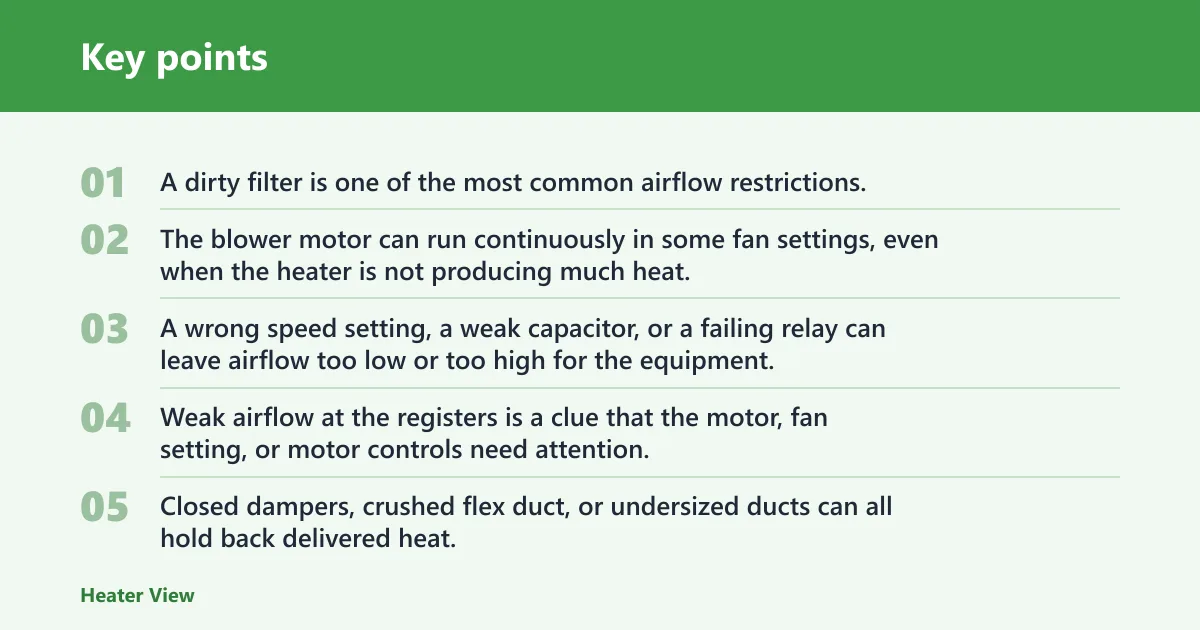
A dirty filter is one of the most common airflow restrictions. Visible dust loading, long replacement intervals, or a filter with a MERV rating that is too restrictive for the system can increase pressure drop and reduce airflow. That lowers heat transfer and can trigger overheat protection in gas or electric systems.
Standard filters are commonly replaced every about 1 to 3 months, though heavy dust, pets, or long runtime can shorten that. If the filter is bowed, gray with dust, or difficult to see through, replace it and confirm the size matches the cabinet so air does not bypass the frame.
Blower motor speed and runtime modes
The blower motor can run continuously in some fan settings, even when the heater is not producing much heat. A wrong speed setting, a weak capacitor, or a failing relay can leave airflow too low or too high for the equipment. Weak airflow at the registers is a clue that the motor, fan setting, or motor controls need attention.
Duct leaks, return blockages, and dampers
Supply leaks can dump warm air into unconditioned spaces, while return restrictions make the blower work against a starved air path. Closed dampers, crushed flex duct, or undersized ducts can all hold back delivered heat. Check that return grilles are open and that room dampers have not been partly closed for too long.
Picture a 2,000-square-foot house with one basement return blocked by stored boxes and two upstairs dampers nearly closed. The furnace may keep running, but the house stays at the same temperature because the blower cannot move enough air through the system to spread the heat.
Heat output failures to check
If airflow looks normal, the next question is whether the heater is actually making heat. A gas furnace can have flame-sensing trouble, an igniter problem, or a control board fault. An electric heater can have a failed element or relay. A heat pump may run without enough warm supply air if the reversing or auxiliary heat controls are wrong.
Flame sensor symptoms and cleaning limits
A dirty flame sensor can cause intermittent heating or a false flame-loss reading. The burner may light, then shut down quickly, making the system cycle without ever warming the house. Cleaning can help if the sensor is only coated with residue, but a cracked or badly worn sensor should be replaced rather than scrubbed repeatedly.
Igniter wear and continuity checks
Hot surface igniters can crack with age, and spark igniters can fail to sustain a heat call if the ignition sequence is interrupted. A damaged igniter may glow weakly, spark inconsistently, or fail to light the burner at all. A technician typically checks voltage and continuity to confirm whether the igniter is still within spec.
Control board relays and fault codes
A control board can stick a relay, misread a sensor, or stop following the normal sequence of operation. Fault codes often point to the part of the cycle that failed, and a power cycle can reset some temporary faults. If the board repeatedly misfires after reset, the problem is no longer a simple glitch.
Why is the heater cycling on and off?
Short cycling usually means the system is hitting a safety limit, losing the flame signal, or failing to keep heat output steady enough to satisfy the thermostat. Repeated on-off behavior is different from a heater that runs continuously with weak output, and that difference helps identify whether the failure is safety-related or output-related.
Limit switch trips and blocked airflow
The limit switch is a safety device that helps protect against overheating. If airflow is blocked by a dirty filter, weak blower, closed register, or duct restriction, the furnace may get too hot and shut the burners off while the fan keeps running. Repeated trips are a warning that the heat exchanger or cabinet is seeing more heat than it should.
If the limit switch keeps tripping after the filter is replaced and the return path is open, turn off the heater and call for service. Repeated safety shutdown cycling can indicate a problem that may overheat parts or damage the heat exchanger.
False flame loss and interrupted heat calls
A dirty flame sensor can tell the board that flame is gone even when the burner is lit. The furnace then shuts down, retries ignition, and repeats the cycle. That can look like a heater that is always running but never quite warming the room, because each cycle ends before useful heat can build up.
Weak heat output versus full shutdown
Weak heat output means the heater is on but delivering too little warmth to change room temperature. Full shutdown means a safety or control device is stopping the heat call. The first points toward airflow, igniter, flame sensor, or output capacity. The second points more strongly to limit-switch, board, or ignition lockout problems.
Heater running table
This table separates the symptom pattern from the most likely subsystem, a homeowner check, the tool needed, and the point where professional service makes more sense. Use it to stop guessing and move from the visible symptom to the most likely fault path.
| Observed symptom | Probable subsystem | Homeowner test | Tool needed | When to call a technician |
|---|---|---|---|---|
| Setpoint and room temperature do not match, but the heater keeps calling for heat | Thermostat error | Compare the thermostat reading with a separate room thermometer; check placement, batteries, and wiring | Room thermometer, small screwdriver | If the reading is still wrong after battery replacement or the display is unstable |
| Airflow feels weak, filter is dusty, and the unit runs longer than usual | Airflow restriction | Inspect the filter for visible dust loading and confirm the correct size and MERV rating for the system | Flashlight, replacement filter | If airflow stays weak after a clean filter and open return path |
| Blower runs continuously even after heat should have stopped | Control board fault | Check for fault codes and note whether a power cycle changes the behavior | Owner manual, flashlight | If the blower or relay seems stuck after a reset |
| Burners light, then shut down, then retry without warming the room | Limit switch cycling | Check for blocked returns, closed dampers, or a severely restricted filter | Flashlight | If the limit switch trips repeatedly after airflow checks |
| Heater runs, but supply air is barely warm | Weak heat output | Check whether the burner lights fully, whether the igniter cycles normally, and whether ducts are losing heat | Flashlight, thermometer | If heat stays weak after airflow and thermostat checks |
When should you turn the heater off?
Turn the heater off if it keeps running with repeated overheating, burning smells, tripped limit switches, or electrical fault codes that return after a reset. Those signs can point to a safety shutdown or an electrical fault, not a harmless thermostat issue. If the system is producing heat unsafely, stop it and get help.
Stop points for gas, electric, and heat pump systems
Gas furnaces should be shut down if the burner will not light correctly, the flame drops out repeatedly, or the limit switch keeps tripping. Electric heaters should be turned off for burning smells, scorch marks, or repeated breaker trips. Heat pumps need service when auxiliary heat fails, the unit runs continuously in mild weather, or defrost behavior is clearly abnormal.
Cost and time decisions
A homeowner can usually handle a filter change, a thermostat battery swap, and an open-return check. A technician is the better choice when the fault reaches ignition, control-board, sensor, motor, or duct sizing work. If the heater has already run for hours with no change in temperature, further trial-and-error can waste energy and hide a deeper fault.
Frequently asked questions
Why does my heater keep running but the temperature never changes?
The most common reason is that the system is calling for heat but the heat is not reaching the room. That can come from a bad thermostat reading, blocked airflow, a weak blower, duct losses, or a heat-production fault such as an igniter, flame sensor, or control board problem.
Can a bad thermostat make a heater run nonstop?
Yes. A thermostat with a bad reading, bad placement, low batteries, or wiring trouble can keep calling for heat even after the room reaches the setpoint. Check whether the displayed temperature matches the room and whether direct sun, drafts, or a supply vent are skewing the reading.
Why does my furnace run continuously but the house stays the same temperature?
That usually means the furnace is running, but the delivered heat is too weak or too scattered to warm the house. Look for a clogged filter, blower trouble, duct leaks, return restrictions, or a flame-sensing problem that keeps the burners from staying on long enough to matter.
What should I check first when my heater won’t reach the set temperature?
Check the thermostat call first, then the filter. Those two items are fast to verify and can explain a surprising number of complaints. If the thermostat is asking for heat and the filter is clean, move on to airflow, flame, igniter, or control-board checks based on the system type.
Is a clogged filter causing my heater to keep running?
It can. A clogged filter raises resistance, cuts airflow, and lowers heat transfer, so the heater runs longer without changing room temperature. If the filter is visibly loaded or past its replacement interval, replace it and see whether airflow improves before looking deeper into the furnace or ducts.
Could duct leaks or airflow problems make a heater run all the time?
Yes. Supply leaks dump warm air into unconditioned spaces, and return blockages starve the blower of air. Closed dampers and undersized ducts can do the same thing. If the system runs but the room stays flat, duct loss and airflow restriction should be high on the list.