How to Reset a Garage Heater After a Shutdown
Reset a garage heater once after a shutdown only after power is off and the safety cause is clear; if it shuts down again, stop resetting it and investigate the fault. Repeated resets can mask a gas, airflow, flame, or overheating problem and raise the risk of damage or carbon monoxide. This guide shows how to reset the heater safely, check the usual trip causes, and decide when to get service.
What this reset guide covers


A full shutdown is different from normal thermostat cycling. If the blower or burner stops completely, the heater may need a cooldown period before it will restart, and the right next step depends on whether the unit is gas, electric, or infrared. The goal here is a safe reset, not repeated restarts.
Use this guide to separate a one-time safety trip from a recurring fault. If the same shutdown returns after about 5-20 minutes, treat that as a fault pattern, not a reset problem.
What you’ll need
- Flashlight
- Multimeter with continuity mode
- Screwdriver set, if the access panel is secured with screws
- Owner’s manual or model label for the heater
- Gloves
- Vacuum or brush for dust around intake and outlet openings
How to reset a garage heater safely
Start with power off, visible inspection, and cooldown. Then restart only once after you have ruled out obvious damage, blocked airflow, or a tripped safety device. If the heater is gas-fired, electric, or infrared, the safe reset path is similar at the power source, but the checks that matter next are different.
What should you do first?
Start with power off, visible inspection, and cooldown. Then restart only once after you have ruled out obvious damage, blocked airflow, or a tripped safety device. If the heater is gas-fired, electric, or infrared, the safe reset path is similar at the power source, but the checks that matter next are different.
-
Turn the heater off. Set the thermostat to its lowest setting or switch the unit off at its control. If the unit has a local power switch, use it first so the heater stops cleanly before you touch anything else.
-
Cut power at the breaker. Disconnect power at the breaker before disassembly, and leave it off until the unit is cool. This matters because a heater can hold heat long enough to trip a safety device again if you restart too soon.
-
Wait for cooldown. Allow 30-60 minutes of cooling before trying again. A heater can sometimes run normally for about 5-20 minutes before shutting down completely, then refuse to restart until the thermal cutoff or limit switch clears.
-
Inspect visible parts. Look for blocked vents, displaced insulation, loose panels, discoloration, or melted insulation near the wiring. Check the terminal block for melting, discoloration, or cracked insulation before any restart attempt.
-
Restore power once. Turn the breaker back on and try a normal restart from the thermostat or unit controls. If it starts and then trips again, stop and move to the fault checks below instead of cycling it repeatedly.
Gas garage heaters
For gas units, a restart usually means restoring power, then calling for ignition through the thermostat or control panel. Do not open or adjust the gas valve assembly unless you are qualified to do so. If there is no ignition after the basic reset, the issue may be flame sensing, rollout protection, or another internal fault that needs service.
Electric garage heaters
For electric units, reset behavior often centers on the high-limit switch, thermal fuse, or the breaker itself. If the fan runs but there is no heat, the unit may have lost its heating circuit even though the controls still work. A continuity test can help identify an open thermal fuse, but it does not explain why the fuse opened.
Infrared garage heaters
Infrared heaters can shut down if the emitter, ignition system, or airflow path overheats. These units are also sensitive to mounting position and nearby surfaces. A safe reset means correcting any obvious clearance or blockage issue before power is restored.
Why did my garage heater shut off after a few minutes?
A shutdown after a few minutes usually points to overheating, ignition trouble, or a safety device that tripped once and needs time to cool. If the unit runs for 5-20 minutes and then stops, that pattern is more important than the restart itself. A true full shutdown is not the same thing as thermostat cycling.
One-time safety trip
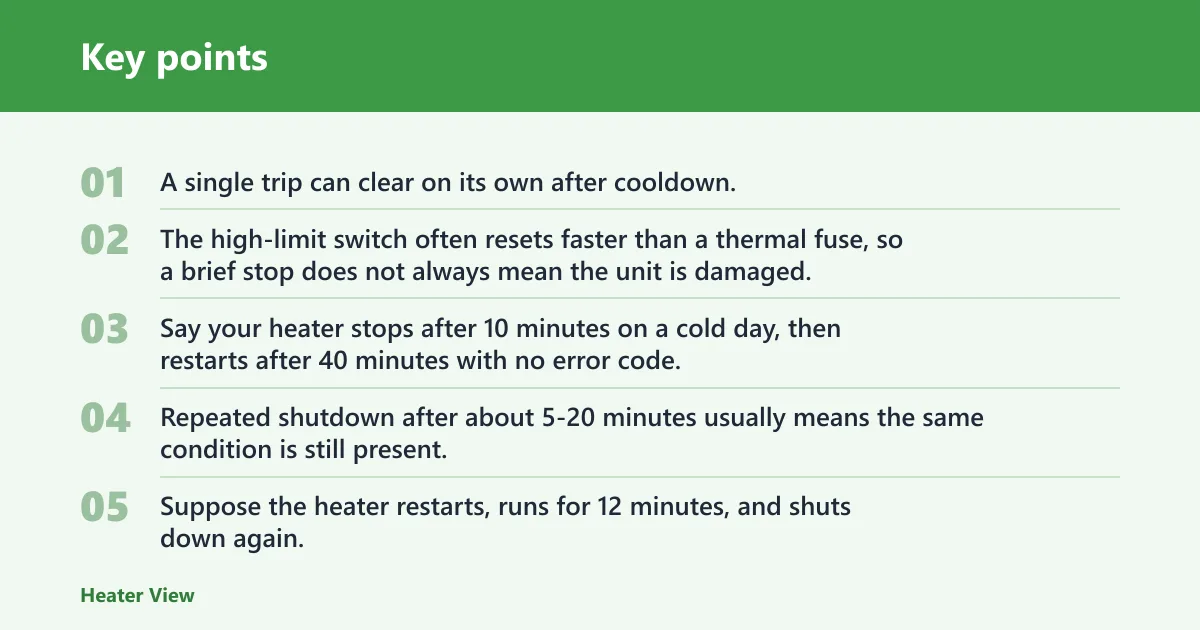
A single trip can clear on its own after cooldown. The high-limit switch often resets faster than a thermal fuse, so a brief stop does not always mean the unit is damaged. If airflow is blocked, the heater is mounted too close to surfaces, or heat builds up in the cabinet, the same trip can return.
Say your heater stops after 10 minutes on a cold day, then restarts after 40 minutes with no error code. That fits a one-time safety trip pattern more than a failed controller, but it still calls for a clearance and airflow check.
Repeated shutdown after 5-20 minutes
Repeated shutdown after about 5-20 minutes usually means the same condition is still present. A thermal fuse may test open on continuity, confirming an over-temperature event, but it does not identify the root cause. The likely causes include poor clearance, blocked airflow, mounting too close to the ceiling, or internal heat saturation.
Suppose the heater restarts, runs for 12 minutes, and shuts down again. That repeat pattern is a stop condition, not a cue to keep resetting it.
No ignition or fan runs with no heat
If there is no ignition, or the fan runs with no heat, the reset path is narrower. Check thermostat settings, confirm power at the breaker, and inspect the terminal block for visible damage. For qualified users, an external thermostat jumper test can help separate a thermostat control problem from a heater fault, but it is not a substitute for internal diagnosis.
Garage heater reset table
This table helps you decide whether to reset once, inspect first, or stop and get service. Use it as a decision aid, not a repair plan.
| Symptom | Likely cause | Safe user action | Parts to inspect | Stop-conditions | Do not reset if… |
|---|---|---|---|---|---|
| No power | Breaker tripped, switched off, or failed supply | Check the breaker, then try one power cycle after cooldown | Breaker, cord, plug, terminal block | Burning smell, arcing, melted wiring, repeated breaker trip | You see heat damage, arcing, or a breaker that trips again |
| One-time safety trip | High-limit switch or thermal protection event | Wait 30-60 minutes, then restart once | Air intake, outlet, clearance around unit | Trip returns after restart | The same safety trip repeats after one reset |
| Repeated shutdown after 5-20 minutes | Heat buildup, poor airflow, mounting problem | Stop resetting and inspect placement and airflow | Clearance, dust, filter, ceiling space | Same shutdown repeats after one reset | The heater keeps shutting down at the same point |
| No ignition | Gas ignition fault, flame sensing issue, control problem | Check basic power and thermostat settings only | Control panel, indicator lights, venting | No ignition after basic checks | You smell gas or the ignition fault returns immediately |
| Fan runs with no heat | Open heating element, gas ignition failure, limit fault | Verify the thermostat and breaker, then stop | Heating element, limit switch, fuse | Fan keeps running with no heat output | The fan runs but the heating output stays off |
| Burning smell or melted wiring | Overheating or terminal block damage | Shut power off and do not restart | Terminal block, insulation, wiring harness | Visible melting at the terminal block | You see discoloration, melted insulation, or a burnt odor |
How much clearance does a garage heater need?
Clearance matters because heat can build up around the unit and trigger a shutdown even when the heater itself is still functional. The safest approach is to verify the minimum side, top, and front clearance on the unit label or in the manual first, then use generic spacing guidance only as context if the label is missing.
What clearance should you verify first?
Clearance matters because heat can build up around the unit and trigger a shutdown even when the heater itself is still functional. The safest approach is to verify the minimum side, top, and front clearance on the unit label or in the manual first, then use generic spacing guidance only as context if the label is missing.
Overhead clearance and mounting mistakes
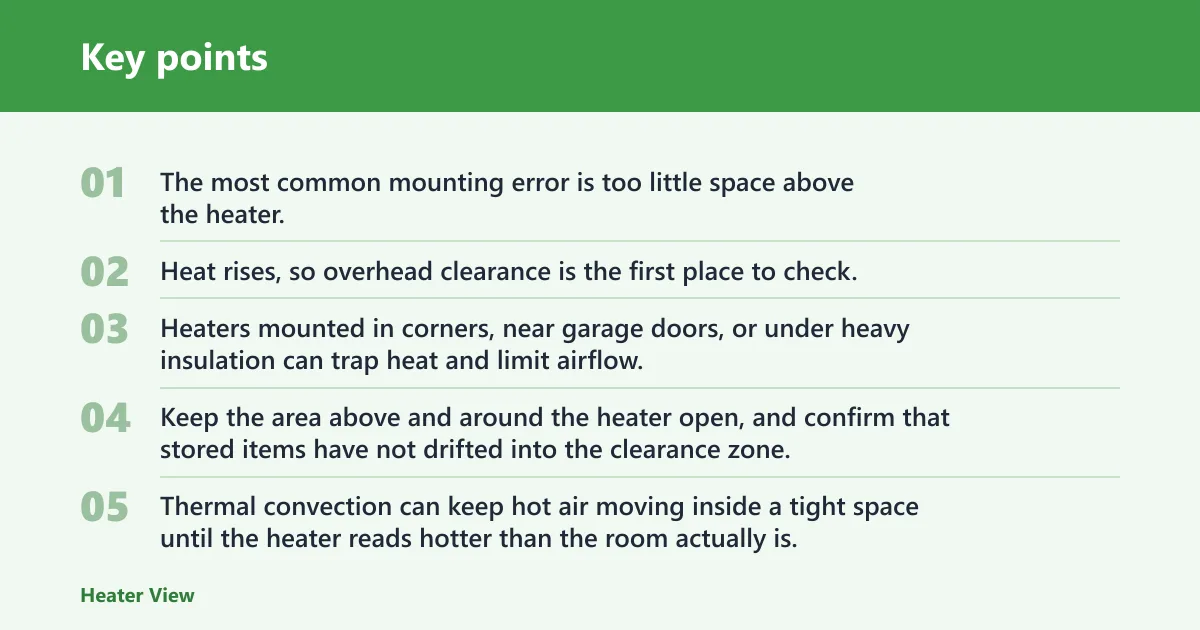
The most common mounting error is too little space above the heater. Heat rises, so overhead clearance is the first place to check. If the unit sits close to a shelf, joist, or insulated ceiling, hot air can collect at the top of the cabinet and trigger false over-temperature readings.
Corners, doors, and insulated ceilings
Heaters mounted in corners, near garage doors, or under heavy insulation can trap heat and limit airflow. That can make a unit trip even when the room feels cool. Keep the area above and around the heater open, and confirm that stored items have not drifted into the clearance zone.
Thermal convection and heat buildup
Thermal convection can keep hot air moving inside a tight space until the heater reads hotter than the room actually is. This is more likely in well-insulated spaces or during long cycles. If the same heater shuts down in the same position, placement is a stronger suspect than the control board.
When should you call a technician?
Call a technician when the heater shows melting, arcing, repeated shutdowns, or no ignition after the basic checks. A one-time reset is reasonable after cooldown, but a recurring fault is not a user-side reset problem. If the terminal block or nearby wiring is damaged, stop using the heater immediately.
Melted wiring or a damaged terminal block
The terminal block is the main house wiring connection point. If you see melting, discoloration, or cracked insulation there, treat it as a stop sign. Visible melting at the main terminal block is not a normal reset issue; it usually points to overheating or an electrical connection problem.
Thermal fuse and high-limit switch checks
A thermal fuse is a small, disc-shaped cutoff component mounted to the heater body or ductwork, and it should be tested for continuity with a multimeter. A failed reading confirms an over-temperature event, but it does not tell you why it happened. The high-limit switch can trip on overheating and may auto-reset faster than a thermal fuse, which is why repeated trips still need a cause check.
Problems that should not be reset again
Do not keep resetting a heater that trips again after cooldown, smells burnt, or shows evidence of arcing. Repeated shutdowns may create a credible fire risk inside the wall or heater cabinet. If the problem returns after one reset and a basic airflow or clearance check, service is the safer move.
Common mistakes
Most bad outcomes come from treating a true shutdown like thermostat cycling, or from resetting too soon. Another common mistake is opening the unit before disconnecting power at the breaker.
Avoid these errors:
- Resetting again and again without checking clearance
- Ignoring a fan that runs with no heat
- Restarting before the 30-60 minute cooldown window
- Overlooking melting or discoloration at the terminal block
- Assuming a thermal fuse replacement fixes the root cause
- Skipping the distinction between gas, electric, and infrared behavior
Prevention is mostly placement and clearance. Keep the area above the heater open, avoid storing items near the cabinet, and recheck mounting space after any garage organization changes.
Frequently asked questions
How to restart gas heater
Turn the thermostat down, switch the heater off, and disconnect power at the breaker first. After 30-60 minutes of cooling, restore power and try one normal start. If there is still no ignition, stop and have the gas ignition, flame sensing, and venting checked by a qualified technician.
How to reset heater in house
For a heater inside the home, the safe sequence is the same: turn it off, cut power at the breaker, wait for cooldown, and restart once. If the unit uses a wall thermostat, confirm the thermostat is calling for heat and not just cycling the fan.
How long should I wait before trying to restart a heater?
Wait 30-60 minutes before trying again. That gives the heater time to cool so a limit device or thermal cutoff can clear. If it still will not restart after that window, or if it shuts down again quickly, the problem needs inspection rather than another reset.
What does a heater high-limit reset mean?
It means the heater tripped a safety device because internal temperature rose too high. The switch may reset on its own after cooling, which is why a brief shutdown can clear without repair. If the same limit trips again, look for airflow restriction, poor clearance, or mounting problems.
When should I call a technician after a garage heater shutdown?
Call for service after any burning smell, melted insulation, visible arcing, repeated breaker trips, no ignition after basic checks, or a shutdown that keeps returning after one reset. If the terminal block shows heat damage, stop using the heater at once and do not attempt another restart.