How Often Should My Garage Heater Run? (What’S Normal)
It’s a common question, especially when the weather turns cold. You look at your garage heater and wonder, “Is it running too much? Or not enough?” This feeling of uncertainty is totally understandable.
You want your space to be comfortable, but you also want to be smart about energy use and keep things safe. We’ve all been there, staring at a thermostat or listening to the hum of a heater, trying to figure out what’s truly normal. Let’s break down exactly what to expect from your garage heater.
Your garage heater’s run time depends on many things. This includes the heater type, its size, how well your garage is insulated, and the outside weather. There’s no single answer for everyone.
However, understanding these factors helps you know what’s normal for your situation.
Understanding Garage Heater Run Times
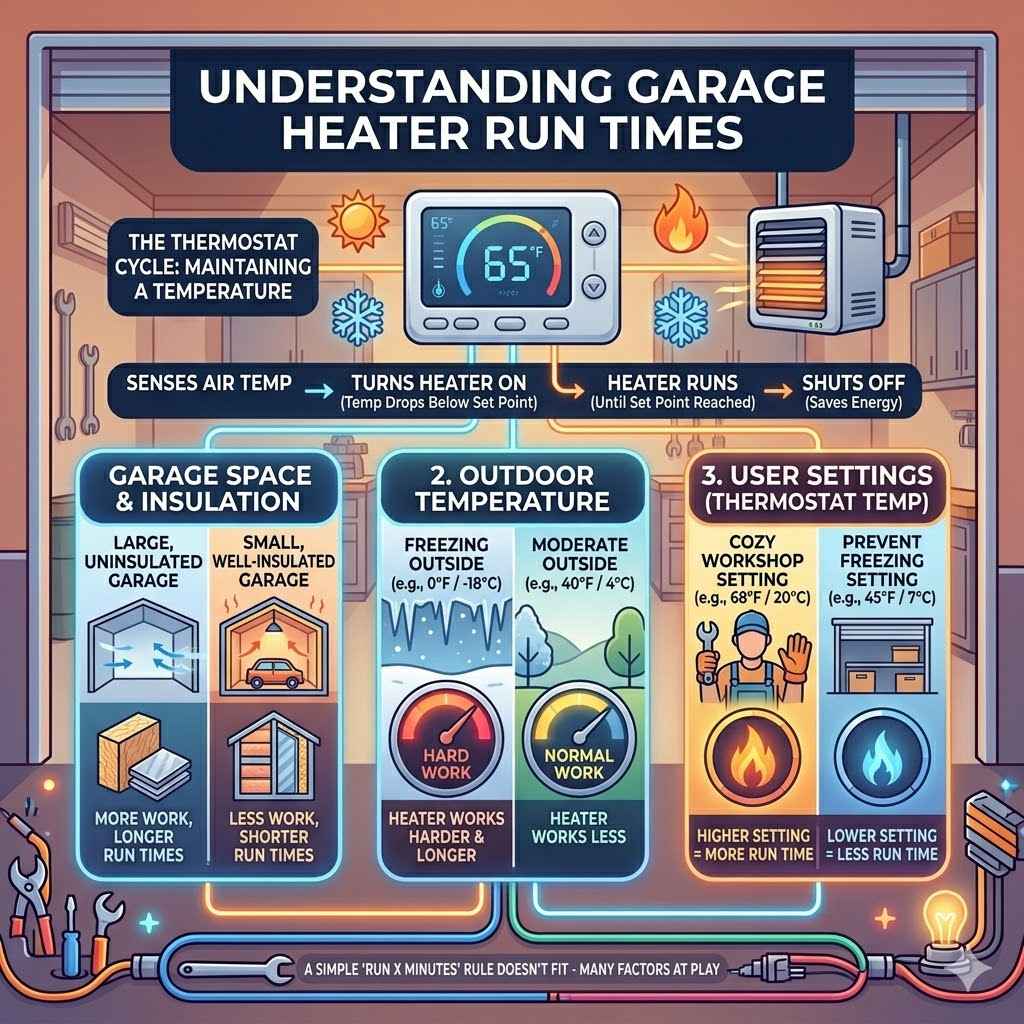
Why does your garage heater turn on and off? It’s all about maintaining a certain temperature. Your heater has a thermostat.
This device senses the air temperature in the garage. When the temperature drops below the level you’ve set, the thermostat tells the heater to start working. It keeps running until the air reaches your set point.
Then, it shuts off to save energy.
But the cycle of on and off isn’t always simple. Many things affect how often this happens. Think about how a big, uninsulated garage will need the heater to run much more than a small, well-insulated one.
And if it’s freezing outside, the heater will work harder and longer to keep up. This is why a simple “run X minutes per hour” rule doesn’t quite fit.
The goal is usually not to keep the garage as warm as your house. Often, people just want to prevent freezing. They might set the thermostat lower.
This means the heater runs less often. If you want a cozy workshop, you’ll set it higher. That will make the heater run more.
My Garage Heater Story: The Mysterious Constant Hum
I remember a time, a few winters back, when I thought my garage heater was broken. I had a natural gas unit installed to keep my woodworking tools from freezing. It was a pretty old garage, not sealed up tight at all.
Every time I went out there, the heater seemed to be on. A constant, low hum. I started to worry about my gas bill.
I even imagined the worst, like a fire hazard or something.
I called the installer back, feeling a bit embarrassed. He came over, took one look around, and just smiled. He explained that my garage was essentially a big, uninsulated box.
Cold air was seeping in everywhere. The heater was working hard, but it was like trying to fill a leaky bucket. He adjusted the thermostat down a bit, told me to check for drafts around the doors and windows, and explained that for my specific setup, constant running wasn’t necessarily a sign of a problem.
It was just doing its best to fight the cold. That experience taught me a lot about how much environment matters.
Garage Heater Basics: What You Need to Know
Heater Type: Electric, gas, or propane heaters work differently. Gas heaters often have pilots or igniters that cycle. Electric ones just heat up.
Thermostat Setting: This is key. A higher setting means more run time. A lower setting means less.
Insulation Quality: How well are your garage walls, ceiling, and doors insulated? Better insulation means less heat escapes, so the heater runs less.
Air Leaks: Cracks and gaps let cold air in. This makes your heater work overtime.
Garage Size: A bigger space needs more heat. This means the heater will run more often and for longer periods.
Factors Influencing Heater Run Time
Let’s dive deeper into what makes your garage heater cycle. It’s a puzzle with several pieces. Each piece plays a role in how long your heater stays on.
Outside Temperature
This is a big one. On a mild winter day, your heater might only kick on briefly. It might run for a few minutes every hour or two.
But when a cold snap hits, or it’s below zero Fahrenheit, your heater will likely run much more. It will stay on for longer stretches. It might even run almost constantly in extreme cold.
Think of it this way. If it’s 30°F outside and you want 50°F inside, the heater doesn’t have to work that hard. But if it’s 0°F outside and you want 50°F, there’s a much bigger temperature difference.
The heater has to fight harder and longer to close that gap.
Garage Insulation
How well your garage is insulated makes a huge difference. If your garage is like a part of your house, with good insulation in the walls, ceiling, and even the garage door, your heater won’t need to run very often. It’s like wearing a warm coat on a cold day.
The heat stays in.
On the other hand, if your garage has bare walls and an uninsulated door, it’s like wearing a thin t-shirt in a blizzard. Heat escapes quickly. This forces your heater to run constantly to try and keep up.
You might have R-values of R-13 or R-19 in a house wall. A garage might have R-0 or R-4. That’s a big difference.
Insulation Levels: What They Mean
Poor Insulation: Bare studs, uninsulated doors. Heater runs often, even on mild days. High energy bills likely.
Moderate Insulation: Some insulation in walls, maybe an insulated door. Heater runs less than poor, but still cycles frequently in cold.
Good Insulation: Well-insulated walls, ceiling, and a quality insulated garage door. Heater runs least often. Consistent temperatures are easier to maintain.
Air Sealing
Even with good insulation, air leaks can make your heater work harder. These leaks are often around windows, doors, electrical outlets, and where walls meet the foundation. Cold air gets in, and warm air escapes.
You might feel a draft. Or you might see light coming through. These small gaps add up.
They force your heater to run more than it should. Sealing these leaks is often a very cost-effective way to reduce heater run time. Using caulk or weatherstripping can make a big impact.
Thermostat Settings
This is something you control directly. What temperature do you want in your garage? Many people don’t heat their garage to the same level as their home.
They might set it to just above freezing, say 40°F or 45°F. This is enough to protect tools and prevent pipes from bursting.
If you use your garage as a workshop or a place to hang out, you’ll set it higher, maybe 60°F or even 70°F. The higher the set temperature, the longer and more often your heater will run. Choosing a lower, practical temperature is the easiest way to reduce run time.
Thermostat Setting Impact
Setting: 40°F
Expected Run Time: Low. Heater cycles on only when absolutely necessary in cold weather. Good for frost prevention.
Setting: 55°F
Expected Run Time: Moderate. Heater cycles more often, especially in colder temps. Good for light workshop use.
Setting: 70°F
Expected Run Time: High. Heater will run frequently to maintain this temp. Best for comfortable living/working space.
Type of Heater
Different heaters work differently. A natural gas garage heater might have a pilot light that stays on. Or it might have an electronic ignition.
This affects its baseline energy use. Electric heaters are simpler, but they can use a lot of power. Infrared heaters warm objects directly, not the air, so their run cycles can seem different.
For example, an electric resistance heater will run at full power when it’s on. It stops when the thermostat is met. A propane unit might have a burner that cycles on and off.
A forced-air gas heater will have a fan that runs when the burner is on.
Real-World Scenarios: What to Expect
Let’s look at a few common garage setups. This will help you see what’s normal for different situations.
Scenario 1: The Uninsulated Workshop Garage
Imagine a two-car garage with bare concrete floors, unpainted concrete block walls, and a single, uninsulated metal garage door. There are no windows, or perhaps just one old, leaky one. This garage is a direct link to the outside.
In winter, the inside temperature will closely match the outside temperature, perhaps only a few degrees warmer.
If you install a heater here and set it to 50°F, expect it to run a lot. On a 20°F day, the heater might come on for 15-20 minutes every hour. If it drops to 0°F, it could be running for 30-40 minutes out of every hour, or even more.
The goal here might just be to keep tools from freezing and moisture down. The heater is constantly fighting the cold air seeping in.
This is where you might see higher energy bills. The heater is working very hard. Improving insulation and sealing leaks would be the best way to reduce run time and costs here.
Scenario 2: The Attached, Moderately Insulated Garage
Now consider a two-car garage attached to a home. It has drywall on the shared wall and the ceiling (if there’s a room above). The other exterior walls might have some R-11 insulation, and the garage door is a newer, insulated one.
There might be a few small gaps around the door frame.
If you set the thermostat to 50°F, the heater won’t run as much as in the first scenario. On a 20°F day, it might run for 10-15 minutes every hour. If it’s 0°F outside, maybe 20-30 minutes out of every hour.
This garage holds heat much better. The insulation and the fact that it’s attached to a warm house help.
Even small improvements like adding weatherstripping to the garage door and sealing any visible cracks can make a noticeable difference in run time. The goal is to make the heater’s job easier.
Garage Usage & Heater Needs
Storage Only: If your garage is just for cars and storage, and you only need to prevent freezing, a low setting (e.g., 40°F) is fine. Heater will run minimally.
Light Workshop: If you do occasional DIY projects, a slightly higher setting (e.g., 50-55°F) might be needed. Heater will cycle more often.
Full Workshop/Living Space: If you spend a lot of time in your garage, you’ll want a warmer temp (e.g., 65-70°F). Heater will run frequently, similar to a home.
Scenario 3: The “Poor Man’s” Heated Space
Sometimes, people just want to take the edge off the cold, not make it tropical. They might use a small electric heater or even a propane heater in a very basic way. They set the thermostat quite low, perhaps just to turn on if the temperature dips near freezing.
In this case, the heater might only come on for short bursts, maybe 5 minutes every few hours. This is often enough to keep things from freezing without using much energy. The key here is the very low thermostat setting.
It’s not trying to create comfort, just prevent damage.
This approach is common for people who store sensitive items or have water lines in their garage they want to protect. The heater is more of a safety net than a comfort system.
What This Means for You: When is it Normal?
So, when should you stop worrying and accept that your heater is just doing its job? It really boils down to a few key points.
Normal Operation Scenarios
It’s usually normal for your garage heater to run:
- More frequently during cold snaps or very cold days.
- For longer periods when the outside temperature is much lower than your desired inside temperature.
- More often if your garage is not well-insulated or has many air leaks.
- More often if you have set the thermostat to a higher temperature.
- More often if you have a very large garage or one with a high ceiling.
If you have an uninsulated garage and it’s 10°F outside, and your heater runs for 20 minutes out of every 30, that’s likely normal for that situation. It’s trying its best to keep up with a significant heat loss.
When to Be Concerned
There are times when frequent running is a sign of a problem. You should pay attention if:
- Your heater runs constantly, even on milder days (e.g., above 40°F outside).
- You hear strange noises, like banging or grinding, when it runs.
- You smell unusual odors, like burning plastic or strong gas fumes (turn off gas heaters immediately if you smell gas).
- Your energy bills suddenly spike for no apparent reason.
- The garage is not reaching the temperature you’ve set, even with the heater running for long periods.
These signs suggest something is wrong. It could be a malfunctioning thermostat, a blockage in the airflow, or a problem with the heating element itself. Don’t ignore these issues.
Simple Checks You Can Do
Before calling a professional, you can do a few simple checks. Make sure the thermostat is set correctly. Check for obvious air leaks around doors and windows and seal them with caulk or weatherstripping.
Ensure the air intake and exhaust vents on your heater are not blocked by debris.
If you have an electric heater, check your circuit breaker. Sometimes, a breaker might trip partially and cause the heater to work inefficiently. For gas heaters, ensure the gas supply valve is fully open.
Quick Heater Checks
Thermostat Setting: Double-check your desired temperature.
Air Leaks: Feel for drafts around doors, windows, and openings.
Vents: Ensure heater vents are clear of obstructions.
Breaker (Electric): Check if the breaker for the heater has tripped.
Gas Valve (Gas): Confirm the gas supply valve is fully open.
Tips for Efficient Garage Heating
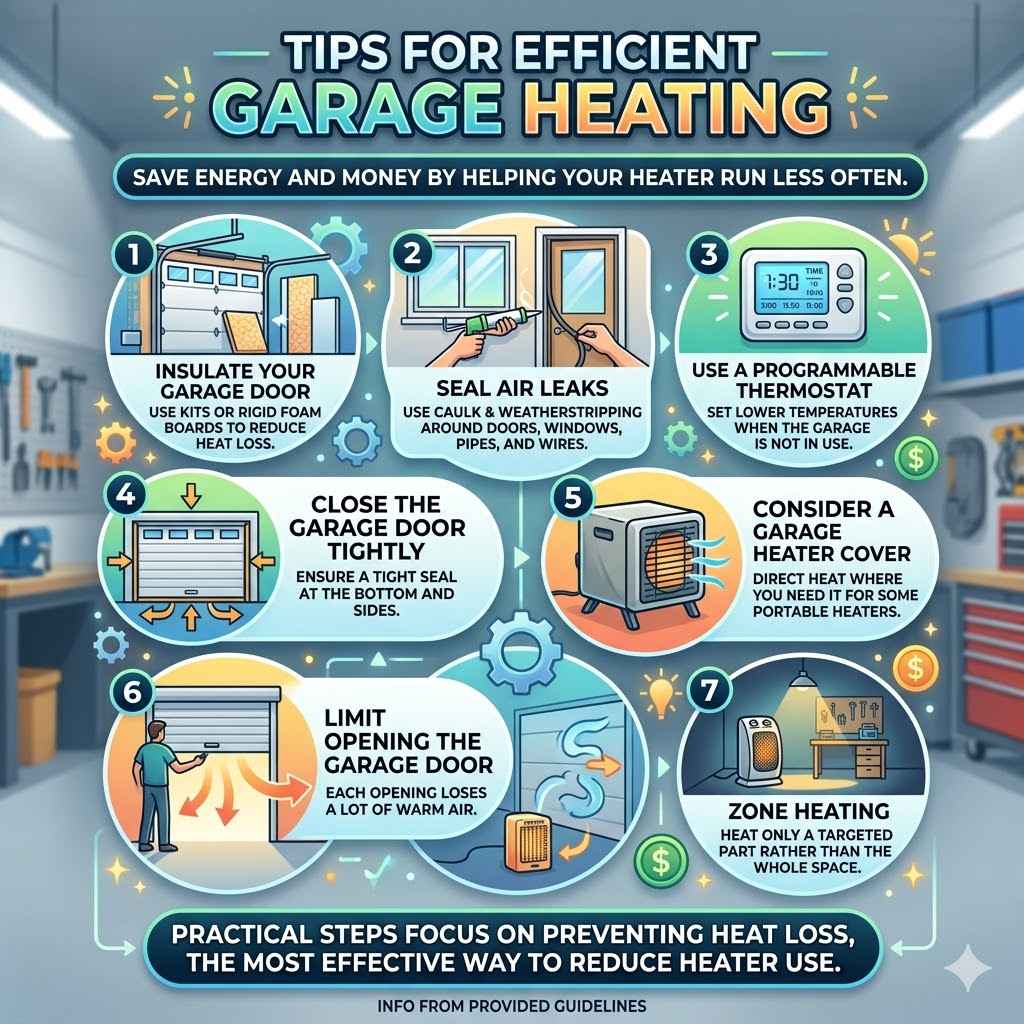
You can help your garage heater run less often and more efficiently. These tips can save energy and money.
- Insulate Your Garage Door: This is often the biggest source of heat loss. You can buy insulation kits or use rigid foam boards.
- Seal Air Leaks: Use caulk and weatherstripping around doors, windows, and any openings. Pay attention to where pipes or wires enter the garage.
- Use a Programmable Thermostat: If you don’t need heat all the time, set it to lower the temperature when you’re not using the garage.
- Close the Garage Door Tightly: Make sure it seals well at the bottom and sides.
- Consider a Garage Heater Cover: For some portable heaters, covers can help direct heat where you need it.
- Limit Opening the Garage Door: Each time you open it, you lose a lot of warm air.
- Zone Heating: If you only use a small part of your garage, consider a smaller, targeted heater for that area rather than heating the whole space.
These are practical steps that don’t require major renovations. They focus on preventing heat loss, which is the most effective way to reduce how often your heater needs to turn on.
Frequently Asked Questions About Garage Heaters
How often should a garage heater run in cold weather?
In very cold weather (below 10°F), an uninsulated garage heater might run 30-40 minutes per hour. A well-insulated garage heater may only run 10-20 minutes per hour at the same outside temperature.
Is it normal for my garage heater to run all the time?
It’s usually not normal for a garage heater to run constantly unless it’s extremely cold outside and the garage is very poorly insulated. If it’s running all the time in moderate weather, check for air leaks or consider insulation improvements.
How can I tell if my garage heater is too small?
If your garage heater runs constantly but still can’t reach your desired temperature, it might be too small for the space. Also, if it struggles to maintain a temperature above freezing in mild cold, it could be undersized.
What is the best thermostat setting for a garage heater to save energy?
To save energy, set your garage heater thermostat as low as possible while still meeting your needs. For example, 40°F to 45°F is often enough to prevent freezing and protect tools, significantly reducing run time compared to higher settings.
Should I heat my garage to the same temperature as my house?
Most people do not heat their garage to the same temperature as their house. Heating a garage to a comfortable living space temperature (e.g., 70°F) can be very expensive, especially if it’s not well-insulated. A lower temperature is usually sufficient and more energy-efficient.
How does insulation affect my garage heater’s run time?
Good insulation dramatically reduces how often your garage heater needs to run. It traps heat inside, meaning the heater only needs to turn on occasionally to make up for small heat losses, rather than constantly fighting the cold.
Conclusion
Understanding how often your garage heater should run involves looking at its environment and your settings. There’s no single magic number. By considering insulation, air leaks, outside weather, and your thermostat choice, you can get a good idea of what’s normal.
This helps you keep your garage comfortable and your energy bills in check.