What Size Garage Heater Do I Need? (Easy Sizing Guide)
The right size garage heater depends on your garage’s size, insulation level, climate, and desired temperature. Calculate the necessary BTU output by considering these factors to ensure efficient and effective heating.
Understanding Garage Heater Sizing
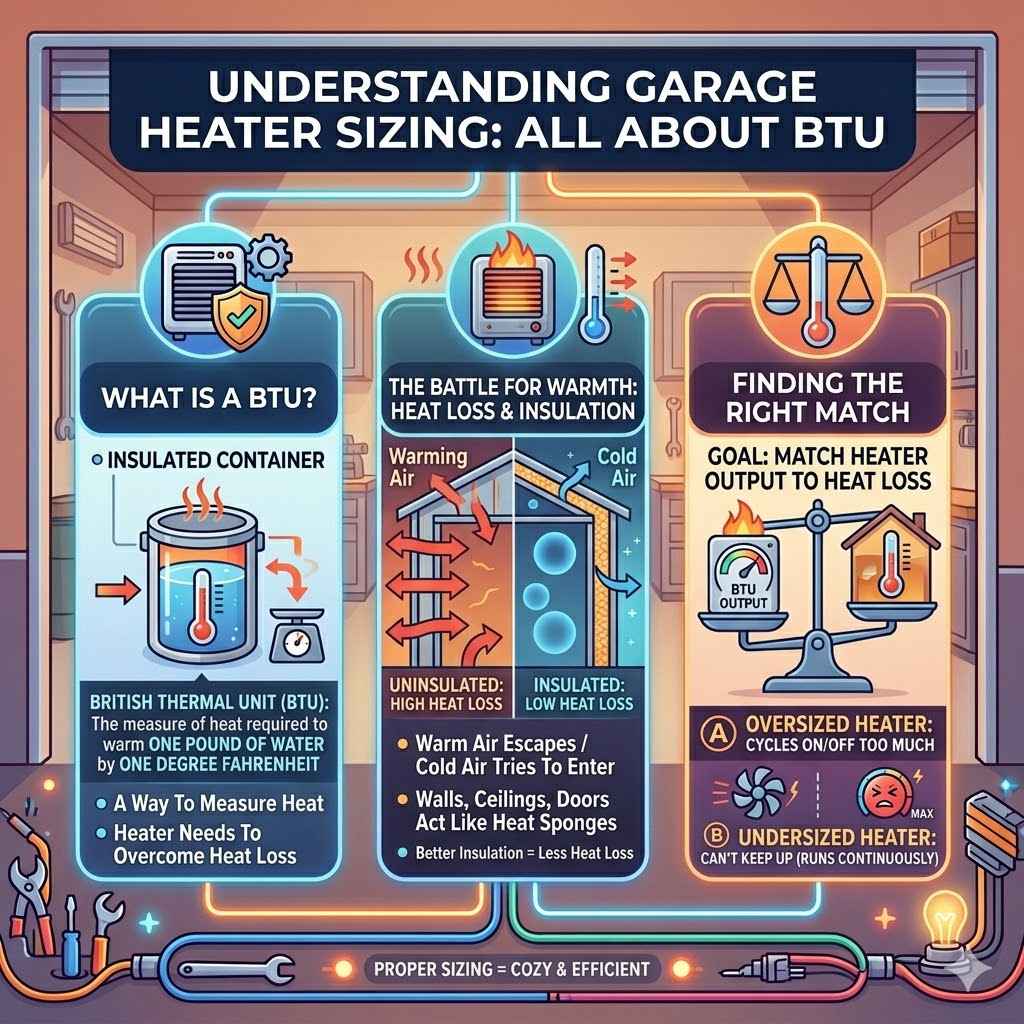
So, what makes a heater the “right size”? It all comes down to something called BTU. BTU stands for British Thermal Unit.
It’s a way to measure heat. Think of it like this: one BTU is the amount of heat needed to warm one pound of water by one degree Fahrenheit. For your garage, you need a heater that can produce enough BTUs to overcome heat loss and reach your comfort level.
This heat loss happens all the time. Warm air inside your garage tries to escape. Cold air from outside tries to get in.
Your garage’s walls, ceiling, and door are like sponges for heat. The better insulated your garage is, the less heat it loses. The colder it is outside, the faster heat escapes.
The goal is to match your heater’s BTU output to the amount of heat your garage loses. This ensures your heater can keep up. It runs just enough to keep things cozy without overworking itself.
An oversized heater cycles on and off too much. An undersized one can’t keep up when it’s really cold.
Why Garage Heater Size Matters
Picking the wrong size heater can lead to a few problems. An undersized heater will struggle on cold days. You might find your garage never gets as warm as you want it.
The heater might run constantly, trying its best, but it just won’t win the battle against the cold. This constant running can also mean it wears out faster.
On the flip side, an oversized heater is also not ideal. It will heat up your space very quickly. Then, it will shut off.
It will stay off until the temperature drops significantly. This on-and-off cycling is hard on the heater’s components. It can shorten its lifespan.
Plus, you might end up using more energy than needed because it’s designed for a much larger space. It’s like using a giant industrial fan to cool a small desk area.
Finding the right size means your heater works efficiently. It will maintain a comfortable temperature. It will use energy wisely.
This saves you money on your utility bills. It also makes your garage a much more enjoyable place to be. You can work on projects, store items, or just hang out without feeling the chill.
The Key Factors in Calculating BTU Needs
To figure out the right BTU output for your garage heater, we need to look at a few things. Think of these as the building blocks for our calculation. Each one plays a role in how much heat your garage needs.
First is the size of your garage. This is usually measured in square footage. A bigger garage needs more heat than a smaller one.
It’s a straightforward relationship: more space means more air to warm up.
Next, we look at insulation. This is a huge factor. Is your garage well-insulated like a heated room in your house?
Or is it uninsulated, like an open shed? Insulation acts as a barrier. It keeps warm air in and cold air out.
A garage with good insulation will need a smaller heater.
The climate you live in is also very important. If you live in a place with very cold winters, you’ll need a more powerful heater. You need to combat those freezing temperatures.
Someone in a milder climate won’t need as much heat.
Finally, think about the desired temperature. What temperature do you want your garage to be? Are you aiming for just above freezing, or a cozy 70 degrees Fahrenheit?
The difference between these temperatures affects how much work the heater has to do.
Calculating Your Garage’s Square Footage
Let’s start with the easiest part: your garage’s size. You need to know the square footage. This is simply the length of your garage multiplied by its width.
Most garages are standard sizes, but yours might be a bit different. Measuring is key to getting this right.
So, grab a tape measure. Measure the length of your garage from the back wall to the garage door. Then, measure the width from one side wall to the other.
Let’s say your garage is 20 feet long and 24 feet wide. To find the square footage, you just multiply these numbers: 20 feet * 24 feet = 480 square feet.
If you have a two-car garage, it’s often around 400 to 600 square feet. A one-car garage might be 150 to 300 square feet. An oversized workshop garage could be 800 square feet or more.
Knowing this number is the first step to a correct calculation.
Quick Square Footage Check
Standard 1-Car Garage: 12′ x 20′ = 240 sq ft
Standard 2-Car Garage: 20′ x 20′ = 400 sq ft
Larger 2-Car Garage: 24′ x 24′ = 576 sq ft
Important: Measure your actual garage for the best results.
The Role of Insulation: A Game Changer
Insulation is where things get really interesting. A garage with no insulation is basically a box exposed to the outside. Heat will escape very quickly.
You’ll need a much larger heater to compensate.
Think about a typical uninsulated garage. The walls might be just single-layer wood or metal. There’s no barrier to stop heat from going through.
In winter, your heater has to work overtime just to keep the temperature from dropping to the outside level. You might need a heater with 100 BTU per square foot or even more in very cold areas.
Now, imagine a garage with decent insulation. This could be fiberglass batts in the walls and ceiling, or rigid foam boards. This insulation slows down heat transfer dramatically.
It keeps the warm air inside and the cold air outside much better. With good insulation, you might only need 30-50 BTU per square foot. This is a significant difference!
If your garage is attached to your house and shares a wall, that can also act as a form of insulation. The heat from your house can transfer into the garage, reducing the heating load. However, make sure any doors connecting the house to the garage are well-sealed and insulated themselves.
The ceiling is often overlooked. If you have a living space above your garage, the ceiling should be well-insulated. If it’s just an attic space, it still benefits from insulation.
Heat rises, so a poorly insulated ceiling will lose a lot of warmth upwards.
Insulation Levels Explained
Level 1: Uninsulated (0-4 R-Value)
- No insulation in walls, ceiling, or door.
- Garage is essentially exposed to outside temperatures.
- Requires the highest BTU heater for its size.
Level 2: Partially Insulated (R-Value 4-12)
- Some insulation in walls or ceiling, or an insulated garage door.
- Reduces heat loss but not as effectively as full insulation.
- Needs a moderately sized heater.
Level 3: Well-Insulated (R-Value 12+)
- Insulation in walls, ceiling, and an insulated garage door.
- Significantly slows heat loss.
- Allows for the smallest heater size.
Climate Zone: The Cold Hard Truth
The weather outside your garage door is a massive factor in how much heat you’ll need. What’s considered “cold” can vary a lot across the United States. A heater that works perfectly in Florida might barely make a dent in Minnesota.
Let’s break this down by typical U.S. climate zones. You can find zone maps from the Department of Energy or your local building codes.
These zones are based on average winter temperatures.
Zone 1 (Mild): Average winter temps above 30°F. Places like Southern California, Florida, and the Gulf Coast. Here, you might only need supplemental heat.
A smaller BTU output will likely suffice, maybe 20-30 BTU per square foot.
Zone 2 (Moderate): Average winter temps between 10°F and 30°F. This includes much of the middle U.S., like the Carolinas, Virginia, and parts of the Midwest. You’ll need a more robust heater, around 30-50 BTU per square foot.
Zone 3 (Cold): Average winter temps between -10°F and 10°F. Think of states like Ohio, Pennsylvania, and parts of the Northeast and Pacific Northwest. A heater in the range of 50-70 BTU per square foot is often necessary.
Zone 4 (Very Cold): Average winter temps below -10°F. This includes states like North Dakota, Minnesota, and parts of Montana and Maine. For these areas, you might need 70-100+ BTU per square foot, especially if insulation is minimal.
It’s important to be realistic about your local climate. Even with good insulation, if your area regularly sees sub-zero temperatures, you need to account for that extreme cold. Using a general rule of thumb based on your zone will give you a much more accurate starting point.
BTU Needs Based on Climate Zone (Per Sq Ft)
Zone 1 (Mild): 20-30 BTU/sq ft
Zone 2 (Moderate): 30-50 BTU/sq ft
Zone 3 (Cold): 50-70 BTU/sq ft
Zone 4 (Very Cold): 70-100+ BTU/sq ft
Note: This is a general guideline. Always adjust for insulation and desired temperature.
Desired Temperature: Comfort Level
What do you plan to do in your garage? This question directly impacts how warm you need it to be. If you just want to keep pipes from freezing and prevent extreme cold, a temperature of 40-50°F might be enough.
This requires less BTU output.
However, if you plan to spend hours working on your car, woodworking, or just want a comfortable space for hobbies, you’ll want a warmer temperature. Aiming for 60-70°F will require a significantly higher BTU output. This is because you’re trying to create a larger temperature difference between the inside and outside.
Let’s do a quick example. Imagine a 400 sq ft garage. You live in Zone 3 (Cold climate).
You have a moderately insulated garage.
If you want to maintain 45°F (just above freezing): Using 50 BTU/sq ft, you’d need 400 sq ft * 50 BTU/sq ft = 20,000 BTU.
If you want to maintain 70°F (a comfortable working temp): You might need closer to 70 BTU/sq ft. So, 400 sq ft * 70 BTU/sq ft = 28,000 BTU.
That’s an 8,000 BTU difference! It’s not just about keeping the cold out; it’s about creating the climate you want inside. Be honest about your comfort needs.
Overestimating slightly is usually better than undershooting, as long as you’re not wildly overdoing it.
The BTU Calculation Formula
Now, let’s put it all together. We can use a simple formula to get a good estimate of the BTU output you need. This formula combines the factors we’ve discussed.
Basic BTU Formula:
BTU = Square Footage × BTUs per Square Foot (based on climate and insulation)
Let’s walk through an example together. Imagine your garage is 24 feet by 20 feet. That’s 480 square feet.
You live in Zone 3 (Cold climate), so we’ll start with the higher end for insulation, let’s say 50 BTU per square foot as a baseline for moderate insulation.
So, 480 sq ft * 50 BTU/sq ft = 24,000 BTU.
Now, let’s adjust for desired temperature. If you want it warmer, say 70°F, you might need to bump that up by 20-30%. So, 24,000 BTU * 1.25 (for 25% more) = 30,000 BTU.
This gives you a target range. You’d look for a heater that offers at least 24,000 BTU, and ideally one that can provide around 30,000 BTU for those colder days when you want it warmer.
Many heater manufacturers provide charts or calculators on their websites. These are helpful, but understanding the underlying factors helps you use them correctly. Always consider your specific garage.
BTU Calculation Example
Garage Size: 20 ft x 24 ft = 480 sq ft
Climate Zone: Zone 3 (Cold)
Insulation: Moderate (Estimate 50 BTU/sq ft base)
Desired Temp: Comfortable (Adding 25% for warmth)
Calculation:
- Base Need: 480 sq ft * 50 BTU/sq ft = 24,000 BTU
- Adjusted for Warmth: 24,000 BTU * 1.25 = 30,000 BTU
Recommendation: Look for a heater around 30,000 BTU.
I Was Chasing the Wrong Number Once
I remember a few years ago, I decided to finally put a heater in my detached garage. It was a two-car garage, about 500 square feet. I lived in a Zone 3 area.
My main goal was to keep it from getting ridiculously cold, maybe around 45°F. I figured a small electric heater would do the trick. I bought one rated for 1,500 watts, which is roughly 5,000 BTU.
I thought, “That’s enough for a small space, right?”
Oh, how wrong I was. The first time a real cold snap hit, it was maybe 15°F outside. That little heater ran non-stop.
The garage felt slightly less arctic, but it was still a place I wouldn’t want to spend more than a few minutes. The floor was still freezing. My tools felt like ice blocks.
It was frustrating because I had spent money, but it wasn’t solving the problem. I realized I had completely underestimated the heat loss and the power needed to counteract it. I ended up selling it and getting a proper vented gas heater.
It was a lesson learned about not skimping on the sizing.
Types of Garage Heaters and Their Sizing Considerations
The type of heater you choose can also influence sizing. Different types heat differently and have different efficiencies.
Electric Garage Heaters: These are simple to install. You just plug them in. However, they are the least efficient for large spaces.
A 1,500-watt heater is about 5,000 BTU. To heat a 400 sq ft garage to a comfortable level in a cold climate, you might need multiple of these or a much larger, more expensive one. For just preventing freezing, they can work in very small or well-insulated spaces.
Their BTU output is directly tied to their wattage. 1 watt ≈ 3.41 BTU.
Propane/Natural Gas Unit Heaters: These are common and powerful. They typically hang from the ceiling and use a fan to distribute heat. They can be very effective.
Sizing is critical here, as they come in a wide range of BTU outputs. You’ll need to consider ventilation for these. A 30,000 BTU unit is a common size for a two-car garage.
Infrared Garage Heaters: These heat objects and people directly, rather than the air. This can be more efficient for spot heating or if you’re working in one area. They are great for feeling warmth quickly.
However, for overall ambient temperature, they still need to be sized based on the square footage and heat loss of the space.
Wood-Burning Stoves: While effective for heat, these require significant space, safety precautions, and fuel management. Sizing is less about a specific BTU number and more about the stove’s firebox size and heating capacity. They are less common for typical garage heating needs due to complexity.
When looking at specifications, always note the maximum BTU output. If a heater says it’s for “up to 500 sq ft,” that’s a general guideline. You still need to apply our insulation and climate factors to that number.
Heater Type vs. BTU Needs
Electric: Often less efficient for large garages. BTU = Watts x 3.41. May need multiple units or very high wattage.
Gas/Propane Unit Heaters: Very effective. Sized by direct BTU output (e.g., 30,000 BTU, 50,000 BTU). Often require professional installation and ventilation.
Infrared: Good for direct, quick warmth. Sizing depends on whether you need area heating or ambient temperature.
Real-World Scenarios and Sizing Adjustments
Let’s look at a few common garage setups and how they might affect your heater choice.
Scenario 1: The Attached, Insulated Garage with a Shared Wall
This is often the easiest to heat. The shared wall with your house provides a good buffer. If the garage door is also insulated, you might need a heater with a significantly lower BTU output.
For a 500 sq ft garage in Zone 2, you might get away with 20-30 BTU/sq ft, so around 10,000-15,000 BTU. However, ensure the door connecting to the house seals perfectly.
Scenario 2: The Detached, Uninsulated Metal Shed Garage
This is the toughest scenario. Metal sheds have very poor insulation. Heat escapes rapidly.
For a 400 sq ft uninsulated garage in Zone 3, you might need 70-100 BTU/sq ft. This means 28,000-40,000 BTU or even more. An undersized heater will just blow cold air.
You might consider adding some basic insulation (like rigid foam panels) to make a significant difference.
Scenario 3: The Hobbyist’s Workshop Garage
If you spend hours in your garage and want it to be 70°F year-round, you’re treating it more like an extension of your home. This means you need to account for higher desired temperatures. For a 600 sq ft, well-insulated garage in Zone 2, aiming for 70°F might push your needs to 60-70 BTU/sq ft.
That’s 36,000-42,000 BTU. You’d likely look at a powerful vented gas unit heater.
Scenario 4: The Garage with High Ceilings
Tall garages (10 feet or more) have more air volume. This means more air to heat. If you have high ceilings, you might need to add a slight buffer to your BTU calculation, perhaps 5-10%.
A convection heater or one with a good fan will help push warm air down from the ceiling.
Real-World Sizing Adjustments
Scenario: Attached, Insulated Garage, Shared Wall
Impact: Lower BTU needs. Can reduce calculated BTU by 20-40%.
Scenario: Detached, Uninsulated Metal Shed
Impact: Higher BTU needs. Can increase calculated BTU by 50-100%.
Scenario: Hobbyist Workshop (High Temp Goal)
Impact: Higher BTU needs. Add 20-30% for desired warmth.
Scenario: High Ceilings (10ft+)
Impact: Slightly higher BTU needs. Add 5-10% for air volume.
What This Means for You: Making the Choice
So, what’s the takeaway from all this? It means you can’t just guess. Taking a few minutes to measure your garage and consider your insulation, climate, and heating goals will save you time, money, and frustration.
When is a smaller heater okay? If you have a small, well-insulated garage (like a single-car garage attached to a heated house) and only need to keep it above freezing, a smaller electric heater or a small propane heater might work. You’re aiming for maybe 20-30 BTU per square foot.
When should you worry? If you have a large, uninsulated garage in a very cold climate and want it to be warm, and your initial calculation is still on the low side, you might have a problem. Always round up slightly when you’re in doubt. It’s better to have a bit of extra capacity than not enough.
Simple checks before you buy:
- Measure your garage dimensions accurately.
- Assess your garage’s insulation honestly.
- Know your average winter temperatures.
- Decide on your comfort level – just above freezing or comfortably warm?
- Use the formula: Square Footage x (BTU/sq ft factor) + adjustment for temperature.
Don’t be afraid to check manufacturer websites for their sizing charts, but use our factors to inform your input into those charts.
Quick Fixes and Tips for Efficient Garage Heating
Beyond just picking the right size heater, there are other things you can do to make your garage heating more effective and efficient.
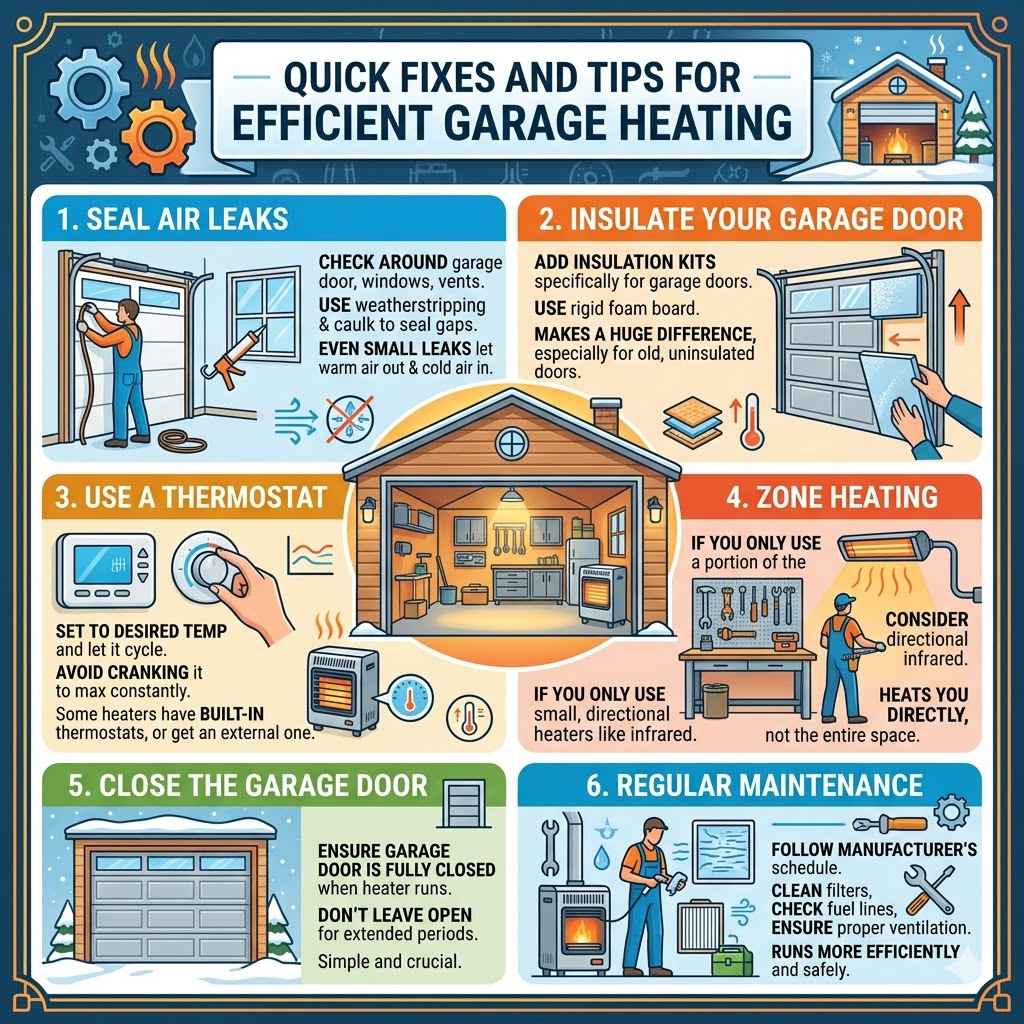
Seal Air Leaks: Check around your garage door, windows, and any vents. Use weatherstripping and caulk to seal up gaps. Even small leaks let a lot of warm air out and cold air in.
This is one of the most cost-effective ways to improve comfort.
Insulate Your Garage Door: If your garage door is old and uninsulated, it’s like a giant window to the cold. You can buy insulation kits specifically for garage doors, or use rigid foam board. This makes a huge difference.
Use a Thermostat: If your heater has a thermostat, use it! Set it to the desired temperature and let it cycle. Avoid just cranking it up to the maximum all the time.
Some propane heaters have built-in thermostats, or you can get an external one.
Zone Heating: If you only use a portion of your garage for projects, consider a smaller, directional heater like an infrared unit that heats you directly, rather than trying to heat the entire space to a high temperature.
Close the Garage Door: This sounds obvious, but make sure it’s actually closed and sealed when the heater is running. Don’t leave it open for extended periods.
Maintain Your Heater: Follow the manufacturer’s maintenance schedule. Clean filters, check fuel lines, and ensure proper ventilation. A well-maintained heater runs more efficiently and safely.
Efficiency Tips for Garage Heating
Seal Leaks: Use weatherstripping and caulk around doors and windows.
Insulate Door: Add insulation kits to your garage door.
Use Thermostat: Set to desired temp; don’t run on high constantly.
Zone Heating: Use directional heaters if you work in one spot.
Keep Door Shut: Ensure garage door is fully closed.
Regular Maintenance: Keep heater clean and checked.
Frequently Asked Questions about Garage Heater Sizing
What is the general rule of thumb for garage heater BTU?
A common rule of thumb is 30-60 BTU per square foot, depending heavily on insulation and climate. For uninsulated garages in cold climates, you might need up to 100 BTU/sq ft. For well-insulated garages in mild climates aiming for just above freezing, you might need as little as 20 BTU/sq ft.
Can I use a standard home furnace for my garage?
Typically, no. Home furnaces are designed for enclosed, well-insulated living spaces with stricter ventilation requirements. Garage heaters are specifically built to handle the environment of a garage, which often has higher heat loss and may require different fuel sources or venting.
How many BTUs does a 20×20 garage need?
A 20×20 garage is 400 sq ft. For a moderately insulated garage in a moderate climate wanting a comfortable temperature, you’d look at 400 sq ft * 50 BTU/sq ft = 20,000 BTU. In a very cold climate or with poor insulation, this could easily double to 40,000 BTU or more.
Is it better to get an oversized or undersized garage heater?
It is generally better to have a slightly oversized heater with a thermostat than an undersized one. An undersized heater will struggle to reach the desired temperature and may run constantly, leading to premature wear. A slightly oversized heater with a thermostat will reach the temperature faster and cycle off, saving energy and reducing strain.
How do I calculate the BTU needed for a garage with a high ceiling?
If your garage has a high ceiling (10 feet or more), you have more air volume to heat. You should add an extra 5-10% to your calculated BTU needs to account for this larger volume of air. Ensure the heater has a good fan to help circulate warm air downwards.
Do I need a vented heater for my garage?
If you are using a fuel-burning heater (like propane or natural gas), you absolutely need proper ventilation to safely exhaust combustion byproducts like carbon monoxide. Electric heaters do not produce these byproducts and typically do not require venting. Always follow manufacturer and local code requirements for ventilation.
Conclusion: Your Warm Garage Awaits
Finding the right size garage heater is about understanding your space and needs. By measuring your garage, assessing insulation, considering your climate, and setting your comfort goals, you can confidently choose a heater that works efficiently. It ensures your garage stays warm without wasting energy.
This knowledge empowers you to make a smart purchase, leading to a more comfortable and functional garage space all year round.