Water Heater Replacement Cost: What You’ll Pay Up Front
A like-for-like water heater replacement usually costs roughly a low-to-mid four-figure amount installed; tankless systems or major electrical/gas upgrades often cost several thousand dollars more, and emergency same-day jobs can add a few hundred dollars. Skip permits, venting, or code fixes and the bill jumps fast, or the new heater fails inspection and gets shut off. I price these jobs by what has to change in the house, not by the tank label. This guide breaks down real installed costs, upgrade pricing, and the hidden work that changes the final bill.
How much does water heater replacement cost?
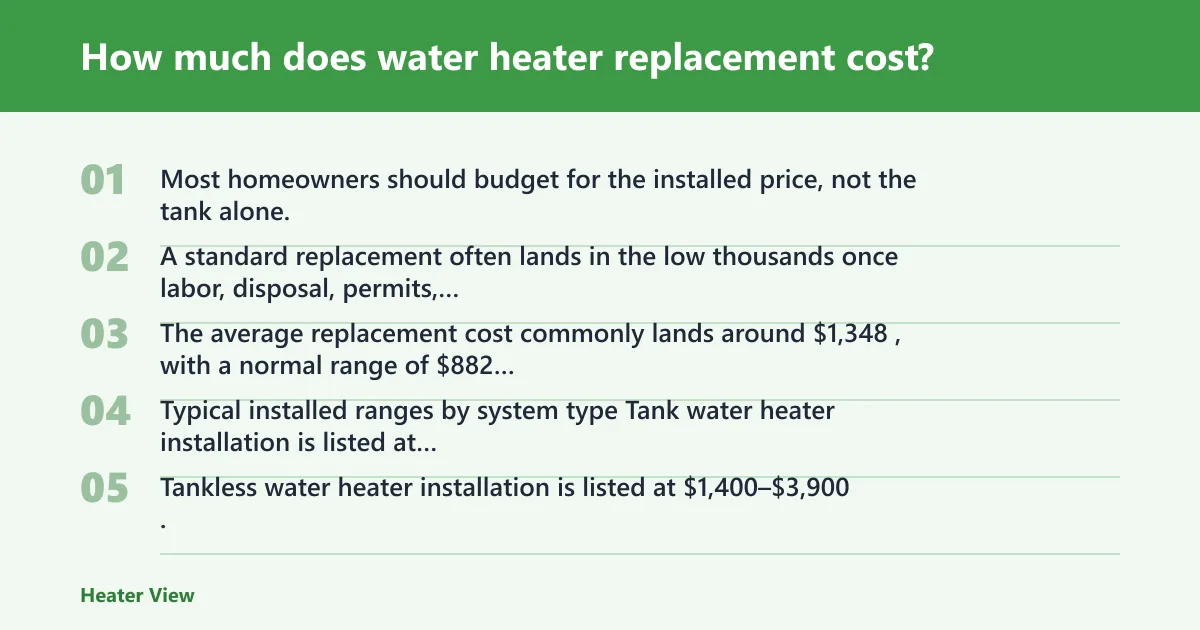
Most homeowners should budget for the installed price, not the tank alone. A standard replacement often lands in the low thousands once labor, disposal, permits, and any code items are included. The average replacement cost commonly lands around $1,348, with a normal range of $882 to $1,826.
Typical installed ranges by system type
Tank water heater installation is listed at $600–$2,500. Tankless water heater installation is listed at $1,400–$3,900. Natural gas water heater installation is listed at $700–$2,700, electric at $600–$3,500, propane at $700–$2,500, and heat pump units usually start higher because the equipment and setup are more complex.
The low unit price can hide the real total. I have seen a bargain tank turn into a larger bill once the plumber adds venting work, electrical changes, or a new drain pan and expansion tank. In some cases, the total can reach $12,000 when unit and labor are included.
Why the final bill often differs from the quote headline
A quote that names only the heater does not describe the job. The final bill changes when the old unit has to be carried out through tight stairs, the shutoff valves are old, the gas line needs work, or the installation must pass a same-day inspection. Labor alone is often a major share of the bill.
Plumbers typically charge $45 to $200 per hour. Electricians typically charge $50 to $100 per hour. Labor alone is often $150 to $450 for a tank-style replacement and $600 to $1,900 for a tankless water heater.
According to How Much Does Water Heater Replacement Cost in 2025? – HomeAdvisor — Tank water heater installation is listed at $600–$2,500.
What affects the total installed price?
The total installed price changes most with tank size, fuel source, access, and whether the new unit fits the old footprint. A straight replacement is usually cheaper than a system change. Moving the tank, changing fuel, or updating old piping adds time and parts.
Tank size and household demand
Larger households usually need larger tanks. Common residential sizes include 30, 40, 50, 75, and 80 gallons. A 36-gallon electric tank heater costs around $400 at A.O. Smith, while a 55-gallon tank heater can cost up to $750 at A.O. Smith. That unit price still does not include labor or code work.
Fuel source and available hookups
Gas, electric, and propane setups are priced differently because the house is already built around one of them. A home with no gas line often stays cheaper with electric. A home switching from electric to gas, or from tank to tankless, may need piping, venting, or panel work before the new heater can operate safely.
Labor, access, and emergency timing
Tight closets, attic installs, crawlspaces, and long carry distances raise labor time. Emergency replacement also costs more because the shopper has less time to compare bids and the installer may have to source parts fast. Same-day work can add $200–$800 to the job.
How much does it cost to replace a tank water heater?
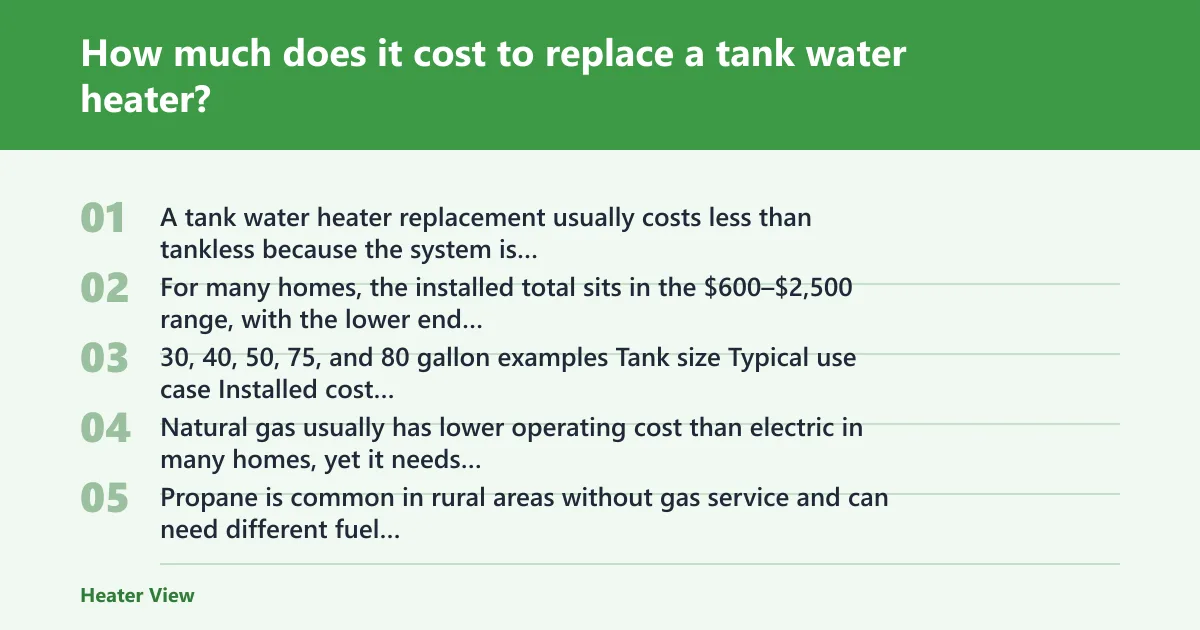
A tank water heater replacement usually costs less than tankless because the system is simpler and the swap is often closer to a like-for-like job. For many homes, the installed total sits in the $600–$2,500 range, with the lower end most common when the size, fuel, and venting stay the same.
30, 40, 50, 75, and 80 gallon examples
| Tank size | Typical use case | Installed cost tendency | Why the price shifts |
|---|---|---|---|
| 30 gallons | Small household, low simultaneous demand | Lower end of the tank range | Less unit cost and easier handling |
| 40 gallons | Small to medium household | Middle of the range | Common size, wide parts availability |
| 50 gallons | Most standard family homes | Middle to upper middle | More capacity, sometimes larger vent or pan needs |
| 75 gallons | Higher demand households | Higher end | Bigger tank, more labor, possible code updates |
| 80 gallons | Large households or high-use homes | Upper end | Heavier unit, more space, sometimes electrical changes |
Electric, natural gas, and propane differences
An electric tank can be easier and cheaper when no gas line exists, but it may require electrical work. Natural gas usually has lower operating cost than electric in many homes, yet it needs gas access and proper venting. Propane is common in rural areas without gas service and can need different fuel infrastructure.
For installed pricing, electric water heater installation is listed at $600–$3,500. Natural gas water heater installation is listed at $700–$2,700. Propane water heater installation is listed at $700–$2,500.
When a like-for-like swap stays cheaper
The cheapest path is usually the same fuel, same location, similar capacity, and no major code corrections. That means the old unit comes out, the new one goes in, and the installer only replaces what is worn out or no longer code-compliant. Once the job stops being a direct swap, the bill moves upward quickly.
How much does tankless water heater installation cost?
Tankless water heater installation usually costs more up front because the unit is pricier and the job often needs more labor, new venting, or electrical and gas changes. A typical installed range is $1,400–$3,900, and the labor portion alone can be far higher than a basic tank swap.
Why tankless jobs cost more up front
Tankless systems heat water on demand, so the equipment and installation requirements are different from tank units. The wall-mounted unit itself is only part of the cost. The real bill often reflects new gas piping, larger venting, condensate handling, or a higher-capacity electrical setup.
Gas, venting, and electrical changes that raise the bill
A tank-to-tankless conversion can trigger vent replacement because many older tank vents do not suit tankless appliances. Gas units may need larger gas lines or a different vent material. Electric tankless systems may need a panel upgrade, new breakers, or heavier wire. Those changes can add several hundred dollars or much more to the project.
When tankless can make sense anyway
Tankless can make sense in a home that wants more continuous hot water, has limited floor space, or is already set up for the fuel and venting the new unit needs. The payoff is not usually in the install bill. It is in the operating pattern and space saved over time.
What hidden work changes the quote?
Hidden work is what turns a simple replacement into a larger project. The most common add-ons are permits, venting, disposal, gas or electrical upgrades, and code-required safety parts. These items often appear only after the old heater is out and the installer can see the full condition of the system.
Permits and inspection fees
A permit can cost between $25 and $300. Many local areas require one for replacement, especially when gas, venting, or electrical work is involved. The permit adds paperwork and may require an inspection before the unit can be used.
Venting, gas line, and electrical upgrades
Venting system changes are common in gas and tankless replacements. Electrical upgrades matter when the panel is full, the wire is undersized, or a new heat pump or electric model draws more power than the old one. Fuel conversions raise cost fast because the house must be modified to support a different energy source.
Expansion tank, code updates, and disposal
Older homes may need an expansion tank, seismic straps, updated pressure relief piping, or a drain pan. These are the quiet line items that keep a replacement passing inspection and reduce risk after installation. Disposal of the old unit also adds to the job, especially when the contractor has to haul from a hard-to-reach location.
What factors make water heater replacement more expensive?
The most expensive replacements are the ones that stop being replacements and turn into system changes. Moving the unit, switching fuel, upgrading a panel, replacing venting, or fixing code issues all raise the bill. Tight access and urgent timing push the total higher too.
The biggest price drivers
- Tankless conversion from a standard tank system
- Switching from electric to gas, or gas to electric
- Relocating the heater to a new room or exterior wall
- New venting, gas piping, or electrical runs
- Older-home code updates such as expansion tanks and seismic straps
- Emergency scheduling and after-hours labor
Do permits, venting, or electrical upgrades change the total cost?
Yes. They can change the total by a little or by a lot, depending on how far the installation strays from the old setup. A permit may be a small added fee, while venting or electrical work can shift the project into a different budget tier entirely. Those items also affect whether the new heater passes inspection.
Where the surprise costs usually appear
Surprise costs usually show up when the installer opens the old system and sees outdated venting, undersized electrical service, missing expansion protection, or damaged shutoffs. A homeowner who budgets only for the tank often gets the biggest shock here. This is the moment to compare the quote line by line.
How much does water heater repair cost?
Water heater repair usually costs less than replacement when the tank is sound and the failure is limited to a part such as a valve, element, thermostat, or gas control. Once repair costs start stacking up, or the tank is leaking, replacement often becomes the better financial move. Small fixes can be worthwhile; tank failure usually is not.
When repair still makes sense
Repair is usually the better choice when the heater is relatively new, the problem is isolated, and the rest of the system is in good shape. If the quote is low and the unit is not rusting out, repair can buy time. If the same unit keeps failing, replacement may cost less over the next few years.
Should I replace my tank with the same type or upgrade to tankless?
Most homeowners should replace like for like unless there is a clear reason to change. A same-type swap keeps the project simpler and usually cheaper. Upgrade when the house needs more hot water, the old equipment is failing badly, or the home is already due for plumbing, gas, venting, or panel work.
Simple decision path for homeowners
- Check whether the tank is leaking, rusted, or past repair value.
- Ask whether the current fuel and location can stay the same.
- Compare the installed quote, not the unit price alone.
- Ask what code items, permits, and disposal are included.
- Choose upgrade only if the added cost fits the long-term plan.
When a repair is still worth paying for
If the tank itself is sound and the failure is a replaceable part, repair can be the cheaper move. That is often true when the heater is younger and the quote is modest. If the repair would only delay a likely replacement by a short time, the money may be better spent on a new unit.
Use this replacement cost worksheet before you hire anyone
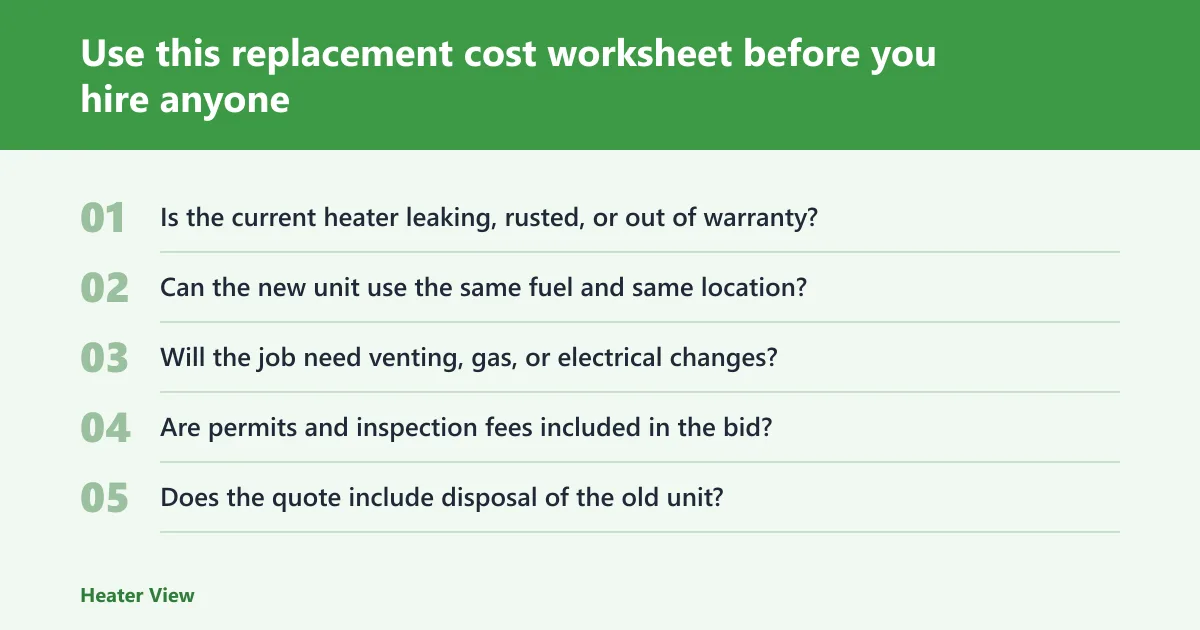
This worksheet keeps the estimate honest. Fill in each line, then compare two or three bids using the same categories. A quote that looks cheaper may be missing venting, permits, disposal, or relocation work.
Homeowner-ready replacement cost worksheet
| Cost item | Your estimate | Included in quote? | Notes |
|---|---|---|---|
| Unit price | $ | Yes / No | Tank, tankless, electric, gas, propane, or heat pump |
| Labor | $ | Yes / No | Plumber, electrician, or both |
| Permit | $ | Yes / No | Local permit and inspection fee |
| Disposal | $ | Yes / No | Haul-away and recycling |
| Venting changes | $ | Yes / No | Pipe, flue, termination, condensate, or chimney work |
| Gas line work | $ | Yes / No | Line sizing, shutoff, fittings, or conversion |
| Electrical work | $ | Yes / No | Breaker, wire, outlet, or panel changes |
| Expansion tank / code items | $ | Yes / No | Seismic straps, pressure relief piping, drain pan |
| Relocation | $ | Yes / No | Moving the unit to a new location |
| Total installed cost | $ | Sum every line item |
Replace-vs-upgrade checklist
- Is the current heater leaking, rusted, or out of warranty?
- Can the new unit use the same fuel and same location?
- Will the job need venting, gas, or electrical changes?
- Are permits and inspection fees included in the bid?
- Does the quote include disposal of the old unit?
- Will code items such as an expansion tank or seismic straps be added?
- Does the repair quote approach a large share of a new install?
Questions to ask on the estimate
Ask whether the estimate is for unit-only or fully installed cost. Ask if venting, permits, disposal, electrical work, and code updates are included. Ask what changes if the old heater is harder to remove than expected. Those answers usually tell you whether the quote is complete or only starting point pricing.
Frequently asked questions
What’s the average cost of replacing a water heater?
The average replacement cost is commonly listed at $1,348, with a normal range of $882 to $1,826. That figure is best treated as a planning number for a standard job. Homes needing venting, electrical, relocation, or emergency service will usually land above it.
How much does it cost to remove and replace a water heater?
Removing and replacing a water heater usually costs more than the unit price alone because labor, disposal, and setup work are part of the job. A tank replacement often falls in the low thousands when the installation is straightforward. Hard access, code corrections, or same-day service can push it higher.
How much does tankless water heater installation cost?
Tankless water heater installation is listed at $1,400–$3,900. The higher upfront cost comes from the equipment and the added work many homes need, such as venting, gas line changes, or electrical upgrades. Labor alone is also higher than for a basic tank swap.
Do permits, venting, or electrical upgrades change the total cost?
Yes. A permit can cost between $25 and $300, and venting or electrical work can add much more depending on the home. These items often decide whether the job stays a basic replacement or becomes a larger project with inspection and code compliance requirements.
Should I replace my tank with the same type or upgrade to tankless?
Replace like for like when the current fuel, size, and location still fit the house. Upgrade to tankless only if the home can support the needed venting, gas, or electrical work and the long-term benefits are worth the larger installed bill. A simple swap is usually cheaper.
How much does water heater repair cost?
Repair usually makes sense when the tank is sound and the problem is limited to a part or control issue. Once the unit leaks, rusts through, or needs repeated service, replacement is often the better financial choice. Compare the repair quote against the installed price of a new heater.