Can You Use An Electric Heater In A Garage? Safe Or Not?
Thinking about adding some warmth to your garage this winter? It’s a common question. Garages can get seriously cold.
They aren’t built like the rest of your house. You might want to work on your car, enjoy a hobby, or just store things without them freezing. An electric heater seems like an easy answer.
But is it really that simple? Is it safe? Will it work well?
We’re going to break down all the details. You’ll learn what you need to know to stay warm and, most importantly, stay safe. We’ll cover the types of heaters, where to put them, and what common mistakes to avoid.
Using an electric heater in a garage is often possible, but safety is key. Ensure the heater is designed for such spaces, properly installed, and kept away from flammable materials. Check local building codes and the heater’s wattage to avoid overloading circuits.
What You Need to Know About Electric Garage Heaters
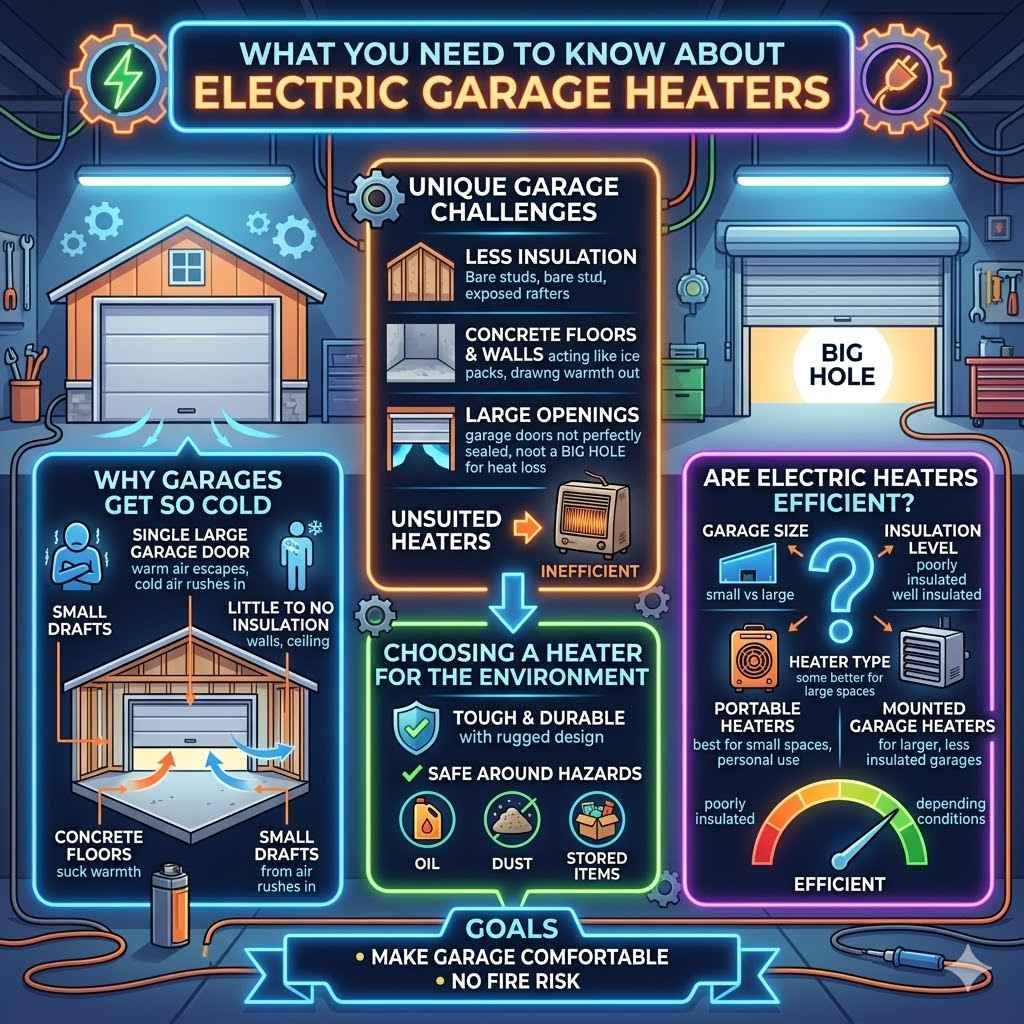
Garages are different from your home’s living areas. They often have less insulation. They might have concrete floors and walls.
There are often more openings, like large garage doors. This means they lose heat much faster. So, just grabbing any old electric heater might not be the best idea.
You need a heater that can handle the unique challenges of a garage. This includes being tough enough for the environment. It also means it needs to be safe enough to use around potential hazards like oil, dust, and stored items.
The goal is to make your garage comfortable without creating a fire risk.
Many people wonder if electric heaters are efficient for garages. The answer depends on a few things. It depends on the size of your garage.
It depends on how well it’s insulated. It also depends on the type of electric heater you choose. Some are better suited for larger, less insulated spaces than others.
Why Garages Get So Cold
Let’s talk about why garages are usually so chilly. Your house has thick walls. It has good windows.
It has a roof designed to keep heat in. Garages often don’t have these features. They might have a single, large garage door that doesn’t seal perfectly.
This is a big hole where warm air escapes and cold air rushes in.
Many garages have little to no insulation. The walls might be bare studs and sheathing. The ceiling might just be exposed rafters.
Even if you have a finished garage with drywall, there might be no insulation behind it. Concrete floors also act like giant ice packs in the winter. They suck warmth right out of the air.
Plus, garages are often used for more than just parking cars. They are workshops, storage areas, and even gyms for some. This means people spend more time in them.
They want them to be usable year-round. This desire leads to the question: what’s the best way to heat them safely?
Even small drafts from a poorly sealed garage door can make a huge difference. Think about how much colder it feels right next to the door. This is because cold air is coming in.
Warm air is going out. This constant exchange of air means your garage is always fighting to stay warm.
My Own Garage Heater Mishap
I remember one particularly brutal winter. My garage is my sanctuary. It’s where I tinker with my old motorcycle.
I’d installed some shelving and a workbench. But on cold days, it was too frigid to spend more than a few minutes out there. I decided I needed heat.
I went to the big box store and bought the cheapest electric space heater I could find. It was small, red, and had a fan.
I plugged it in, set it on a metal shelf, and thought I was good to go. It did blow out warm air, but it took forever to make even a small dent in the garage’s chill. I’d leave it running for hours.
Then, one evening, I was working on a bike part. I bent down to grab a tool, and the heater’s cord snagged on something. It tipped over.
Luckily, it had a tip-over switch and shut off. But it landed near a pile of old rags and some oily cardboard. My heart jumped into my throat.
I realized right then how dangerous my quick, cheap solution really was. That was the moment I understood that not all heaters are created equal, especially for a place like a garage.
I quickly unplugged it and decided to do some serious research. I learned about different types of heaters, what safety features were essential, and how to make sure I wasn’t risking my property or my safety. That old red heater is long gone, replaced by something much more appropriate.
Garage Heater Safety Checklist
Tip-Over Protection: Does it shut off if knocked over? This is vital.
Overheating Protection: Does it have a sensor to stop it if it gets too hot?
Enclosure: Is the heating element protected so it won’t easily touch flammable items?
Cord Quality: Is the power cord heavy-duty and in good condition? Avoid damaged cords.
Placement: Do you have enough clearance around it for airflow and to keep it from nearby items?
Types of Electric Heaters for Garages
Not all electric heaters are designed for every situation. For a garage, you have a few main options. Each has its own pros and cons.
1. Ceramic Heaters (Fan-Forced)
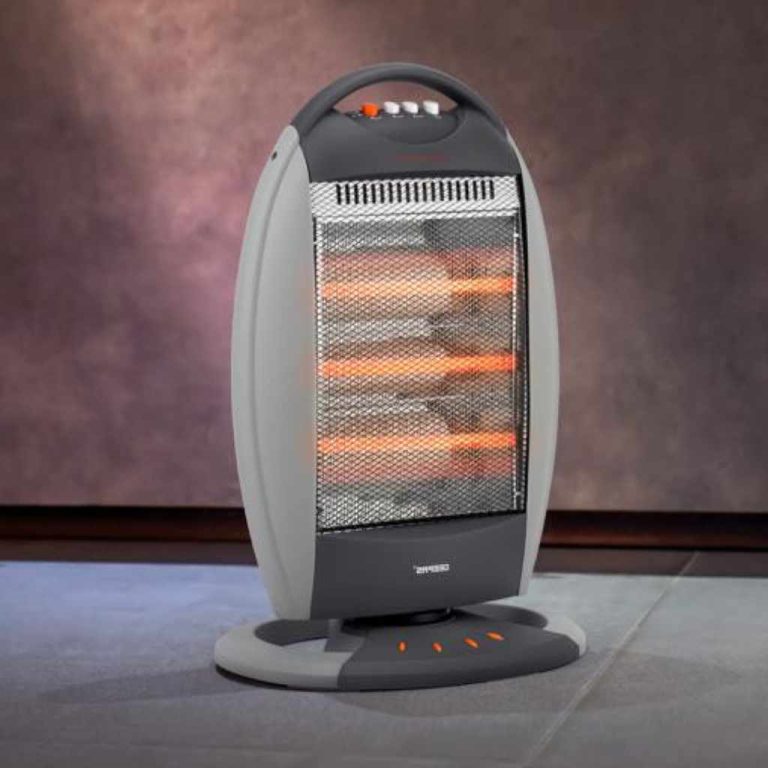
These are very common. They use a ceramic heating element. A fan blows air over it and out into the room.
They heat up quickly. They are usually portable and relatively inexpensive.
Pros: Fast heat, portable, often have safety features like tip-over switches. They don’t produce an open flame.
Cons: Can be noisy due to the fan. The fan can also blow dust around. They might not be powerful enough for very large or uninsulated garages.
The surface can get hot, posing a burn risk.
2. Infrared Heaters
Infrared heaters work differently. They don’t heat the air directly. Instead, they emit radiant heat.
This heat warms objects and people in their path. Think of how the sun feels warm even on a cool day.
Pros: Heat is directed, so you feel warm where you are. They don’t blow air, so they don’t circulate dust. They can be very quiet.
Many are designed for wall mounting.
Cons: They only heat what they “see.” If you move out of the direct path, you get cold. They can take longer to warm up a whole space if there are many objects to heat. The upfront cost can be higher.
3. Oil-Filled Radiators
These look like old-fashioned radiators. They have internal fins filled with oil. Electricity heats the oil.
The oil then radiates heat into the room. They heat up slowly but provide a more even, steady warmth.
Pros: Very quiet. Provide a gentle, consistent heat. The surface stays warm but not usually dangerously hot.
They don’t dry out the air as much.
Cons: Slow to heat a space. They are bulky and not very portable. They can be less effective in very large or drafty spaces where heat escapes quickly.
4. Garage-Specific Wall-Mounted Heaters
Some manufacturers make electric heaters specifically for garages and workshops. These are often more robust. They might offer higher wattage.
They are designed to be mounted securely out of the way.
Pros: High power output. Designed for tough environments. Safer placement away from the floor.
Often more durable construction.
Cons: Require installation. Usually more expensive than portable heaters. Less flexible if you need to move the heat around.
When choosing, think about how you use your garage. Do you need quick spot heating for short periods? A ceramic heater might work.
Do you spend hours working in one spot? An infrared heater could be better. If you want gentle, all-over warmth and have time to let it build, an oil-filled radiator is an option.
Quick-Scan Table: Heater Types for Garages
| Heater Type | Best For | Key Safety Note |
|---|---|---|
| Ceramic (Fan) | Quick heat, smaller spaces, temporary use | Ensure tip-over protection; keep away from clutter. |
| Infrared (Radiant) | Targeted warmth, quiet operation, workshops | Keep clear path for heat; wall mount is safer. |
| Oil-Filled Radiator | Steady, quiet heat, larger areas, longer periods | Slow to heat; needs space to radiate effectively. |
| Garage-Specific | High power needs, larger garages, permanent setup | Requires professional installation; check circuit capacity. |
Choosing the Right Wattage and Power
Wattage is a big deal when it comes to electric heaters. It tells you how much power the heater uses. It also tells you how much heat it can produce.
For a garage, you generally need more power than you might think.
A good rule of thumb is about 10 watts per square foot. This is for a moderately insulated space. For a poorly insulated garage, you might need 15 watts per square foot.
So, a 200 sq ft garage might need a 2000-watt heater (200 sq ft 10 watts/sq ft). A larger, draftier 300 sq ft garage might need 4500 watts (300 sq ft 15 watts/sq ft).
However, you also need to consider your electrical system. Most standard household outlets are 120-volt. These circuits can usually handle up to about 1500 watts safely.
A 1500-watt heater draws about 12.5 amps (1500 watts / 120 volts = 12.5 amps). If your circuit breaker is 15 amps, you’re pushing its limit.
If you need more heat, you’ll likely need a heater that runs on 240 volts. These are often the higher wattage garage-specific heaters. They require a dedicated circuit and a special outlet.
This type of installation often needs an electrician. Trying to run a high-wattage heater on an overloaded circuit is a major fire hazard. It can also damage your wiring and appliances.
Always check the heater’s power requirements. Compare it to your electrical panel’s capacity. If you’re unsure, consult an electrician.
It’s better to be safe than sorry. The last thing you want is to start a fire trying to get warm.
Think about the plug type too. A standard plug is usually okay for smaller heaters. But higher wattage heaters might have larger, different shaped plugs.
Make sure your outlets can accept the plug. And never use an extension cord unless it’s specifically rated for the heater’s amperage. Most portable heaters are not meant to be used with extension cords at all.
Wattage vs. Square Footage Guide (Estimates)
Small Garage (e.g., 10′ x 12′ = 120 sq ft):
- Well-Insulated: 1200 – 1500 watts
- Poorly Insulated: 1800 – 2400 watts (may require 240V)
Medium Garage (e.g., 20′ x 20′ = 400 sq ft):
- Well-Insulated: 4000 watts (likely 240V)
- Poorly Insulated: 6000+ watts (definitely 240V, professional install needed)
Note: These are general guidelines. Draftiness, ceiling height, and desired temperature play a big role.
Where to Place Your Garage Heater Safely
Placement is critical for both safety and effectiveness. You don’t want to put a heater where it can be easily knocked over. You also don’t want it near anything that could catch fire.
Keep it off the floor: For most portable heaters, placing them on a sturdy table or workbench is a good idea. This gets them up and away from potential spills or things being dragged across the floor. If using a wall-mounted heater, ensure it’s installed according to the manufacturer’s instructions.
These are often placed high on a wall.
Clearances are key: Always follow the manufacturer’s recommended clearances. This usually means at least 3 feet of clear space around the heater. This space should be free of anything flammable.
That includes cardboard boxes, gasoline cans, paint, wood scraps, and even piles of dust or cobwebs. Garages are notorious for collecting such items.
Avoid direct contact: Never let the heater’s body or cord touch anything flammable. The surfaces of heaters can get quite hot. Even if the element itself is shielded, the outer casing can be a hazard.
Away from doors and windows: Don’t place heaters directly in front of garage doors or windows. These areas are often the coldest and draftiest. While it seems logical to put heat there, it’s usually inefficient.
The heat will escape quickly, and the heater will run constantly. It also puts the heater in a high-traffic area.
Consider ventilation: While electric heaters don’t produce carbon monoxide like gas heaters, they still need air to work. Don’t block the air intake or output vents. This can cause the heater to overheat, which is dangerous.
It also makes it less effective.
Secure portable heaters: If you have a tip-over switch, ensure the heater is on a stable surface. If it’s not, a slight bump could send it tumbling. Some people even use a small piece of velcro or a strap to secure portable heaters on shelves, just in case.
Never cover it: Don’t put clothes, blankets, or anything else over the heater to try and make the room warmer. This is a major fire risk. It blocks airflow and can cause the heater to overheat.
Placement Rules for Garage Heaters
Keep 3 Feet Clear: Ensure a minimum 3-foot radius around the heater is free of flammable materials (wood, paper, fabric, liquids).
Elevate When Possible: Place portable heaters on stable, elevated surfaces like workbenches or shelves to avoid floor-level hazards.
Away from Traffic: Position heaters so they are not in the path of frequent movement to prevent accidental bumps.
Stable Surface: Always use a level, stable surface to prevent tipping. Check for tip-over protection features.
No Obstructions: Never block air intakes or outlets. This ensures proper function and prevents overheating.
Real-World Garage Heating Scenarios
Let’s look at a few different garage situations and what might be the best approach for heating them.
Scenario 1: The Weekend Hobbyist
Meet Sarah. She uses her garage mainly on Saturdays and Sundays for woodworking. The rest of the week, it’s just for parking her car.
She’s in Northern California, so winters aren’t brutal but can get chilly. She doesn’t want the whole garage to be 70 degrees, just comfortable enough to work without freezing.
What works for Sarah: A good quality, portable infrared heater. She can aim it directly at her workbench area. It heats her up quickly when she’s in that zone.
She keeps it on a sturdy bench, well away from sawdust and wood scraps. When she’s done, she unplugs it and stores it. She also made sure to check that her garage outlet is on a circuit that can handle it.
She doesn’t use it continuously; she turns it on when she’s actively working.
Scenario 2: The Home Gym Enthusiast
Mark has converted his two-car garage into a home gym. He’s in Michigan, so winters are serious. He needs consistent warmth to avoid muscle injury and make his workouts bearable.
The garage is reasonably insulated, but he still feels the cold seeping in.
What works for Mark: A 5000-watt 240-volt garage-specific electric heater mounted high on the wall. This requires a dedicated circuit installed by an electrician. It provides a constant background heat.
He keeps the temperature at a comfortable 60-65 degrees. He’s careful to keep his workout equipment, towels, and mats at a safe distance from the heater. He also has a backup portable ceramic heater for extra boost on the coldest days, using it only for short periods.
Scenario 3: The Car Mechanic (DIY)
David works on his classic cars in his garage in Colorado. He spends long hours under the hood, often in the evenings. His garage is detached and not insulated at all.
He needs reliable heat and has a lot of tools and car parts lying around.
What works for David: David chose a powerful, heavy-duty oil-filled radiator. He places it on a heavy-duty rolling cart. This allows him to move it closer to where he’s working, but he ensures it’s always on a stable, level surface.
He’s meticulous about keeping the area around the cart clear. He runs it for extended periods. The gentle, even heat is good for long working sessions.
He also makes sure his electrical cords are industrial-grade and not frayed. He knows his garage’s wiring capacity and ensures the heater doesn’t overload it.
These scenarios show that the “best” heater depends on your specific needs, garage setup, and climate. But in all cases, safety and proper usage are paramount.
Contrast Matrix: Common Garage Heating Mistakes
Myth: Any electric heater will do. Reality: Garages have unique needs; choose one designed for durability and safety in such spaces.
Myth: Bigger is always better. Reality: Overly powerful heaters can overload your electrical system. Match wattage to garage size and electrical capacity.
Myth: It’s okay to place a heater near stored items. Reality: Flammable materials must be kept at a safe distance (usually 3 feet) to prevent fires.
Myth: Extension cords are fine for all heaters. Reality: Most electric heaters should not be used with extension cords, especially high-wattage ones.
What This Means for Your Garage Space
So, what’s the takeaway from all this? Using an electric heater in your garage can absolutely make it a more usable space. But it’s not a simple plug-and-play situation.
You need to be thoughtful about your choice and how you use it.
When it’s normal: It’s perfectly normal to want to heat your garage. Many people do it for hobbies, car maintenance, or just extra living space. Using a properly rated, safe electric heater in a well-ventilated garage is a common and acceptable practice.
When to worry: You should worry if you’re using a heater not designed for garages. You should worry if you’re running it on an undersized or overloaded circuit. You should worry if you’re placing it too close to flammable materials.
Signs of trouble include a heater that smells burnt, makes strange noises, or trips your circuit breaker frequently. If you notice any damage to the cord or plug, stop using it immediately.
Simple checks: Before you even buy a heater, check your garage’s electrical panel. What’s the amperage of the circuits serving the garage? Are they 15-amp or 20-amp 120-volt?
Is there a 240-volt outlet available? This will tell you what kind of heaters you can safely consider.
Also, inspect your garage for flammable items. Are there old paint cans? Gasoline cans?
Piles of oily rags? Flammable liquids? You need to either move these items far away from where the heater will be or choose a heater that can be safely placed far from them (like a wall-mounted unit).
The overall goal is to add comfort without adding risk. Electric heaters are a good option for garages because they don’t produce combustion byproducts like fuel-burning heaters do. But they still require respect for their power and potential hazards.
Your Garage Heating Action Plan
Step 1: Assess Your Garage. Note its size, insulation level, and common items stored there.
Step 2: Check Your Electrical. Determine your available circuits (voltage and amperage).
Step 3: Choose the Right Heater. Select a type and wattage suitable for your needs and electrical system.
Step 4: Plan Placement. Decide where the heater will go, ensuring safe clearances.
Step 5: Install and Use Safely. Follow all manufacturer instructions and safety guidelines.
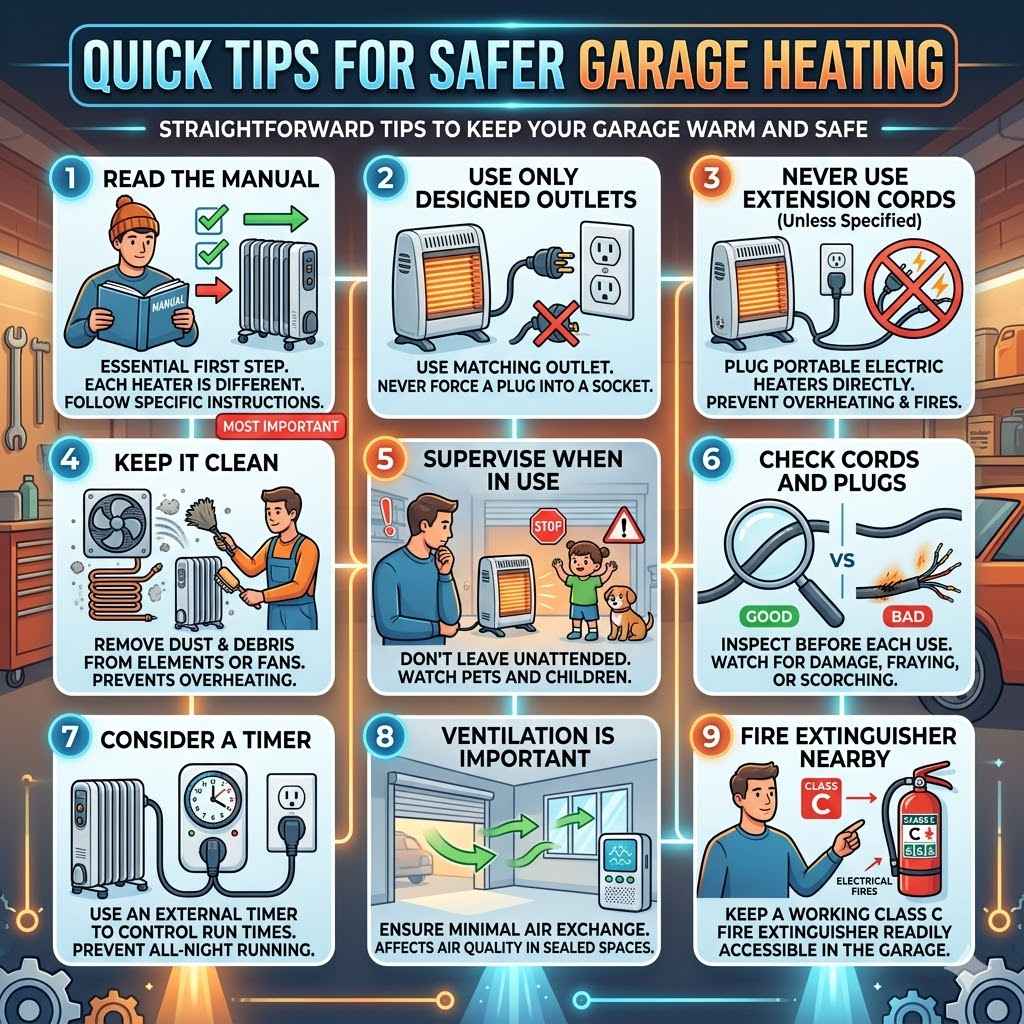
Quick Tips for Safer Garage Heating
Here are some straightforward tips to make sure your garage stays warm and safe.
- Read the Manual: This sounds basic, but it’s the most important step. Every heater is different. The manual has specific safety instructions.
- Use Only Outlets Designed for the Heater: If your heater has a special plug, use the matching outlet. Never force a plug into a socket.
- Never Use Extension Cords (Unless Specified): Most portable electric heaters, especially higher wattage ones, should be plugged directly into a wall outlet. Extension cords can overheat and cause fires.
- Keep it Clean: Dust and debris can build up on heater elements or fans. Clean your heater regularly as per the manufacturer’s instructions. This prevents overheating and potential fires.
- Supervise When in Use: Don’t leave a portable heater running unattended for long periods, especially if you have pets or children who might interact with it.
- Check Cords and Plugs: Before each use, inspect the power cord and plug for any signs of damage, fraying, or scorching. If you see any, do not use the heater.
- Consider a Timer: For some heaters, using an external timer can help control run times. This adds a layer of safety, ensuring it doesn’t run all night if you forget to turn it off.
- Ventilation is Still Important: Even electric heaters can affect air quality if they are constantly running in a very sealed space. Ensure there’s some minimal air exchange.
- Fire Extinguisher Nearby: It’s always a good idea to have a working fire extinguisher rated for electrical fires (Class C) readily accessible in your garage.
Essential Safety Gear
Fire Extinguisher: A multi-purpose extinguisher (ABC or BC) is recommended for garages.
Smoke Detector: Ensure you have a working smoke detector installed in or near your garage.
Carbon Monoxide Detector: While electric heaters don’t produce CO, other things in a garage might. It’s a good general safety item.
Frequently Asked Questions About Garage Heaters
Can I use a regular indoor space heater in my garage?
It’s not ideal. Indoor space heaters are not typically built to withstand the harsher conditions of a garage (dust, moisture, potential spills). They may also lack the necessary safety features for a garage environment.
Always opt for a heater designed for garage or workshop use if possible, or one with robust safety features like tip-over and overheat protection.
Will an electric heater dry out my garage too much?
Some electric heaters, especially fan-forced ones, can reduce humidity. Oil-filled radiators tend to be less drying. If humidity is a concern, consider a humidifier or use a heater that doesn’t rely on blowing air, or ensure some minimal ventilation.
Is it safe to leave an electric heater in the garage overnight?
It depends on the heater and your setup. A heater designed for continuous operation, with all safety features functioning correctly, and placed away from flammables, might be okay. However, many experts recommend turning them off when not in direct use or when you’re not present, especially older or less robust models.
Always follow manufacturer guidelines.
How much does it cost to run an electric garage heater?
The cost depends on the heater’s wattage and how long you run it, plus your local electricity rates. A 1500-watt heater running for 8 hours at $0.15 per kWh would cost about $1.80 ($1.5 kW 8 hours $0.15/kWh). Higher wattage heaters or running them constantly will cost more.
They are generally more expensive to run than gas heaters but offer a safer option for many.
What is the safest type of electric heater for a garage?
Heaters with multiple safety features are safest. Look for automatic tip-over shutoff, overheat protection, and a durable, enclosed design that minimizes direct contact with heating elements. Wall-mounted units are often safer because they are out of the way.
Infrared heaters are also considered safe as they don’t use fans to blow air and typically have protected elements.
Can I plug an electric garage heater into an outdoor outlet?
Only if the outlet is specifically designed and rated for use with outdoor appliances and the heater itself is rated for outdoor use. Most garage heaters are intended for indoor use within the garage space. Using an indoor-rated heater outdoors or in a damp environment can be dangerous and void warranties.
How do I know if my garage circuit can handle a heater?
Check your electrical panel. Look for the breaker labeled for your garage. Note its amperage (e.g., 15A or 20A).
Then check the heater’s wattage. Divide the wattage by your circuit’s voltage (usually 120V) to get the amperage the heater draws. For example, a 1500W heater on a 120V circuit draws 12.5A.
Ensure this draw is less than 80% of the circuit breaker’s rating for continuous use. If you’re unsure, consult a qualified electrician.
Conclusion
Warming up your garage with an electric heater is definitely achievable. It can turn a chilly, unused space into a comfortable area for your projects and hobbies. The key is to approach it with safety as your top priority.
Understand the differences in heater types. Know your garage’s electrical capacity. And always give your chosen heater plenty of space and respect.
By making informed choices and following simple safety rules, you can enjoy a warmer garage all season long. Don’t let the cold keep you out of your favorite space any longer!