How Much Clearance Does a Garage Heater Need From Storage?
Keep storage at least the heater’s listed clearance away. If the manual is missing, use the heater’s label and do not place shelves, cabinets, totes, or hanging items within about 3 feet of the front or about 18 inches of the sides and top until verified. Too little space can overheat materials, block airflow, and turn a normal garage layout into a fire hazard. This guide shows how to measure those clearances around stored items before you buy, move, or mount a garage heater.
How clearance changes by heater type

Clearance changes with the heater type, the mounting method, and the exact model. Electric, infrared, gas, and forced-air heaters all need space around them, but the danger zone is shaped differently for each one. Use the installation manual as the controlling source, then check local code before you pick a location.
Electric heaters
Electric garage heaters still need open space around the cabinet, intake, discharge, and wiring path. Even when a model mounts high on a wall or ceiling, nearby storage can block heat flow or trap warm air against combustible items. A heater that looks “out of the way” can still fail the moment a shelf end or hanging bin enters its required zone.
Infrared heaters
Infrared garage heaters send heat in a directional path, so clearance depends on mounting angle and aim, not just the box around the unit. That makes nearby storage a bigger problem on one side of the heater than the other. If the unit is mislocated, it can overheat vehicles, shelving, or stacked totes directly in its radiant path.
Aura Shadow heaters specify 6 feet of clearance for combustible furniture, paper, clothing, curtains, and similar items. They also specify 18 inches of clearance from an end or adjacent wall, 8 inches from the ceiling when wall-mounted, and 4 inches from the ceiling when ceiling-mounted. Aura Shadow wall-mounted heaters need a floor-to-bottom height of 6 feet 7 inches in the United States.
Gas heaters
Gas garage heaters add venting and carbon monoxide concerns on top of clearance requirements. They still need space around the unit, and they also need a safe exhaust path plus proper combustion air. That makes gas models less forgiving when storage crowding limits vent routing or nearby ceiling space.
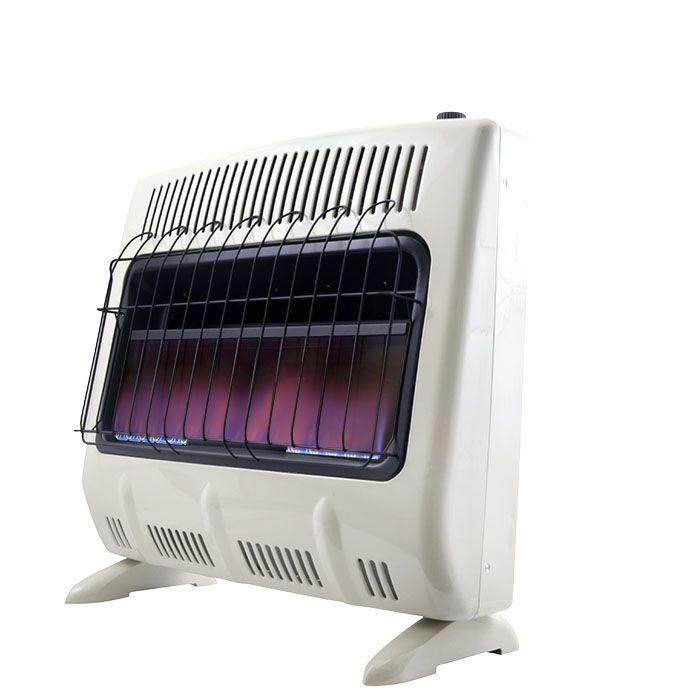
The Mr. Heater Big Maxx is a natural gas heater intended for heating a medium-sized space and is commonly reported to come with an LP conversion kit. Those figures do not replace the installation manual or local code.
Forced-air heaters
Forced-air garage heaters can warm a space quickly, and some ceiling-mounted versions fit low-clearance garages better than bulkier models. Even so, they still need clear floor-to-unit spacing where the manual calls for it, plus open intake and discharge paths. Storage that sits near the unit may not touch the heater, yet still interfere with airflow.
They come in six sizes from 30,000 to 125,000 BTUs and can heat up to 1,200 square feet. That makes them useful in many garages, but storage still has to stay outside the listed clearance envelope.
📊 The Mr. Heater Big Maxx is designed to heat a 1,250- to 1,667-square-foot space. Source: Familyhandyman.
What stored items count as clearance risks
Combustible items are the biggest risk, but noncombustible storage can still block airflow, shade the heater, or interfere with mounting access. Treat every shelf, cabinet, tote, and hanging item as part of the clearance plan, not as background clutter. The issue is not only what burns. It is also what sits in the wrong place.
Combustible storage
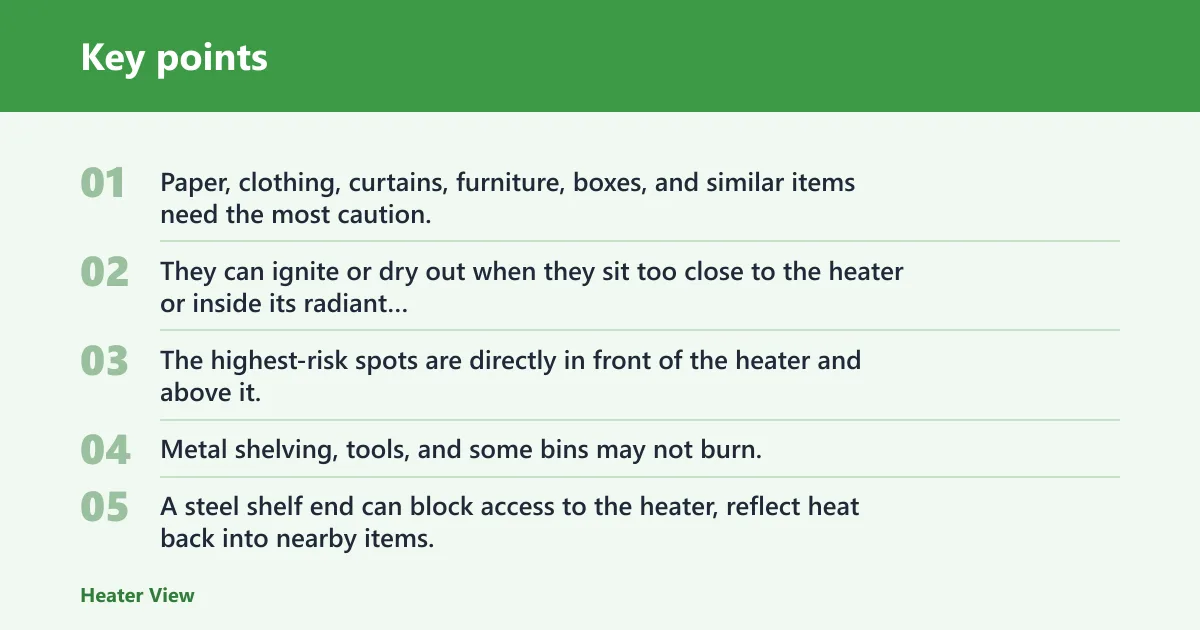
Paper, clothing, curtains, furniture, boxes, and similar items need the most caution. They can ignite or dry out when they sit too close to the heater or inside its radiant path. The highest-risk spots are directly in front of the heater and above it, where heat can collect and rise into stored materials.
Noncombustible storage
Metal shelving, tools, and some bins may not burn, but they can still create a hazard if they narrow the open space around the unit. A steel shelf end can block access to the heater, reflect heat back into nearby items, or force the heater into a tighter corner than its manual allows. Noncombustible does not mean irrelevant.
Hanging items and overhead storage
Overhead storage is especially risky because it can sit inside the heater’s warmest zone without looking close from the floor. Hanging bicycles, extension cords, rafters with stored lumber, and suspended bins can all intrude into the ceiling clearance area. If the heater is wall- or ceiling-mounted, check the full vertical path, not only the unit itself.
Say your garage has a ceiling-mounted gas heater over the service door, and a row of plastic totes hangs from ceiling racks nearby. The totes may seem far enough away from the wall, but they can still sit inside the heater’s required overhead space. Move the storage, do not guess at the gap.
Measure from the unit, not from the wall, and measure in every direction the manual calls out. You need front, side, rear, ceiling, and floor clearance, plus any special spacing for venting or angle. A heater can pass a wall check and still fail once you account for shelf ends, open doors, or parked vehicles.
Step-by-step measurement method
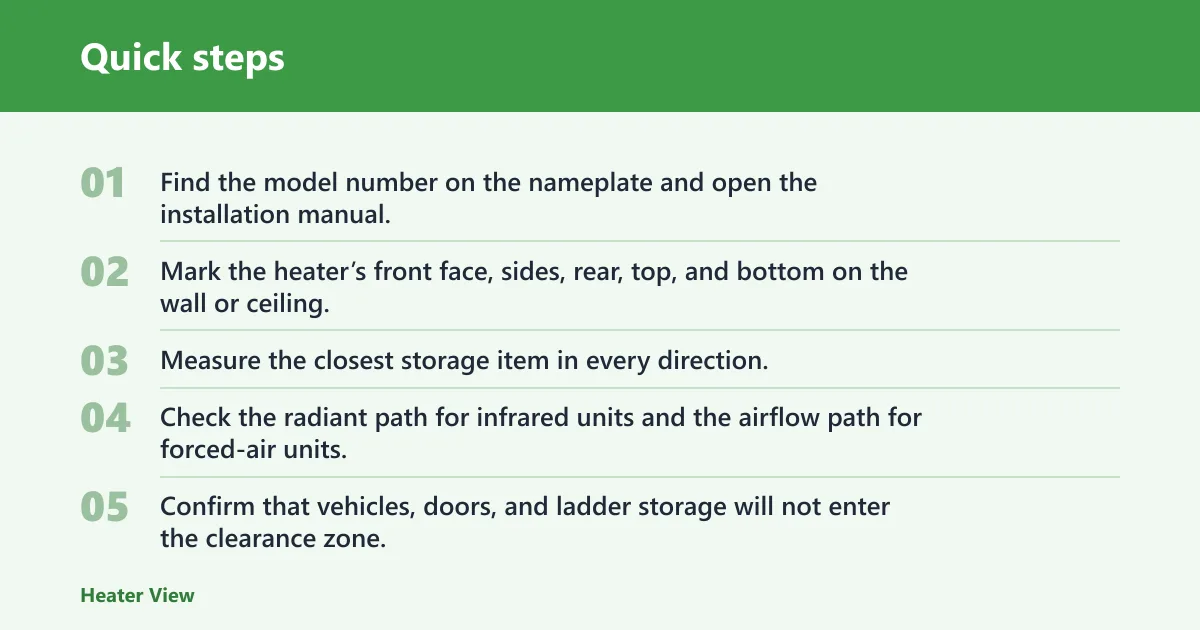
- Find the model number on the nameplate and open the installation manual.
- Mark the heater’s front face, sides, rear, top, and bottom on the wall or ceiling.
- Measure the closest storage item in every direction, including shelf ends and hanging bins.
- Check the radiant path for infrared units and the airflow path for forced-air units.
- Confirm that vehicles, doors, and ladder storage will not enter the clearance zone.
- Compare your measurements with the manual and local code before mounting or moving anything.
What to measure around the unit
Front clearance matters because heat discharge leaves the unit there. Side and rear clearances matter because heat can wrap around the cabinet and because the housing may need room for service access. Ceiling and floor clearances matter for mounting height, air movement, and safe installation. If the heater uses venting, measure that route too.
A common first-timer mistake is to measure the wall-to-shelf distance and stop there. That can miss the shelf overhang, the bin lip, or the hanging hook that actually enters the clearance zone. Measure from the nearest point of the storage item, not its mounting rail.
Account for layout changes
Garage layouts change. A parked SUV, a tall ladder, or a new cabinet can turn a safe installation into a blocked one. Leave room for the full swing of the garage door, any door tracks, and the highest point of stored items when bins are stacked. If the location only works when the bay is empty, it is not a practical location.
Garage heater clearance checklist
This checklist turns the clearance question into a pass or fail decision. Use the model’s listed distances first, then verify that your shelves, cabinets, totes, lumber, clothing, and hanging storage stay outside those zones. If any item crosses a required distance, the layout fails until you move the heater or the storage.
| Heater type | Minimum clearance zones | Storage item type | Common layout result | Pass/fail |
|---|---|---|---|---|
| Forced-air ceiling unit | Front: per manual; sides: per manual; ceiling: per manual; floor: keep discharge clear | Boxes under the discharge path | Warm air blocked by stacked boxes | Fail |
| Forced-air wall unit | Front: per manual; sides: per manual; ceiling: per manual; floor: keep unit above stored items | Lumber stacked against the wall | Board ends crowd the intake side | Fail |
| Infrared wall-mounted unit | Front: model-specific radiant path; sides: 18 inches for Aura Shadow; ceiling: 8 inches for Aura Shadow; floor: 6 feet 7 inches minimum to bottom | Clothing rack or hanging bins | Suspended items intrude into radiant zone | Fail |
| Infrared ceiling-mounted unit | Front: directional path; sides: model-specific; ceiling: 4 inches for Aura Shadow; floor: model-specific mounting height | Metal shelving near the beam path | Shelf top reflects heat toward storage | Fail |
| Gas unit | Front, sides, rear, vent path, ceiling, floor: per manual and code | Plastic totes near vent or exhaust route | Heat and venting space restricted | Fail |
Use this same table for a quick pass/fail check on common garage materials. Boxes, lumber, paint, clothing, plastics, and metal shelving do not all behave the same way, but they all need a location that stays outside the heater’s required clearance zone. Paint and plastic deserve extra caution because heat can deform containers before anything visibly burns.
Can you store items above a garage heater?
Stored items above a garage heater are the highest-risk placement because heat rises, radiant heat can concentrate overhead, and many heater models need a protected ceiling zone. If the manual gives an overhead distance, that distance applies to shelves, bins, hooks, cords, and anything else hanging above the unit. Do not assume the ceiling itself is enough protection.
Why overhead storage is the highest-risk zone
Overhead storage can sit inside both the heater’s direct heat path and its warm air plume. That matters most for cardboard, fabric, plastic, and coated finishes. Even when the item is not touching the heater, the closer it hangs, the more likely it is to deform, dry out, or block the unit’s intended airflow.
When shelving ends become a problem
The end of a shelf run is often the part that creeps into the clearance zone first. A shelf may seem safe in the middle of the bay, but the overhang, bracket, or corner post can sit too close to the heater. Measure the nearest shelf edge, not the centerline of the rack.
When to move storage instead of the heater
Move the storage first if the heater location is fixed, such as near a service bay or vent route. Move the heater only when the manual and code allow a different location and the new spot still provides safe mounting, venting, and electrical access. A safe layout is one where the heater stays open and the storage stays out of the way.
Do gas heaters need extra planning?
Gas heaters need extra planning because clearance is only one part of the installation. Venting, combustion air, and carbon monoxide control all affect where the unit can go. If storage blocks the vent path or crowds the service area, the location may fail even if the heater itself appears to fit.
Venting and combustion air
Gas units need a clear exhaust path and enough room for combustion air. That means you should not tuck boxes, shelving, or hanging storage near the vent components or around the intake area. If the route changes through a remodel or new shelf layout, the heater may need to be relocated.
Carbon monoxide and installation limits
Gas garage heaters produce carbon monoxide as a byproduct, so clearance planning is not only about heat. Poor placement can trap exhaust, reduce air movement, or create a layout that tempts someone to store items too close to the unit. Follow the manual exactly and do not treat a gas heater like a simple electric appliance.
Why professional installation is often required
Professional installation is often required for gas or hardwired heaters because code, venting, and electrical work can all apply at once. Local building code and electrical code may override generic advice on mounting height, connection methods, or clearances. The label can tell you what the heater wants; the code tells you what the garage is allowed to have.
What to check before you buy or remount
Check the manual and nameplate first, then measure the space, then compare the result with local code. That order matters because a heater that fits the garage size may still fail the clearance layout once shelves, cabinets, or overhead storage are included. If the manual is missing, stop and verify the exact model before you mount anything.
Manual and nameplate details
The nameplate gives the model identification needed to find those values. Do not rely on a general product page if the actual unit in the garage has a different mounting requirement or a different venting setup.
Ceiling height and mounting location
Ceiling height can determine whether the heater clears the floor-to-unit minimum and whether storage below it remains safe. Wall-mounted infrared units may need a specific angle, while ceiling-mounted units may allow a different position but still need open space above or around them. Measure from the proposed mount point, not from the floor plan alone.
Local code and electrical requirements
Local building code and electrical code can change the answer, especially for mounting height, wiring method, and venting. That is why a garage heater should never be chosen only by BTU rating or garage square footage. Capacity matters, but so does the exact installation space around the heater and the storage that sits nearby.
Frequently asked questions
How much clearance does a garage heater need from storage?
There is no universal distance that fits every garage heater. The correct clearance comes from the model’s installation manual and nameplate, then local code. If the manual is missing, keep shelves, cabinets, totes, and hanging items out of the front, side, and overhead zones until you verify the exact requirement.
How far should stored boxes be from a garage heater?
Boxes should stay outside the heater’s listed clearance zone, including the front and any overhead path. Cardboard can dry out and ignite more easily than metal shelving can, so boxes deserve extra caution. If a stack could slide, tip, or expand into the heat path, it is too close.
What clearance does a garage heater need from walls and ceiling?
That depends on the heater type and the exact model. Some infrared units call for specific wall and ceiling spacing, while gas and forced-air models often have different side, rear, and ceiling requirements. Use the manual’s listed distances, not a generic garage rule, because mounting height can change the answer.
How close can shelving be to a garage heater?
Metal shelving may not burn, but it still needs to stay outside the listed clearance zone. Shelf ends, brackets, and overhangs can block heat, intake, or service access. Measure the nearest physical edge of the shelving, then compare that point with the heater’s required front, side, rear, and overhead clearance.
Do gas garage heaters need more clearance than electric heaters?
Often they need different planning rather than simply “more” clearance. Gas heaters add venting, combustion air, and carbon monoxide concerns, so the safe layout depends on both spacing and exhaust path. Electric heaters may be simpler, but they still need the model’s listed clearances and unobstructed airflow.