Garage Heater Troubleshooting Before Calling a Pro
Check power, airflow, placement, and controls before you call a technician. If a heater trips breakers, smells burnt, leaks fuel, or shuts off again after one reset, stop using it and inspect for a possible fault. Ignoring those signs can lead to wasted service calls or turn a small failure into a fire, shock, or carbon monoxide risk. This guide walks you through symptom-by-symptom troubleshooting for electric, infrared, fan-forced, and fuel-fired garage heaters.
Garage heater checklist table
| Symptom | Likely cause | Safe homeowner checks | Tools needed | Stop-now red flags |
|---|---|---|---|---|
| No heat | No power, wrong thermostat setting, tripped limit, or failed control | Check the breaker, wall switch, thermostat, and any reset button; confirm the unit is set to Heat and the setpoint is above room temperature | Flashlight, non-contact voltage tester, owner’s manual | Scorch marks, melted plug, repeated tripping, smoke, or a fuel smell |
| Weak heat | Undersized heater, poor placement, blocked airflow, or drafty garage | Clear intake and discharge openings; compare heater output to garage size, insulation, ceiling height, and temperature rise | Tape measure, manual, thermometer | Overheating, arcing, or a damaged cord |
| Breaker trips | Overload, short circuit, bad receptacle contact, or wiring fault | Unplug other loads on the same circuit; inspect plug, outlet, and cord for heat or discoloration | Flashlight, non-contact voltage tester | Burn marks, buzzing, repeated trips after reset |
| Shutdowns | Overheat limit, dirty fan, cold draft, low supply voltage, or cycling thermostat | Check airflow, louver position, and reset instructions; note whether shutdowns follow a short run time or a cold draft | Flashlight, manual | Smoke, fuel odor, visible damage, or a reset that will not hold |
| Burning smell | Dust burn-off on first use, overheated wiring, or failed motor parts | Run the unit only if the smell is light, brief, and fading; inspect for dust buildup on guards and fins | Flashlight, vacuum with brush attachment | Pungent smell, smoke, sizzling, or melted insulation |
| Noisy fan | Loose mounting, debris in fan path, worn motor, or bent blade | Turn power off and check for loose screws, obstructions, or rubbing parts | Screwdriver, flashlight | Grinding, sparking, vibration that worsens fast |
| Uneven heating | Placement issue, poor circulation, cold drafts, or heater type mismatch | Check wall, ceiling, and corner placement; compare spot heating versus whole-garage heating needs | Tape measure, thermometer | Fuel smell, soot, or hot spots near combustibles |
What to check first
Confirm the heater type, power source, and control settings first. A 120V unit plugs into most household outlets, while many larger garage heaters need 220-240 volt wiring. Electric heaters move heat with a fan, while radiant heaters warm people and objects directly; gas, diesel, and kerosene units add combustion checks.
What you’ll need
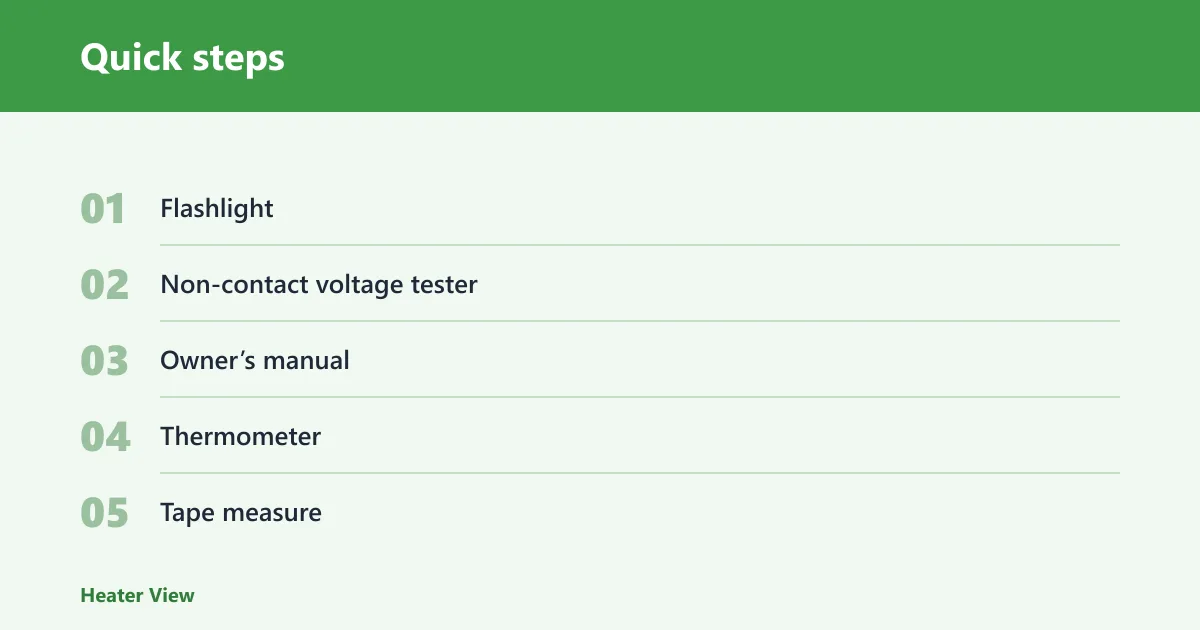
- Flashlight
- Non-contact voltage tester
- Owner’s manual
- Thermometer
- Tape measure
- Screwdriver
- Vacuum with brush attachment
Step 1: Confirm the power source
- Check the nameplate for 120V or 240V, then match it to the circuit label.
- Verify the breaker is on and the disconnect is closed, if present.
- Test the outlet or switch for heat, looseness, or discoloration.
Step 2: Check airflow and control settings
- Set the thermostat above the current garage temperature.
- Clear intake grills, discharge openings, louvers, and fan guards.
- Review the manual for any manual-reset limit or lockout code.
Step 3: Match the heater to the space
- Measure the garage and note whether it is insulated or drafty.
- Check ceiling height; garages are generally at least 8 feet high, and higher ceilings need more heat.
- Compare the heater output to the expected temperature rise, which is the difference between desired indoor and outdoor temperatures.
Why is my garage heater not blowing hot air?
No hot air usually means the heater has lost power, the control is not calling for heat, or airflow is blocked. If the unit runs but stays cold, check the thermostat, fan switch, and safety limit before assuming the heating element or burner has failed. Size and placement matter too.
If that didn’t work, try this next
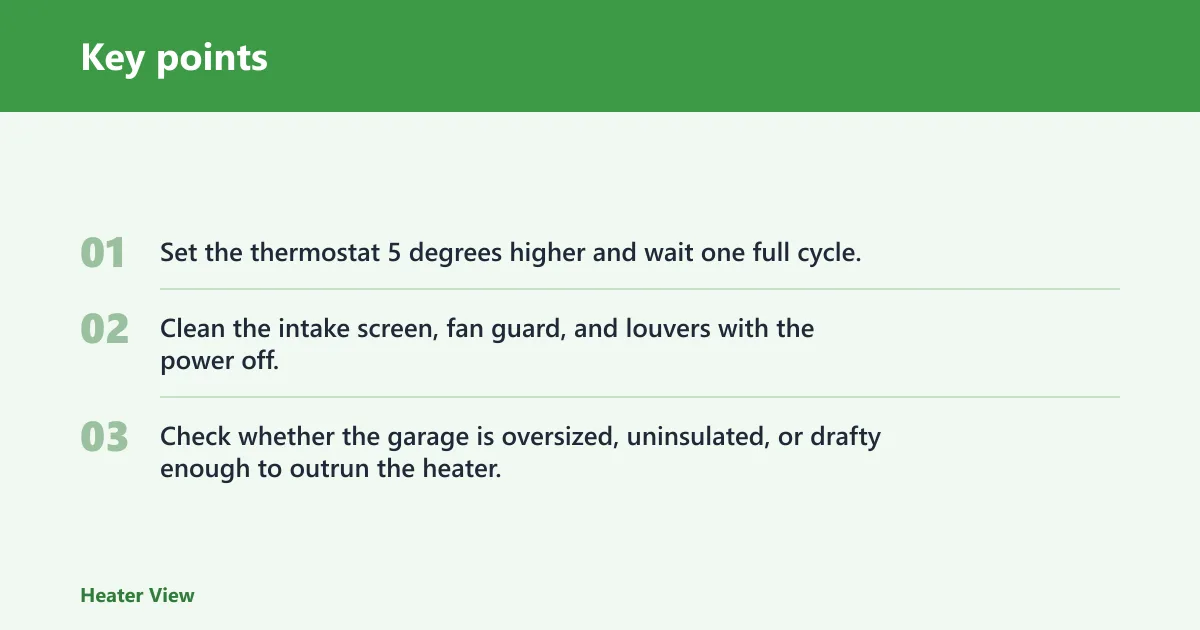
- Set the thermostat 5 degrees higher and wait one full cycle.
- Clean the intake screen, fan guard, and louvers with the power off.
- Check whether the garage is oversized, uninsulated, or drafty enough to outrun the heater.
Say your 1,500W fan-forced unit runs in a non-insulated garage with an open side door. It may blow air that feels only mildly warm because cold air is replacing it faster than the heater can raise the room temperature.
Why does my garage heater keep shutting off?
Repeated shutoffs usually point to overheating, thermostat cycling, or a supply problem. Cold drafts, blocked airflow, and undersized heaters can make the limit switch trip sooner than expected. If the unit shuts off after one reset, treat that as a warning, not a nuisance.
If that didn’t work: check for blocked fans, dirty
- Check for blocked fans, dirty filters, and furniture too close to the unit.
- Close doors or vents that create direct drafts across the heater.
- Look for low-voltage symptoms such as slow fan speed or dim controls on a 240V unit.
What should you check before calling a pro?
Before booking service, verify the heater’s voltage, circuit, and reset behavior, then note the exact symptom. A technician can work faster if you can say whether the issue is no heat, weak heat, tripping, shutdowns, odor, or uneven coverage. Writing down the pattern often saves a repeat visit.
If that didn’t work: match the heater
- Match the heater to a dedicated circuit, especially for a 240V model.
- Inspect the cord, plug, receptacle, or hardwired disconnect for heat damage.
- Write down any fault code, reset step, or time-to-failure from the manual.
Picture a wall-mounted 240V heater that runs for ten minutes, then shuts off every time the garage door opens. That pattern points toward airflow disruption or temperature drop, not automatically a failed heater.
How should you troubleshoot a 240V garage heater safely?
A 240V heater needs careful checks because wiring, breaker size, and the disconnect should all match before deeper troubleshooting. Confirm the circuit is dedicated and clearly labeled, then check both breaker poles and any switch or disconnect without opening live equipment. Stop at any sign of damage.
If that didn’t work: turn the breaker off
- Turn the breaker off, then inspect the receptacle or disconnect for scorch marks.
- Look for loose plugs, damaged conductors, or a cord that feels warm after short use.
- Restore power only if nothing appears damaged and the manual allows homeowner checks.
Common mistakes
Do not treat a tripping breaker as proof the heater is bad. Poor receptacle contact can create heat, arcing, and voltage drop before the breaker trips. Do not ignore insulation, ceiling height, and temperature rise either; a heater can run normally and still be too small for the space.
- Using a 120V heater on a space that needs 240V service.
- Blocking fan inlets or radiant clearances with stored items.
- Resetting a limit switch over and over without finding the cause.
- Ignoring soot, gas odor, or fuel odor on combustion heaters.
- Trying to repair gas valves, burners, or internal wiring without training.
Frequently asked questions
What should I check before calling a garage heater repair tech?
Record the symptom, the heater type, and the circuit voltage. Check the cord, plug, receptacle, breaker, reset button, and any warning code in the manual. If the heater is 240V, tell the technician whether it is hardwired or on a dedicated outlet.
Is my garage heater breaker tripping because the heater is bad?
Not always. A bad breaker is possible, but so are loose receptacles, damaged cords, short circuits, and heaters that pull more current than the circuit can safely carry. If the breaker trips again after one reset and the plug or outlet feels hot, stop using the heater.
Why does my garage heater smell burning the first time I use it?
A light dust smell during the first run can be normal, especially after storage. Shut the unit off and inspect for lint, dust, or debris if the odor is strong, persistent, or comes with smoke. Fuel smell, soot, or sizzling is not a normal first-use condition.
How do I troubleshoot a 240V garage heater safely?
Check the circuit label, breaker, and disconnect first, then inspect for scorch marks or a loose fit at the receptacle. Do not open live electrical parts. If the heater trips repeatedly or the cord, plug, or junction box shows heat damage, call a licensed electrician or heater technician.
When is a garage heater problem unsafe to keep using?
Stop using it if you see smoke, smell fuel, hear arcing, find a damaged cord, or get repeated breaker trips after a reset. Soot on a gas, diesel, or kerosene unit is also a red flag. Those conditions can point to combustion, wiring, or ventilation faults.
What size garage heater do I need for a workshop?
Start with the space, not the label on the heater. Small workshop heaters are often around 1,500 watts, while larger garage heaters are typically around 4,000 to 5,000 watts. Higher ceilings and poor insulation push the required output up because the heater must condition more cubic space.
Should I choose a fan-forced or infrared garage heater?
Choose fan-forced heat if you want warmer air across the room. Choose infrared if you want direct heat in a work zone, especially around a bench or vehicle bay. Infrared units often come wall- or ceiling-mounted, and a 1500W model may offer 900W, 1200W, and 1500W settings.
Do I need a 120V or 240V garage heater?
Use 120V for lighter-duty, plug-in setups and 240V for larger garages or colder climates. Many larger garage heaters require 220-240 volt wiring and a dedicated circuit. If you are unsure about the wiring, stop at the panel and have the circuit verified before buying or running the heater.