How to Compare Garage Heater Brands Before You Buy
Compare garage heater options by checking four things before price: installation burden, operating cost, safety requirements, and whether the model fits your garage size and use pattern. Skip one, and you can end up with a heater that costs more to run, needs upgrades you did not plan for, or is unsafe in your space. This guide shows how to judge brands on those four points so you can cut the list fast.
Brand matters because garage heaters are not interchangeable. A model line built for a medium or large garage can miss the mark in a low-ceiling two-car bay, and a wall-mounted unit that saves floor space can still be a poor fit if you do not have safe venting or enough clearance around it.
Garage heater brands: what matters most
The biggest mistakes are usually simple. Buyers pick by fuel type alone, then find the heater is underpowered, costly to install, or awkward to service.
What to compare first
- Heat source: propane, natural gas, or electricity.
- Heating style: fan-forced, infrared, or radiant.
- Mounting style: wall-mounted, ceiling-mounted, or free-standing.
- Garage fit: small, medium, or large space, plus ceiling height.
- Safety requirements: venting, shutoff controls, and enclosure limits.
- Ownership cost: install work, fuel cost, and maintenance.
Say your detached two-car garage has an insulated ceiling and you mainly need enough warmth for short evening tune-ups. A compact electric unit may be the better fit than a gas model that needs venting and more installation work. A different garage, with higher ceilings and all-day use, can swing the choice the other way.
Brand comparison matrix
This matrix compares common garage heater brand lines by the details shoppers miss most: heat source, mounting style, garage size fit, venting need, installation difficulty, and likely operating cost. The point is not to name one universal winner. It is to show where each brand line fits best and where it creates avoidable problems.
| Brand / model line | Heat source | Mounting style | Garage size fit | Ventilation need | Installation difficulty | Likely operating cost | Best for | Avoid if |
|---|---|---|---|---|---|---|---|---|
| Modine Hot Dawg | Natural gas | Wall-mounted or ceiling-mounted | Medium or large garages | Required | Higher, because of gas and vent work | Often lower than electric for frequent use, depending on local rates | Detached or attached garages that need strong whole-space heat | You want a simple plug-in install or do not want venting work |
| Electric ceiling heater lines | Electricity | Wall-mounted or ceiling-mounted | Small to medium garages | None for combustion fumes | Moderate, depending on circuit capacity | Often higher per hour than gas, but simple to meter and control | Garages used for short projects, storage, or occasional DIY work | You need high output for a large or poorly insulated garage |
| Propane garage heater lines | Propane | Free-standing or portable formats are common | Small to medium garages, with strict attention to code and manufacturer instructions | Needed when the heater is a fuel-burning model intended for enclosed use | Low to moderate for the heater itself, higher if code or ventilation upgrades apply | Can be costly if propane prices are high or if the unit runs often | Job sites, temporary heat, or spaces where portability matters more than permanence | You want a permanent, low-maintenance setup in a tightly enclosed garage |
That matrix leaves out one tempting shortcut: do not assume a portable fuel-burning heater is suitable for a garage. Many unvented fuel-burning heaters are often restricted or prohibited in enclosed garages by manufacturer instructions or local code. Check that before you compare anything else.
Size the heater to the garage dimensions, ceiling height, insulation level, and how often you use the space. Small garages need less power, and large garages need more. For gas units, the capacity metric is usually BTUs; for electric units, it is wattage.
Start with the room, not the brand. A heater that is too small runs constantly and still leaves cold spots. A heater that is too large can cycle too fast, waste energy, and make the garage uncomfortable near the unit while leaving far corners cold.
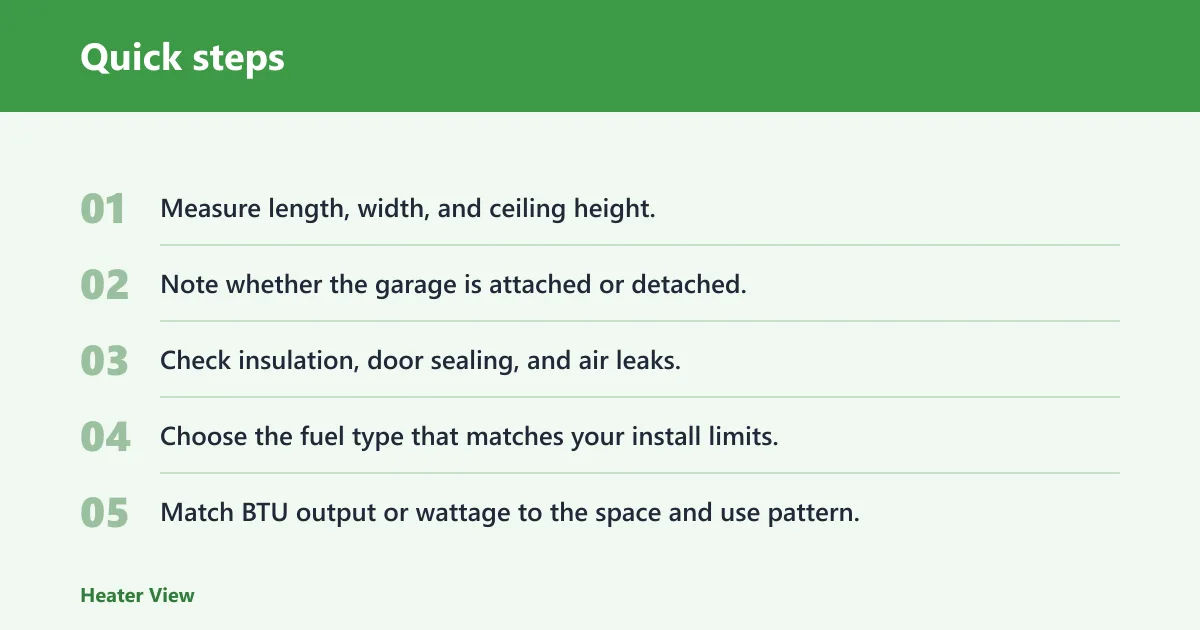
A simple sizing workflow
- Measure length, width, and ceiling height.
- Note whether the garage is attached or detached.
- Check insulation, door sealing, and air leaks.
- Choose the fuel type that matches your install limits.
- Match BTU output or wattage to the space and use pattern.
For a rough planning estimate, compare output to the volume of the garage, then adjust for insulation and ceiling height. A 2-car garage with a standard ceiling can often be treated as a medium space, while a tall, detached workshop pushes you toward a larger output class.
A roughly 400-square-foot garage with a tall ceiling can need more heater output than a similar floor plan with a standard ceiling, because the heater has more air to warm and more heat can sit above the work zone.
How to compare BTUs and wattage
BTU rating tells you how much heat a gas heater can deliver. Wattage tells you the electrical load and output capacity of an electric heater. When you compare brands, do not stop at the label. Check whether the output fits your garage size and ceiling height, and whether the heater style spreads heat across the room or only around the unit.
For electric heaters, wattage is often the easier comparison because electric garage heaters work well in small to medium spaces. For gas units, look for a model line that matches the garage size and the way you use the room, especially if you want quick warm-up in a bigger bay.
Which power source fits your garage?
Choose the power source based on output needs, installation limits, and how often you plan to run the heater. The main choices are propane, natural gas, and electricity. Gas-powered garage heaters can heat a room very quickly, while electric garage heaters work well in small to medium spaces.
Natural gas usually makes the most sense when you already have a gas line and want frequent heating. Electricity can be simpler for a smaller garage or a space where installation work needs to stay light. Propane adds portability, but it also adds fuel handling and bottle upkeep.
Are gas garage heaters cheaper to run than electric?
Often, yes, but not always. Gas can cost less per unit of heat delivered, especially for frequent use, while electric may be simpler to install and control in a small or medium garage. The real answer depends on your local utility rates, heater efficiency, and how many hours you run it.
A simple operating-cost check is this: hourly cost = fuel price per unit × heater input per hour. For electricity, use your cost per kilowatt-hour and the heater’s kilowatt draw. For gas, use your gas rate and the heater’s input rating. For propane, convert bottle cost to cost per hour based on the heater’s fuel use. The formula matters more than the brand name.
What if you want quick heat?
Propane and natural gas units are usually the faster warm-up choice for a cold garage, especially when the space is larger or less insulated. Electric heaters can still be a good fit, but they are usually chosen for smaller spaces or for installations where simplicity matters more than raw output.
Is an infrared garage heater better than a fan-forced heater?
Infrared or radiant heaters are better when you want heat to localize around people and objects in a specific area. Fan-forced heaters are better when you want warmer air spread through more of the garage. The right choice depends on ceiling height, layout, and whether you heat the whole room or only a work zone.
How each style behaves
- Infrared or radiant: localizes heating and can feel effective quickly in the occupied zone.
- Fan-forced: moves warmed air through the space, which helps when you want broader coverage.
- Hybrid thinking: a garage with high ceilings often needs more attention to how heat is distributed, not just how much output the label shows.
If the garage has a tall ceiling, radiant heat can be attractive because it reduces the feeling that all the warmth is stuck overhead. If the garage is a daily workshop with multiple work areas, fan-forced heat can give more even coverage across the floor plan.
Picture a detached garage with a 10-foot ceiling and one workbench against the wall. A localized infrared setup can make the bench area more usable without needing to heat every corner. Picture a wider bay with a vehicle, tools, and two work zones; fan-forced heat is usually the safer comparison point.
Mounting and installation tradeoffs
Wall-mounted heaters save space, and some garage heaters can be installed on the wall or ceiling. Free-standing units avoid permanent mounting, but they take up floor space and can be less convenient in a busy garage. The right mount depends on clearance, airflow, and how much work you want to do during installation.
Wall-mounted versus ceiling-mounted
Wall-mounted units are easier to keep out of the way when floor space matters. Ceiling-mounted units can be even better for saving wall space, but they require a good plan for clearance, airflow, and service access. Either way, the mounting location should match the heater’s output and the height of the garage.
Free-standing options
Free-standing heaters are the simplest to move, but they are also the easiest to place badly. They can block storage, sit too close to combustibles, or become an obstacle in a tight garage. That tradeoff matters more in small garages than in larger workshop spaces.
Installation cost can rise fast when the heater needs gas piping, a vent path, or a new electrical circuit. A heater that looks inexpensive on the shelf can become the costly option once the install is fully counted.
Safety, venting, and maintenance differences
Safety starts with the fuel type. Gas-powered heaters can be dangerous in enclosed spaces, and natural gas heaters need a venting system to eliminate fumes. Electric heaters avoid combustion fumes, which is one reason they are common in small to medium garages.
What safety features should you look for?
Look for automatic shutoff controls, overheat protection, and, for portable units, tip-over protection. Those features do not solve every problem, but they reduce the chance of a simple mistake turning into a hazard. Also check whether the brand lists the installation requirements clearly, especially for gas models.
Safety is not just about the heater body. It also includes where the unit sits, whether the garage has the right venting, and whether the installation follows the manufacturer’s instructions. If the heater is meant to be vented, treat that as part of the product decision, not an optional extra.
Maintenance and long-term reliability
Electric heaters usually need less fuel handling and less day-to-day upkeep. Gas heaters add more maintenance points: venting checks, fuel connections, and, for propane, bottle upkeep. The more often you run the heater, the more those service details matter.
When you compare brands, ask about replacement parts access, service network coverage, warranty length, and return policy. Those items are part of ownership cost. A heater that is cheap on paper can become annoying if parts are hard to find or service support is thin.
Choose Modine Hot Dawg if… / Choose electric garage heater lines if…
Choose Modine Hot Dawg if you want a gas heater line that is suitable for a medium or large-sized garage, you have room for venting work, and you want a wall- or ceiling-mounted unit that can handle frequent use. Choose electric garage heater lines if your garage is small to medium, you want a simpler install, and you value lower installation burden over maximum output.
Choose modine hot dawg if…
- Your garage is medium or large.
- You already have, or can add, proper venting.
- You want a mounted heater that stays out of the way.
- You need stronger whole-space heating for regular use.
Choose electric garage heater lines if…
- Your garage is small to medium.
- You want to avoid combustion venting.
- You prefer simpler installation and easier fuel management.
- You use the garage for occasional DIY work or shorter sessions.
Suppose you are comparing a medium garage with a basic workshop layout against a larger detached bay with colder winters. The electric option may fit the first space with less installation burden, while the gas option may fit the second space better because it can handle larger heating demand and more frequent use.
Frequently asked questions
What should I compare when choosing a garage heater brand?
Compare installation burden, operating cost, safety requirements, and garage fit first. Then compare mounting style, venting needs, warranty support, parts access, and return policy. Those details tell you whether a heater is convenient to own, not just whether it looks powerful on the box.
Which garage heater brand is best for a medium garage?
A medium garage often points toward a mounted gas unit like the Modine Hot Dawg if you want stronger output and can handle venting. Electric lines can also fit a medium garage well when the goal is simpler installation and moderate heat rather than the fastest warm-up.
What size garage heater do I need for my space?
Match the heater to the garage dimensions, ceiling height, insulation, and intended use. Small garages usually need less output, while large or tall garages need more. Use BTUs for gas heaters and wattage for electric heaters, then check whether the brand line is meant for that space.
Should I choose wall-mounted, ceiling-mounted, or portable?
Choose wall-mounted or ceiling-mounted if you want to save floor space and keep the heater out of the way. Choose portable only if mobility matters more than permanence, and make sure the unit is permitted for garage use. In enclosed garages, never assume a portable fuel-burning model is acceptable.
What safety features should I look for in a garage heater?
Look for automatic shutoff, overheat protection, and tip-over protection on portable units. For gas models, confirm venting requirements and installation instructions before buying. Safety also depends on the garage layout, the ceiling height, and whether the heater is rated for that environment.
How do I compare garage heater BTUs and wattage?
BTUs measure gas heater capacity, and wattage measures electric heater load and output. Use BTUs to compare gas model lines against garage size and ceiling height. Use wattage to compare electric lines, especially for small to medium garages where a simpler electrical setup may be enough.