Best Infrared Heater for a Cold Office Cubicle
A practical infrared heater for a cold office cubicle is a low-wattage model with a thermostat, tip-over shutoff, and overheat protection, ideally about 1500 watts max, used only with about 3 feet of clearance and a dedicated outlet. Bad picks can trip breakers, overheat paper and fabric partitions, or violate office policy and get removed. This guide compares cubicle-friendly infrared heaters by safety features, outlet load, clearance needs, and daily office use.
Why a compact infrared panel works best
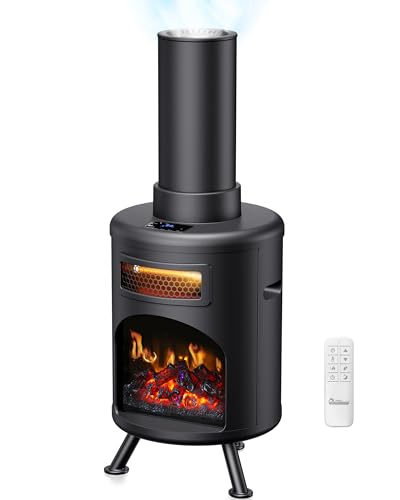


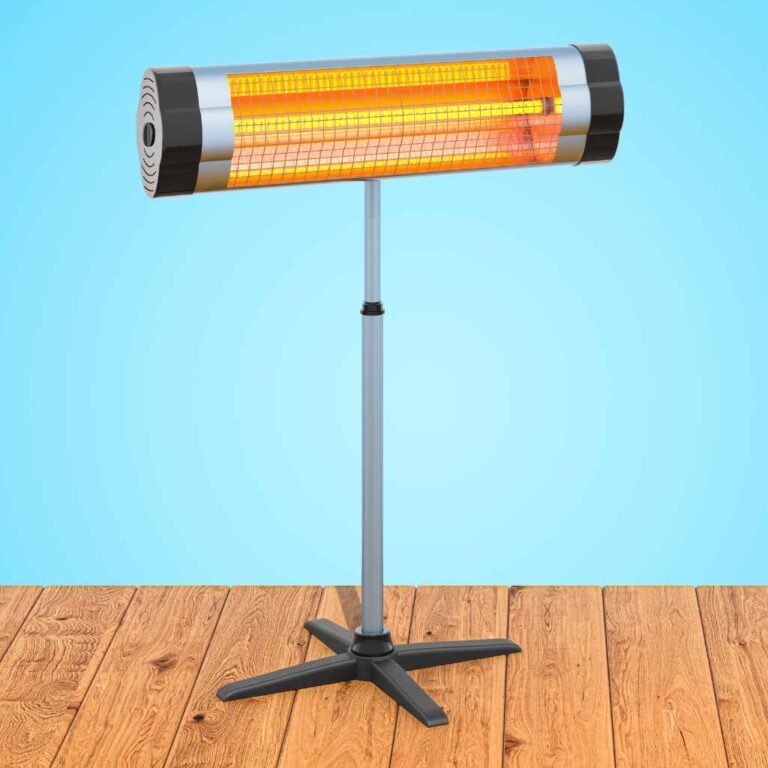
The best choice for most cubicles is a compact, fanless infrared panel with a thermostat, 750W to 1500W output, tip-over shutoff, and overheat protection. It works best when your chair, legs, and torso sit in the heater’s line of sight, and it stays quiet enough for shared-office use.
Why this fit is strongest
Infrared heat sends energy directly to nearby surfaces and people instead of warming a large air volume first. That matters in a cubicle, where partitions, desk clutter, and open walkways can make a small fan heater feel noisy and uneven. A panel also takes less floor space than a tower.
Use the heater as a personal warmth source, not as a whole-office solution. If the cubicle is drafty, radiant heat still helps, but only where the heater can “see” you. If a paper stack, curtain, or fabric divider blocks that line of sight, comfort drops fast.
Quick picks by office layout
Pick by the cubicle you actually sit in, not by a room-size label on the box. Shared offices, under-desk setups, and drafty corners need different shapes, wattage, and placement rules.
- Under-desk use: compact panel, 750W, fanless, with a cool-touch front and wall-mount or upright stand option.
- Shared-office use: low-profile panel, 750W to 1500W, thermostat, tip-over protection, and quiet operation with no fan whine.
- Drafty cubicle: portable infrared panel or small tower, 1500W max, with a thermostat and a wide, stable base.
Say your cubicle has a low desk shelf and your knees fit under it only with about 24 inches of clearance. A slim panel mounted beside the desk can warm your seated zone without crowding foot space, while a tower on the floor may block the path and collect paper dust.
Suppose your office has a shared power strip under the desk and a carpeted floor with file boxes nearby. A 1500W heater may be the wrong fit if the outlet is already loaded; a 750W unit with a thermostat is easier on the circuit and easier to place safely.
Cubicle heater comparison table
| Heater type | Common wattage | Noise level | Footprint | Safety features to demand | Estimated 8-hour cost* | Under-desk suitability | Minimum stated clearance | Cord length | Surface-heat risk | Oscillation | Best-use scenario |
|---|---|---|---|---|---|---|---|---|---|---|---|
| Infrared panel | 350W to 1500W | Fanless, near-silent | Thin, wall-adjacent or upright | Thermostat, tip-over shutoff, overheat protection | 750W: $0.96; 1500W: $1.92 | Sometimes, only if the manual allows it and workplace policy permits under-desk use | About 3 feet in front and away from paper, fabric, and walls | Varies by model; longer cords help reach a wall outlet without extension cords | Low to moderate, because the front can still get hot | No | Fixed desk, shared office, aisle-facing cubicle |
| Compact portable radiant heater | 750W to 1500W | Quiet if fanless; some click as they cycle | Small floor footprint | Thermostat, tip-over shutoff, overheat protection | 750W: $0.96; 1500W: $1.92 | Only in limited cases; usually better beside the desk than under it | About 3 feet from paper, fabric, and partition walls | Varies by model; check whether the plug reaches a dedicated wall outlet | Moderate to high on exposed surfaces | No | Drafty corner, tight floor area, shared office |
| Tower-style infrared heater | 1000W to 1500W | Usually quiet, but some models use a fan or oscillation motor | Taller footprint, more floor clearance needed | Tip-over shutoff, overheat protection, stable base | 1000W: $1.28; 1500W: $1.92 | Generally poor; the tall body can crowd knees and traffic paths | About 3 feet from surrounding items, plus extra aisle clearance | Varies by model; avoid dependence on power strips or extension cords | Moderate to high, especially on the front grille area | Sometimes | Aisle-facing cubicle, wider seating zone, fixed desk with open floor space |
*Cost example uses $0.16 per kWh from U.S. electricity-price data; actual rates vary by utility, time of use, and location. Formula: watts ÷ 1000 × hours × rate.
Which infrared heater type fits your cubicle?
Panel heaters fit fixed desks best. Compact portables suit tighter floorspaces. Tower-style units can help if you need warmth at standing height or across an adjacent desk zone, but the taller shape is less forgiving in cramped aisles.
Panel heaters for fixed desks
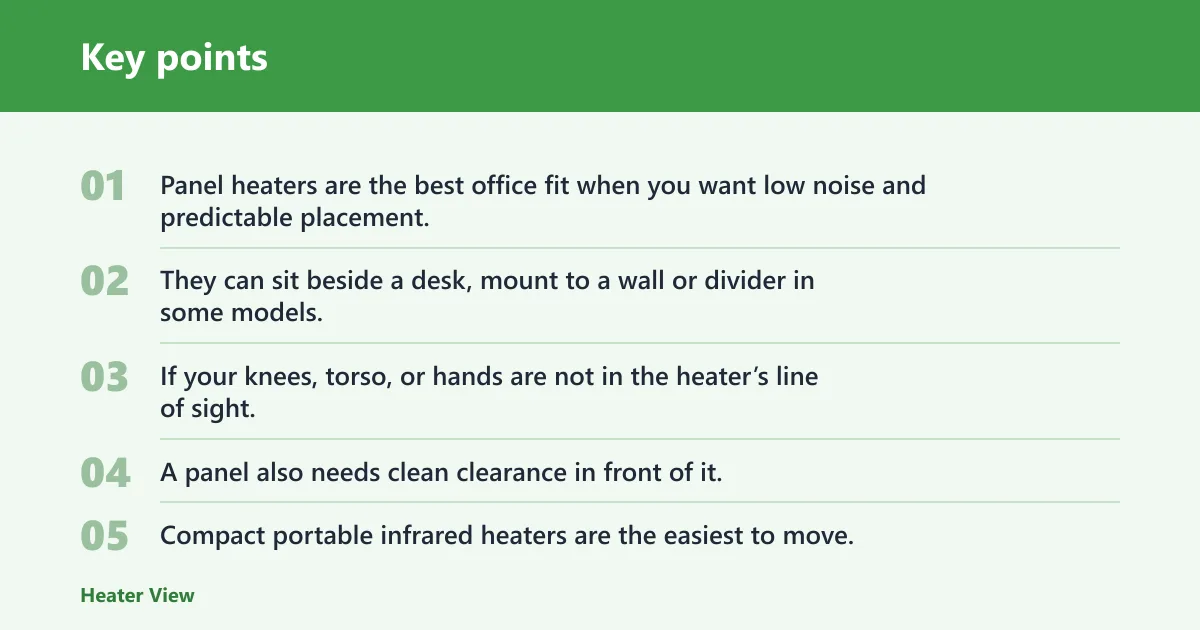
Panel heaters are the best office fit when you want low noise and predictable placement. They can sit beside a desk, mount to a wall or divider in some models, and send radiant heat toward your seated area without moving air and paper around.
The main tradeoff is angle. If your knees, torso, or hands are not in the heater’s line of sight, the warmth feels weaker than the wattage suggests. A panel also needs clean clearance in front of it, because stacked folders and tote bags block radiant delivery.
Compact portables for small floorspaces
Compact portable infrared heaters are the easiest to move, which helps when office rules change or your seating assignment changes. They are a practical fit for a cubicle with only a small open area under or beside the desk.
Look for a wide base that resists tipping, a thermostat, and surface temperatures that stay controlled enough for a crowded workspace. Portable units can still run hot on the outside, so they need more separation from paper, fabric panels, and shoelaces than many buyers expect.
Tower-style units and oscillation
Tower units can warm a longer span of desks or a wider seated area, especially if your cube opens toward an aisle. Oscillation helps when you want the heat to sweep across a neighboring chair zone, but it is usually a poor fit for one fixed cubicle seat.
In a tight cube, oscillation can send warmth where nobody sits while moving the heater closer to folders, wastebaskets, or the edge of a walkway. If your goal is personal heat at a single desk, steady aim is better than moving output.
How much wattage do you need?
For a cubicle, 750W is the safer low-load starting point, while 1500W is the upper end common on personal heaters. Higher wattage means more heat output and faster warm-up, and it also means more electrical load and a larger chance of tripping a shared circuit.
750W vs 1500W
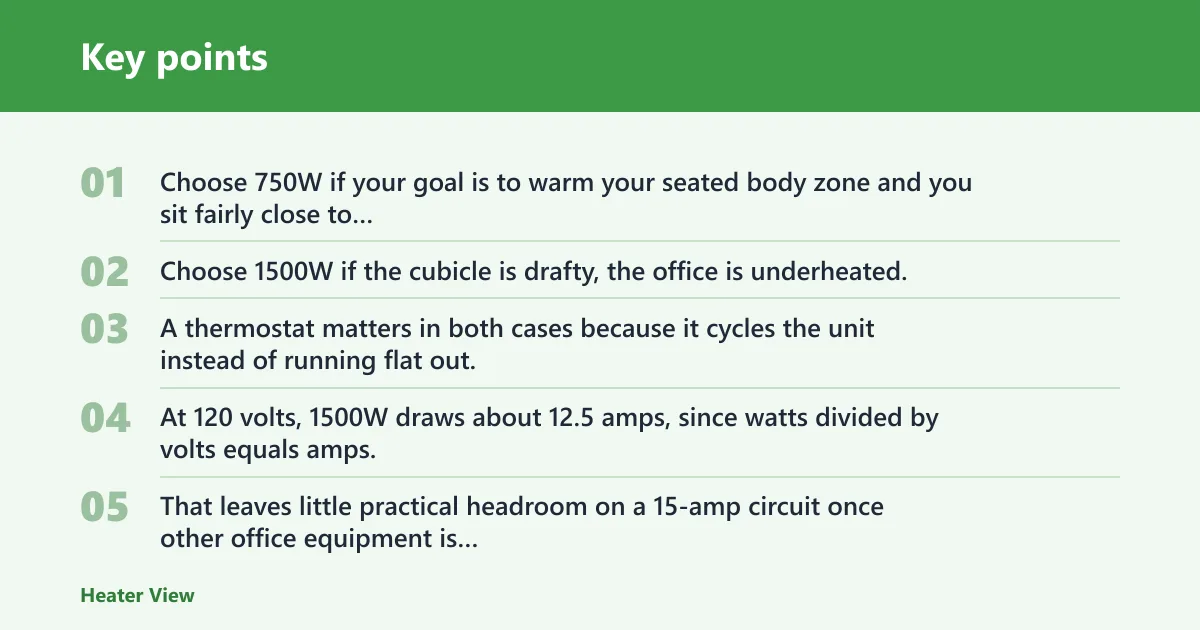
Choose 750W if your goal is to warm your seated body zone and you sit fairly close to the heater. Choose 1500W if the cubicle is drafty, the office is underheated, or you need stronger radiant output on cold mornings. A thermostat matters in both cases because it cycles the unit instead of running flat out.
At 120 volts, 1500W draws about 12.5 amps, since watts divided by volts equals amps. That leaves little practical headroom on a 15-amp circuit once other office equipment is included, which is why many workplaces avoid that load on shared outlets. A 750W heater at 120 volts draws about 6.25 amps, which may leave more margin for a monitor, laptop charger, and dock.
Circuit load and outlet limits
Do not assume an office outlet is empty just because nothing obvious is plugged in. Shared circuits often feed nearby desks, printer stations, and under-floor equipment. A heater on the same circuit as a laser printer, desktop computer, and task light can push the load too high.
Most office policies also bar heaters on extension cords and power strips. OSHA warns against overloading cords and daisy-chaining or relying on temporary wiring for high-demand equipment, and the U.S. Department of Energy recommends plugging space heaters directly into a wall outlet instead of using extension cords or power strips. If the heater manual forbids extension cords, follow the manual, and ask facilities or IT for a better outlet. OSHA extension-cord guidance and DOE space-heating guidance both point in the same direction: direct wall connection is the safer default.
Workday running cost
Energy cost comes from wattage and runtime, not from the marketing label. A 750W heater used for 8 hours uses about 6 kWh. At about $0.16 per kWh, that comes to about $0.96 for the day. A 1500W heater used for 8 hours uses about 12 kWh, which works out to about $1.92.
Thermostat cycling can lower the real daily cost if the heater does not run at full power the whole time. Still, the 8-hour math is the right starting point because it shows the ceiling for a full office day.
What safety features matter at work
Workplace safety depends on more than a warm surface and a power switch. For cubicles, the must-have list is short: tip-over protection, overheat protection, a thermostat, stable placement, and a clear buffer from paper, fabric, and walls. The U.S. Consumer Product Safety Commission also recommends keeping space heaters at least 3 feet away from anything that can burn. CPSC heater safety guidance
Tip-over protection
Tip-over protection shuts the heater off if it falls or tilts past a set angle. That is a portable heater safety standard feature and a good fit for a cubicle where chairs bump into legs, bags slide under desks, and foot traffic is tight.
Overheat protection
Overheat protection uses a thermal cutoff to shut the unit down if internal temperatures rise too far. It matters in enclosed workspaces because blocked airflow, nearby partitions, or dust buildup can raise surface temperature during continuous use.
Clearance and under-desk rules
Most manufacturers call for at least 3 feet of clearance from paper, curtains, upholstery, and walls. In a cubicle, that often means the heater belongs beside the desk, not buried under it. Under-desk use is only acceptable when the manual allows it and your workplace policy allows it too; suitability depends on the specific manual and the office rules, not just on the heater type.
How close can you sit? Close enough to feel the radiant heat, but not so close that the heater can dry out a document stack or touch fabric. If the front grille or panel gets uncomfortably hot to the touch, the setup is too tight for office use.
Start with the office rulebook. If employer policy limits heaters, that decides the size and placement before comfort does. Then check the outlet load, the distance from paper and fabric, and whether the desk layout gives the heater a clear path to your body.
Shared-office constraints
Shared offices need quieter heaters, stable cords, and less visible clutter. A low-profile infrared panel fits better than a fan heater because it avoids airflow that can stir dust or blow papers. The best option is one that looks tidy and stays within policy.
Noise and airflow
What heater is quiet enough for an office cubicle? A fanless infrared panel is the safest answer. Near-silent operation matters in an open office because fan noise, oscillation motors, and loud thermostat clicks can distract nearby coworkers even when the heat itself is welcome.
Thermostat and placement
A thermostat keeps the heater from running continuously at full power, which helps with comfort consistency and energy use. Placement matters just as much. Aim the heat toward the seated area, keep paper and fabric out of the path, and leave the required spacing on every side.
Will an infrared heater dry out the air in your cubicle? It can make the air feel drier because the radiant heat warms your skin and nearby surfaces faster, while HVAC settings and low indoor humidity usually dominate the overall comfort level. It does not remove moisture the way a dehumidifier does, so if dryness is a concern, check the room humidity and the office HVAC setting first.
Practical decision checklist
Before you buy, make sure the heater works with the real cubicle, not just the product listing.
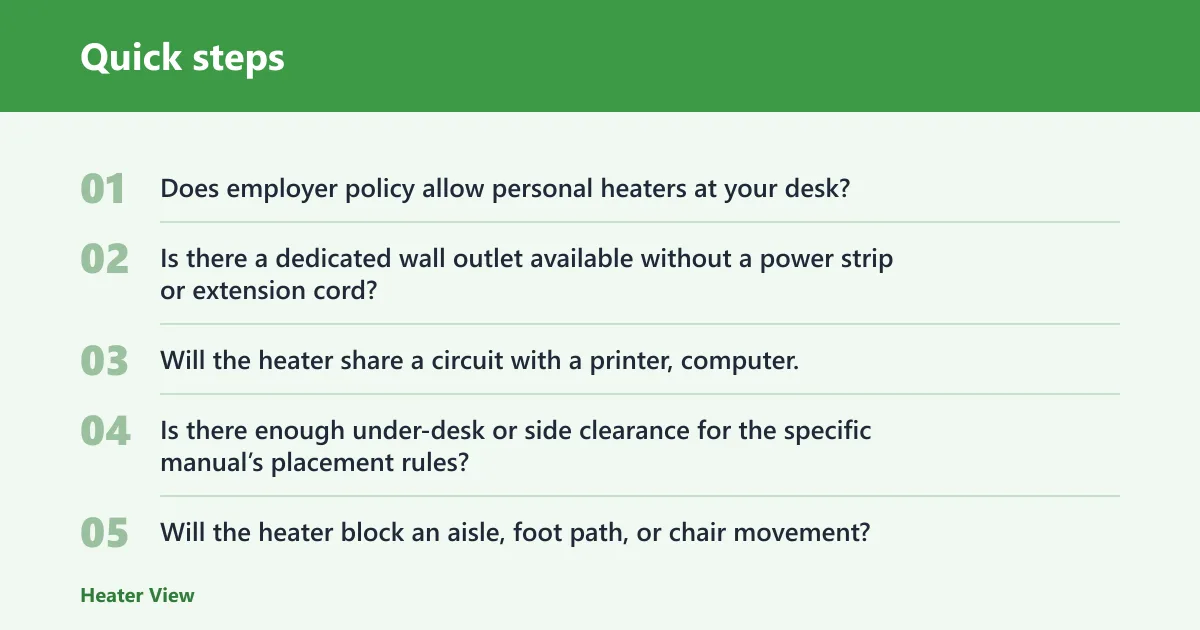
- Does employer policy allow personal heaters at your desk?
- Is there a dedicated wall outlet available without a power strip or extension cord?
- Will the heater share a circuit with a printer, computer, or other load that could trip the breaker?
- Is there enough under-desk or side clearance for the specific manual’s placement rules?
- Will the heater block an aisle, foot path, or chair movement?
- Are paper, fabric partitions, tote bags, and trash bins far enough away?
- Can you tolerate the noise level, including fan sound, clicking, or oscillation?
- Does the model have a thermostat, tip-over shutoff, and overheat protection?
Frequently asked questions
What is the best infrared heater for a cold office cubicle?
The best choice is a fanless infrared panel with a thermostat, tip-over shutoff, and overheat protection. For most cubicles, 750W is the safer starting point, while 1500W works when the space is especially drafty and the circuit has enough spare capacity.
Are infrared heaters safe to use under a desk?
Sometimes, but only if the manual allows under-desk placement and you can keep the required clearance from paper, fabric, and cables. Many cubicles are too cramped for safe under-desk use, especially when bags, power cords, and files share the same space.
How many watts do I need to heat a cubicle?
Most office cubicles do well with 750W to 1500W. Use 750W for personal warmth in a fairly enclosed cube, and 1500W when the cubicle is drafty or the office is cool enough that a low setting never catches up.
Should I choose a radiant heater or a ceramic heater for an office?
Choose radiant or infrared heat if you want quiet, direct warmth aimed at your seated body zone. Choose ceramic if you need more air movement in a slightly larger area. For a cubicle, the lower noise and tighter focus of radiant heat are usually better.
Can I use an infrared heater with a power strip or extension cord?
Usually no. Many heater manuals and office policies prohibit extension cords and power strips because high-wattage appliances can overheat them. A dedicated wall outlet is the safer choice, and it reduces the chance of nuisance trips or hidden overloads.
Do infrared heaters use a lot of electricity in an office?
They can, if you run them at high wattage for a full workday. Thermostat cycling can lower the actual total.