What to Look for in a Quiet Infrared Heater
For a quiet infrared heater, choose a fanless model, or one rated around 40 dB or lower at the highest setting; avoid units with pulsing fans, loose grills, or clicking thermostats. Bad picks can add steady fan noise, thermal clicking, and uneven heat to a bedroom or office. This guide explains the specs, design cues, and warning signs that actually predict quiet, effective warmth.
What makes an infrared heater quiet?
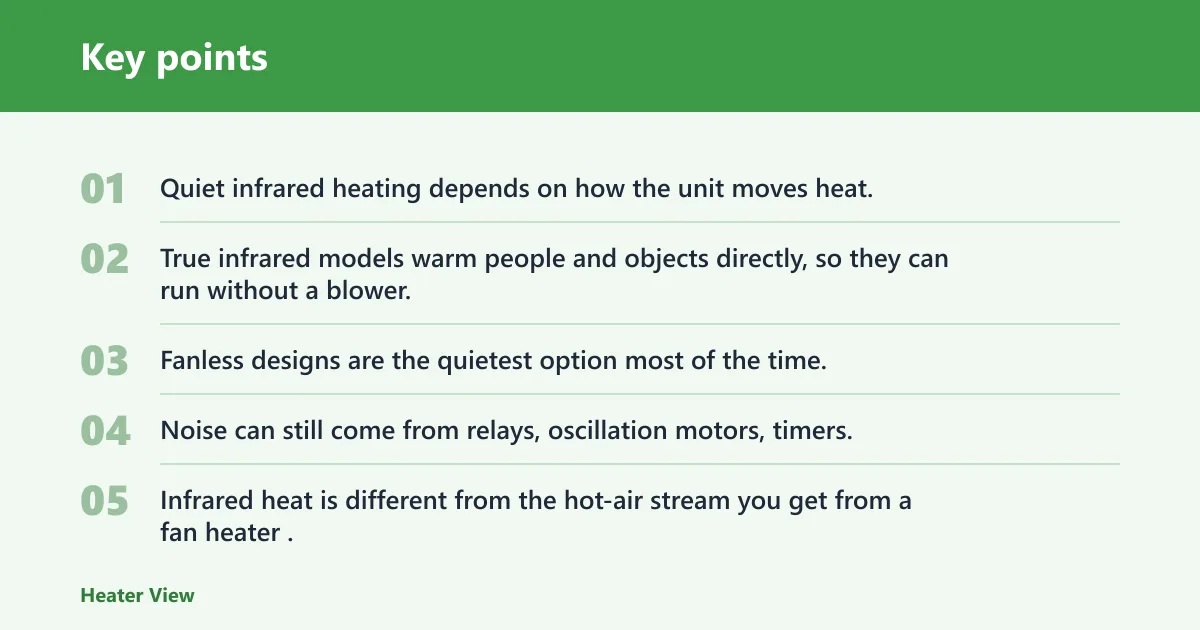

Quiet infrared heating depends on how the unit moves heat. True infrared models warm people and objects directly, so they can run without a blower. Fanless designs are the quietest option most of the time. Noise can still come from relays, oscillation motors, timers, or a fan that only runs at certain settings.
Radiant heat versus air movement
Infrared heat is different from the hot-air stream you get from a fan heater. Because the heater is not pushing air through the room, it usually avoids the constant whoosh that many buyers hear first. That is why quiet infrared heaters are common in bedrooms, children’s rooms, and offices that need steady heat without a loud airflow.
Some products use the infrared label loosely. If a model depends on a fan to circulate warmth, it can still be useful, but it is no longer the same as a truly fanless radiant heater. Noise-sensitive buyers should separate the heating method from the marketing copy.
Why fanless models stay quieter
AENO says silent infrared heaters use no fans or motors, which is the cleanest noise cue to look for. Fewer moving parts usually mean fewer mechanical sounds. That does not guarantee total silence, because thermostats and relays can still click, but it removes the largest source of steady noise.
Fanless units also avoid the start-stop noise pattern that can be distracting in a small room. If the product page mentions only infrared output and no blower, that is a better sign than vague claims about “whisper quiet” operation.
Where noise still comes
Even a fanless heater can make noise. Common sources include a thermostat click, a control relay, a wobbling grille, or a timer that cycles power. Quartz elements can also change temperature quickly, which makes some units more prone to audible expansion and contraction sounds.
That is why a decibel number matters more than adjectives. For a quiet heater, look for a published rating around 40 dB or lower at the highest setting. A 35 dB rating, such as the R.W.FLAME figure listed by Heater Guides, sits in the range many buyers would consider sleep-friendly.
How quiet should a bedroom heater be?
For a bedroom, aim for a heater that stays at or below about 40 dB on its highest setting, ideally without continuous fan noise. Lower is better, especially if the room is small and the heater sits close to the bed. If the unit cycles loudly, the effective noise can be worse than its listed rating suggests.
Practical decibel targets
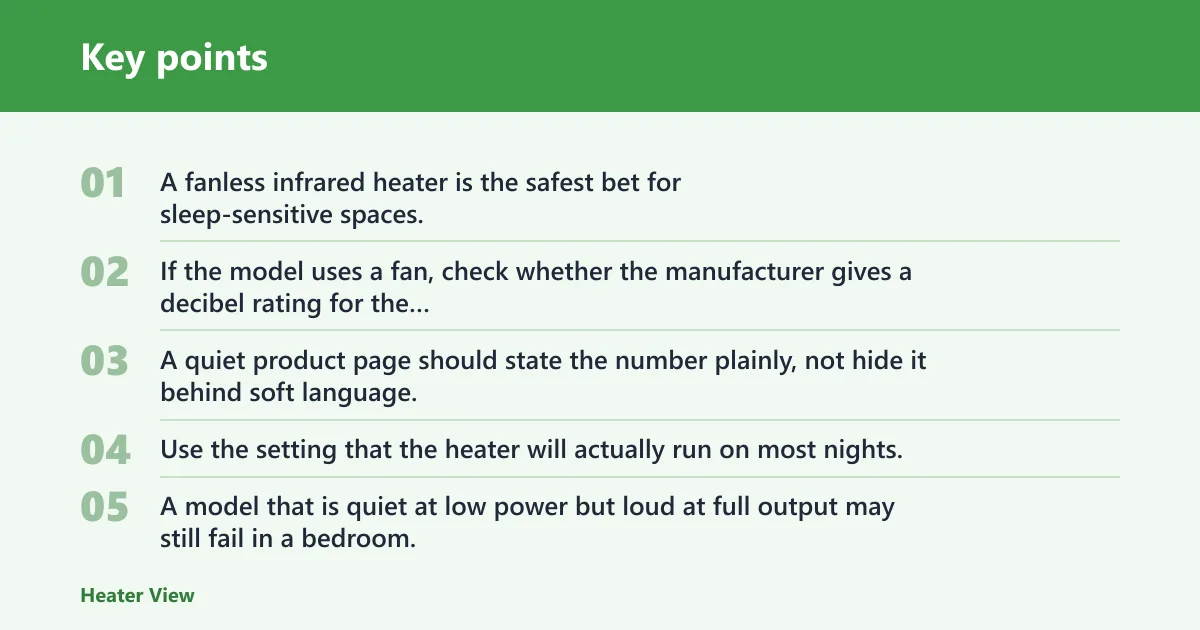
A fanless infrared heater is the safest bet for sleep-sensitive spaces. If the model uses a fan, check whether the manufacturer gives a decibel rating for the top heat setting rather than a low setting. A quiet product page should state the number plainly, not hide it behind soft language.
Use the setting that the heater will actually run on most nights. A model that is quiet at low power but loud at full output may still fail in a bedroom. The highest-setting number matters because that is when the unit is working hardest and often making the most noise.
Sleep-friendly noise sources
Sleep is usually disturbed by repeating sounds, not one brief click. That means a pulsing fan, a loud thermostat, or an oscillating base can be more annoying than a steady low hum. Fanless infrared heaters fit overnight use better because they remove the most obvious moving-part noise.
Suppose a 120-square-foot bedroom has a heater near the foot of the bed. A 35 dB fanless unit is far less likely to draw attention than a fan-assisted model that cycles louder every few minutes. The room is small enough that placement matters as much as the heater type.
When all-night use makes sense
All-night use makes sense when the heater has overheat protection, tip-over shutoff if it is portable, and a thermostat that can hold a set temperature without constant cycling. A timer is useful too, because it gives you control over how long the unit stays on.
Do not assume all-night use is safe just because a heater is quiet. Quiet operation does not replace clearance rules, stable placement, or room-size limits. If the heater has to run at maximum output for hours to keep up, it may be the wrong fit for the room.
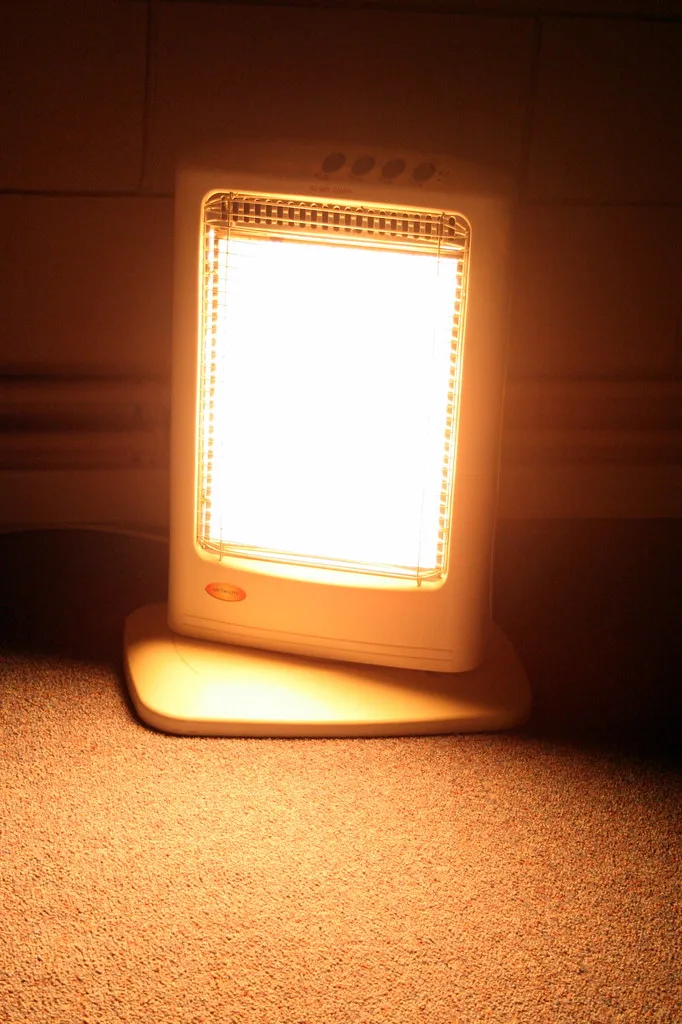
Quiet heater buyer checklist
Use this checklist to separate true quiet infrared heaters from models that only sound quiet on the product page. The best choice depends on the room, the noise target, and whether the heater can hold comfort without running at full power all the time.
| Noise target | Heater type | Wattage | Room size | Safety features | Mounting style | Red flags |
|---|---|---|---|---|---|---|
| 40 dB or lower | Fanless infrared | 750 W | Up to about 100 square feet | Overheat protection, thermostat, cool-to-touch grille | Wall-mounted or portable with stable feet | Fan noise, no published dB rating, weak coverage claims |
| 35 to 40 dB | Fanless or low-noise infrared | 1000 W | About 100 to 150 square feet | Overheat protection, tip-over shutoff, timer | Portable or wall-mounted | Pulsing blower, clicking thermostat, no room-size guidance |
| 40 dB or lower | Infrared with careful placement | 1500 W | Up to about 150 to 200 square feet | Overheat protection, child lock, timer, thermostat | Wall-mounted, ceiling-mounted, or portable | Claims for large or drafty rooms, no mounting limits |
- Pick the heater type first: fanless infrared if quiet is the top priority.
- Match wattage to the room, not the marketing headline.
- Check the published decibel rating at the highest setting.
- Confirm overheat protection and, for portable units, tip-over shutoff.
- Make sure the mounting style fits the room layout and clearance space.
- Reject any model that needs constant full-power operation in a drafty room.
A common mistake is choosing a noisy infrared heater with a rattling fan for a small home office and expecting it to stay distraction-free during long work sessions. The unit may be silent enough, but it will still struggle to cover the space evenly, so it runs longer and may create more cycling noise than expected.
What wattage fits your room?
Wattage tells you how much heat the unit can produce, not how quiet it will be. For small indoor spaces, 750 W can be enough. A 1000 W heater fits compact bedrooms or offices better. A 1500 W unit gives more coverage, but only when the room size and layout support it.
750 W for small spaces
A 750 W heater is a reasonable choice for very small rooms, tight offices, or a spot-heating setup near a desk. AirConditionerLab lists the Heat Storm Phoenix at 750 to 1500 watts and rates it for 150 square feet, which shows how much coverage can vary by mode and design.
For a tiny room with closed doors and modest drafts, 750 W may be enough to take the chill off without needing a louder high-output model. If the room has high ceilings or leaks air around windows, 750 W may feel underpowered.
1000 W for compact bedrooms or offices
1000 W is a practical middle ground for a quiet infrared heater in a compact bedroom or office. It can provide more cushion than 750 W without automatically pushing you into the largest, hottest units. That matters when the goal is steady comfort rather than fast recovery after a cold start.
If the room has furniture that blocks line of sight, the heater may need better placement rather than more wattage. Infrared warmth works best when the radiant path reaches the occupied zone directly.
1500 W when coverage needs are higher
1500 W is the common upper end for portable indoor space heaters, and it can suit larger small rooms if the layout is favorable. Heater Guides lists the R.W.FLAME unit at 1500 watts with a room rating up to 200 square feet and a 35 dB figure, plus a 24-hour timer and safety features.
That said, 1500 W is not a fix for a drafty space or a room with poor placement options. If the heater must fight cold air from every direction, quiet operation may remain intact, but comfort will be less reliable.
What safety features matter most?
For a quiet infrared heater, the most important safety features are overheat protection and tip-over shutoff, plus a thermostat that prevents unnecessary cycling. Child lock and a cool-to-touch grille matter in shared spaces. Timers are especially useful for sleep or unattended operation.
Overheat protection and tip-over shutoff
Overheat protection should be non-negotiable. It is the basic safeguard if airflow is blocked or the unit is running harder than expected. Tip-over shutoff matters for portable heaters, especially in bedrooms, hallways, and offices where cords or pets can create a hazard.
The same source lists both tip-over shutoff and child lock among the R.W.FLAME safety features. That is the kind of plain-language checklist worth looking for on any quiet heater intended for indoor use.
Child lock and cool-to-touch grille
Child lock helps prevent accidental changes to temperature or timer settings. A cool-to-touch grille reduces burn risk, especially when the heater sits near a desk, crib, or play area. These features do not make a heater quieter, but they matter when quiet operation is part of an overnight setup.
When timers and thermostats help
An adjustable thermostat lets you set a target temperature instead of letting the heater blast continuously. Eco mode can reduce unnecessary output once the room reaches a set point. A timer supports set-and-forget use, which is useful when you want the heater to shut off before morning or after a work session.
The same source says smart temperature control helps prevent overheating. That is useful because a heater that holds temperature more steadily can also avoid the stop-start behavior that often creates more noticeable noise.
Should you choose wall-mounted or portable?
Wall-mounted and ceiling-mounted infrared heaters can free up floor space and keep the unit away from foot traffic. Portable heaters are easier to move from room to room. Neither type is automatically quieter, because placement, vibration, and airflow around the unit shape what you hear.
Wall-mounted and ceiling-mounted options
Wall-mounted units are often a strong fit for bedrooms and offices because they keep the heater fixed in the best radiant position. The same source describes the Heat Storm Phoenix as a wall-mounted space heater, and says the DR-268 is wall- or ceiling-mounted and water-resistant. Fixed mounting can also reduce accidental contact and tip-over risk.
The same source says its heater profile is only 11 mm thick, which shows how slim a wall unit can be. A thinner profile may fit tighter spaces better, but thickness alone does not make a heater quieter. The key is whether the unit has a fan or moving parts.
Portable units and detachable feet
Portable heaters with detachable feet are flexible, but they need stable placement. On carpet or uneven floors, a portable model may transmit more vibration or make more cabinet noise than a fixed unit. For a quiet room, check whether the base feels solid and whether the controls click loudly.
Portable models are best when you need to move the heater between a bedroom and office. If the same unit must sit next to your bed every night, a wall mount often gives you a cleaner setup and fewer placement problems.
Placement, clearance, and noise perception
Placement changes how quiet a heater feels. A unit mounted too close to a wall, curtain, or shelf can bounce sound and trap heat. A heater placed in open space may sound quieter because the room is not amplifying the grill or relay noise.
Use the room layout as part of the buying decision. High ceilings, open doorways, and drafty corners can make any heater seem less effective, which may tempt you to increase the setting and tolerate more noise. Better placement can avoid that tradeoff.
Infrared or ceramic for quiet heating?
Choose infrared if you want the quietest path to direct warmth and a low-noise room presence. Choose ceramic if you need faster air warming and temperature regulation in a compact space. PTC ceramic heaters can be quiet, but they usually depend more on airflow than fanless infrared units.
Quartz element behavior
Quartz elements heat quickly and cool down quickly. That fast response can help a quiet infrared heater feel immediate without long warm-up noise. It can also create a slight ticking or expansion sound in some designs as parts heat and cool.
Quartz is a good fit when you want direct radiant output in a small room and you do not want a blower in the mix. The tradeoff is that heat feels more directional, so placement matters more than with a fan-driven unit.
PTC ceramic heater tradeoffs
PTC ceramic heaters warm air rapidly and regulate temperature well. They can be a good choice when you want a compact heater that adjusts quickly, but many models rely on a fan, which raises the noise floor. That makes them less suitable when the room has to stay very quiet at night.
If the product is a hybrid, check whether the fan shuts off at low settings or runs continuously. A low-noise fan may be acceptable in an office, but it is usually a weaker choice than fanless infrared for a bedroom.
When each type fits a small room
Use fanless infrared when the room is small, the occupant is noise-sensitive, and the goal is gentle, direct warmth. Use PTC ceramic when you want faster room-wide air movement and can accept a little blower noise. Neither type is a good match for whole-home heating or a drafty open floor plan.
Frequently asked questions
How quiet is a quiet infrared heater?
A quiet infrared heater is usually fanless or rated around 40 dB or lower at full output. The best models avoid continuous blower noise, but they may still click, hum, or tick as the thermostat cycles. For sleep-sensitive rooms, a published decibel number is more useful than a general “quiet” claim.
What noise level should I look for in a heater for a bedroom?
For a bedroom, look for about 40 dB or lower at the highest setting. A 35 dB rating is a stronger sign that the heater will stay unobtrusive at night. Also check for fanless operation, because even a low decibel figure can hide a steady fan sound that becomes noticeable in a quiet room.
Do infrared heaters need a fan, and does that make them louder?
No, true infrared heaters do not need a fan. A fan is often used in hybrid or ceramic designs to move air faster, and that usually adds noise. If you want the quietest option, choose a fanless infrared heater and confirm that the product does not rely on a blower for normal heat output.
What safety features matter most in a quiet infrared heater?
Overheat protection and tip-over shutoff matter most. For shared rooms or overnight use, add child lock, a cool-to-touch grille, and an adjustable thermostat or timer. A quiet heater should still have basic safeguards, because low noise does not reduce the need for stable, predictable operation.
How do I know if an infrared heater is good for a small room?
Match the wattage to the room size and check whether the layout supports direct radiant heating. Watch for drafty corners, high ceilings, and furniture that blocks the heat path.
Can a quiet infrared heater run all night?
It can, if it has the right safety features and the room size is appropriate. Look for overheat protection, a stable thermostat, and ideally a timer. All-night use is less sensible in a drafty room, because the heater may run longer and the comfort level may still drop.