Do Infrared Heaters Work in Poorly Insulated Rooms?
Infrared heaters can work well in poorly insulated rooms for spot warmth, but they do not replace whole-room heating when drafts and heat loss are high; if the room feels cold within a few minutes of switching them off, use them only as supplemental heat. Bad matching wastes electricity and leaves cold corners. This guide explains where infrared helps, where it falls short, and when another heating choice makes more sense. For plug-in use, most portable electric heaters are limited to 1,500 watts on a standard 120-volt household circuit, so the practical ceiling is usually the outlet and breaker, not the heater category itself (DOE/Energy Saver; manufacturer manuals).
Why radiant heat feels warm in a cold room
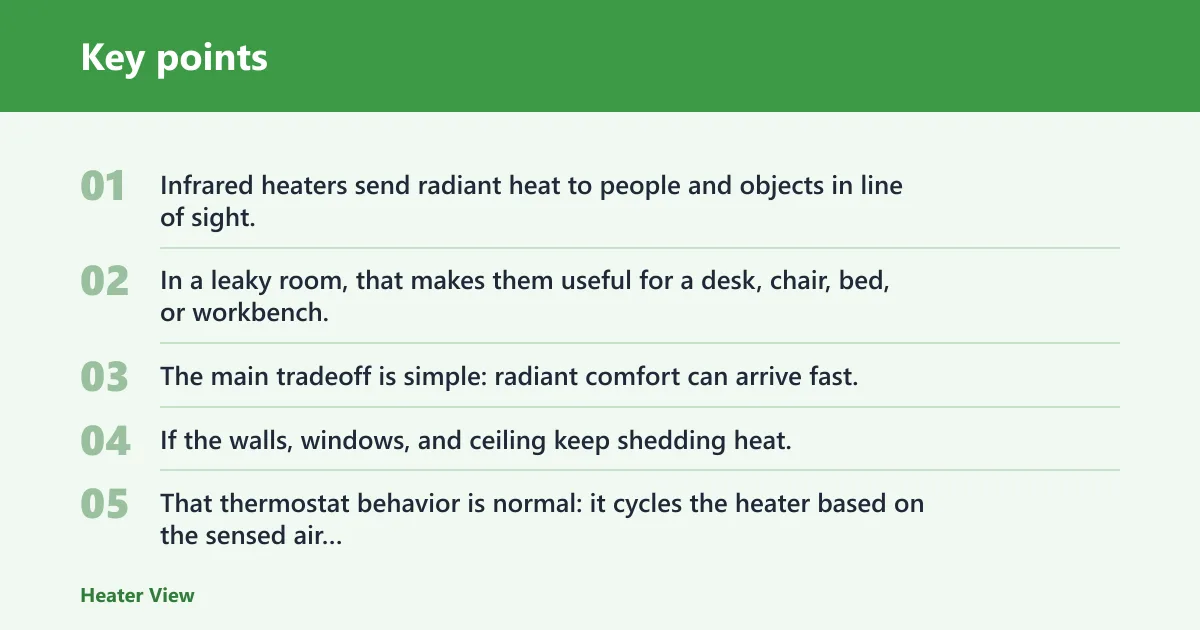


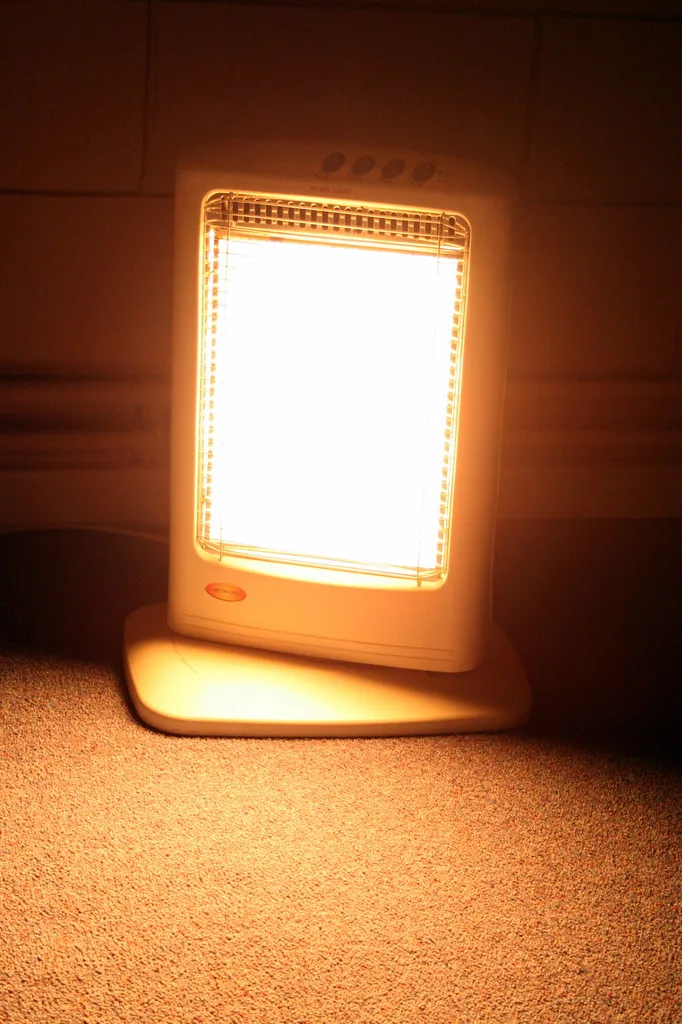
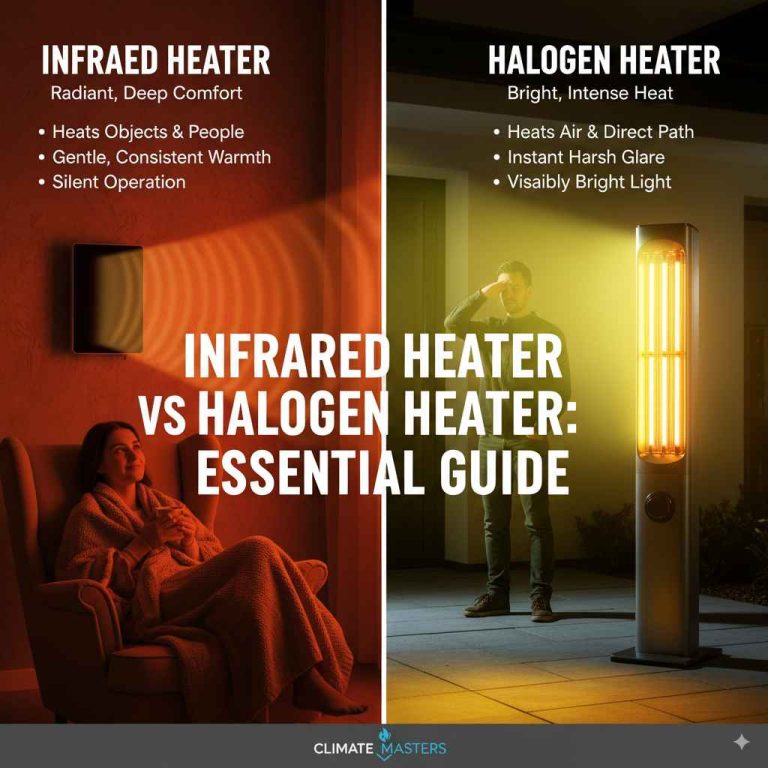
They do, but only in the right role. Infrared heaters send radiant heat to people and objects in line of sight, so you can feel warm even when the air is still cool. In a leaky room, that makes them useful for a desk, chair, bed, or workbench, not for fixing the room as a whole.
The main tradeoff is simple: radiant comfort can arrive fast, while room air temperature can lag or stay low. If the walls, windows, and ceiling keep shedding heat, the heater may warm your skin and nearby surfaces while the thermostat keeps calling for more runtime. That thermostat behavior is normal: it cycles the heater based on the sensed air temperature at the unit or remote sensor, not on how warm you feel in a nearby chair (manufacturer manuals; Energy Star room-heating guidance).
Why the room can stay cold while you feel warm
Infrared heat does not need to warm every cubic foot of air first. That is why it feels effective near the heater in a drafty room. But cold surfaces and moving air keep pulling heat away from the occupied zone, so the room can still read low on a thermostat even when you feel comfortable sitting still.
For example, a basement office of about 140 square feet with a concrete wall, a single leaky window, and a chair about six feet from a 1500W infrared unit may be a useful test case. Your face, hands, and torso may feel warm within minutes, yet the far corner can remain chilly because the heat is aimed and the room is losing energy faster than it is being recovered.
Where this heating method helps most
best infrared heaters for zoned heating make the most sense in enclosed spaces where one or two people stay in a defined zone. Bedrooms, small basements, closed garages, and tight sunrooms can all benefit if the seating or sleeping area sits within the heater’s direct path. Portable and wall-mounted models both fit this use pattern.
They work best as supplemental heat when you want comfort now and do not need the entire room to equalize quickly. A built-in thermostat can cut wasted runtime, but it cannot overcome major leakage on its own.
Where it falls short
They struggle when the room is large, open plan, or very drafty. They also struggle when furniture, storage, or partitions block the beam path. In those cases, the heater keeps warming visible surfaces, but room air and cold walls keep stealing that heat away.
That is the failure mode many pages skip: the person in front of the heater feels fine, the air behind them stays cold, and the unit cycles longer without producing steady whole-room comfort.
Infrared heater decision matrix
Use this matrix to match room conditions with the right expectation. The verdict changes with insulation level, draft severity, room size, occupancy pattern, and heater type.
| Room condition | Insulation level | Draft severity | Room size and layout | Occupancy pattern | Heater type | Verdict |
|---|---|---|---|---|---|---|
| Small enclosed bedroom | Moderate to good | Low | Up to about 120 sq. ft., standard ceiling | One sleeping zone | Portable or wall-mounted infrared | Works well |
| Drafty bedroom with window leakage | Low | Moderate | 120 to 180 sq. ft., enclosed | One occupied zone | 1500W infrared with thermostat | Works only as supplemental |
| Small basement office | Low to moderate | Moderate | 100 to 150 sq. ft., low ceiling acceptable | Intermittent desk use | Portable infrared aimed at desk area | Works well |
| Open basement rec room | Low | High | 250 sq. ft. or more, open layout | Scattered seating | Infrared plus other heat source | Not recommended |
| Garage with door gaps | Low | High | Large, tall ceiling, vehicle clearance | Short work sessions near one area | Wall-mounted infrared near work zone | Works only as supplemental |
| Sunroom with single-pane glass | Low | Moderate to high | Compact, glass-heavy room | Daytime seating | Infrared aimed at seating zone | Works only as supplemental |
| Large open-plan living area | Low | Moderate to high | Open flow, multiple zones | Several people moving around | Any portable infrared | Not recommended |
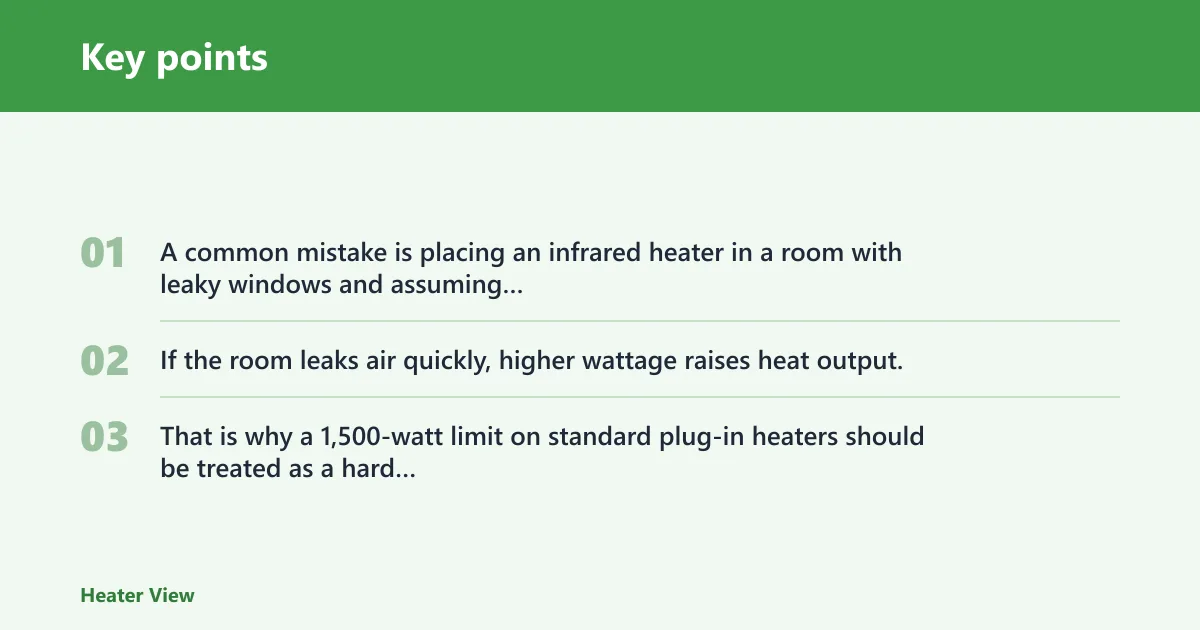
A common mistake is placing an infrared heater in a room with leaky windows and assuming it will keep the whole space warm without addressing the drafts. If the room leaks air quickly, higher wattage raises heat output, but it also raises runtime and operating cost if the leakage stays unchanged. That is why a 1,500-watt limit on standard plug-in heaters should be treated as a hard cap, not a sizing target, when the room itself is the real problem (DOE/Energy Saver; utility space-heating guides).
How much heat do you need?
For electric infrared models, about 750W to 1500W is a common range. A 750W unit can warm a tight seat or desk area, while a 1500W unit gives the highest common output before you reach typical plug-in limits. In a poorly insulated room, the top end of that range is usually the practical floor, not the finish line.
Square footage guidance can only estimate the starting point. It does not account for ceiling height, open-plan layouts, or how far you sit from the heater. A 1500W unit may feel strong in an about 100 sq. ft. enclosed bedroom, yet disappointing in an about 220 sq. ft. room with a 9-foot ceiling and steady infiltration. Energy math also depends on runtime: 1.5 kW × hours used = kilowatt-hours, and cost is simply kWh multiplied by your electric rate (Energy Star; utility bill calculators).
What square footage guidance can and cannot tell you
Use square footage as a filter, not a promise. Enclosed rooms with short distances to the occupied zone need less output than rooms where the heater must reach across open space. Higher ceilings increase the air volume that cold surfaces can affect, which usually makes radiant spot heating more useful than trying to heat the full room evenly.
Why open-plan rooms need a different expectation
Open-plan layouts let warm surfaces lose heat into adjacent areas. That makes the heater feel weaker, even at full output. If the seating zone is not enclosed, infrared can still help at the chair or couch, but it is a poor match for maintaining a steady whole-room temperature.
How should you size an infrared heater?
Use a practical checklist instead of a single square-foot rule. First, cap the heater at the circuit’s safe plug-in limit, usually 1,500W on a standard 120-volt household outlet. Then measure the distance to the occupied zone, the enclosure level of the room, and the ceiling height. If the space is open or leaky enough that warmth disappears quickly, stop upsizing and fix infiltration instead (DOE/Energy Saver; manufacturer manuals).
Simple sizing formula
Start with a room band: about 75-120 sq. ft. for tight spot heating, about 120-180 sq. ft. for supplemental warmth, and above that only if the room is enclosed and the occupant stays close to the heater. Use 750W for a close desk or seat, 1,000W to 1,500W for a larger occupied zone, and avoid treating 1,500W as a cure for uncontrolled drafts. Once leakage is the dominant issue, a bigger heater mostly buys runtime, not comfort.
Checklist before you buy a bigger unit
Ask four questions: Is the occupied zone within direct line of sight? Is the ceiling standard height or higher? Does the room stay enclosed during use? Does the cold come from infiltration, not just low thermostat settings? If the answer points to air leakage or a large open layout, seal the room first and keep the heater size modest.
Where should you place it?
Place the heater so its radiant path reaches the occupied zone directly. The best spot is usually near, but not beside, the person or area you want to warm. Keep a clear line of sight. If the beam hits a table, cabinet, bed frame, or stack of storage bins first, output to the body drops fast.
Best location near the occupied zone
For a chair, set the unit so the torso and legs face the heater. For a bed, wall-mounted placement at manufacturer-approved height can direct warmth toward the sleeping zone. For a workbench, angle the unit toward the front of the body rather than toward the open room.
Keep the radiant path clear
Do not bury the heater in a corner or crowd it with furniture. Corners trap heat against nearby surfaces, but they also reduce useful coverage. Clutter, drapes, and tall objects can block radiation and create uneven comfort. A clear path matters more in drafty rooms because you need every usable watt aimed at the occupied zone.
Example placement choices
Picture a 12 by 10 foot bedroom with a bed against an exterior wall. A wall-mounted infrared heater on the opposite wall can aim across the room without being blocked by the bed frame, which is better than a portable unit hidden behind a chair in the corner.
Can sealing leaks improve results?
Yes. Air sealing can materially improve how well infrared heating feels because it slows the heat loss that keeps pulling comfort out of the room. Weatherstripping, door sweeps, window film, curtains, and draft blockers do not turn infrared into central heat, but they can reduce the load enough for the heater to feel more effective.
Weatherstripping and door sweeps
Start with doors and windows that leak air around the edges. Weatherstripping seals moving gaps, and a door sweep helps cut the cold flow under an exterior door. These are low-cost fixes that often improve a drafty room faster than buying a bigger heater.
Window film and curtains
Plastic window film can reduce the cold-surface effect from single-pane or leaky windows. Heavy curtains help at night, especially on exterior glass. They are most useful when the heater is aimed at a nearby seating zone, because the goal is to reduce the nearby cold surfaces that sap comfort.
Draft blockers and other low-cost fixes
Draft blockers at the bottom of doors, outlet gaskets on exterior walls, and sealing visible gaps around trim can all help. These fixes are small, but they reduce the constant heat loss that makes infrared heaters run longer without fully stabilizing the room.
How do infrared, ceramic, and oil-filled heaters compare?
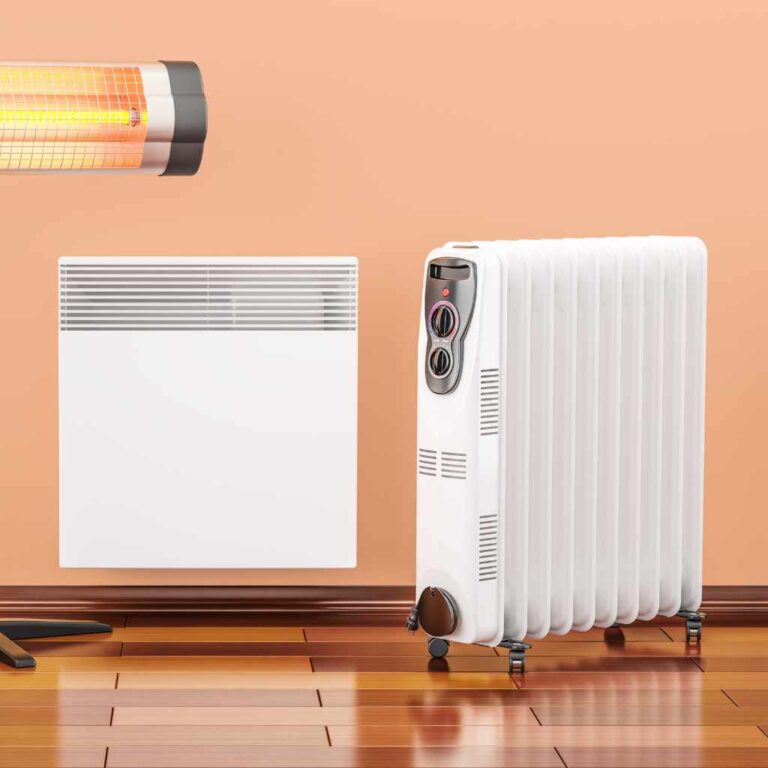
Infrared is best for occupied-zone comfort, ceramic/convection is better for mixing air in a smaller enclosed room, and oil-filled heaters are best when you want slower but steadier whole-room warmth. In drafty rooms and basements, the right choice depends on whether you need immediate directional heat, air circulation, or longer-lasting background comfort.
| Heater type | Best for drafty rooms | Best for basements | Main strength | Main limitation |
|---|---|---|---|---|
| Infrared | Good for direct occupied-zone warming | Good for desks, chairs, and beds in enclosed zones | Fast feel of warmth on people and surfaces | Does not solve whole-room heat loss |
| Ceramic/convection | Fair if the room is moderately enclosed | Fair for smaller finished basements | Warms and mixes room air more evenly | Feels weaker when leakage is high |
| Oil-filled | Fair to good for steady use | Good for longer background comfort | Slow, even heat with less fan noise | Slower warm-up and less directional comfort |
Safety and operating costs
Do not treat radiant heaters as set-and-forget devices. Follow the manufacturer’s clearance distances, keep them away from flammable materials, and use tip-over protection on portable units plus overheat protection on any model that offers it. Those features matter more in tight rooms where furniture and fabrics sit close to the heater. CPSC guidance and NFPA-style safety advice both emphasize keeping space heaters away from combustibles and placing them on stable, unobstructed surfaces (CPSC; NFPA; manufacturer manuals).
Clearance and flammable-material rules
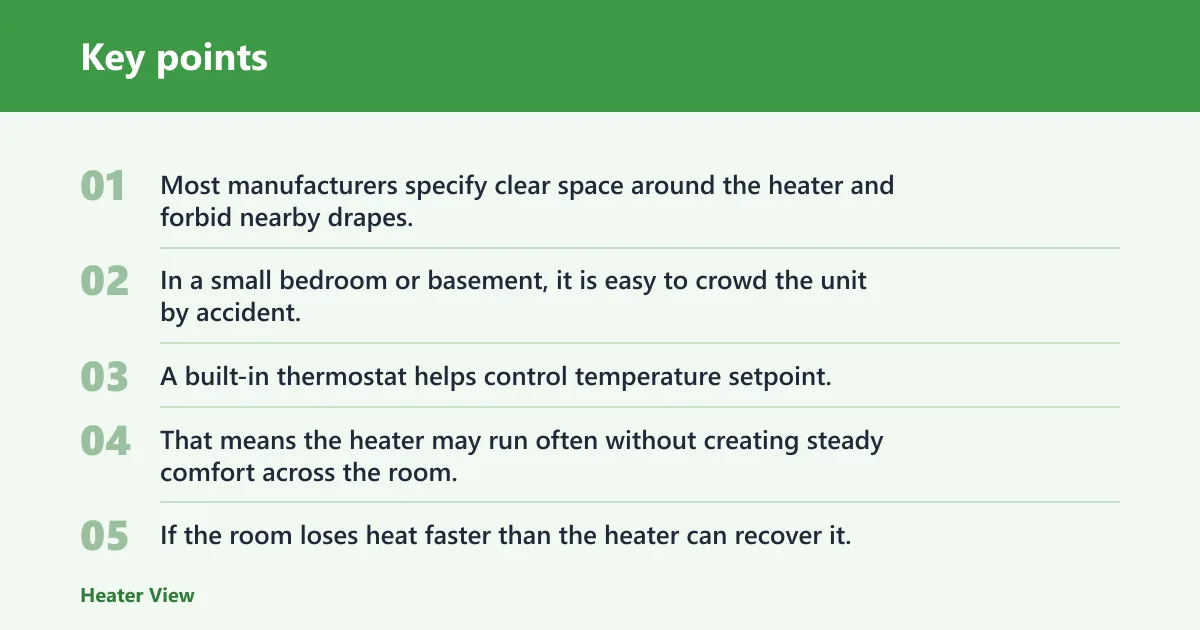
Most manufacturers specify clear space around the heater and forbid nearby drapes, bedding, paper, or stored items. Keep those distances exact. In a small bedroom or basement, it is easy to crowd the unit by accident, especially if you are trying to aim it toward a chair or bed.
Thermostat cycling in leaky rooms
A built-in thermostat helps control temperature setpoint, but a leaky room can force more on-off cycling. That means the heater may run often without creating steady comfort across the room. If the room loses heat faster than the heater can recover it, runtime climbs and comfort still feels uneven.
What poor insulation does to electricity use
Poor insulation does not just make the room colder. It also raises the amount of time the heater must stay on to maintain a target feel. That is why cost depends on runtime, leakage, wattage, and your setpoint. A 1500W heater used for short spot warming may cost less than a lower-wattage unit that runs all evening in a drafty room. The basic math is wattage in kilowatts multiplied by hours used, then multiplied by your electric rate, which is why a “smaller” heater can still cost more if it runs much longer (Energy Star; utility rate calculators).
Frequently asked questions
Do infrared heaters work in poorly insulated rooms?
Yes, but mainly as infrared heaters vs ceramic and oil-filled space heaters. They warm people and nearby objects in line of sight, so they can feel effective even when the air stays cool. In rooms with major leakage, they work best for one occupied zone, not for whole-room heating.
Will an infrared heater keep a drafty room warm?
Only if the room is small, enclosed, and only mildly leaky. In a very drafty space, cold air and cold surfaces can outpace the heater’s output. You may feel warm near the unit while the rest of the room stays uncomfortable and uneven.
How much room insulation do infrared heaters need?
They do not need perfect insulation, but they do need a room that can hold some of their heat. Mild to moderate leakage is workable for spot comfort. If the room loses heat fast after the thermostat cycles off, sealing gaps first will matter more than choosing a larger infrared model.
Can an infrared heater heat a basement with poor insulation?
Yes, if you use it as a zone heater. A basement office, hobby area, or chair area can benefit, especially with a 1500W unit aimed directly at the occupied zone. Open basements with cold concrete, high leakage, or multiple sitting areas are much harder to manage.
How do I size an infrared heater for a poorly insulated room?
Start with the common 750W to 1500W range and then match the room to the use case. Small enclosed rooms can often work with about 750W to 1000W for close-range spot warmth. Drafty or larger rooms usually need the full 1500W, but even then the heater may remain supplemental only. If you still cannot hold comfort at 1,500W, the next move is usually air sealing, not a bigger portable heater.
Where should I place an infrared heater in a drafty room?
Put it where it has a direct path to the occupied zone, such as a chair, desk, or bed. Avoid corners, clutter, and blocked sightlines. In a drafty room, bad placement wastes the beam and makes the heater seem weaker than it really is.