How to Heat a Garage Workshop Without Open Flames
Heat a garage workshop without open flames by using an electric unit heater, infrared panel, or oil-filled heater sized at about 10 watts per square foot for a typical insulated space. The wrong heater can trip breakers, stir dust, or leave tools cold and unsafe. This guide compares heater types, electrical limits, clearance rules, and dust-friendly setups so you can pick the right option.
Which heater fits your workshop?
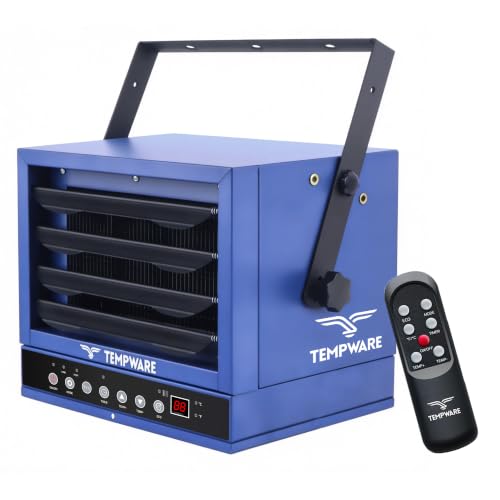


Start with the shop, not the heater. A small insulated one-car garage with light bench work needs a very different heat source than a detached, drafty two-car space filled with sawdust and power tools. If you need quick warm-up at the bench, a radiant option or fan heater can make sense; if you want quiet background heat, a sealed oil-filled unit is usually a better fit.
Garage insulation and air sealing matter before heater size. Door weatherstripping, wall insulation, and ceiling insulation cut heat loss faster than a larger unit can compensate for. If the overhead door leaks or the ceiling is bare, warm air escapes as fast as the heater makes it.
Garage workshop heater decision table
Use this table to match the safest non-flame heating option to the way the garage is used. The goal is to choose by dust, noise, mounting space, and electrical fit, not by output alone.
| Workshop scenario | Safest non-flame option | Power source | Typical wattage range | Warm-up speed | Noise | Dust sensitivity | Mounting or clearance needs | Best-use scenario |
|---|---|---|---|---|---|---|---|---|
| Well-insulated garage used for quick bench work | Infrared heater | Electric, usually hardwired or plug-in depending on model | Varies by model; confirm the listing | Fast for people and surfaces in the beam | Quiet | Low, because it does not blow air | Needs line-of-sight and ceiling or wall clearance | Spot heat over a workbench or standing area |
| Drafty garage that needs fast warm-up | Forced-air electric heater | Electric, often hardwired in larger sizes | Varies by model; confirm the listing | Fast | Moderate to noticeable | Higher, because fan airflow can move dust | Needs clear intake and discharge space | Heating the whole room before a work session |
| Small garage used for light repairs and storage | Oil-filled radiator | Plug-in electric | Varies by model; confirm the listing | Slow | Very quiet | Low, since there is no fan | Needs floor space and clearance from clutter | Steady background heat near an occupied zone |
| Larger insulated workshop with fixed heat needs | Electric garage heater | Hardwired or plug-in electric, depending on model | Varies by model; confirm the listing | Moderate to fast | Low to moderate | Depends on fan design; some units move dust | Requires listed wall, ceiling, and combustible clearances | Whole-space heating with thermostat control |
| Workshop with frequent tool cleanup and limited wall space | Infrared heater | Electric | Varies by model; confirm the listing | Fast in the line of sight | Quiet | Low | Must stay aimed at an open area with proper mounting height | Targeted warmth where you stand most often |
A common mistake is placing a portable electric heater right next to stacked lumber and extension cords instead of giving it clear, noncombustible clearance. Suppose a 20-by-20-foot insulated garage is used for hand tools and assembly. A smaller electric heater with a thermostat may be enough if the space is sealed well; a leaky detached garage of the same size often needs more input and better insulation before heater choice pays off.
What should you check before buying?
Measure the room, note drafts, and decide whether you want whole-space heat or just a warm work zone. The most useful first step is to look at insulation, ceiling loss, and the garage door. If the door leaks air, add weatherstripping before sizing the heater. If the ceiling is uninsulated, heat loss can be high even when the walls look finished.
Next, check whether you need a plug-in unit or a hardwired one. Small portable heaters may fit a standard receptacle, but larger electric garage heaters often need a dedicated circuit. For workshop use, a thermostat helps hold temperature, adds freeze protection, and keeps the heater from running at full output all day.
Start with the garage size and insulation level
A practical sizing rule for a typical insulated garage is about 10 watts per square foot. That gives a rough starting point, not a final answer. A 200-square-foot insulated workshop may need about 2,000 watts for background heat, while a leaky detached garage of the same size may need more than a small plug-in unit can provide safely.
For a quick estimate, multiply the floor area by 10 watts. Then adjust upward if the ceiling is high, the garage is detached, or the walls and door leak badly. Adjust downward if you have good air sealing, insulated walls, and a tight overhead door.
Check whether the heater needs a plug or hardwire
Plug-in heaters are easier to place, but they are limited by the receptacle and cord setup. Hardwired units are common for larger electric garage heaters because they can fit a dedicated branch circuit and a more permanent location. If a model needs a hardwired connection, the circuit should match the listing and the garage layout should allow the required clearance.
How much electrical capacity do you have?
Electrical capacity sets the ceiling for safe heater choice. A 120V circuit is useful for smaller plug-in heaters, while a 240V circuit is common for larger garage heaters and faster warm-up. Higher voltage does not make resistance heat inherently more efficient; it mainly affects how power is delivered and how the load fits the circuit.
Check the breaker size and the amperage load before you buy. On a 15-amp circuit, a common rule of thumb is to keep continuous load at or below about 80% of the breaker rating, or about 12 amps at 120V (roughly 1,440 watts). That means a 1,500-watt heater may be acceptable for short use on some setups, but it is not a clean fit for continuous heating on a 15-amp circuit.
Compare 120V and 240V circuits
Many garages have both types of service somewhere in the panel, but the usable outlet is what matters. A 120V plug-in heater is simpler to place, yet it usually tops out sooner on safe continuous load. A 240V unit often suits larger spaces because it can deliver the needed wattage without pushing one small circuit too hard.
If the heater will run for long stretches, a dedicated circuit is the safer plan. Shared circuits can trip when lights, tools, and heat run together. That matters in a workshop, where a table saw, compressor, or dust collector may already be on the same branch.
Check breaker size, amperage load, and whether you need a dedicated circuit
Look at the breaker number first, then check the heater amperage on the nameplate. If the heater load comes close to the breaker limit, plan for a dedicated circuit rather than hoping the shared outlet will hold. This is especially important for hardwired garage heaters and larger portable electric heaters used for long sessions.
Some portable heaters can also nuisance-trip GFCI protection, especially in damp garages or when the heater’s electronics are sensitive to the circuit setup. That does not mean GFCI should be ignored. It means the receptacle and protected circuit should be chosen carefully for the model and the garage conditions.
Which heater type works best in each setup?
Each heater type solves a different garage problem. Infrared heat is best when you want to warm people and tools in a direct path. Forced-air electric heat is better when you need faster room warm-up. Oil-filled radiators are strong on quiet operation. Electric garage heaters fit larger, fixed workshop spaces when the circuit and clearance rules are in place.
Infrared for spot heating and line-of-sight warmth
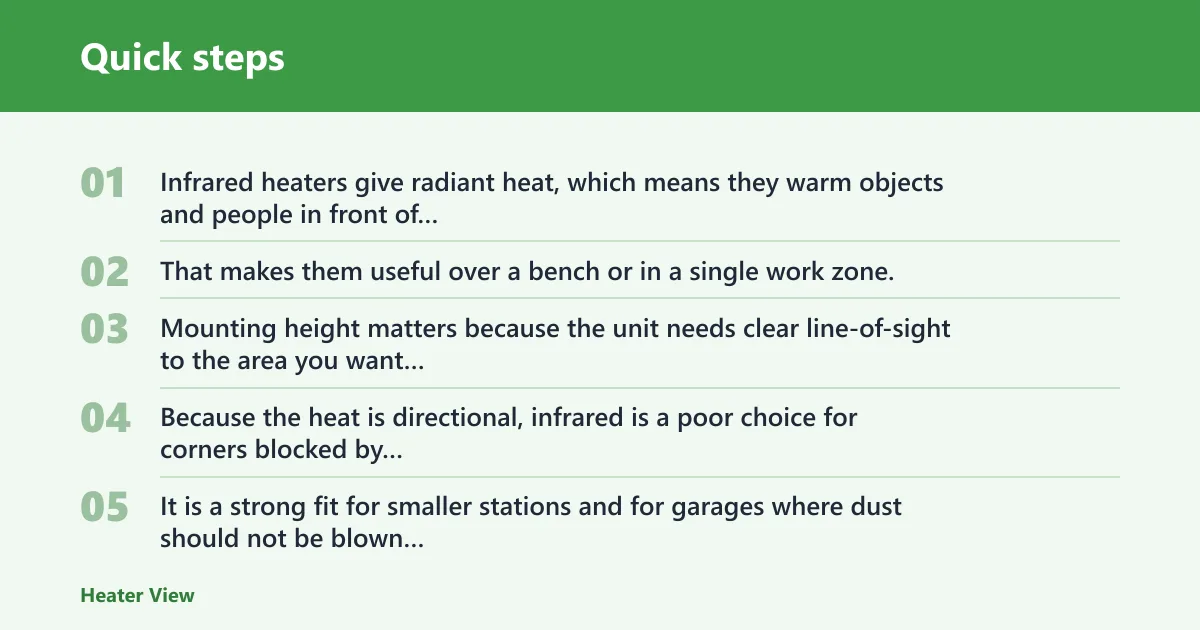
Infrared heaters give radiant heat, which means they warm objects and people in front of them instead of trying to heat every cubic foot of air first. That makes them useful over a bench or in a single work zone. Mounting height matters because the unit needs clear line-of-sight to the area you want warmed.
Because the heat is directional, infrared is a poor choice for corners blocked by shelves or vehicles. It is a strong fit for smaller stations and for garages where dust should not be blown around. Keep the mounting and clearance distances in the manufacturer’s listing.
Forced-air for faster warm-up
Forced-air electric heaters use a fan to move heat quickly. That makes them useful when the garage starts cold and you want the room to feel usable sooner. The tradeoff is noise and dust circulation. In a sanding-heavy shop, that airflow can push fine debris across the room.
Use this type when rapid warm-up matters more than quiet operation. It works well in garages that are insulated, sealed, and used for short, active sessions. If the room is full of sawdust or overspray, a fan-driven heater may be the wrong fit.
Oil-filled radiator for quiet background heat
Oil-filled radiators are portable and quiet. The sealed heating element and fluid-filled body warm more slowly than a fan heater, but they are well suited to steady background heat near an occupied area. That makes them useful for long bench sessions where noise would be distracting.
They are less useful for quick recovery after the garage door has been open. If you need fast warm-up from a cold-soaked space, an oil-filled unit may feel slow. If you want a low-noise heater that does not move dust, it is often a practical choice.
Electric garage heater for larger fixed spaces
An electric garage heater is the broad category most owners mean when they want a permanent, combustion-free heat source. These units come in hardwired and plug-in versions, and many include thermostat compatibility for setpoint control or freeze protection. They also usually need specific clearance from walls, ceilings, and stored items.
Choose this path when the garage is larger, the circuit can support the load, and you want a fixed installation. For many workshops, this is the most straightforward non-flame option because it can heat the whole space rather than only one corner.
Safety and clearance rules for garage heat
Keep combustibles away from any heat source, even electric ones. Cardboard, rags, solvents, aerosol cans, sawdust piles, and finish supplies should stay outside the heater’s clearance zone. A heater that is safe on paper can still become a fire hazard if the surrounding area is cluttered.
Use the manufacturer’s listed clearances for the exact model, since they vary. As a general planning guide, many wall- or ceiling-mounted electric heaters need several feet of open space around the unit, including distance from the floor, side walls, and any shelf or stored material. Do not guess at those distances once the unit is installed.
Use GFCI and a thermostat where the setup calls for it
GFCI protection matters in garages because moisture exposure is common. Damp floors, melted snow, and concrete all add risk around receptacles. For portable heaters, some protected circuits may nuisance-trip depending on the model, so the receptacle choice should be planned rather than assumed.
A thermostat is one of the simplest ways to control cost and comfort. Setback settings can hold the garage above freezing without overheating the room, and freeze protection can keep tools and fluids from seeing hard cold. If the heater has a thermostat, use it instead of switching the unit on and off by guesswork.
Carbon monoxide risk is another reason this guide stays with electric heat. Any combustion source belongs in a different conversation, because the hazard is tied to fumes and venting, not just temperature. For a workshop that needs safe, non-flame heat, electric units avoid that problem from the start.
Keep dust, fumes, and air leaks in view
Dust is more than a cleanup issue. In a workshop, fine particles can build up around heaters, fans, and stored materials. A fan-driven heater can move that dust around. A radiant or oil-filled heater avoids the airflow, but the space still needs a clean area around the unit.
Say your detached garage is 24 by 24 feet with a high ceiling and a leaky overhead door. A small portable heater may run constantly and still leave the corners cold. In that case, air sealing and door weatherstripping should come before a bigger heater purchase.
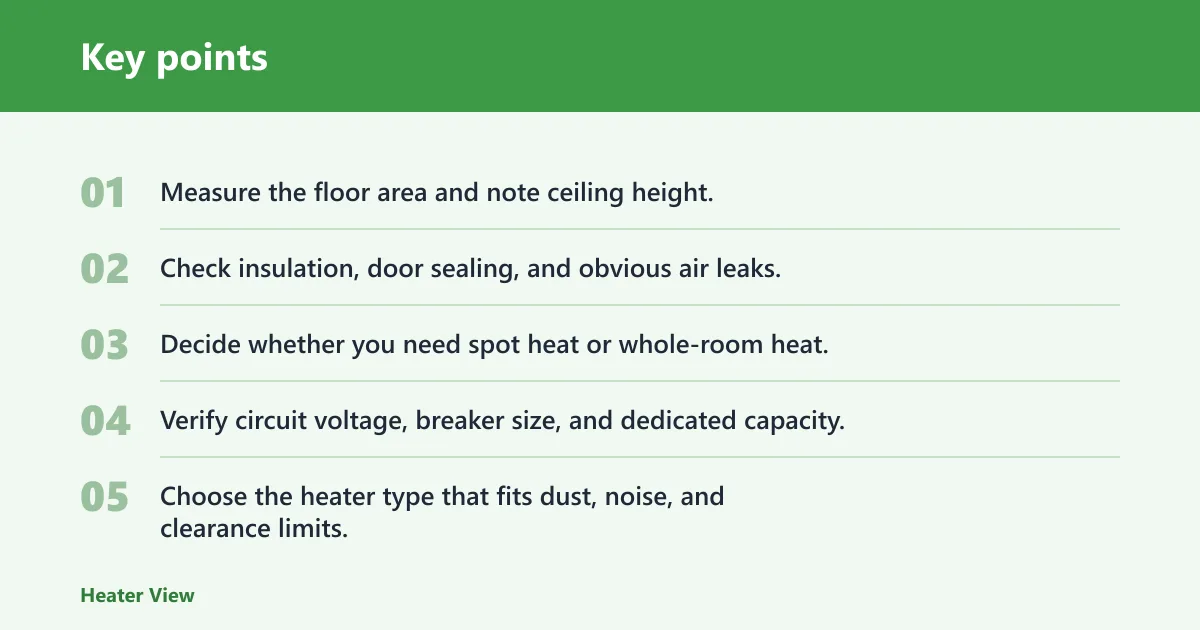
- Measure the floor area and note ceiling height.
- Check insulation, door sealing, and obvious air leaks.
- Decide whether you need spot heat or whole-room heat.
- Verify circuit voltage, breaker size, and dedicated capacity.
- Choose the heater type that fits dust, noise, and clearance limits.
- Place combustibles outside the clearance zone and use the thermostat.
Frequently asked questions
How do I heat a garage workshop without open flames?
Use an electric heater, not a combustion heater. The safest choices are an electric garage heater, infrared panel, oil-filled radiator, or forced-air electric unit, depending on the room and use pattern. Start with insulation and air sealing, then size the heater for the space and your electrical capacity.
What is the safest heater for a garage workshop?
The safest heater is the one that fits the room, the circuit, and the way you work. For many garages, a fixed electric unit heater or an infrared heater is safer than a portable fan heater because it can be mounted with proper clearance and paired with a thermostat.
Can I use an electric heater in a garage workshop?
Yes, if the heater matches the receptacle or hardwired circuit and the garage can support the load. Check breaker size, amperage, and clearance requirements before you buy. In damp garages, think carefully about GFCI protection and whether the heater is likely to nuisance-trip on that circuit.
How can I keep a garage workshop warm cheaply?
Cheap heat starts with insulation, not a bigger box. Seal the door, close obvious gaps, and match the heater to the actual space. A thermostat with setback settings can also save energy by holding a lower target when the shop is idle.
What should I avoid when heating a garage workshop?
Avoid open flames, crowded heater placement, and blind guesses about electrical load. Do not put rags, cardboard, solvent cans, or dust piles near the unit. Avoid fan heaters if dust circulation is a problem, and avoid oversizing a heater to cover up a leaky garage.
How do I heat a detached garage efficiently?
Seal air leaks first, especially around the overhead door and any gaps at the sill or wall joints. Then choose a heater that matches the circuit and the room’s real heat loss. Detached garages usually need more attention to insulation and weatherstripping than attached spaces do.